

Need a full custom project? See the options below.
Need a full custom project? See the options below.
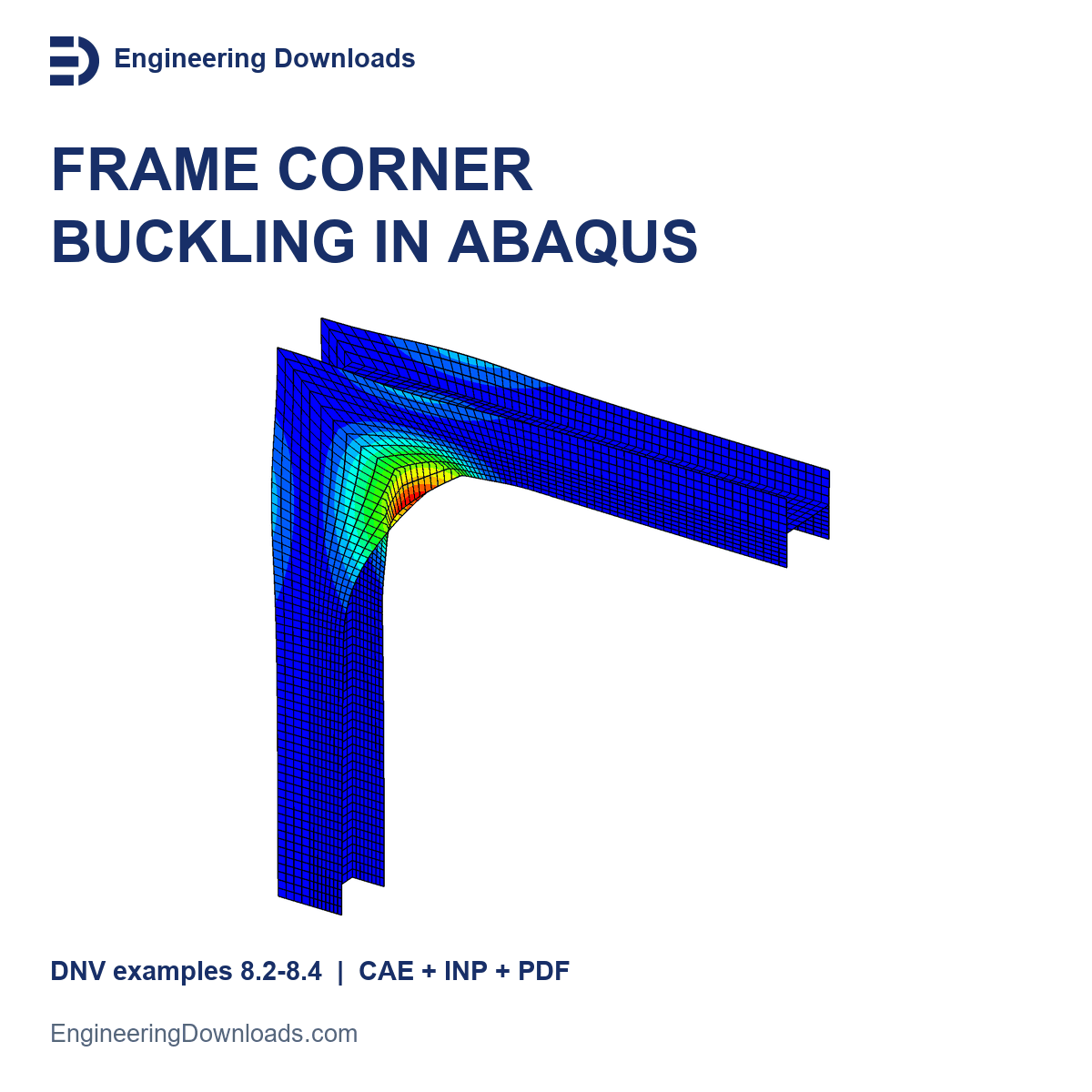
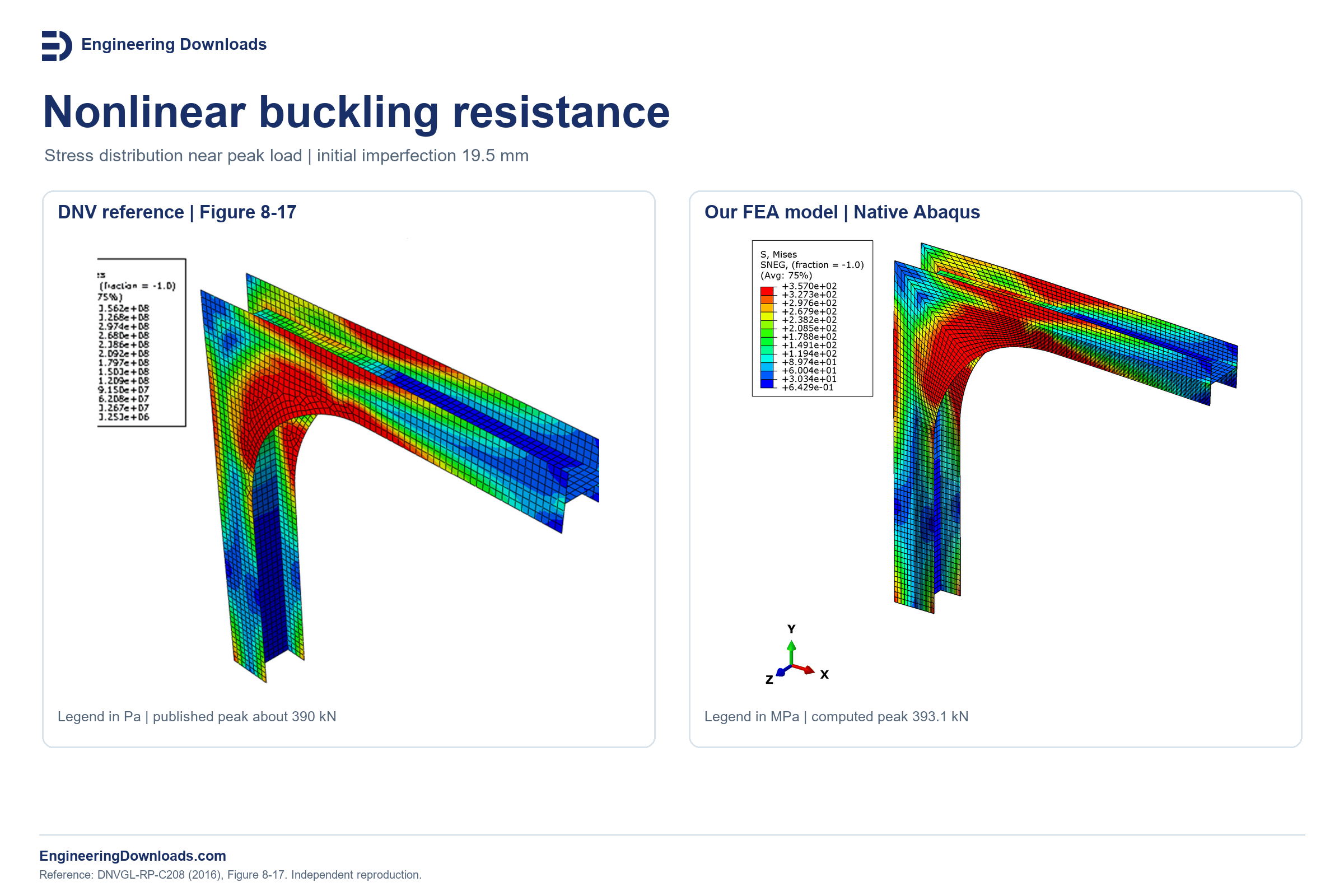
This package reproduces DNV-RP-C208 Examples 8.2 to 8.4 in Abaqus: the six-case mesh convergence study for linearized buckling of a welded steel frame corner, the representative-stress buckling resistance check, and two nonlinear Riks collapse analyses with equivalent geometric imperfections. One CAE database, nine matching INP decks and an 18-page step-by-step PDF tutorial walk through the full build, from the orphan-mesh geometry to a buckling resistance Rd computed from the model’s own Abaqus results.
DNV-RP-C208, Determination of Structural Capacity by Non-linear Finite Element Analysis Methods (DNV GL AS, September 2016), works a single steel frame corner through three linked checks in Section 8, pages 56-65: Example 8.2 is a mesh and element-type convergence study for the linearized (eigenvalue) buckling load; Example 8.3 takes the converged eigenvalue and a linear reaction/stress read-out into the representative-stress buckling resistance formula of DNV-RP-C208 Section 5; Example 8.4 repeats the problem as a full nonlinear (GMNIA) collapse analysis with two equivalent geometric imperfection patterns derived from the buckling eigenvector. This package builds and solves all three independently in Abaqus/Standard, from a from-scratch orphan mesh, and compares every published number against the model’s own results.
DOI / reference: DNVGL-RP-C208 (September 2016), Section 8.2-8.4, Figures 8-13, 8-15 and 8-17.
| Standard | DNVGL-RP-C208 (2016), Examples 8.2-8.4 |
| Software | Abaqus/Standard 2023 |
| Geometry | Frame corner, outer flange envelope 4000 × 4000 mm, straight flange width 500 mm, inner cutout R = 1500 mm centred on (2000, 2000) |
| Thickness | Flange 20 mm, web 15 mm |
| Material | Steel, E = 210000 MPa, ν = 0.3, ρ = 7.85×10⁻⁹ tonne/mm³, fy = 355 MPa (nonlinear cases) |
| Mesh | Six convergence cases, S4R/S8R, 864 to 15,946 elements; separate 6,136-element S4R mesh for the nonlinear eigenvector seed |
| Loading | Web-only tip displacement, U2 = -10 mm (reference/linear) and -500 mm (Riks termination) |
| Analyses | Linear eigenvalue buckling (8.2), linear static reaction + stress check (8.3), two nonlinear Riks GMNIA runs with 19.5 mm and 12.2 mm imperfections (8.4) |
The frame corner is two flat, broad flange plates with a square outer corner and a curved inner edge, joined by two straight webs that meet at a right angle—not a swept I-section. The model is a conforming orphan shell mesh with named element sets (FLANGE, WEB) and node sets (BASE, TIP_WEB, TIP, MONITOR), where MONITOR is a single tip-web node used to terminate the Riks step. As an independent check on the published geometry, the outstand from the web intersection to the middle of the curved edge works out to a = 1750√2 − 1500 = 974.874 mm, against DNV’s published a = 975 mm—confirmation that the corner geometry is built correctly before any analysis is run.
BASE is fully fixed (U1 = U2 = U3 = 0, rotations free). TIP_WEB restrains U1 = U3 = 0 with the reference displacement U2 = -10 mm applied only to the web nodes—the flange tip edges carry no additional constraint. Driving the whole cross-section, or adding a rigid end coupling, changes the local end restraint and can change the buckling load; the published idealization is reproduced only by loading the web alone. A displacement of -0.01 m in the DNV reference becomes -10 mm in these (mm-N-MPa-tonne-s) models—the single most common source of a 1000× eigenvalue error when rebuilding this example from scratch.
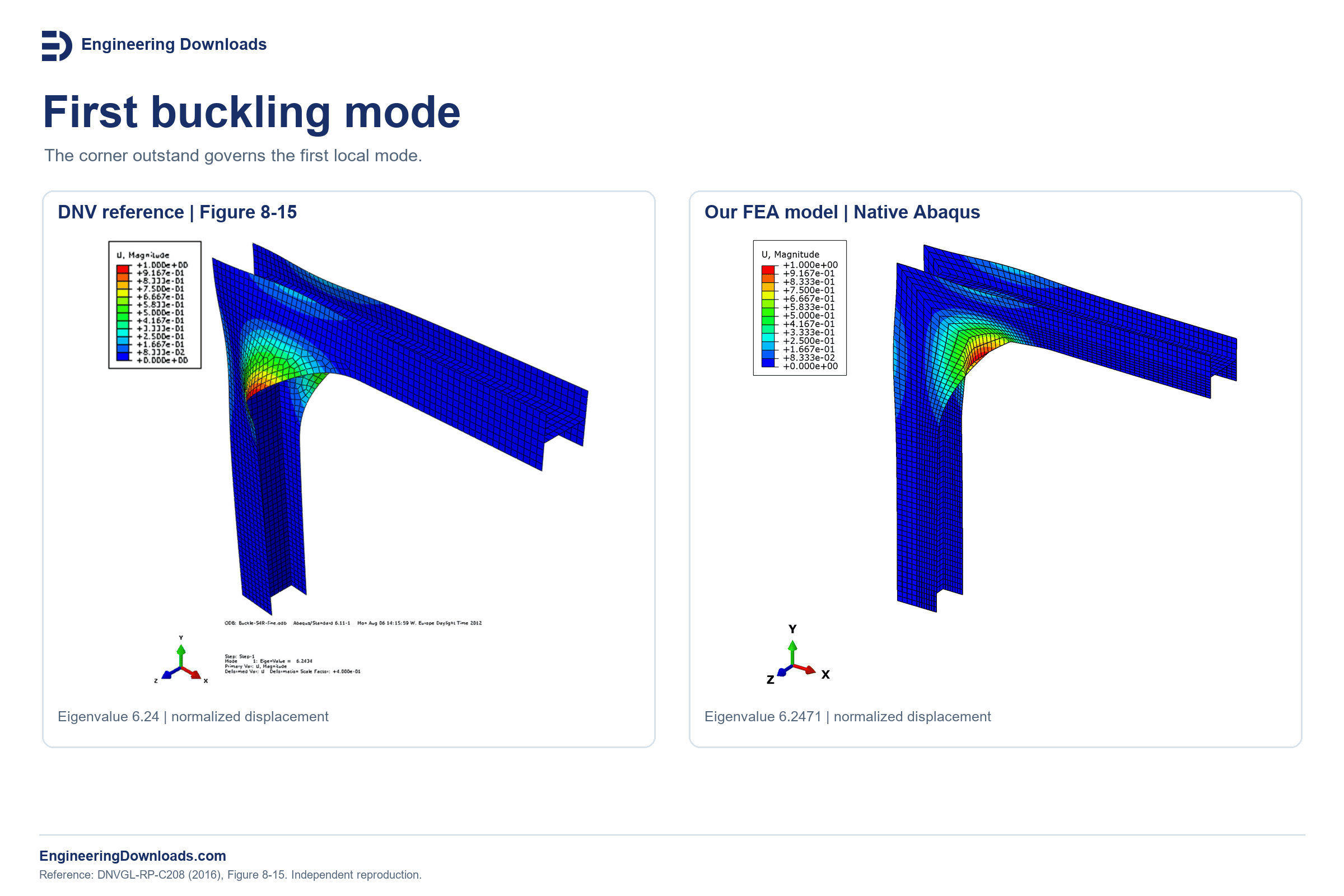
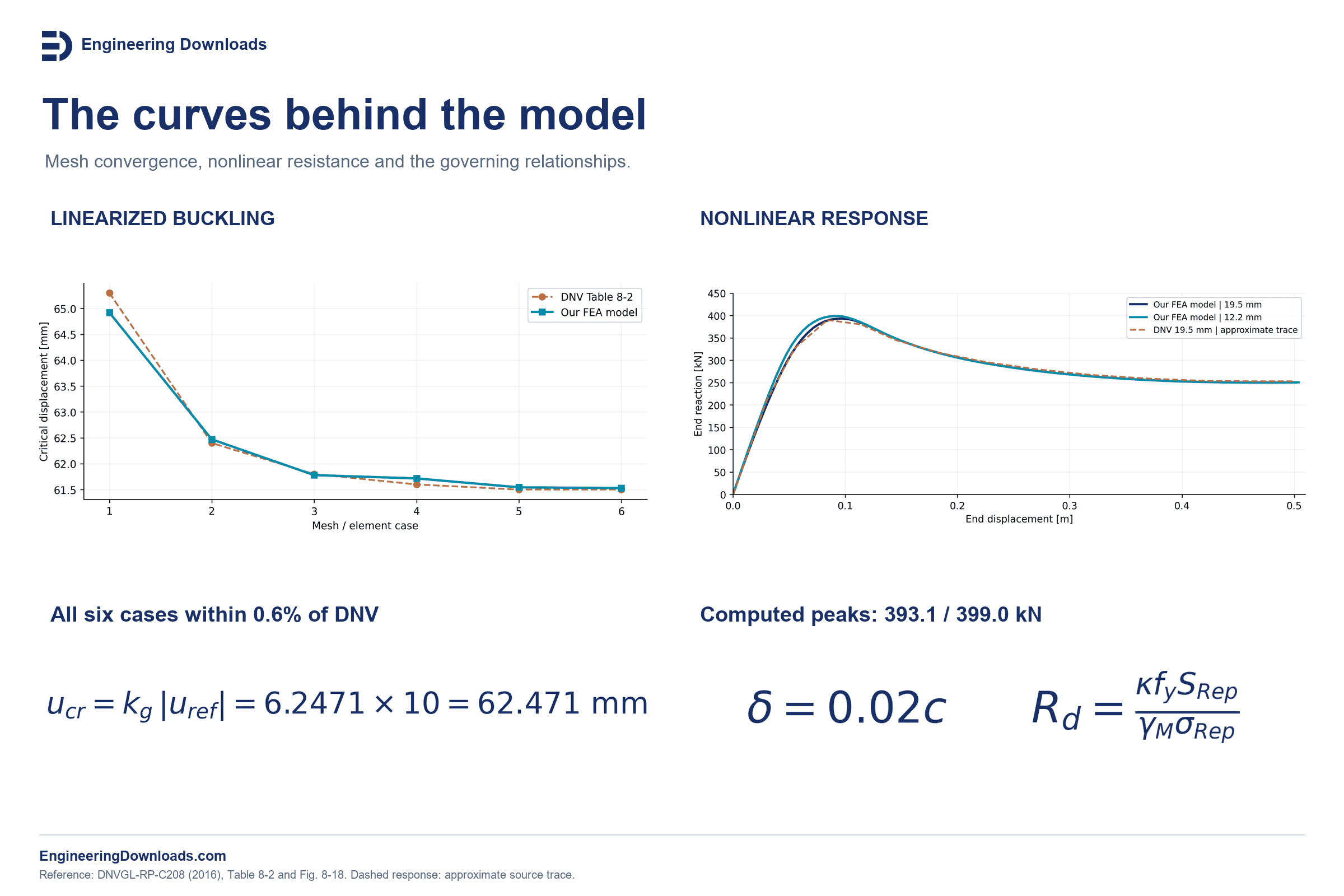
Six models sweep mesh density and element order: Coarse/Fine/Very fine, each in 4-node S4R and 8-node S8R shells, from 864 up to 15,946 elements. A BUCKLE (linear perturbation) step on the Fine S4R case extracts six eigenvalues from 24 Lanczos vectors. The governing mode is local flange-outstand buckling near the inner corner, with first eigenvalue kg = 6.2471, giving a critical displacement ucr = kg×|uref| = 62.471 mm. All six critical displacements agree with DNV Table 8-2 within 0.6%, across both element types and every mesh density tried.
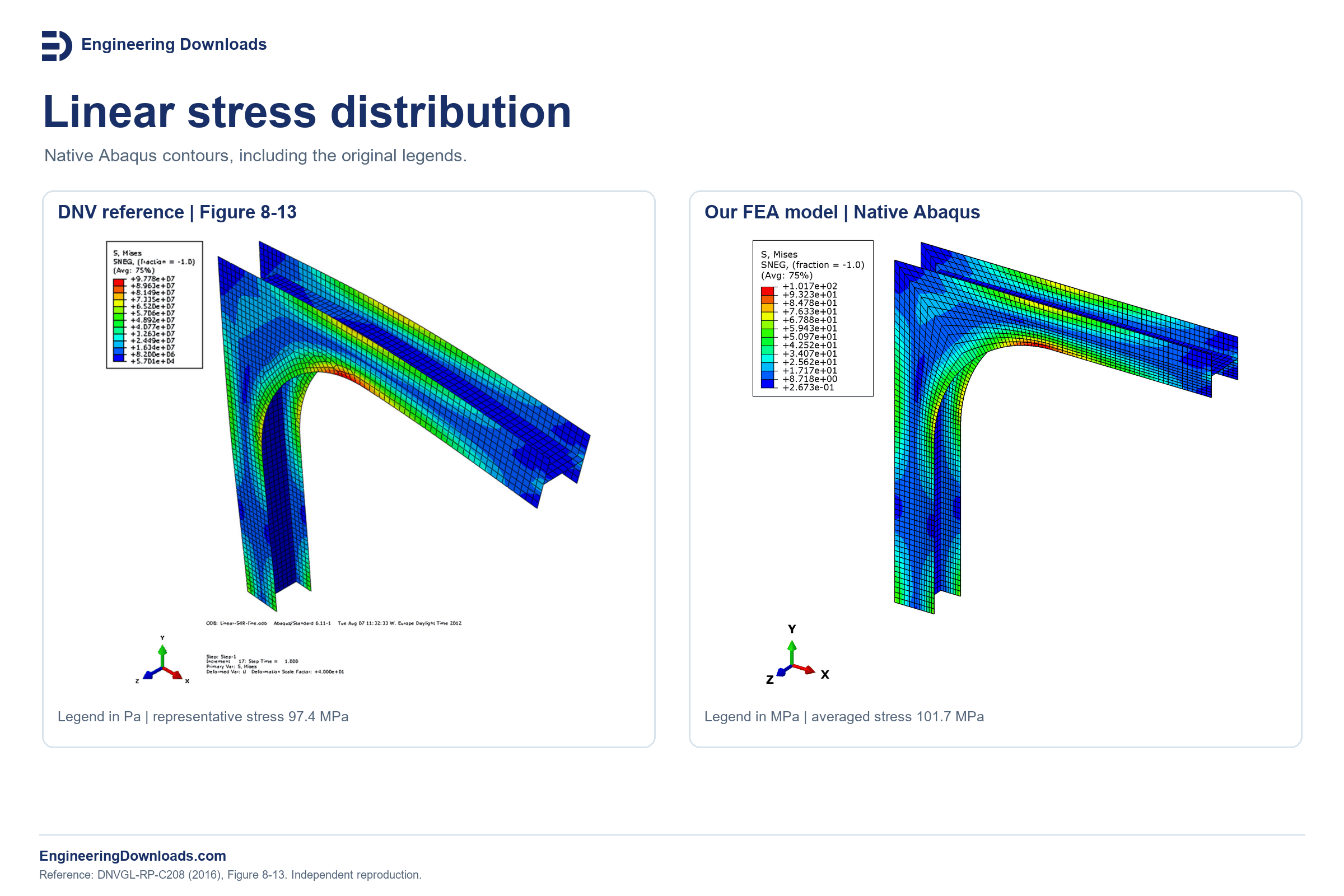
A separate linear static step (NLGEOM off, same -10 mm web-only displacement) reads out two numbers at the fillet: the tip-web reaction and the local Mises stress. This model’s reaction is 75.8495 kN against a published 75.7 kN (+0.2%); the equilibrium residual across every node is below 0.03 N. The 75%-averaged, element-nodal Mises stress at the flange fillet comes out to 101.68 MPa against DNV’s rounded representative stress of 97.4 MPa — a 4.4% difference that the tutorial keeps rather than quietly resolves, since it comes from how the averaging is read, not from a modelling error.
Carrying this model’s own reaction, stress and eigenvalue through DNV-RP-C208 Section 5’s eight-step procedure (σki = kg×σRep, reduced slenderness, buckling reduction factor κ, then Rd) gives a buckling resistance Rd = 178.53 kN. Re-running the same formula with DNV’s own rounded published inputs (75.7 kN, 97.4 MPa, kg = 6.24) reproduces the reported resistance of about 184 kN. The two routes agree to within about 3.0%, and both are shown worked in full in the tutorial so you can see exactly where the difference enters.
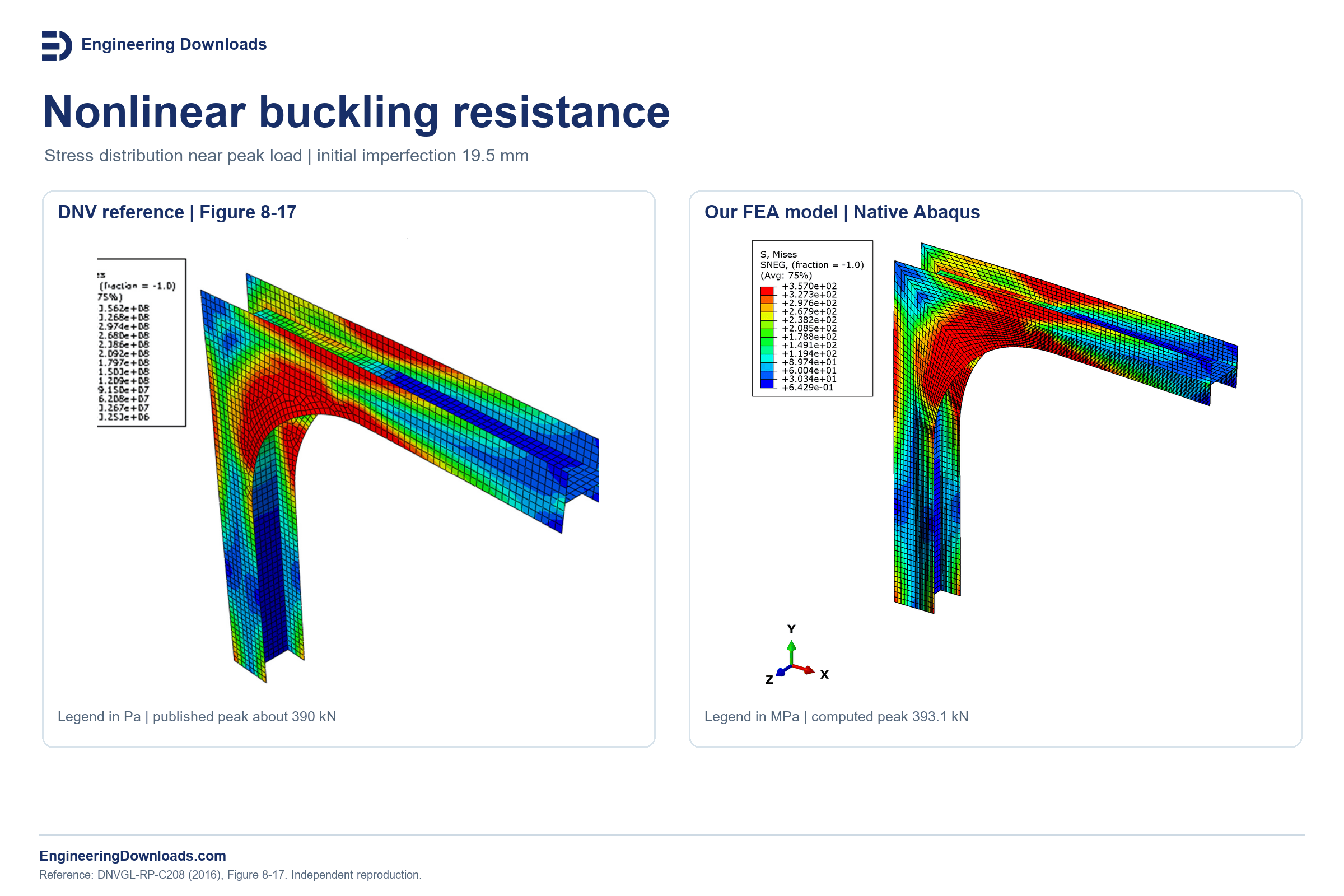
Two equivalent geometric imperfections are built from the refined-mesh eigenvector (kg = 6.1832 on that mesh): a “maximum outstand” case with c ≈ a ≈ 975 mm and amplitude δ = 0.02c = 19.5 mm, and an “average outstand” case with c = (a + b/2)/2 (b = 500 mm) and δ = 12.2 mm. Each runs as a Riks step with NLGEOM on, up to 400 increments, arc-length scale 1.0, and termination at U2 = -500 mm on the MONITOR node.
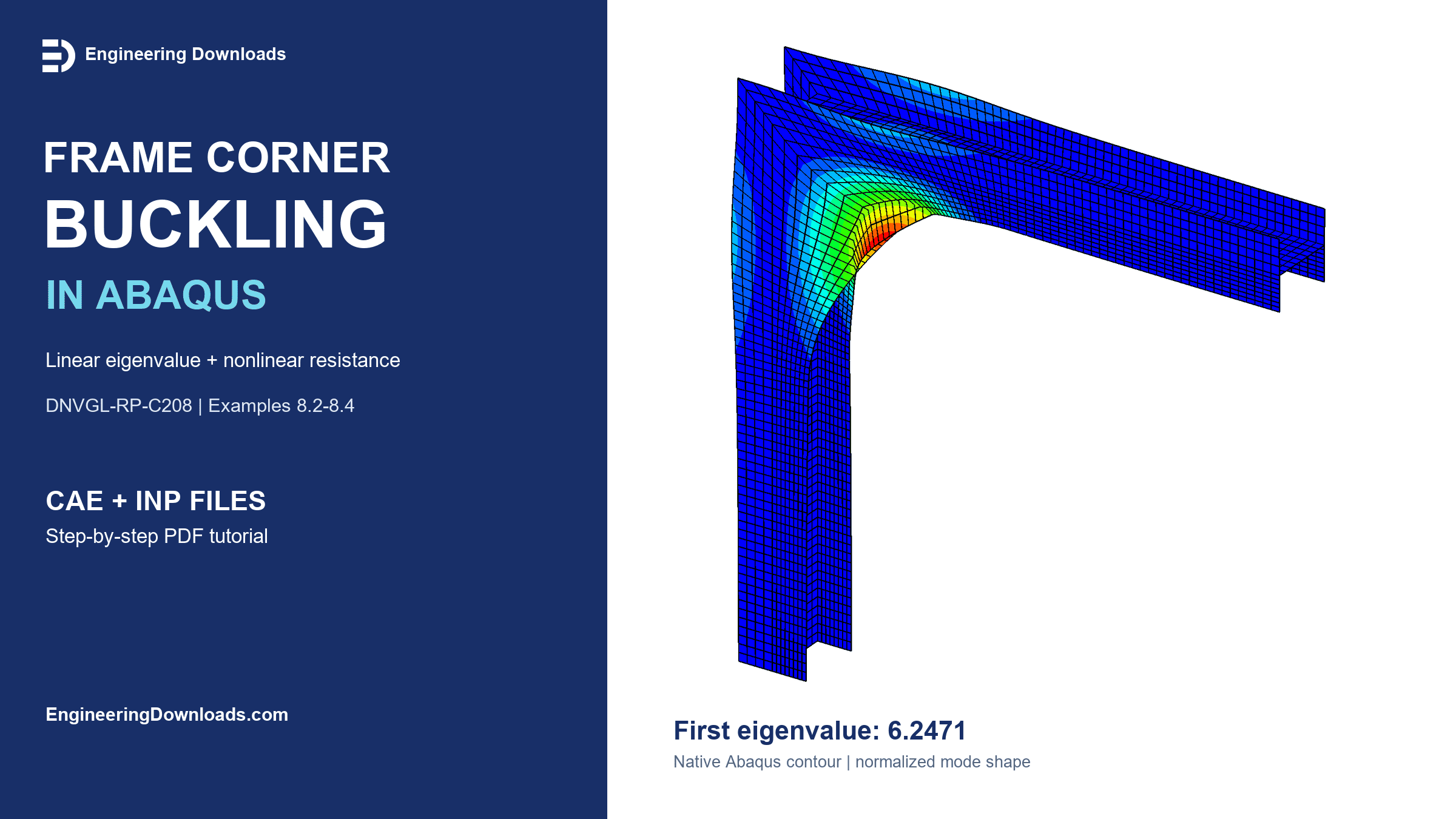
Both cases solved with zero cutbacks and zero solver warnings. The 19.5 mm case peaks at 393.10 kN at 96.71 mm tip displacement (DNV’s graph reads ≈390 kN); the 12.2 mm case peaks at 399.00 kN at 92.15 mm (DNV ≈398 kN) — both within about 1% of the published curve, with the descending post-buckling branch tracking the reference closely out to the 500 mm termination (terminal reactions 250.33 kN and 250.64 kN respectively). Peak-load plastic strain stays modest in both cases, PEEQ = 0.953% and 0.966%, consistent with a buckling-governed rather than a yield-governed collapse.
| Quantity | This model | DNV-RP-C208 | Difference |
| Six-case convergence (8.2) | 61.530 – 64.921 mm | Table 8-2 | within 0.6%, all six cases |
| Independent geometry check | a = 974.874 mm | a = 975 mm | <0.02% |
| Tip-web reaction, SRep (8.3) | 75.8495 kN | 75.7 kN | +0.2% |
| Representative stress, σRep (8.3) | 101.68 MPa | 97.4 MPa | +4.4% |
| Buckling resistance, Rd (8.3) | 178.53 kN (own inputs) | ≈184 kN | −3.0% |
| Peak load, 19.5 mm imperfection (8.4) | 393.10 kN @ 96.71 mm | ≈390 kN | ≈+0.8% |
| Peak load, 12.2 mm imperfection (8.4) | 399.00 kN @ 92.15 mm | ≈398 kN | ≈+0.3% |
No ODB, solver scratch files, Python scripts or the DNV standard itself are included — each job solves directly from the supplied INP/CAE files in a few minutes on 4 cores, and the standard is cited, not reproduced.
abaqus job=DNV82_C2_Fine_S4R cpus=4 interactive, or open the CAE database directlyMost published buckling examples give you a final number and a contour plot. This package gives you the whole chain, instead: a mesh-convergence study that agrees with DNV to within 0.6%, a resistance check worked two ways so you can see exactly where a 3% difference comes from, and two nonlinear collapse runs that land within about 1% of the published capacity curve — all from a model built from scratch, not reverse-engineered from the answer. If you are validating your own frame-corner, bracket or portal-frame buckling checks against DNV-RP-C208, or teaching the linearized-buckling-to-GMNIA workflow, this is a template you can trust and adapt. For a bolted-connection resistance check built the same way, see the DNV-RP-C208 Example 8.7 bolted flange joint; for a complementary shell-buckling problem, see the ring-stiffened cylinder buckling package; for a fully parametric, scriptable joint model, see the FRP tubular X-joint degree-of-bending package.
Yes, closely. The six-case mesh convergence study (8.2) agrees with DNV Table 8-2 within 0.6%, the linear reaction (8.3) is within 0.2%, the representative stress is 4.4% higher than DNV’s rounded figure, and the nonlinear peak loads (8.4) are within about 1% of the published capacity curve.
a = 1750√2 − 1500 = 974.874 mm, essentially identical to the published a = 975 mm. This confirms the corner geometry is built correctly before any analysis is run, independent of the FE results that follow.
Using this model’s own computed stress and reaction in the DNV Section 5 formula gives Rd = 178.53 kN, about 3.0% lower than the roughly 184 kN obtained from DNV’s rounded published inputs. Both calculations follow the identical eight-step procedure; the tutorial shows both worked in full so you can see exactly where the numbers diverge.
Yes. All six convergence cases (S4R and S8R, coarse through very fine) land within 0.6% of DNV Table 8-2, and the two nonlinear Riks runs use a separately partitioned, more refined mesh to seed the buckling eigenvector.
“Maximum outstand” uses c ≈ a ≈ 975 mm with amplitude 19.5 mm (0.02c); “Average outstand” uses c = (a + b/2)/2 with amplitude 12.2 mm. Both are modelled as Riks analyses with NLGEOM on, terminating at 500 mm tip displacement.
No. The CAE database contains nine ready-to-run models and jobs; no ODB, solver scratch files, Python scripts or the DNV reference PDF are bundled inside the model ZIP. The PDF tutorial is a separate download.
Abaqus/Standard 2023. The INP decks are plain text and should open in any reasonably recent Abaqus/Standard version without modification.
No. It is a validated benchmark and training package for reproducing a published buckling and resistance example. It does not replace a stability assessment carried out by a qualified engineer.
Write to us. Engineering Downloads refunds clients who are not satisfied with a delivered product.
All comparison figures on this page pair the original DNV-RP-C208 figure with our own native Abaqus output, run independently from a from-scratch model. DNVGL-RP-C208 is cited as the reference standard; it is not included in this package, and the original standard figures remain attributed to DNV GL AS. No endorsement or certification by DNV is implied.
Need more than the files?
There are two ways we can help. Book a one hour online consultation if you want to talk a problem through with a CAE engineer, using the checkbox in the order box. Order a project if you need a full simulation built for you, delivered to an agreed scope, price and deadline under a written contract.
We work on FEA and CFD for engineers, researchers and companies. Order your project, or message us on WhatsApp for a quick reply.
Other packages engineers working on this topic also download.
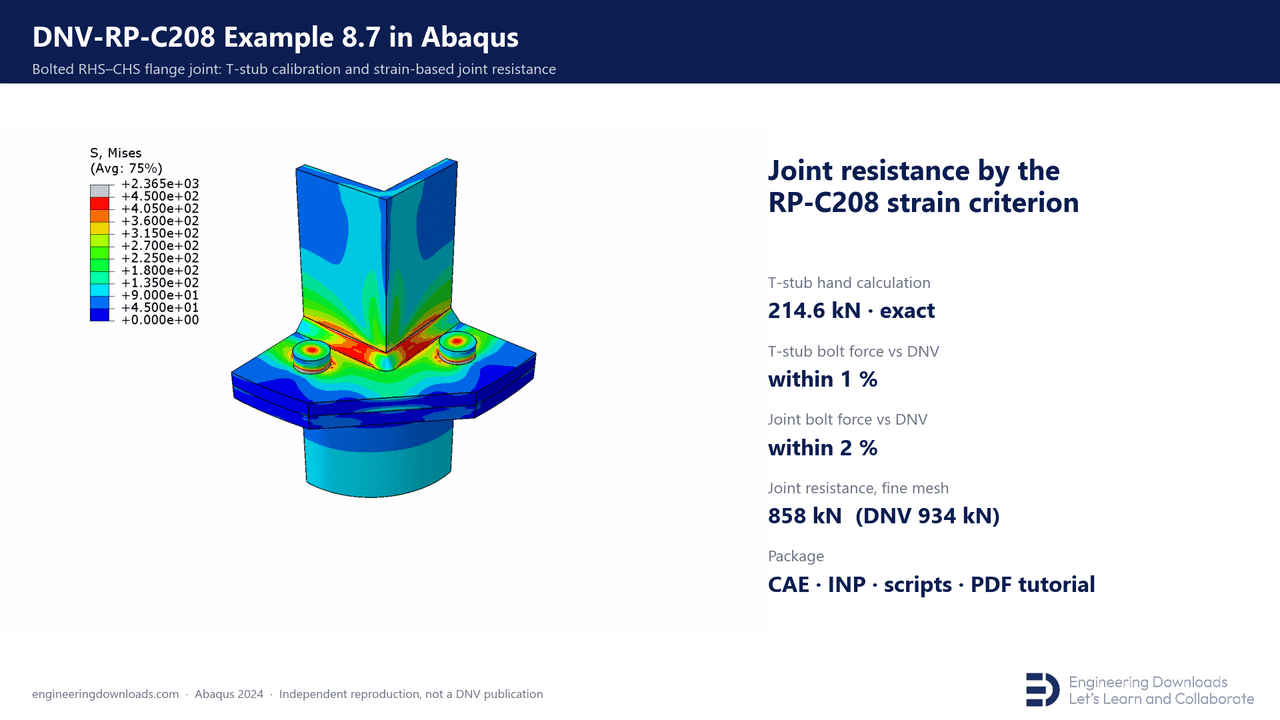 DNV-RP-C208 Example 8.7 in Abaqus: Bolted RHS-CHS Flange Joint Resistance with T-Stub Calibration
 DNV-RP-C208 Example 8.9 in ANSYS: Low-Cycle Fatigue of a Tubular T-Joint under Out-of-Plane Load€29,00
 DNV-RP-C208 Example 8.9 in Abaqus: Low-Cycle Fatigue of a Tubular T-Joint under Out-of-Plane Load€29,00
 Abaqus Buckling Analysis of a Steel Braced Frame (Linear + Nonlinear)
 Ring-Stiffened Cylinder Buckling in Abaqus: T and L Stiffening Rings vs Zhu, Dong & Gao (2015)€59,00
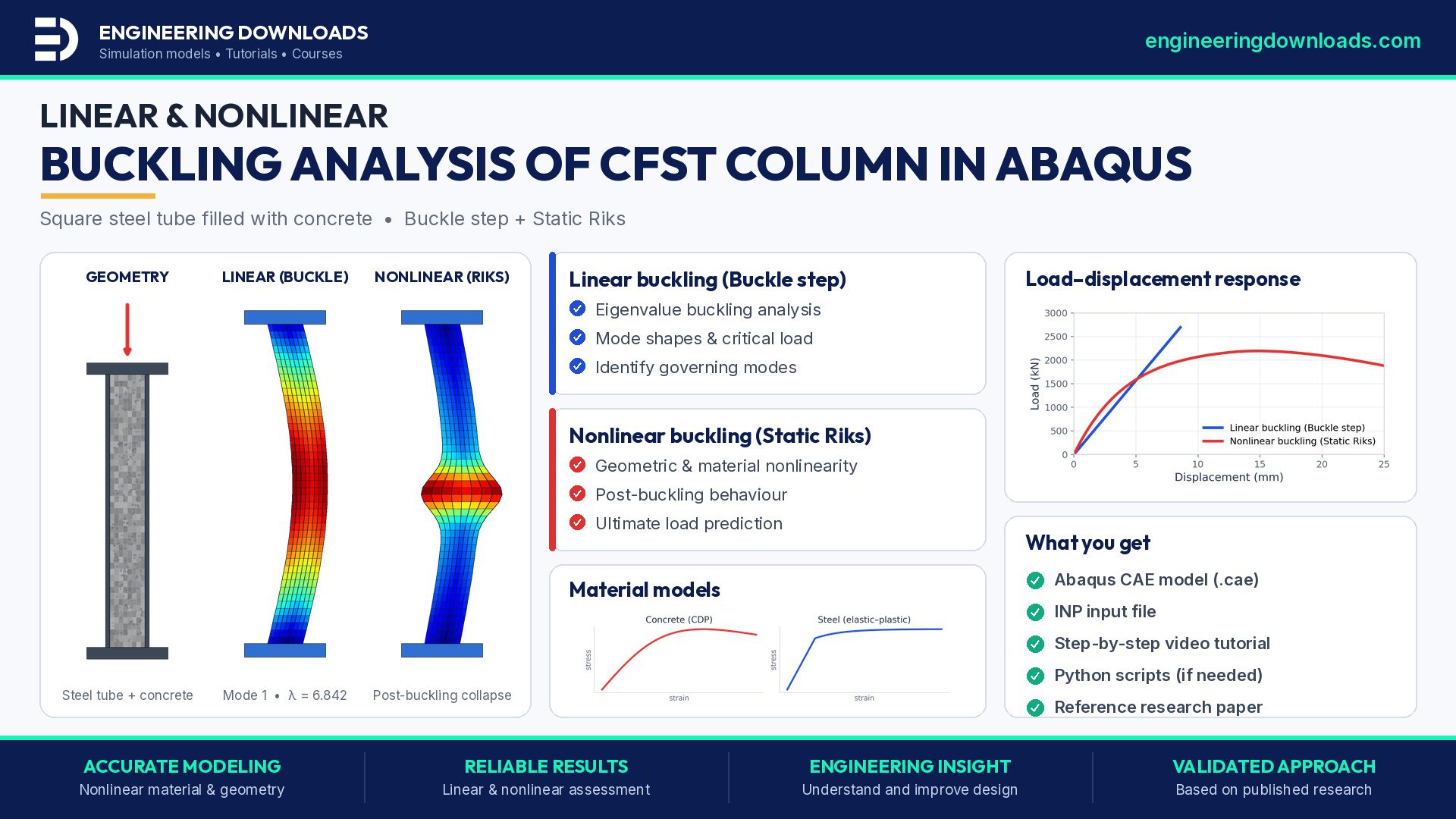 Buckling Analysis of a Concrete-Filled Steel Tube (CFST) Column Using Abaqus
 Tank Wind Buckling in ANSYS: EN 1993-1-6 MNA-LBA Model of a Cylindrical Oil Tank€129,00
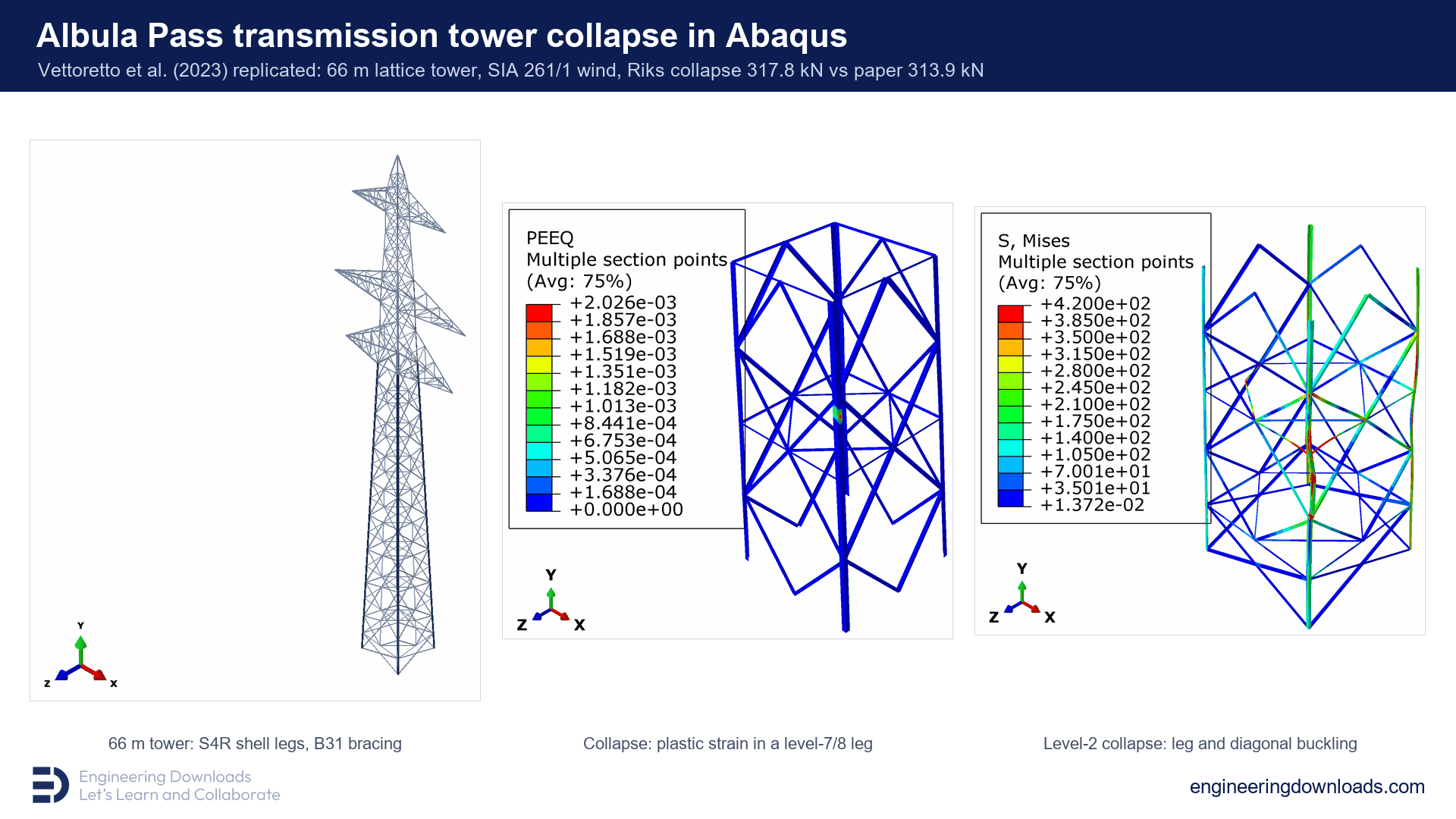 Transmission Tower Collapse under Extreme Wind in Abaqus: Buckling, Riks and Post-Buckling, after Vettoretto et al. (2023)€169,00

Need a full custom project? See the options below.

€129,00

€179,00

€149,00

€119,00

€129,00

€149,00
See more
Want to receive push notifications for all major on-site activities?



