

Need a full custom project? See the options below.
Need a full custom project? See the options below.
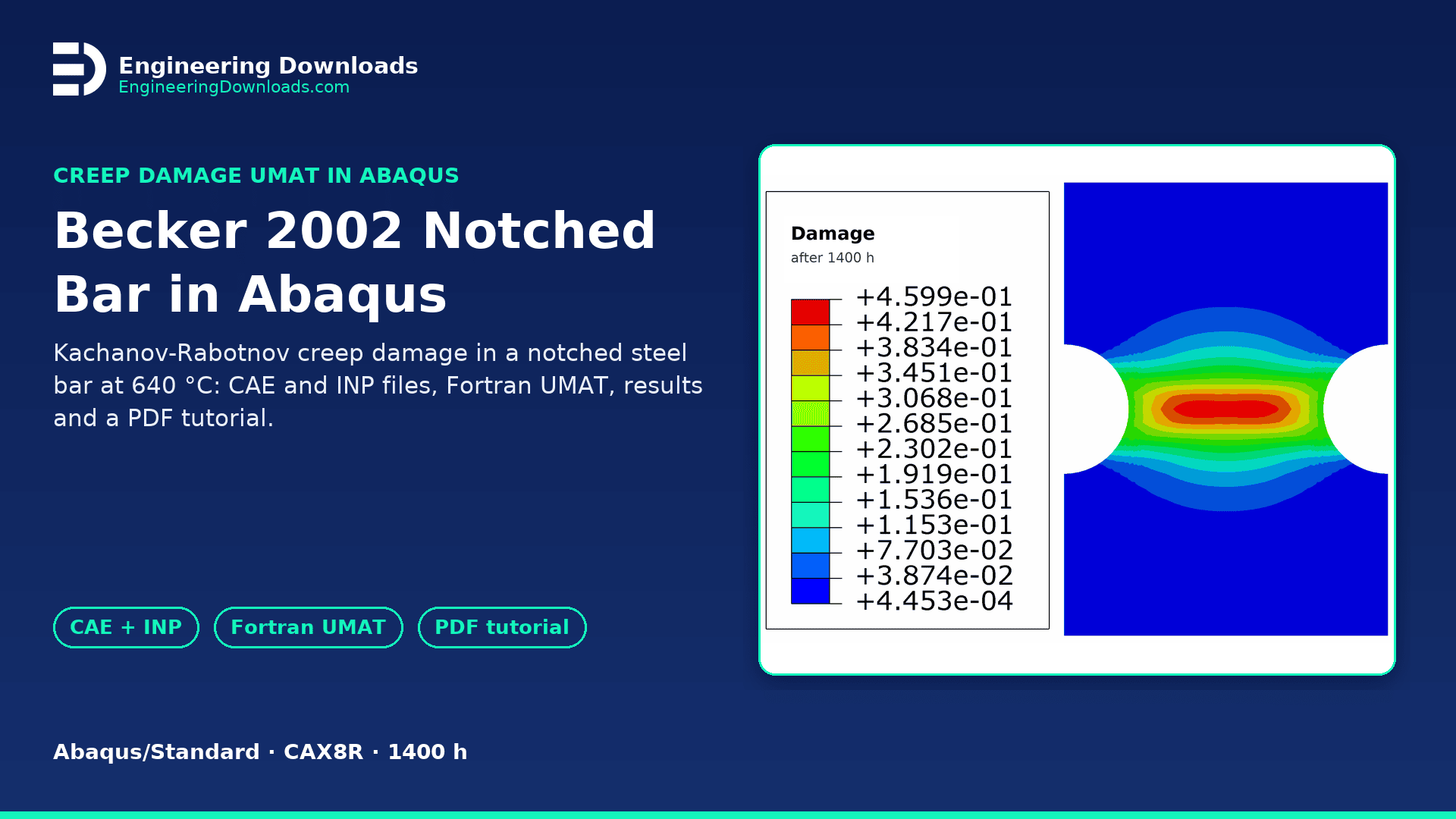
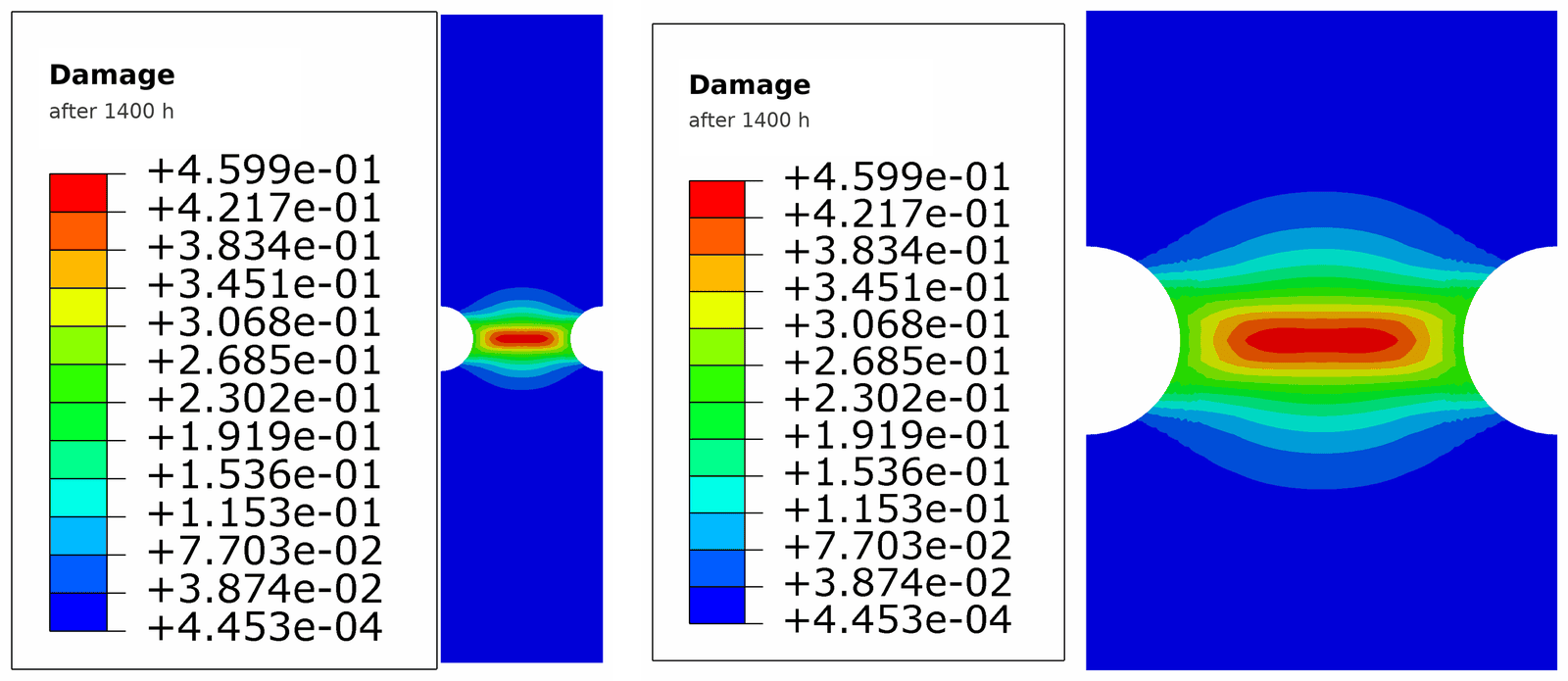
What happens at a deep notch in a steel bar that creeps at 640 °C for 1400 hours? The stress first jumps at the notch root, then relaxes while internal damage grows and speeds the creep up. This package rebuilds the Becker et al. (2002) notched bar benchmark in Abaqus/Standard with a Fortran creep-damage UMAT. You get the Abaqus CAE database, the INP files, the UMAT source, reference results and a PDF tutorial that explains the law, the models and how to run them.
Paper: A.A. Becker, T.H. Hyde, W. Sun and P. Andersson (2002), Benchmarks for finite element analysis of creep continuum damage mechanics, Computational Materials Science, 25, 34–41. DOI: 10.1016/S0927-0256(02)00247-1
Creep rupture life can be predicted using a continuum damage mechanics approach incorporated within a finite element (FE) formulation. The rate of change of a damage parameter, ω, ranging from ω = 0 (no damage) to ω = 1 (100% damage), is computed within each element, until failure occurs in the material cross-section. The main difficulty in the numerical formulation arises due to the very small time steps needed as the damage parameter increases to 1. This paper presents the results of a number of benchmark tests involving the FE analysis of creep continuum damage mechanics that can be used to verify the FE solutions. Two independent FE codes are used; an in-house code (FE-DAMAGE) and a commercial code (ABAQUS) in which a user-subroutine (UMAT) is incorporated. The results of a series of tests used to represent uniaxial, biaxial, triaxial and multi-material creep and damage behaviour are presented.
Abstract quoted from the paper for reference (© 2002 Elsevier Science B.V.). The paper itself, and its figures, are not included in this package.
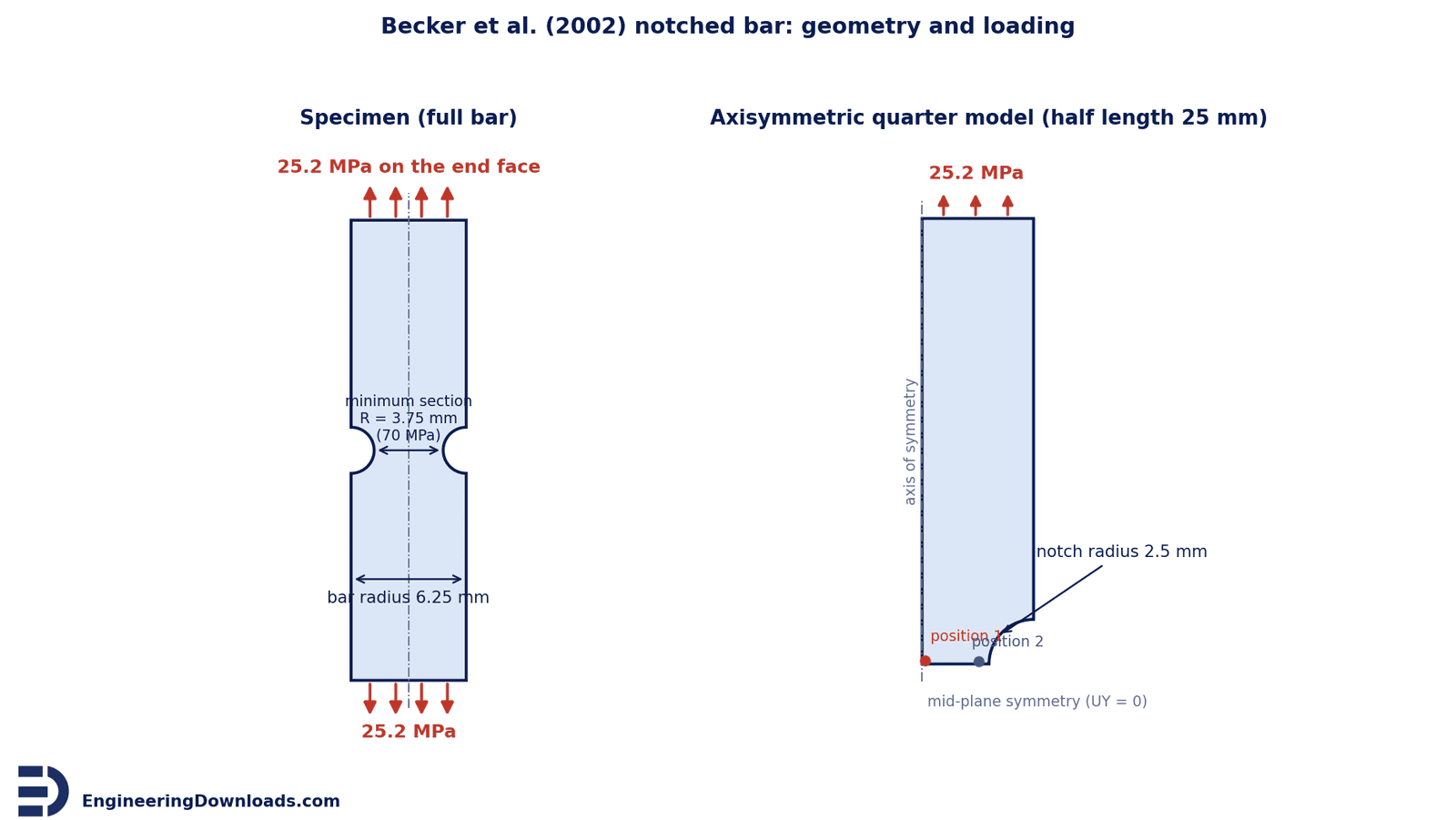
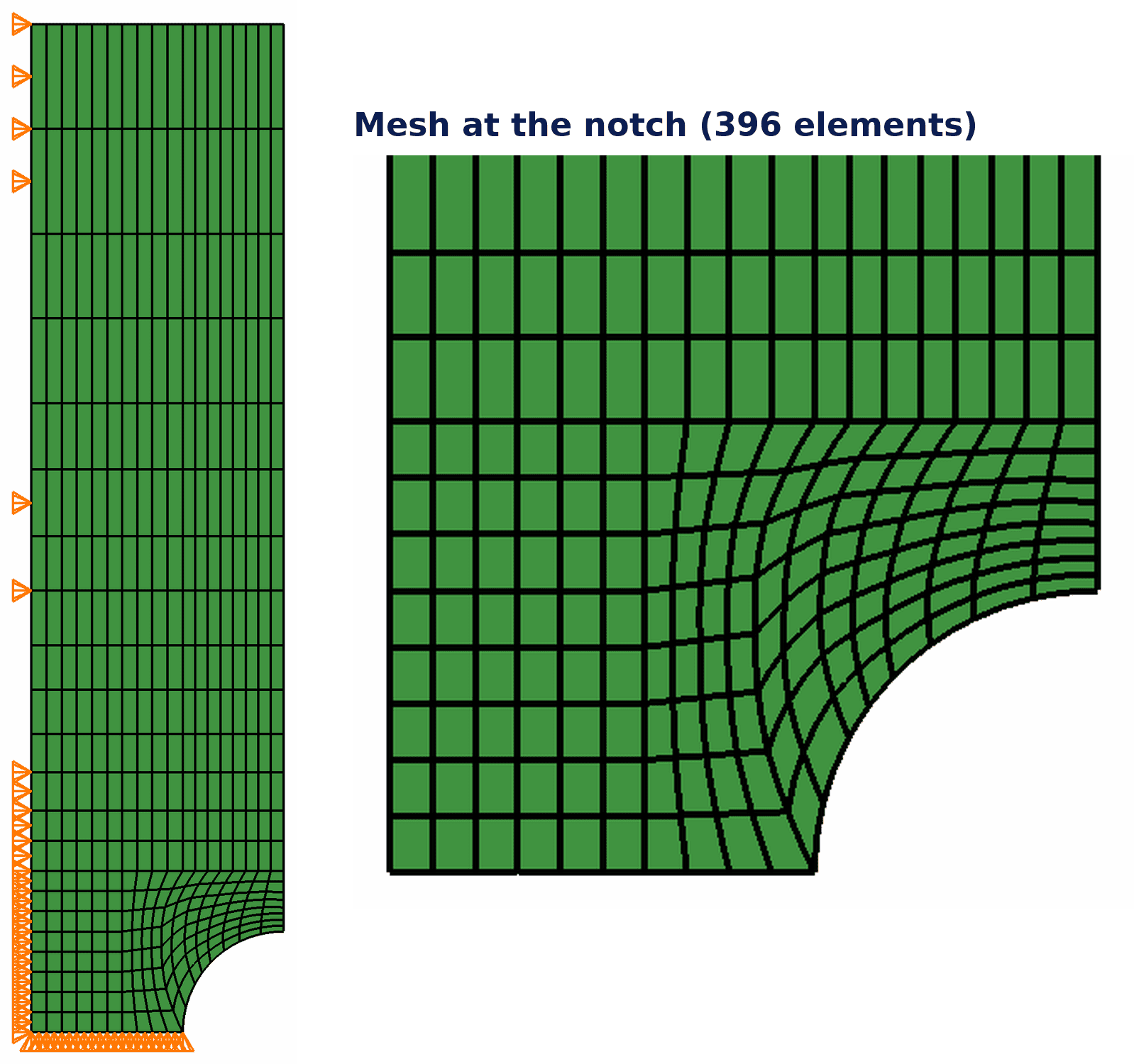
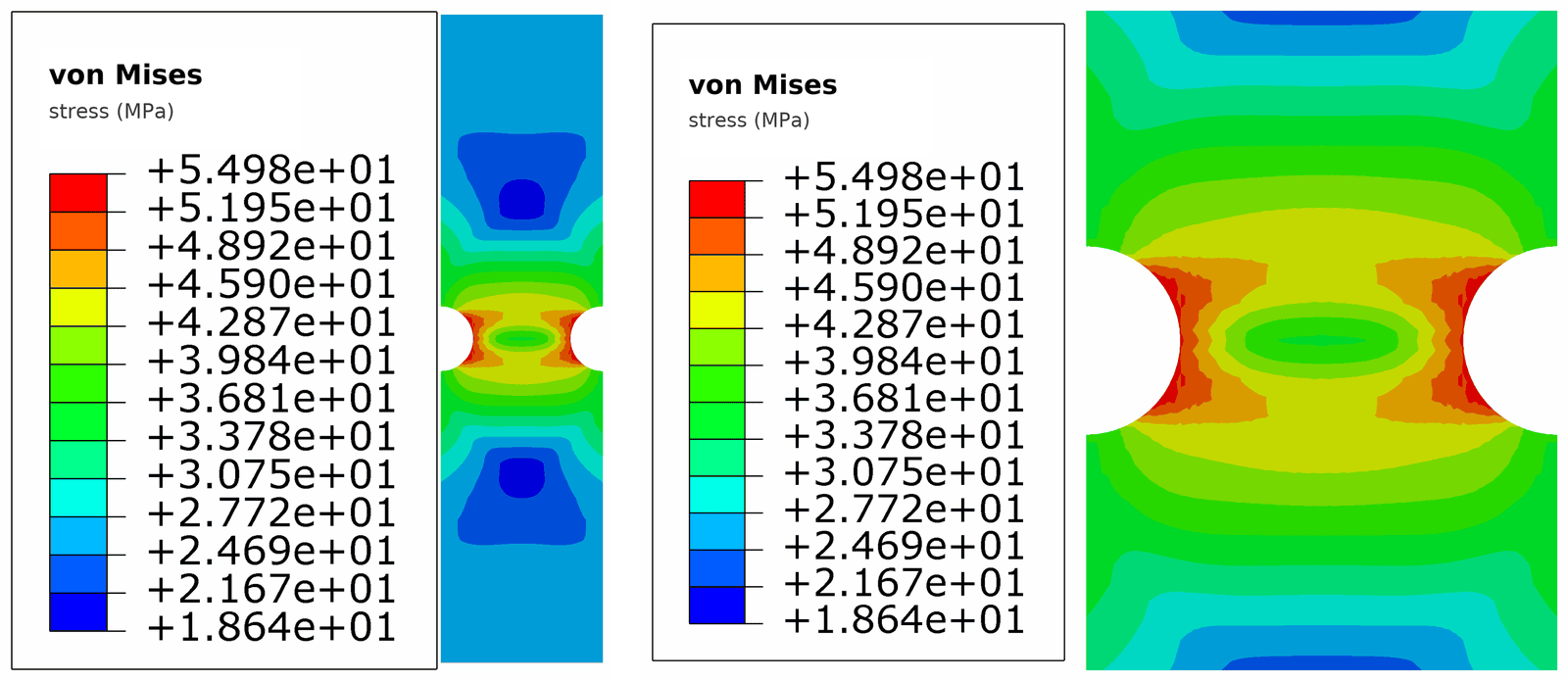
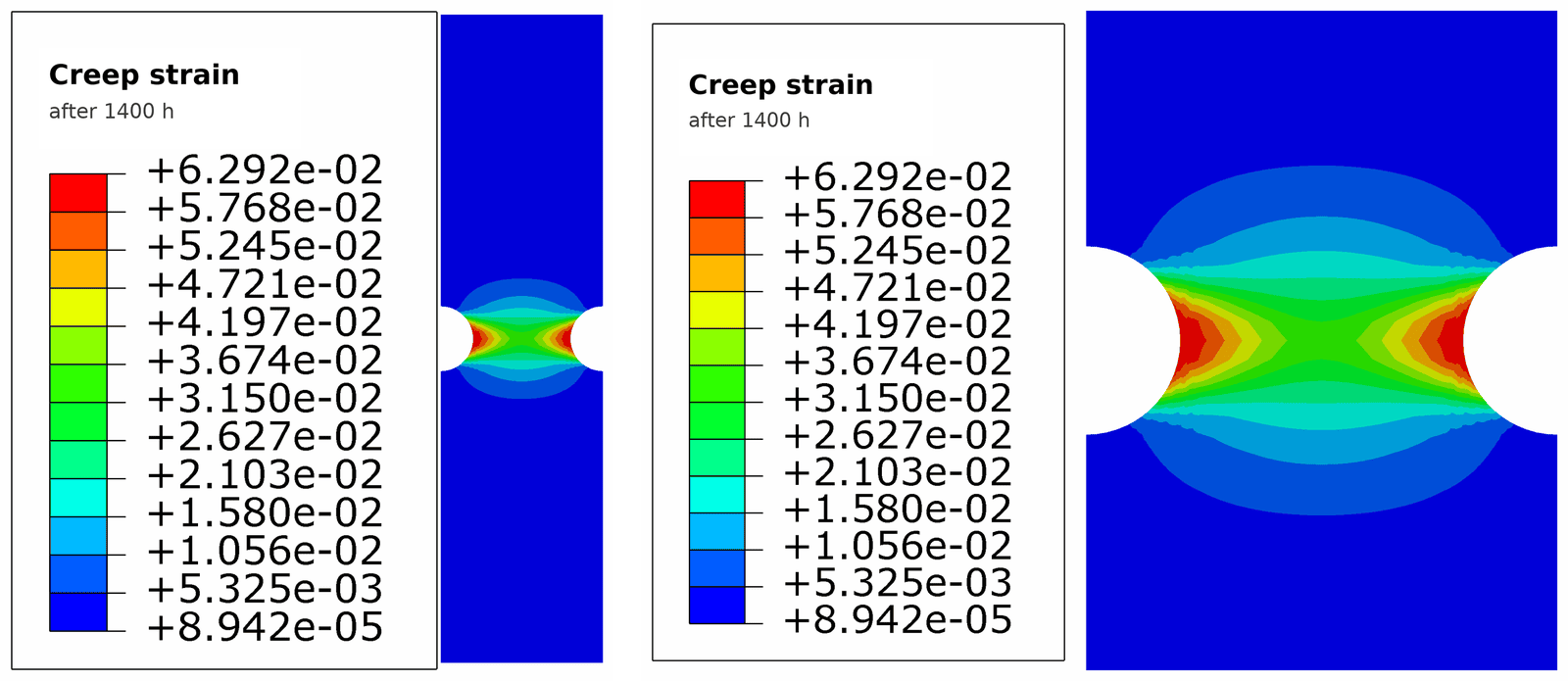
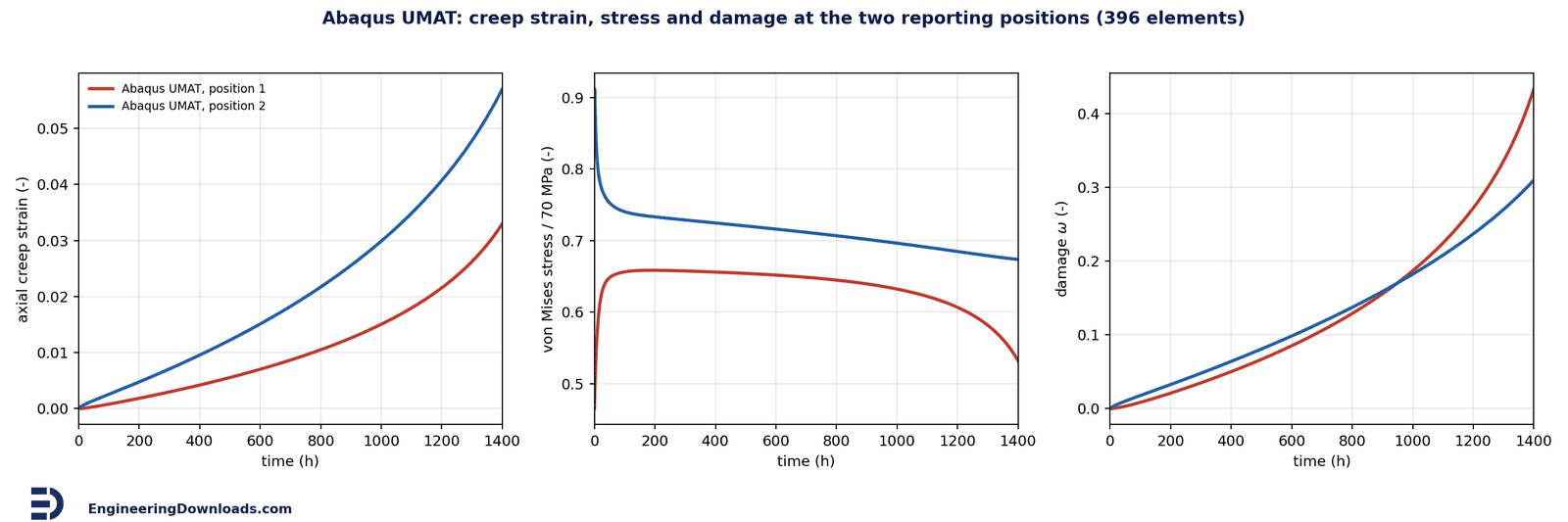
The paper plots the y creep strain, the equivalent stress divided by 70 MPa and the damage against time at two positions (its Fig. 6), from its own FE-DAMAGE code and from Abaqus with a UMAT. We overlaid our curves on a high-resolution scan of that figure, with the axes calibrated from the printed labels (about ±3 pixels). Our Abaqus curves run through the paper’s markers in all three panels at both positions over the 1400 h window, including the initial stress jump and the slow stress relaxation. The paper’s curves continue to about 1550 h, where damage rises steeply; our window ends at 1400 h.
This is a visual comparison with a published plot, not a numerical acceptance test: we did not extract the paper’s data points and no tolerance was agreed. The mesh is not the authors’ mesh (theirs has 77 elements) and the half length of the bar (25 mm) is an estimate, but changing it between 20 and 30 mm moves the results by less than 0.002 %. The model is an independent reconstruction, not the authors’ code.
Researchers, graduate students and engineers who want a working creep-damage UMAT in Abaqus, a published benchmark to verify their own implementation against, and a starting point for high-temperature creep, structural integrity and fitness-for-service work.
Abaqus with a Fortran compiler linked to Abaqus (the UMAT is compiled at job start). Abaqus is not included.
You skip the work of writing and testing a creep-damage UMAT and start from files that already run, with reference results to check against. See also the creep damage versus time in Abaqus (one-element failure curve), the Becker 2002 perforated plate benchmark in Abaqus, the creep damage analysis of a welded steam pipe branch in Abaqus, our guide Introduction to UMAT Subroutine in Abaqus and the article Life Assessment and Creep Damage Analysis of Welded Components.
Does it predict rupture life? It reproduces creep strain, stress and damage histories for the 1400 hour hold. For a rupture curve to failure see the one-element package.
Is the comparison with the paper numerical? It is a visual overlay on the paper’s Fig. 6, not a digitised acceptance test.
Do I need a Fortran compiler? Yes, to compile the UMAT in Abaqus.
Can I use my own material? Yes, change the constants on the *User Material line.
Can I edit the models? Yes, you get the CAE and INP files and the UMAT source.
Quality guarantee: if you are not satisfied with the delivered product, we will refund you.
Need more than the files?
There are two ways we can help. Book a one hour online consultation if you want to talk a problem through with a CAE engineer, using the checkbox in the order box. Order a project if you need a full simulation built for you, delivered to an agreed scope, price and deadline under a written contract.
We work on FEA and CFD for engineers, researchers and companies. Order your project, or message us on WhatsApp for a quick reply.
Other packages engineers working on this topic also download.
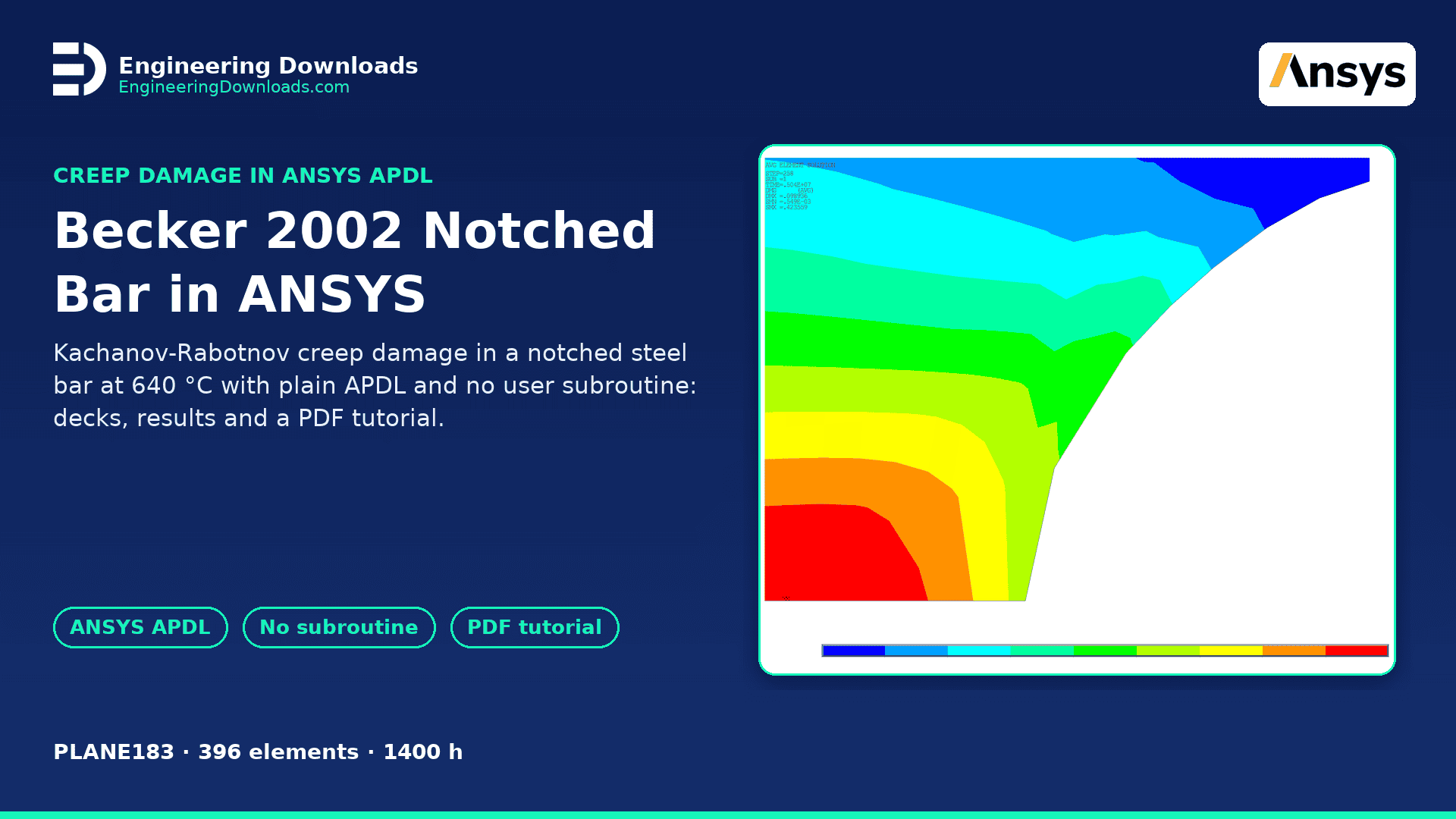 Creep Damage Notched Bar in ANSYS APDL: Becker 2002 Benchmark with No User Subroutine, Decks and Paper Comparison€49,00
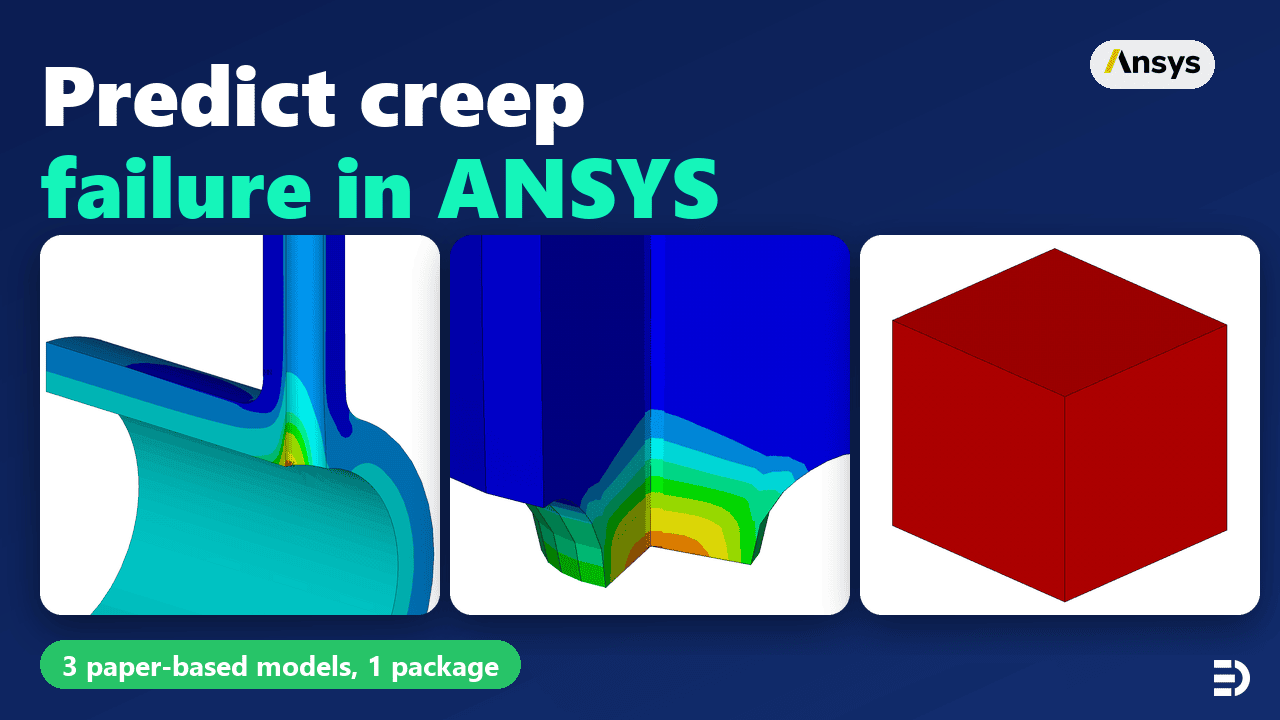 ANSYS Creep Damage Package: 3 Paper-Based APDL Models (Welded Pipe Branch, Notched Bar, Failure Horizon)€299,00
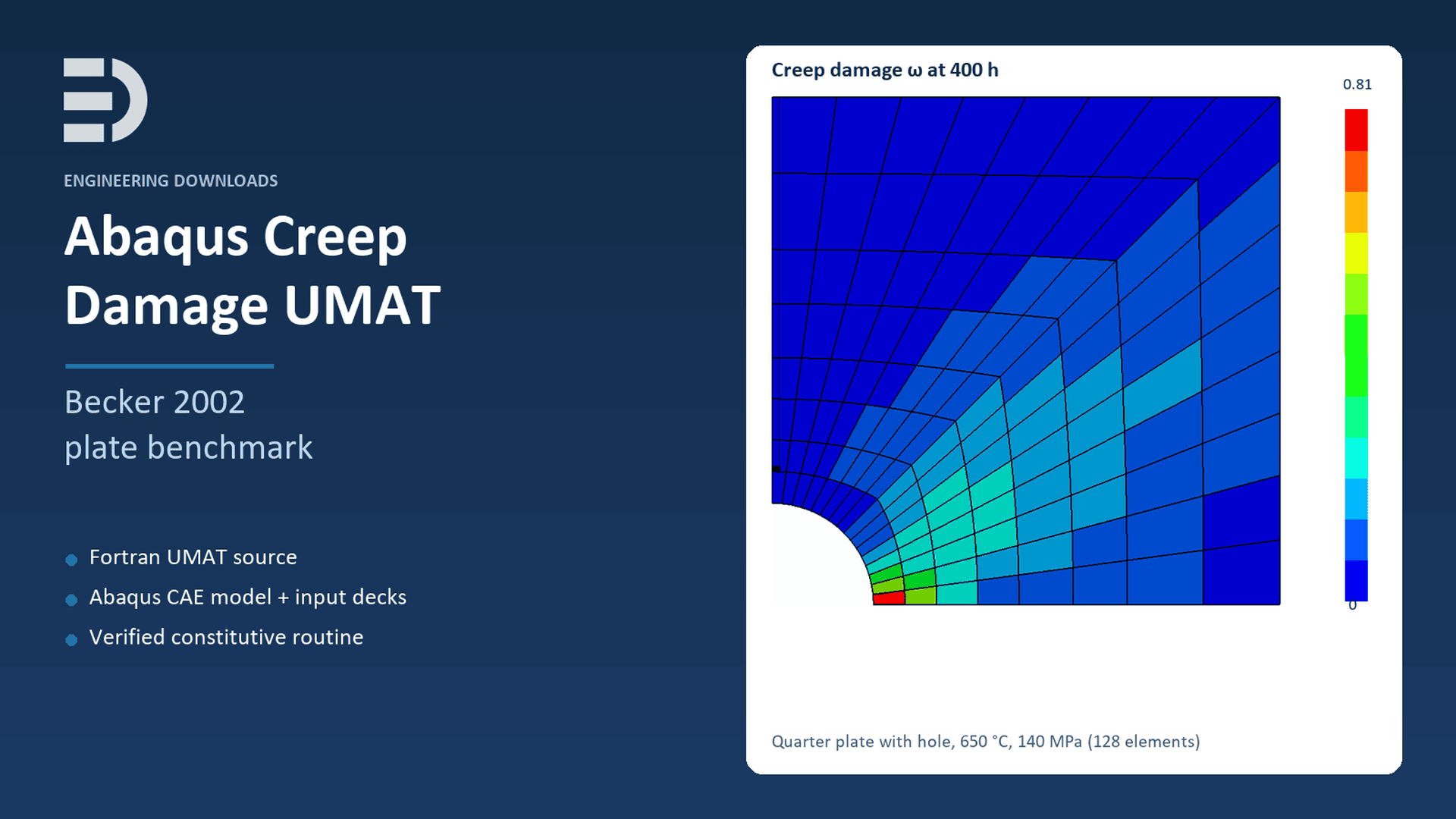 Creep Continuum Damage UMAT in Abaqus: Becker 2002 Perforated Plate Benchmark€49,00
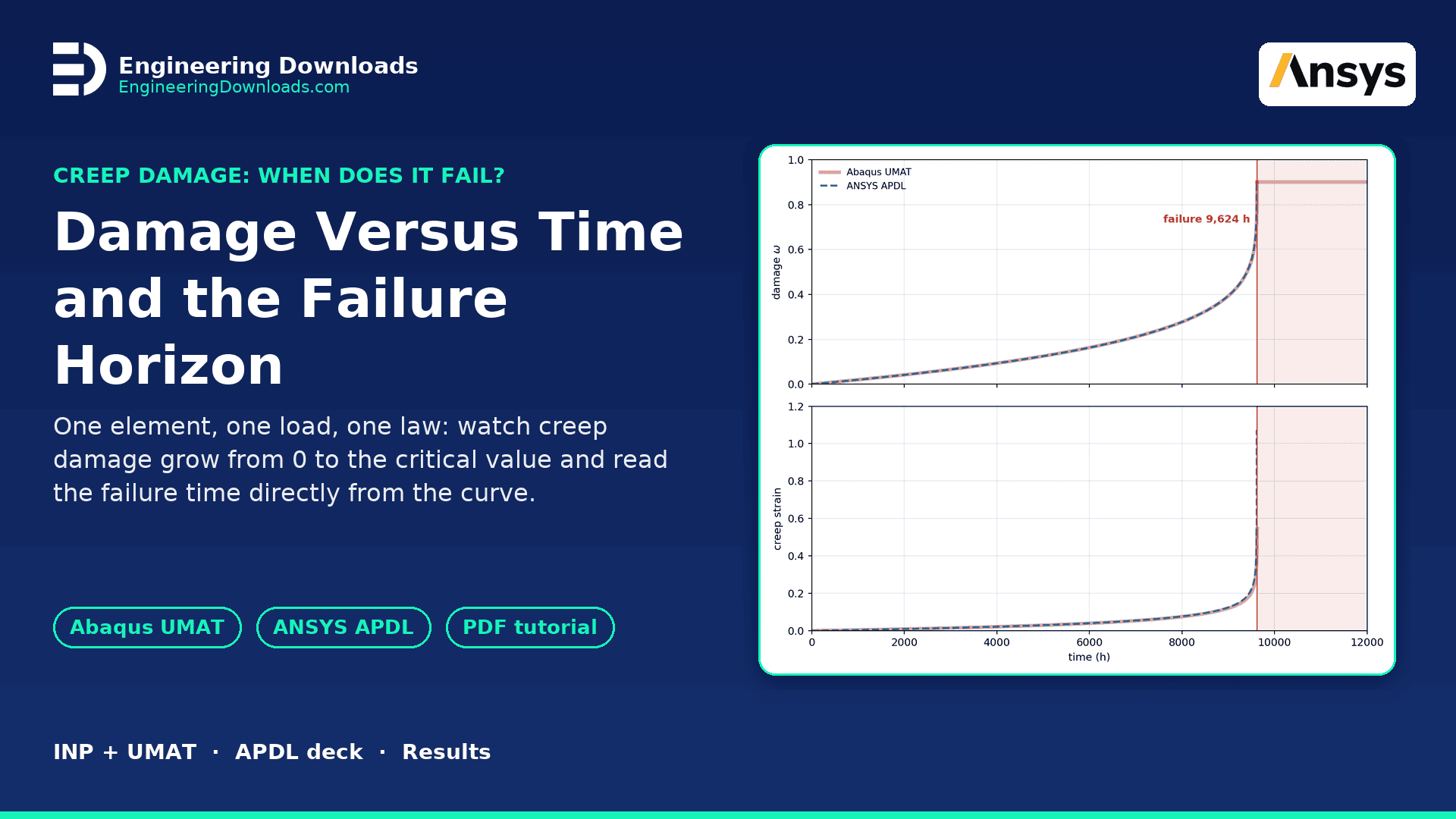 Creep Damage Versus Time in Abaqus: Failure Horizon of a Single Element with a Kachanov-Rabotnov UMAT€49,00Creep Damage Versus Time in ANSYS APDL: Failure Horizon of a Single Element, No User Subroutine€49,00
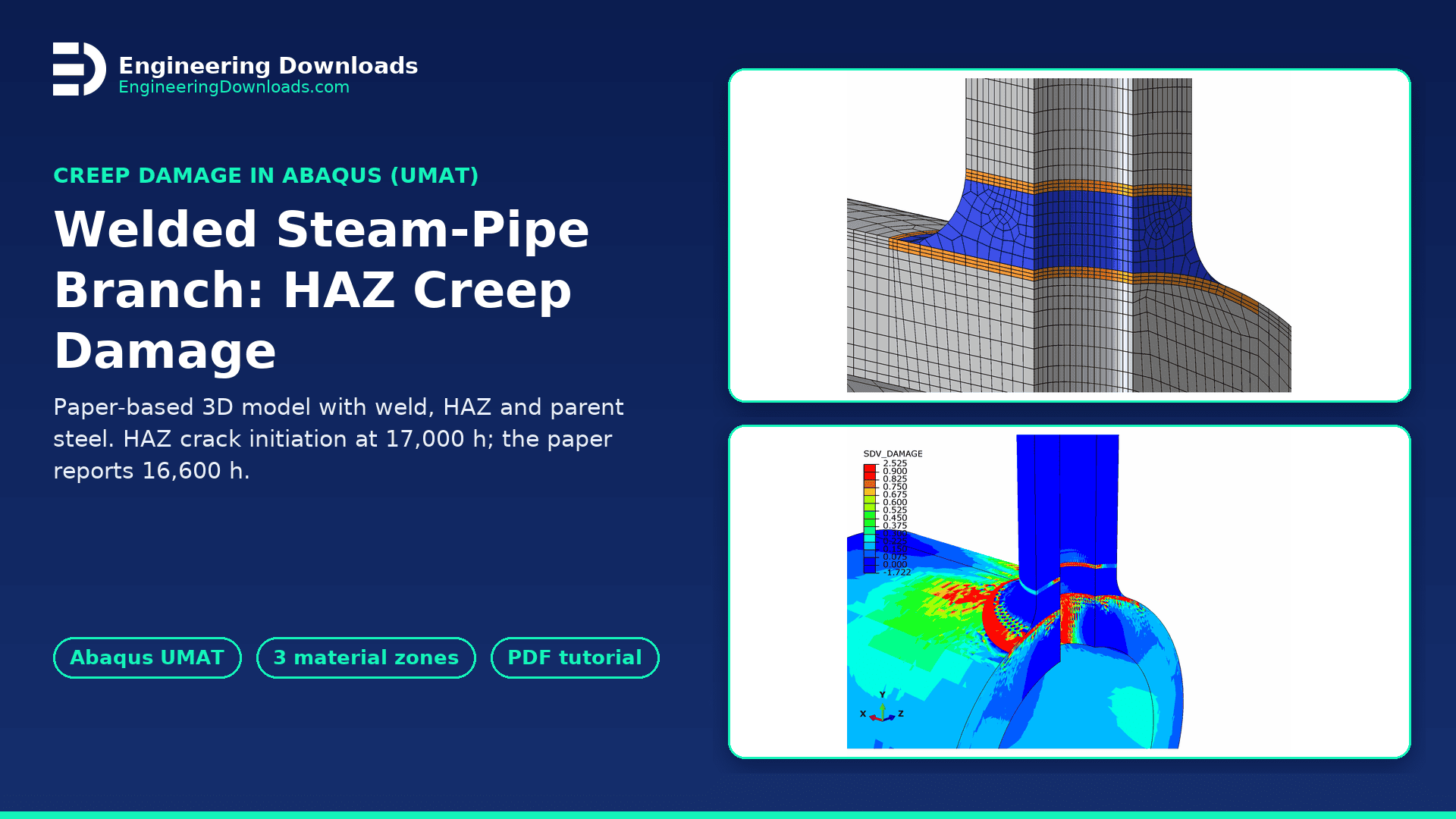 Creep Damage Analysis of a Welded Steam Pipe Branch in Abaqus: UMAT, HAZ Hex Mesh and Paper Comparison€149,00
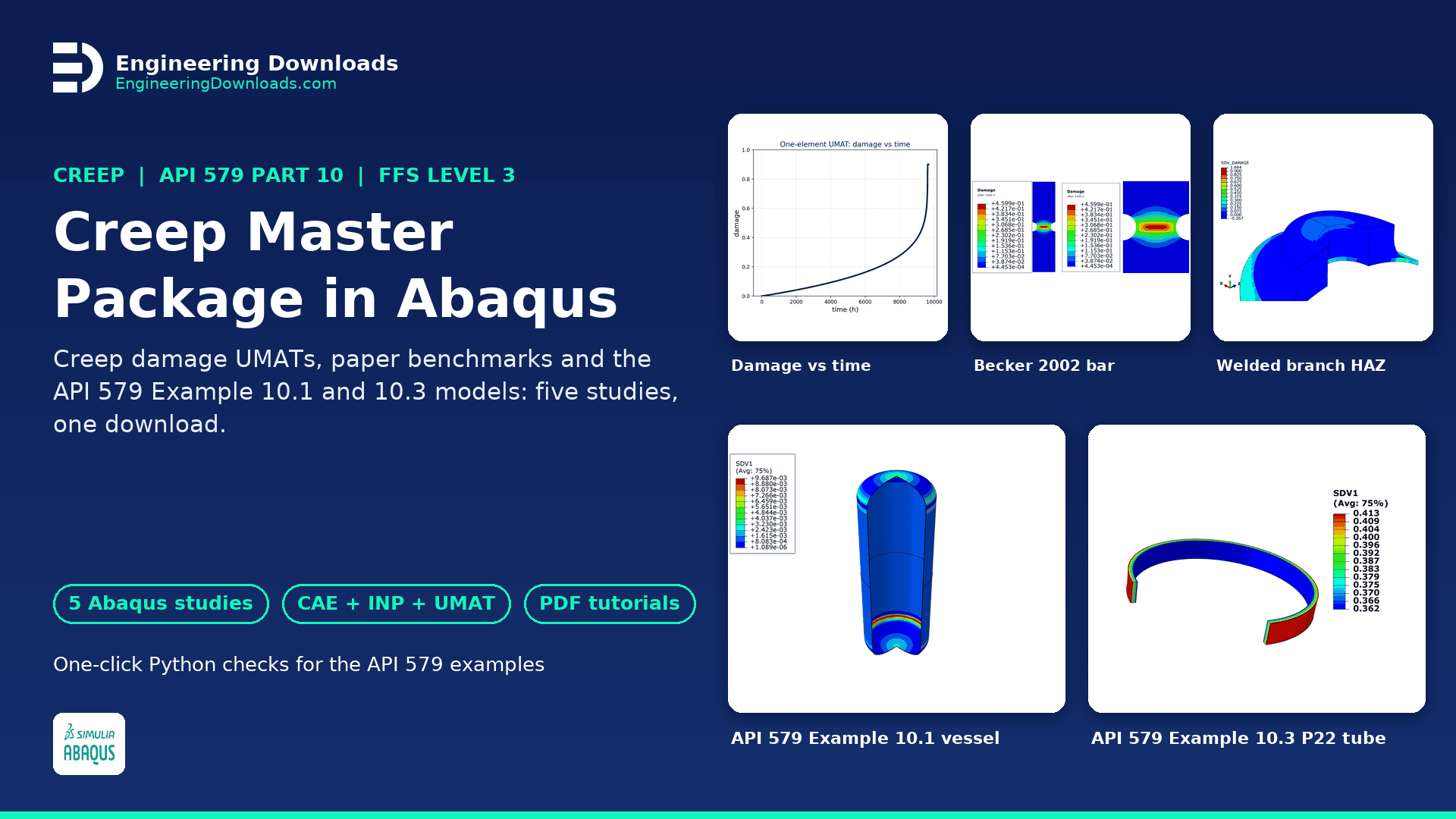 Creep Master Package in Abaqus: API 579 Part 10 Examples 10.1 and 10.3, Creep Damage UMAT and Paper Benchmarks€299,00
 Creep Damage of a Welded Steam Pipe Branch in ANSYS APDL: HAZ Failure, All-Hex Mesh and Paper Comparison€149,00

Need a full custom project? See the options below.

€129,00

€179,00

€149,00

€119,00

€129,00
See more
Want to receive push notifications for all major on-site activities?