

Need a full custom project? See the options below.
Need a full custom project? See the options below.
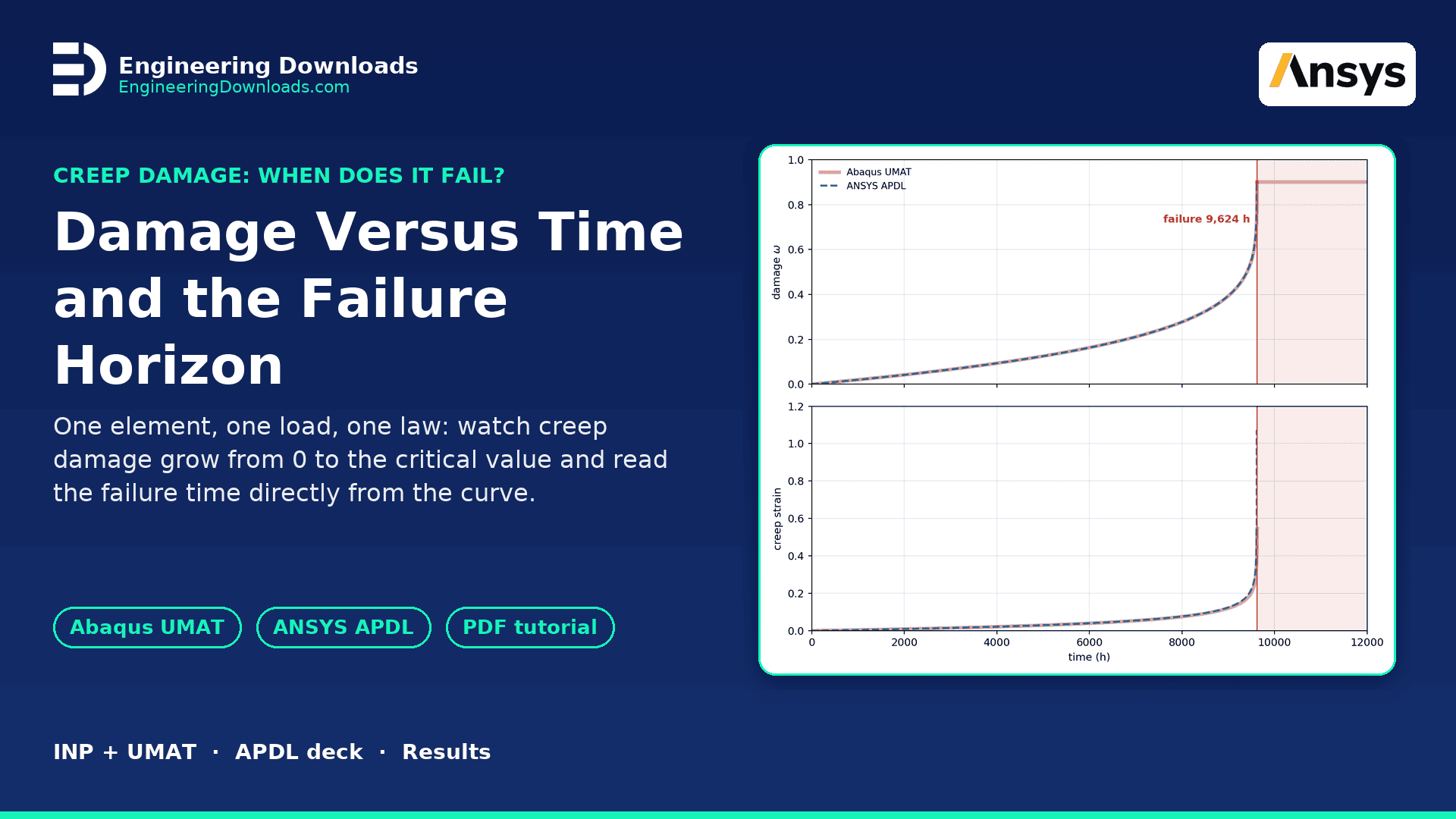
Steel under a constant load at 640 °C creeps, damage builds up inside it, and the damage speeds the creep up. The result is a curve that is almost flat for most of the life and then turns sharply upward: failure comes suddenly. This package shows that curve in the simplest possible model, one element under uniaxial stress in Abaqus with a Fortran creep-damage UMAT. You run it in seconds, read the failure horizon straight from the damage-versus-time curve, and compare it with the closed-form answer.
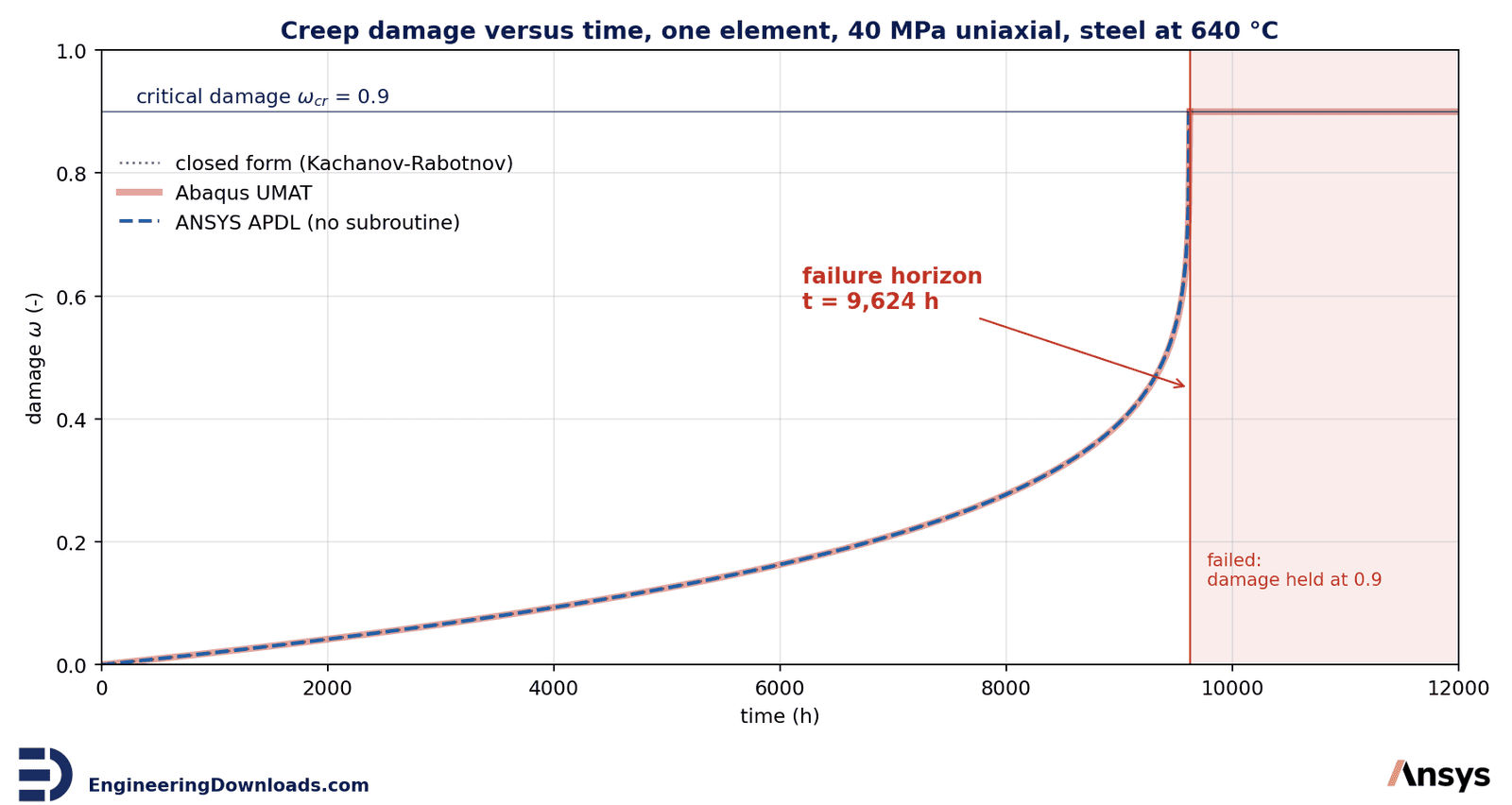
The form of the law is the one used in A.A. Becker, T.H. Hyde, W. Sun and P. Andersson (2002), Benchmarks for finite element analysis of creep continuum damage mechanics, Computational Materials Science, 25, 34–41, DOI: 10.1016/S0927-0256(02)00247-1. The steel constants are those printed in Table 3 of M. Hosseini-Toudeshky and M. Jannesari (2022), Welding in the World, 66, 1653.
Creep rupture life can be predicted using a continuum damage mechanics approach incorporated within a finite element (FE) formulation. The rate of change of a damage parameter, ω, ranging from ω = 0 (no damage) to ω = 1 (100% damage), is computed within each element, until failure occurs in the material cross-section. The main difficulty in the numerical formulation arises due to the very small time steps needed as the damage parameter increases to 1. This paper presents the results of a number of benchmark tests involving the FE analysis of creep continuum damage mechanics that can be used to verify the FE solutions. Two independent FE codes are used; an in-house code (FE-DAMAGE) and a commercial code (ABAQUS) in which a user-subroutine (UMAT) is incorporated. The results of a series of tests used to represent uniaxial, biaxial, triaxial and multi-material creep and damage behaviour are presented.
Abstract quoted for reference (© 2002 Elsevier Science B.V.). Neither paper, nor any of its figures, is included in this package.
| Failure time (ω = 0.9) | Max |ω − closed form|, ω < 0.6 | Creep strain error, ω < 0.2 / ω < 0.6 | |
|---|---|---|---|
| Closed form | 9,614.2 h | – | – |
| Abaqus UMAT | 9,624.2 h (+0.10 %) | 0.0071 | 1.1 % / 10 % |
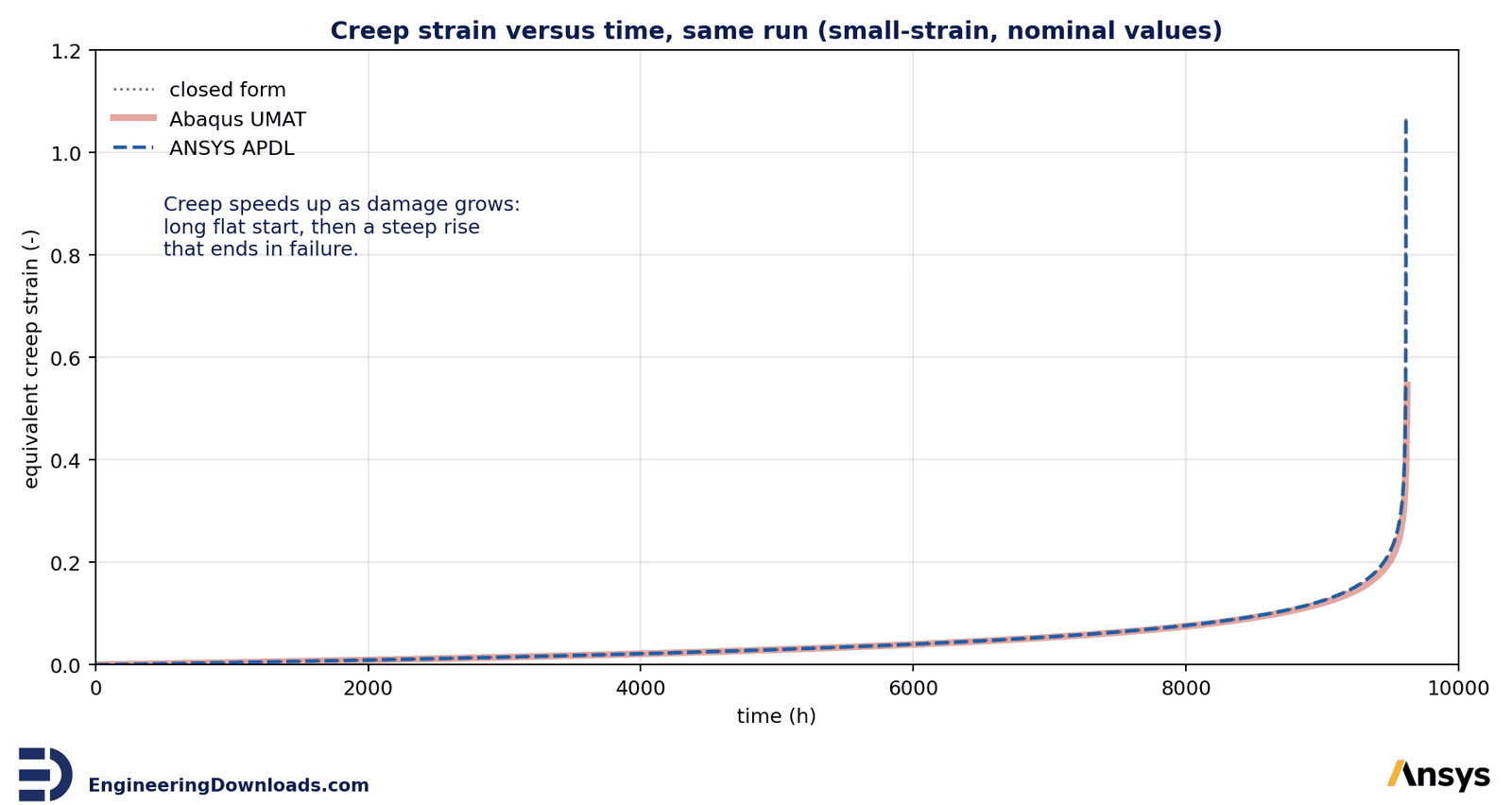
The Abaqus UMAT follows the closed-form curve. It uses a backward-Euler update with automatic time steps, stable at any step size, which loses some accuracy in the creep strain close to the knee; its damage and failure time stay within 0.1 %. The model is small-strain, so strains near failure are nominal values.
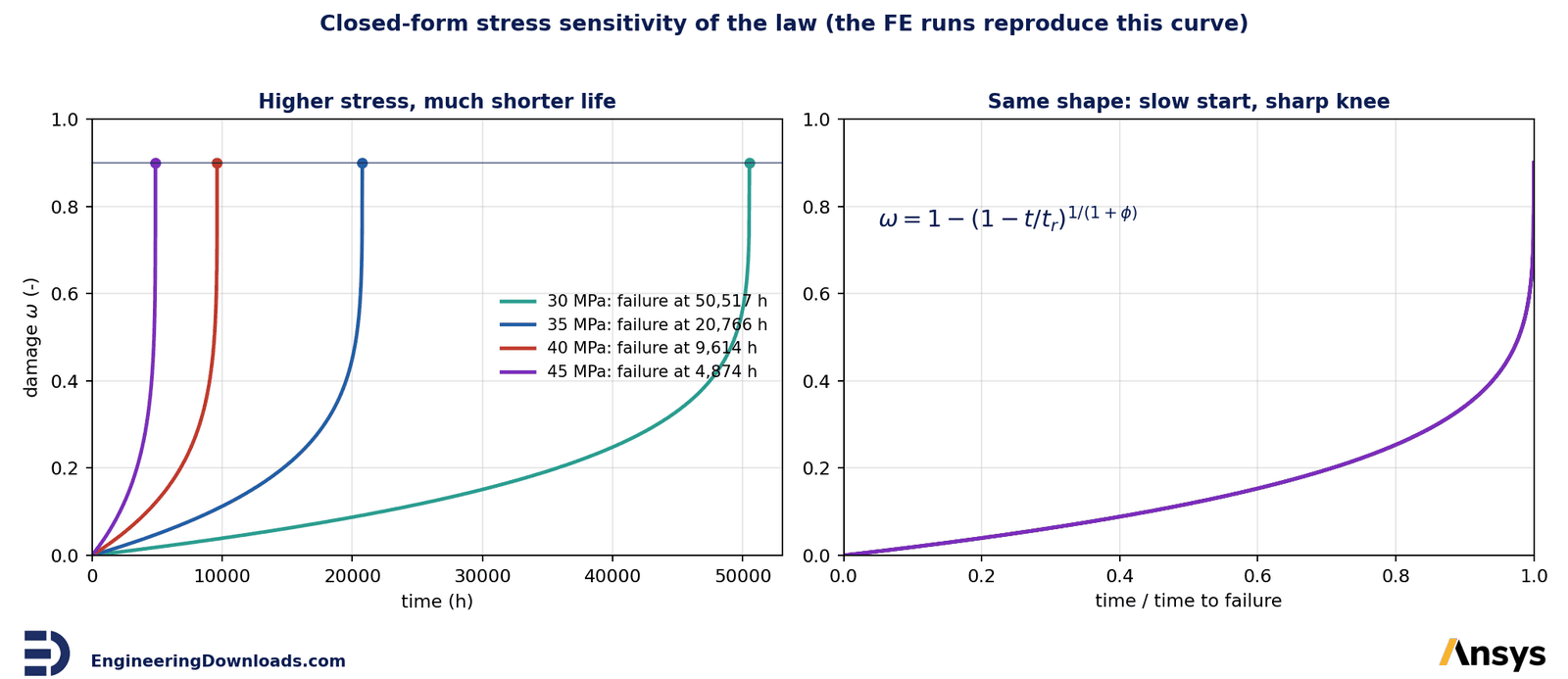
Students, researchers and engineers who want to understand creep damage first, in the simplest model, before moving to structures: you read the failure time from the curve and see how a few MPa move it.
Abaqus with a Fortran compiler linked to Abaqus (the UMAT is compiled at job start). The run takes about 10 seconds. Abaqus is not included.
A tested creep-damage UMAT that runs on one element in seconds, with the closed-form check built in. For a structure, see the Becker 2002 notched bar in Abaqus.
Related: our guide Introduction to UMAT Subroutine in Abaqus and the article Life Assessment and Creep Damage Analysis of Welded Components.
Can I change the stress? Yes: change the pressure on the *Dsload line of the input file.
Do I need a Fortran compiler? Yes, to compile the UMAT.
Does the curve predict the life of a real component? No. It is a material-point check of the law, using the constants of the cited paper.
Quality guarantee: if you are not satisfied with the delivered product, we will refund you.
Need more than the files?
There are two ways we can help. Book a one hour online consultation if you want to talk a problem through with a CAE engineer, using the checkbox in the order box. Order a project if you need a full simulation built for you, delivered to an agreed scope, price and deadline under a written contract.
We work on FEA and CFD for engineers, researchers and companies. Order your project, or message us on WhatsApp for a quick reply.
Other packages engineers working on this topic also download.
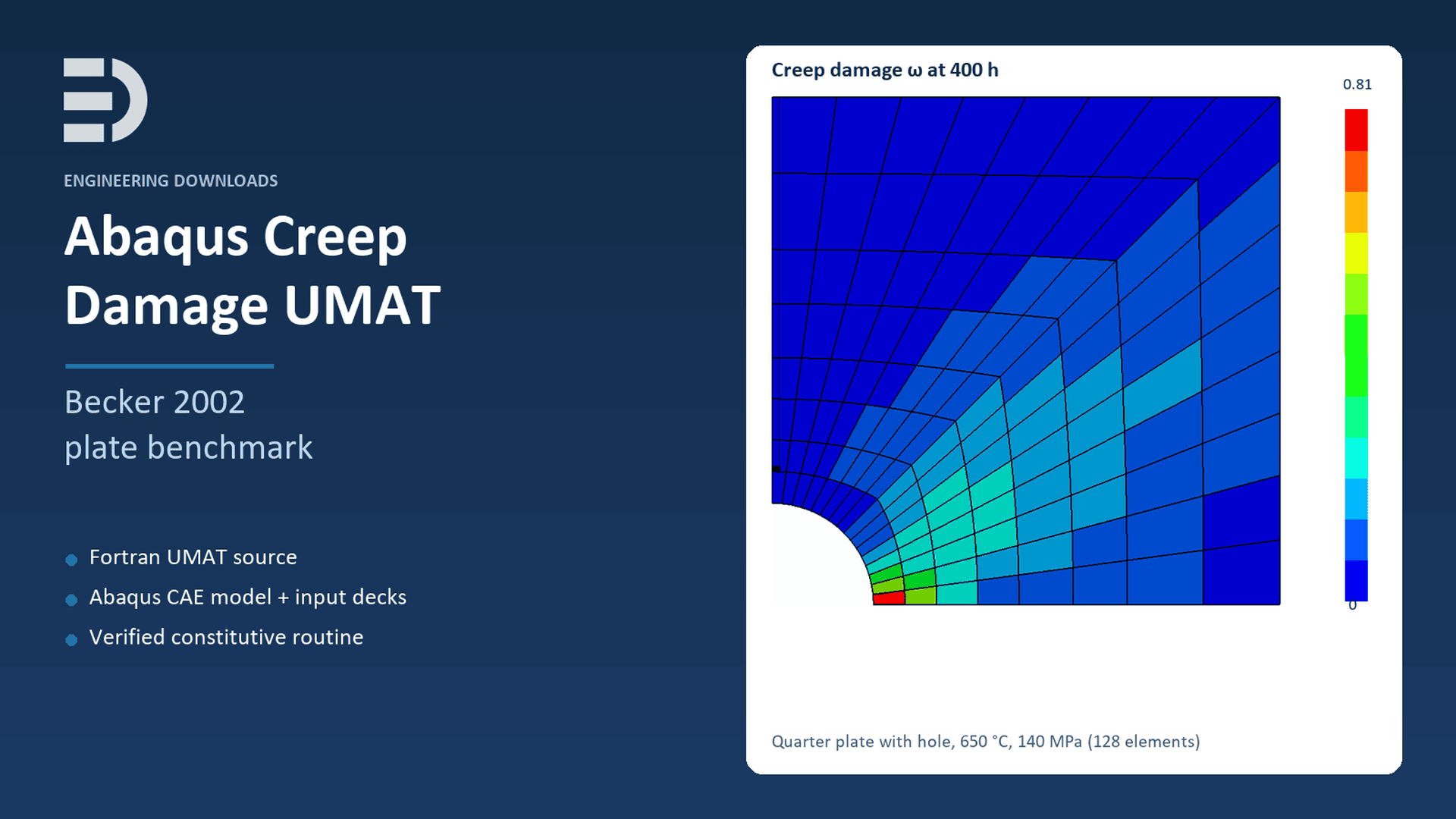 Creep Continuum Damage UMAT in Abaqus: Becker 2002 Perforated Plate Benchmark€49,00
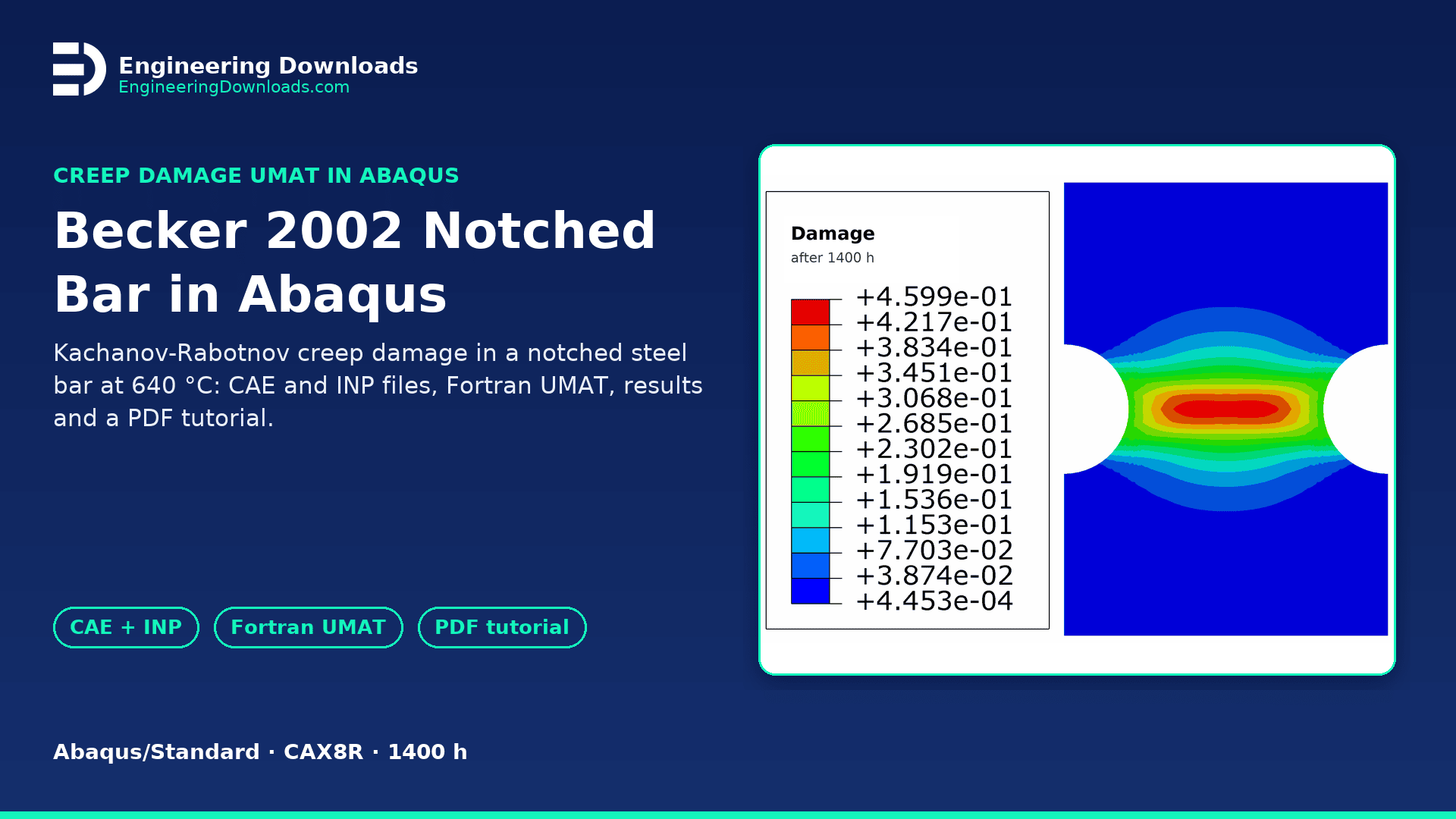 Creep Damage Notched Bar in Abaqus: Becker 2002 Benchmark with UMAT, CAE and INP Files and Paper Comparison€49,00
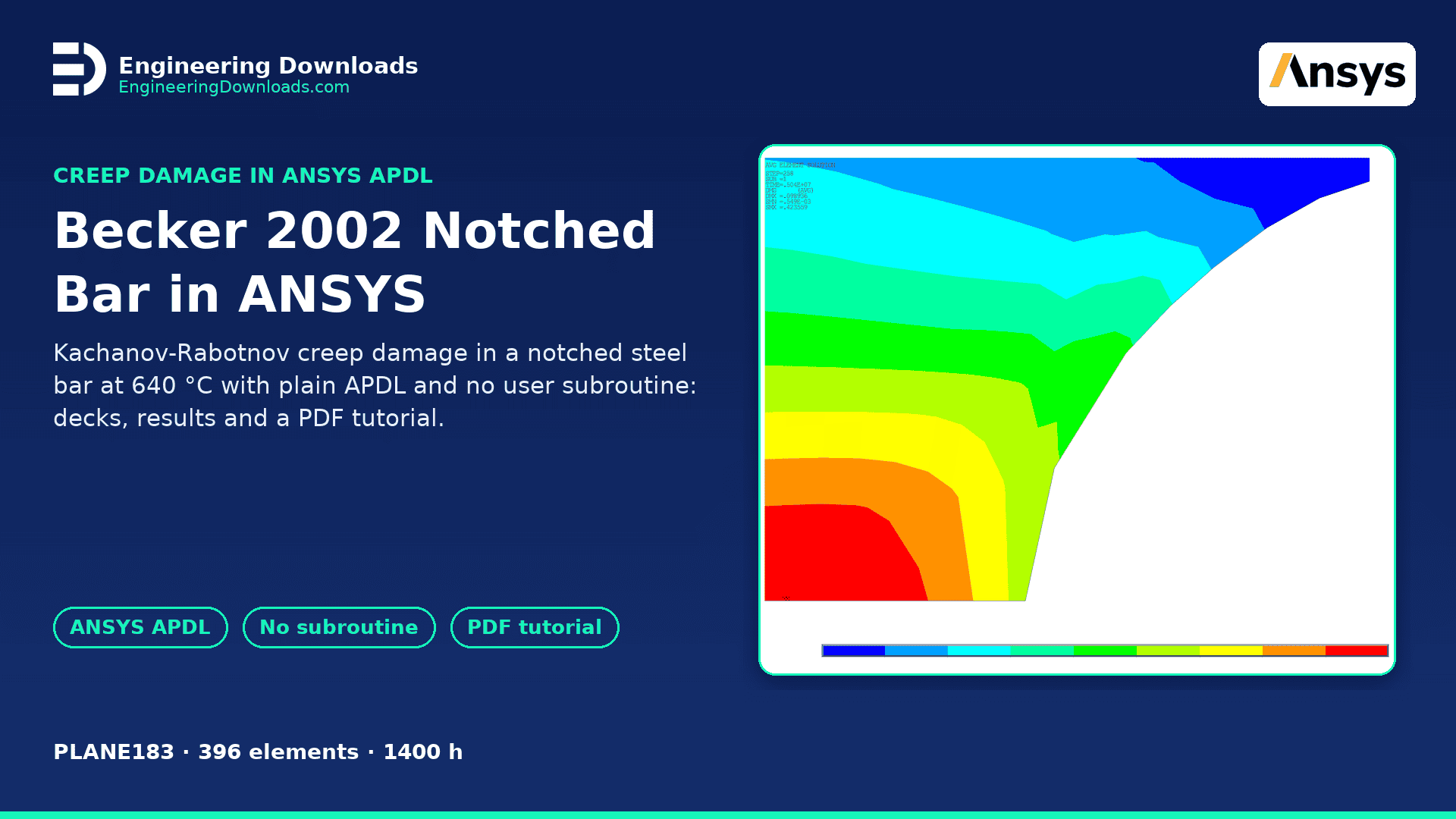 Creep Damage Notched Bar in ANSYS APDL: Becker 2002 Benchmark with No User Subroutine, Decks and Paper Comparison€49,00Creep Damage Versus Time in ANSYS APDL: Failure Horizon of a Single Element, No User Subroutine€49,00
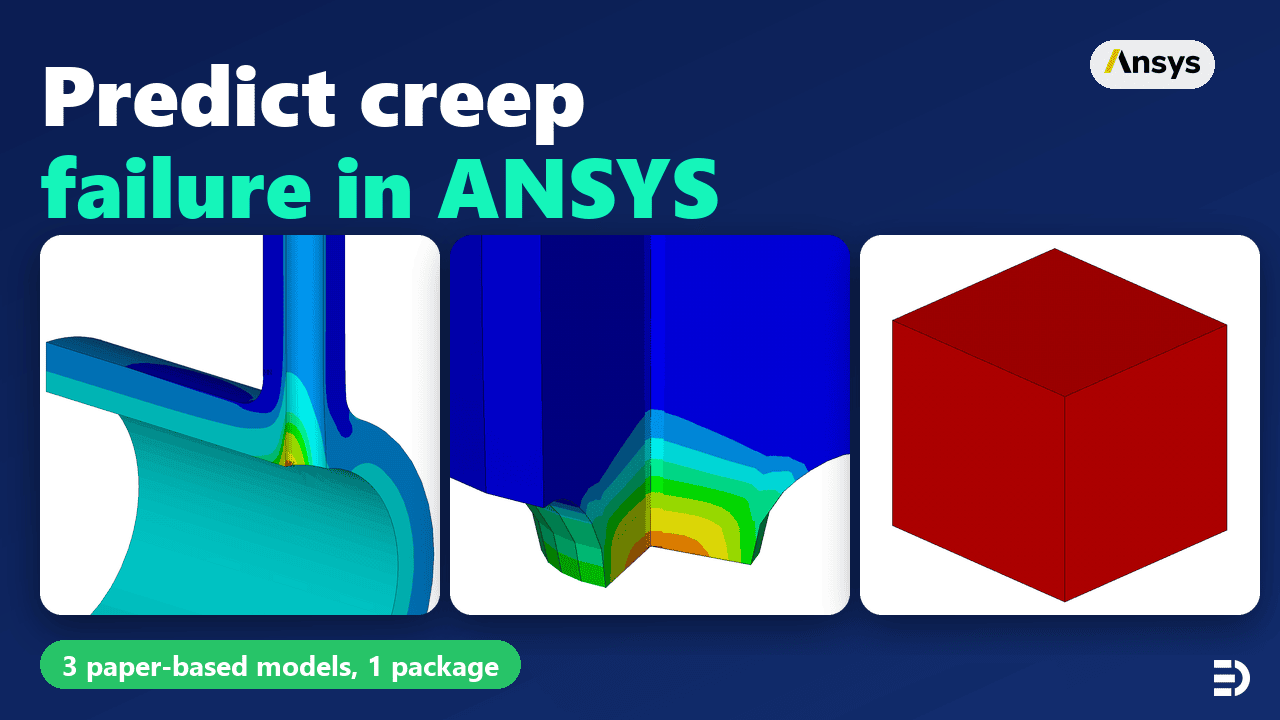 ANSYS Creep Damage Package: 3 Paper-Based APDL Models (Welded Pipe Branch, Notched Bar, Failure Horizon)€299,00
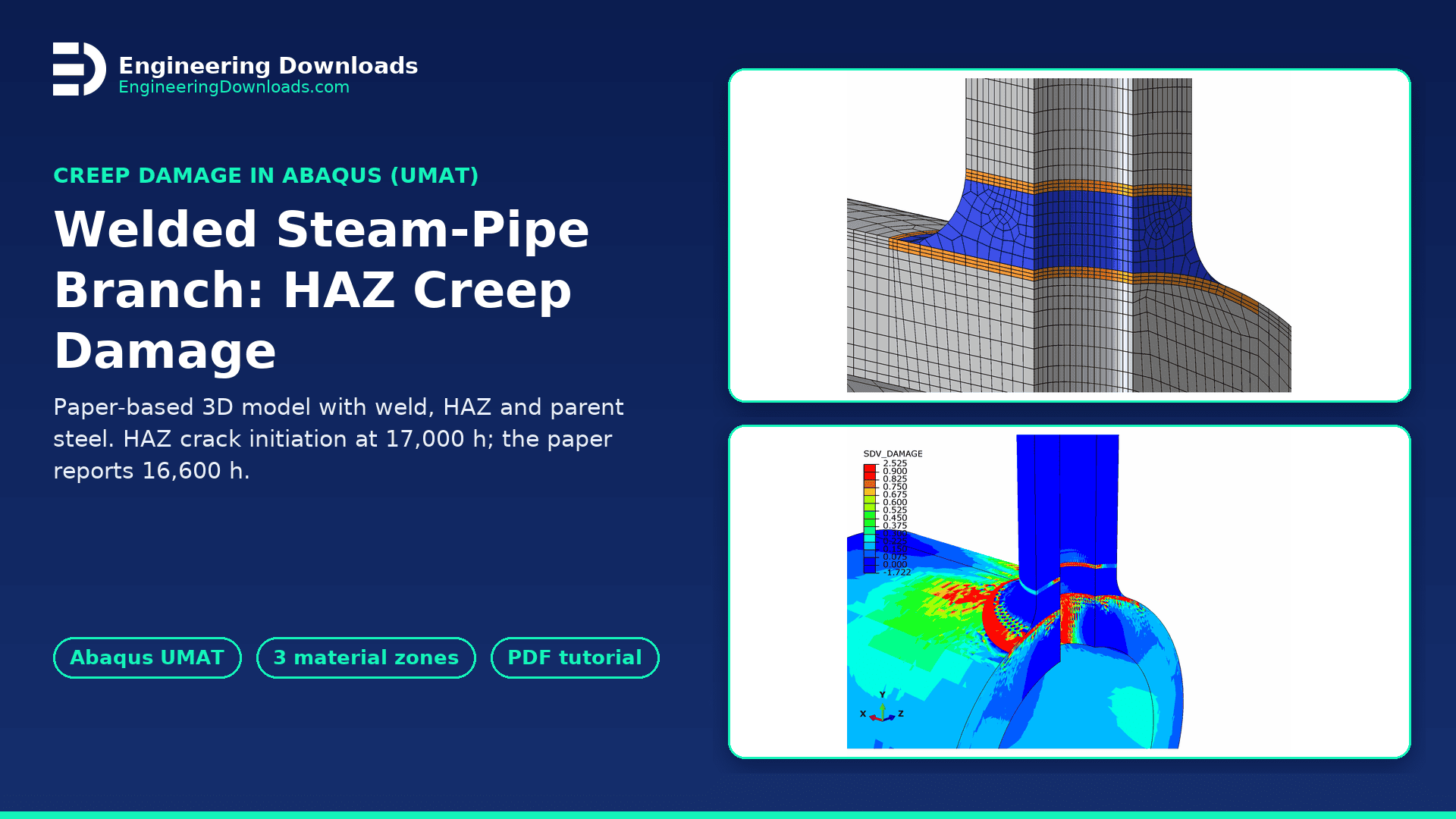 Creep Damage Analysis of a Welded Steam Pipe Branch in Abaqus: UMAT, HAZ Hex Mesh and Paper Comparison€149,00
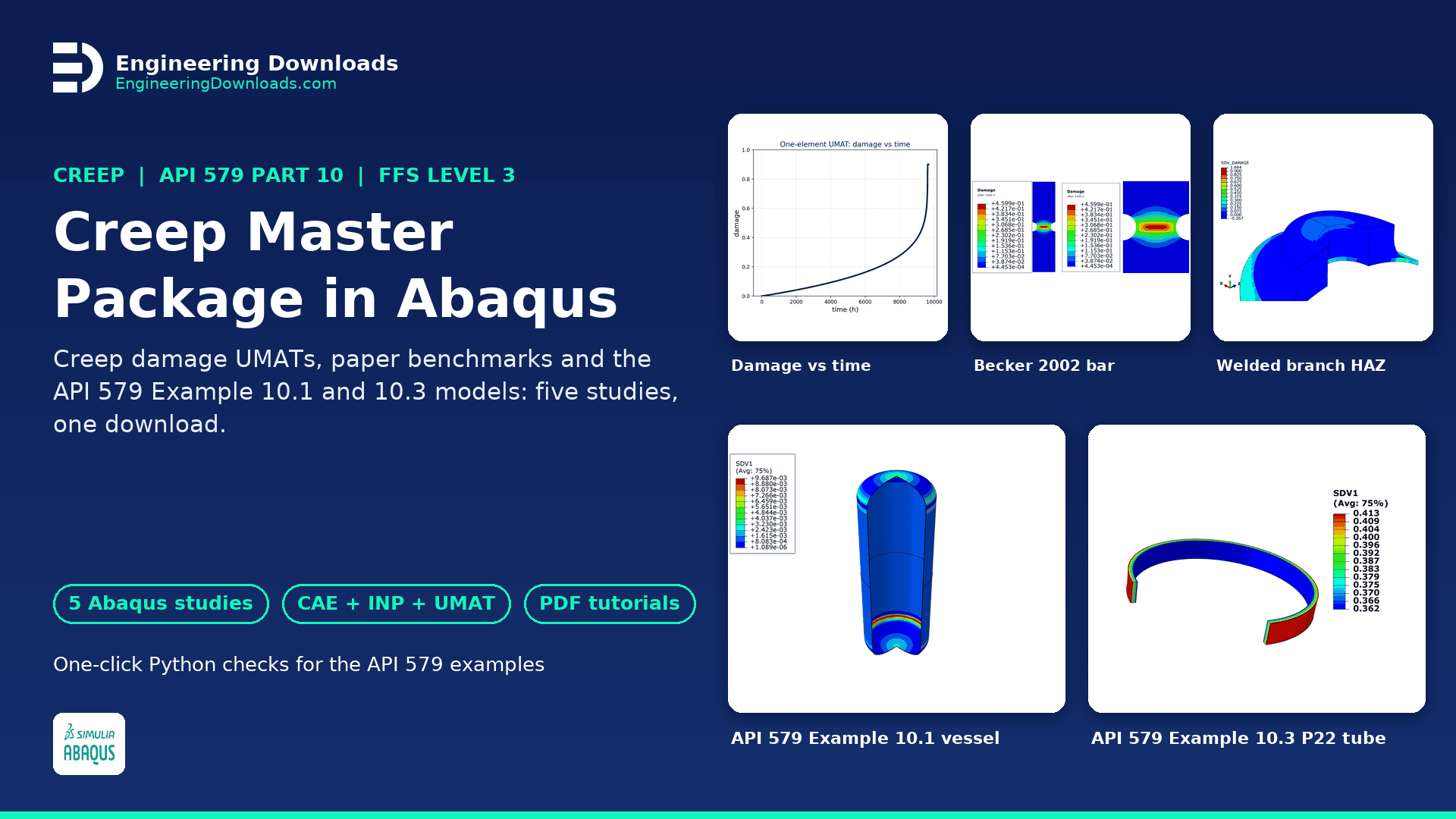 Creep Master Package in Abaqus: API 579 Part 10 Examples 10.1 and 10.3, Creep Damage UMAT and Paper Benchmarks€299,00
 Creep Damage of a Welded Steam Pipe Branch in ANSYS APDL: HAZ Failure, All-Hex Mesh and Paper Comparison€149,00

Need a full custom project? See the options below.

€129,00

€179,00

€149,00

€119,00

€129,00

€149,00
See more
Want to receive push notifications for all major on-site activities?



