

Need a full custom project? See the options below.
Need a full custom project? See the options below.
Fixed tubesheet heat exchangers are designed against plastic collapse, and the design-by-analysis route of ASME Section VIII Division 2 asks for a plastic load from an elastic-plastic finite element analysis. Which criterion you use to read that load (limit load, twice elastic slope, tangent intersection, plastic work curvature or a strain limit) can change the answer by tens of percent. This Ansys Mechanical APDL package rebuilds the fixed tubesheet heat exchanger of a published paper, runs the elastic-perfectly plastic limit analysis and six elastic-plastic cases, and evaluates every criterion the paper reports.
The same model also exists as an Abaqus package. Both were built from one mesh and one set of loads, so every result here is checked twice: against the paper and against an independent solver.
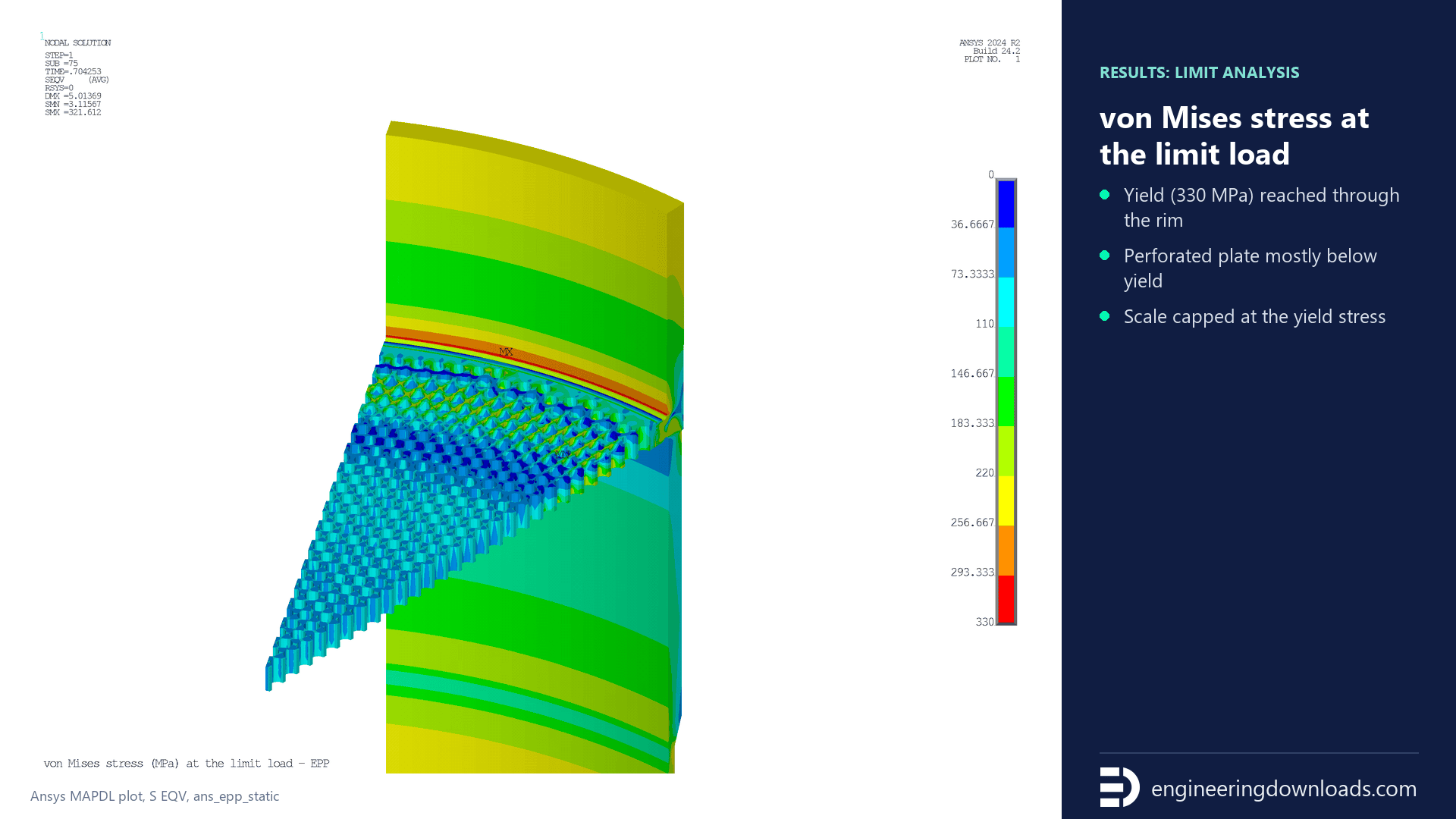
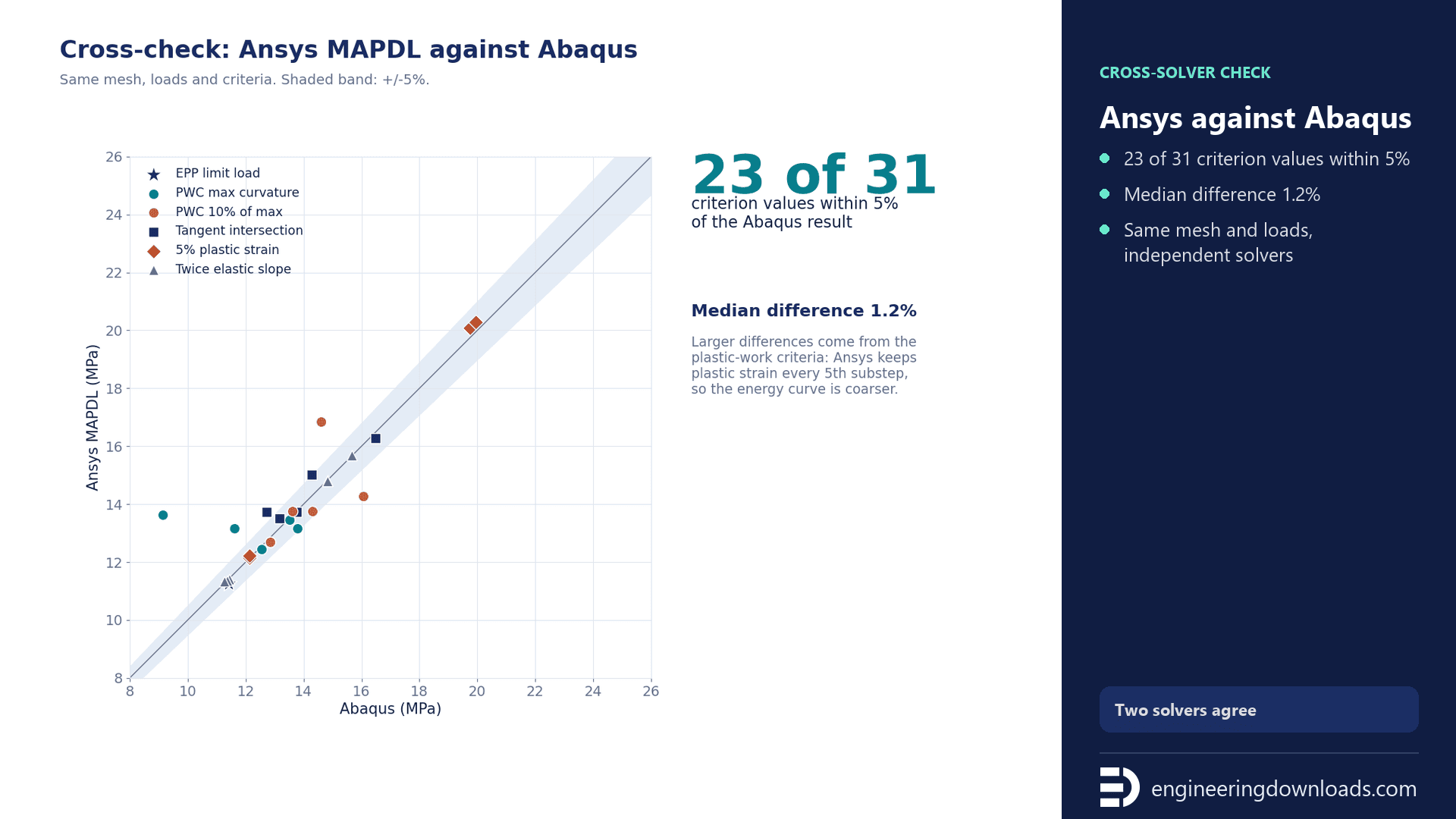
Honest status: partial validation. The limit load is 11.27 MPa against the paper’s 11.7 MPa (-3.7%) and 11.41 MPa in Abaqus, with the same collapse mechanism. The plastic work curvature load agrees with the paper within -2.0% to -7.9% in small deformation and within 3% in large deformation. The twice-elastic-slope load is about 30% lower than the paper in every case, exactly as in Abaqus, and the multilinear large-deformation instability load is 17.8 MPa against 21 MPa. Ansys and Abaqus agree within 5% on 23 of 31 criterion values (median difference 1.2%). Nothing was tuned to close any gap.
K. Behseta, D. Mackenzie, R. Hamilton, "Plastic load evaluation for a fixed tube sheet heat exchanger subject to proportional loading", International Journal of Pressure Vessels and Piping 92 (2012) 11-18.
What the paper does. It analyses a fixed tubesheet heat exchanger under tube-side pressure with a 3-D finite element model and compares plastic-load criteria for elastic-perfectly plastic, bilinear and multilinear (ASME VIII-2 Annex 3-D) material, with isotropic and kinematic hardening, in small and large deformation.
What this package reproduces. The geometry of the paper’s Fig. 4, the limit analysis, the four small-deformation hardening cases of Tables 2 and 3 and the two large-deformation cases of Table 4, with the same criteria. The paper does not give the tube pitch and count, the shell length or the channel head, so these are assumptions listed below. The paper is cited but not included, and none of its figures are used on this page; only its published values are compared.
| Tubesheet | 100 mm thick, SA266, 12.5 mm grooves on both faces at the shell junction |
|---|---|
| Tubes | Ø57 × 2.9 mm, SA334, triangular pitch 71.25 mm, 2917 tubes (pitch and count assumed) |
| Shells | Channel ID 4230, t = 90 mm, SA537. Lower shell ID 4250, 70 mm hub, 1:3 taper, 34 mm shell, SA516. 3000 mm to the mid-plane (assumed) |
| Elements | 143 924 nodes, 111 612 SOLID185 (enhanced strain); outer 4 tube rows BEAM188 CTUBE, other tubes LINK180; RBE3 tube-to-hole couplings; bonded CONTA174/TARGE170 rim tie |
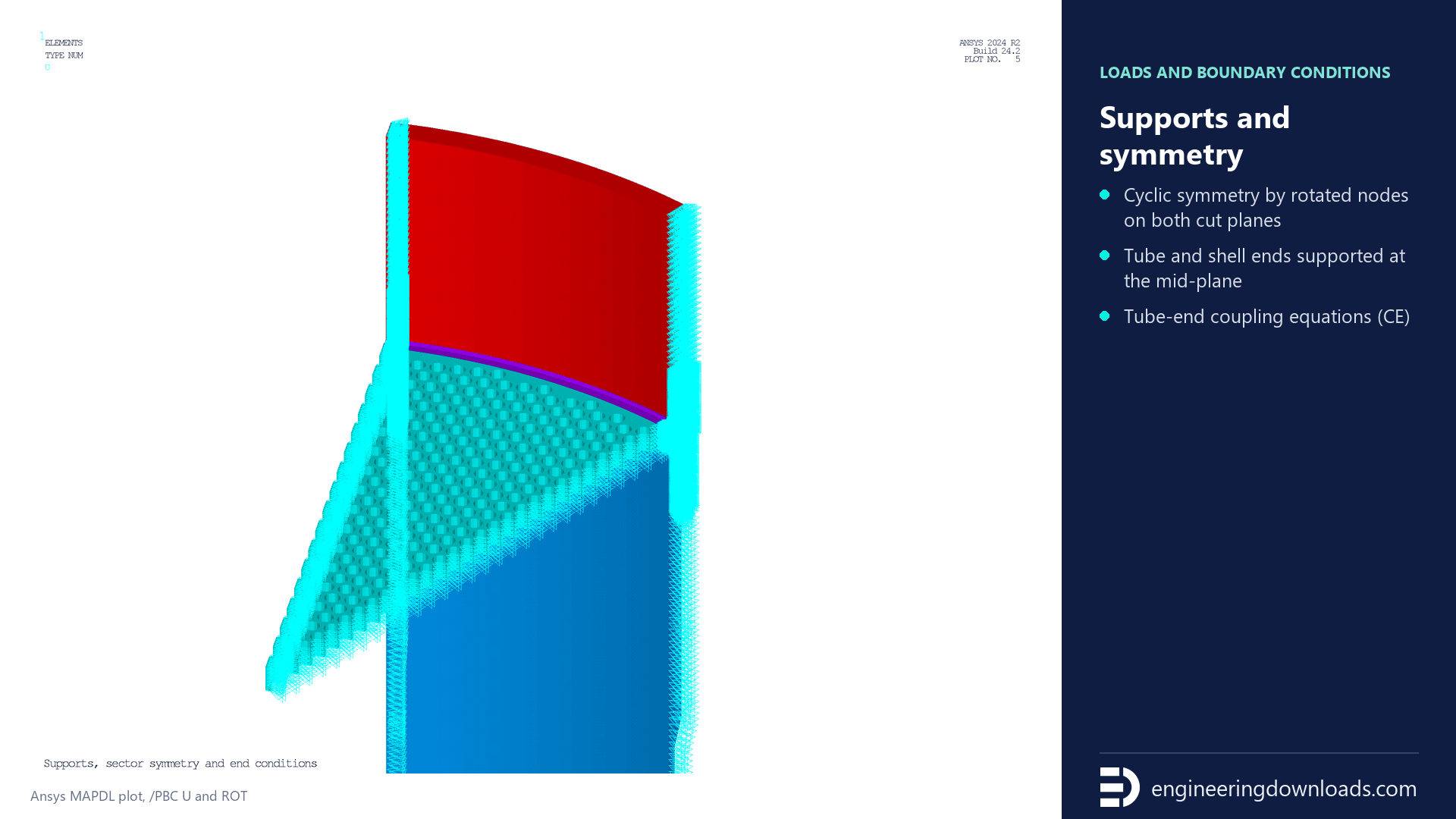
| Symmetry | 30 degree sector, nodes on both cut planes rotated into the cylindrical system (NROTAT), constraint equations on UZ at the tube ends |
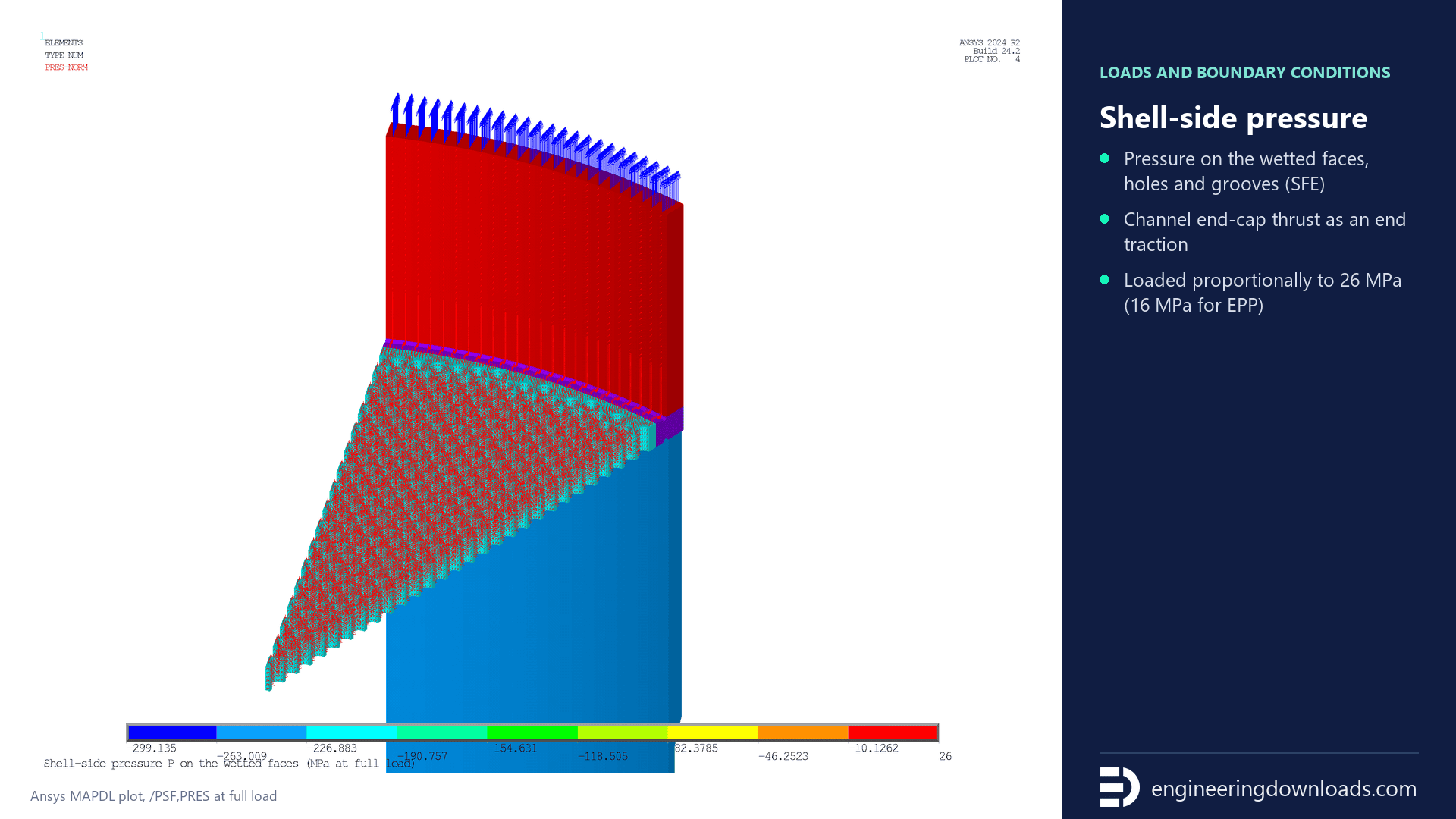
| Load | Tube-side pressure (SFE) on the tubesheet, holes, grooves and channel, end-cap thrust, increased proportionally to 26 MPa (30 MPa large deformation) |
| Materials | EPP (TB,PLAS MISO); bilinear Et = 0.1E (MISO, TB,BKIN); ASME VIII-2 Annex 3-D multilinear (MISO, 3-term TB,CHAB fit for kinematic) |
| Criteria | EPP limit load, twice elastic slope, tangent intersection, plastic work curvature (peak and 10%), 5% plastic strain, numerical instability |
| Solver | Ansys Mechanical APDL 2024 R2, SMP 4 cores, about 45-110 minutes per elastic-plastic case |
All pictures on this page are plots from Ansys MAPDL itself (EPLOT and PLNSOL of the delivered decks and their result files).
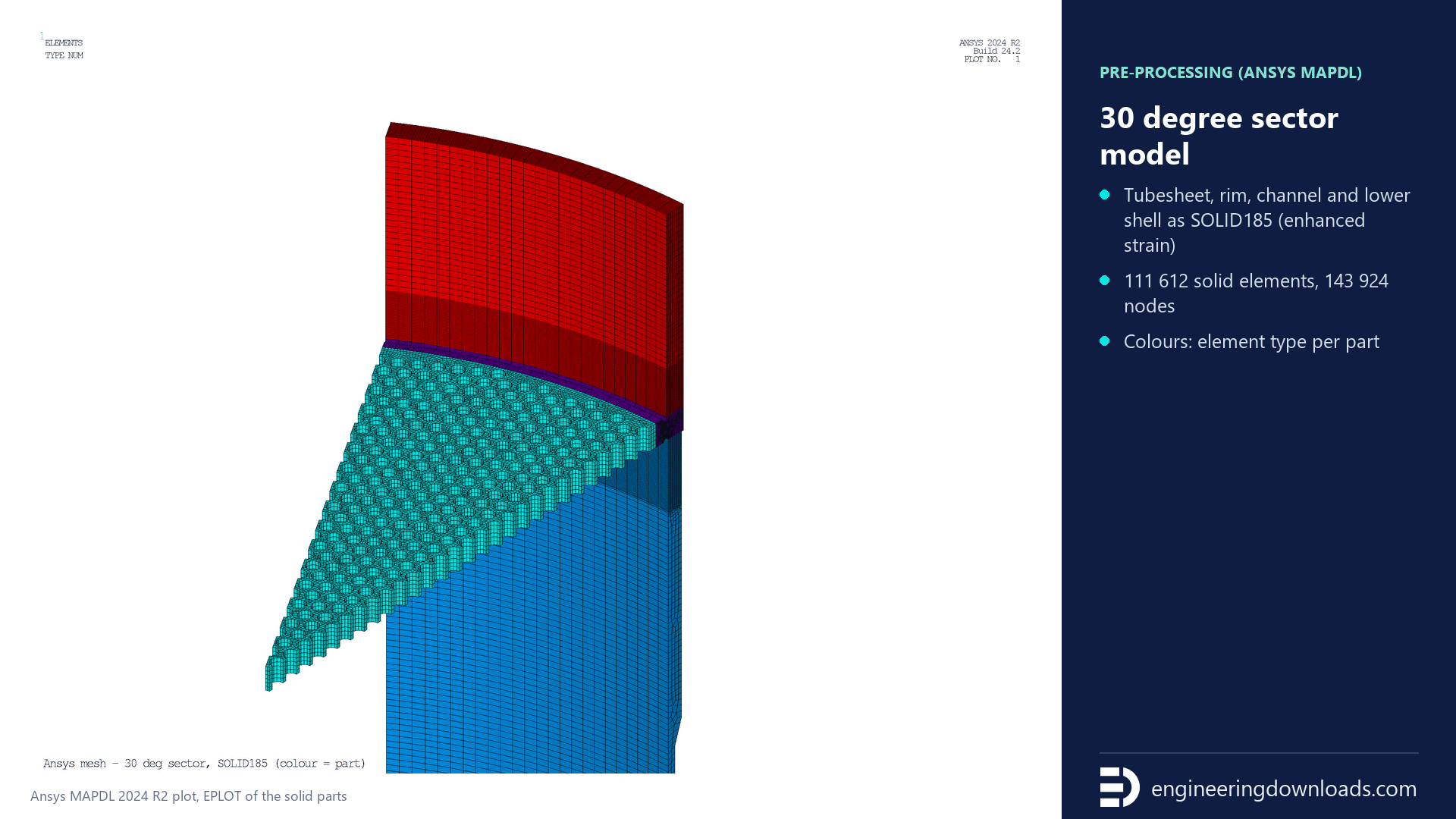
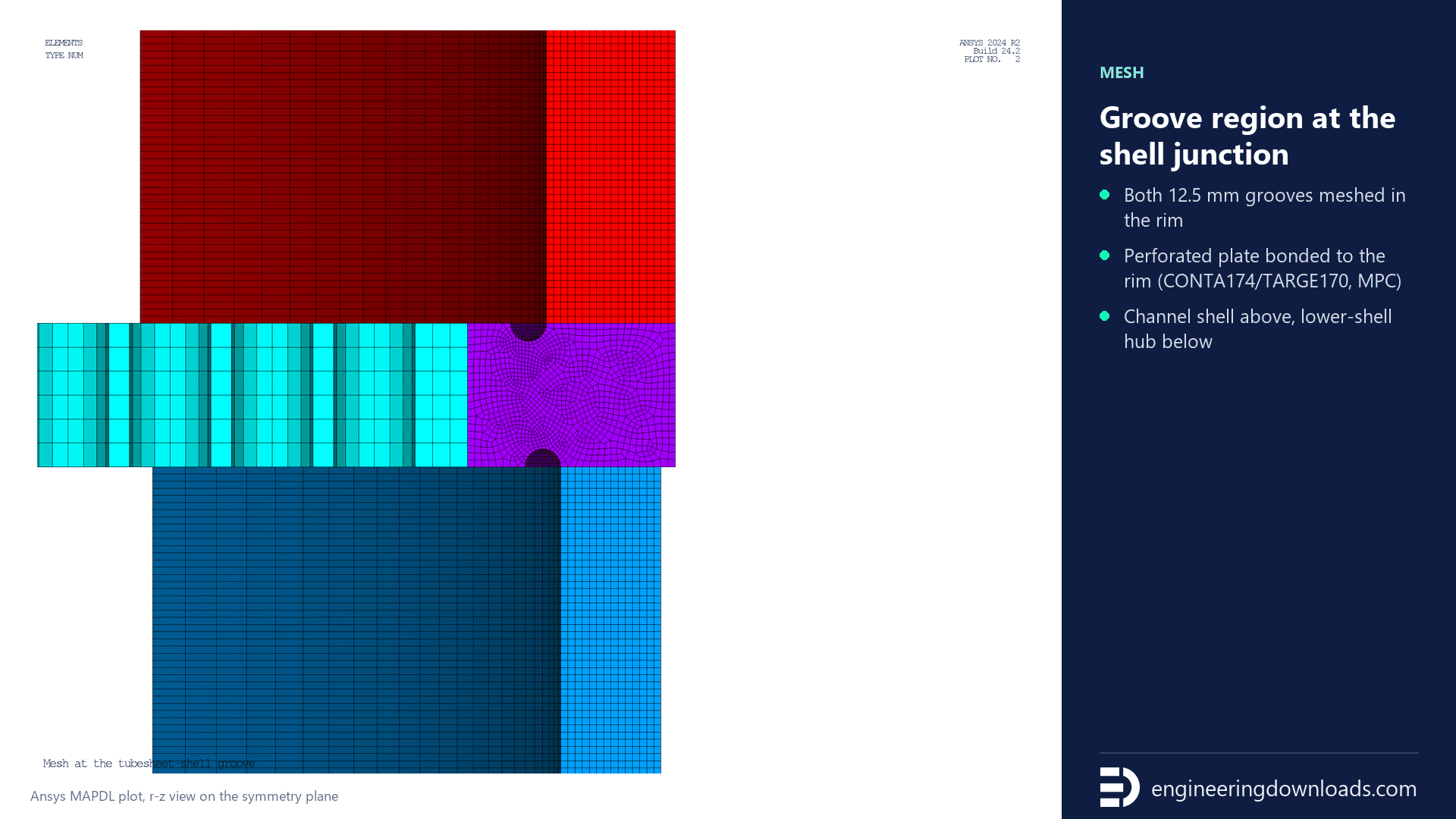
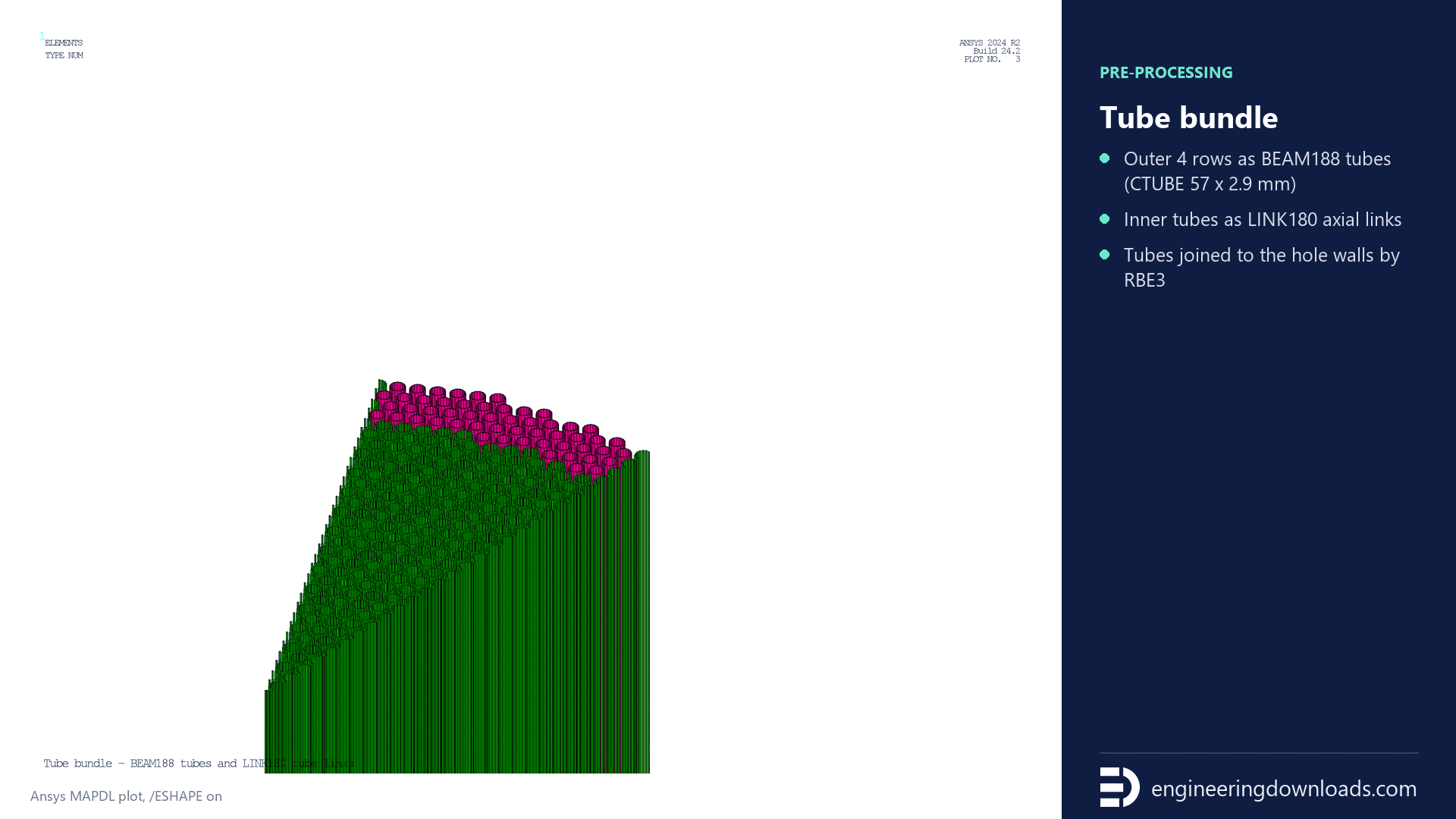
Pressure acts on every wetted face of the tubesheet, the hole walls, the grooves and the channel. The channel head is replaced by its pressure thrust and the tube-end loads by nodal forces. In large deformation the tube tops are held axially, as in the paper.
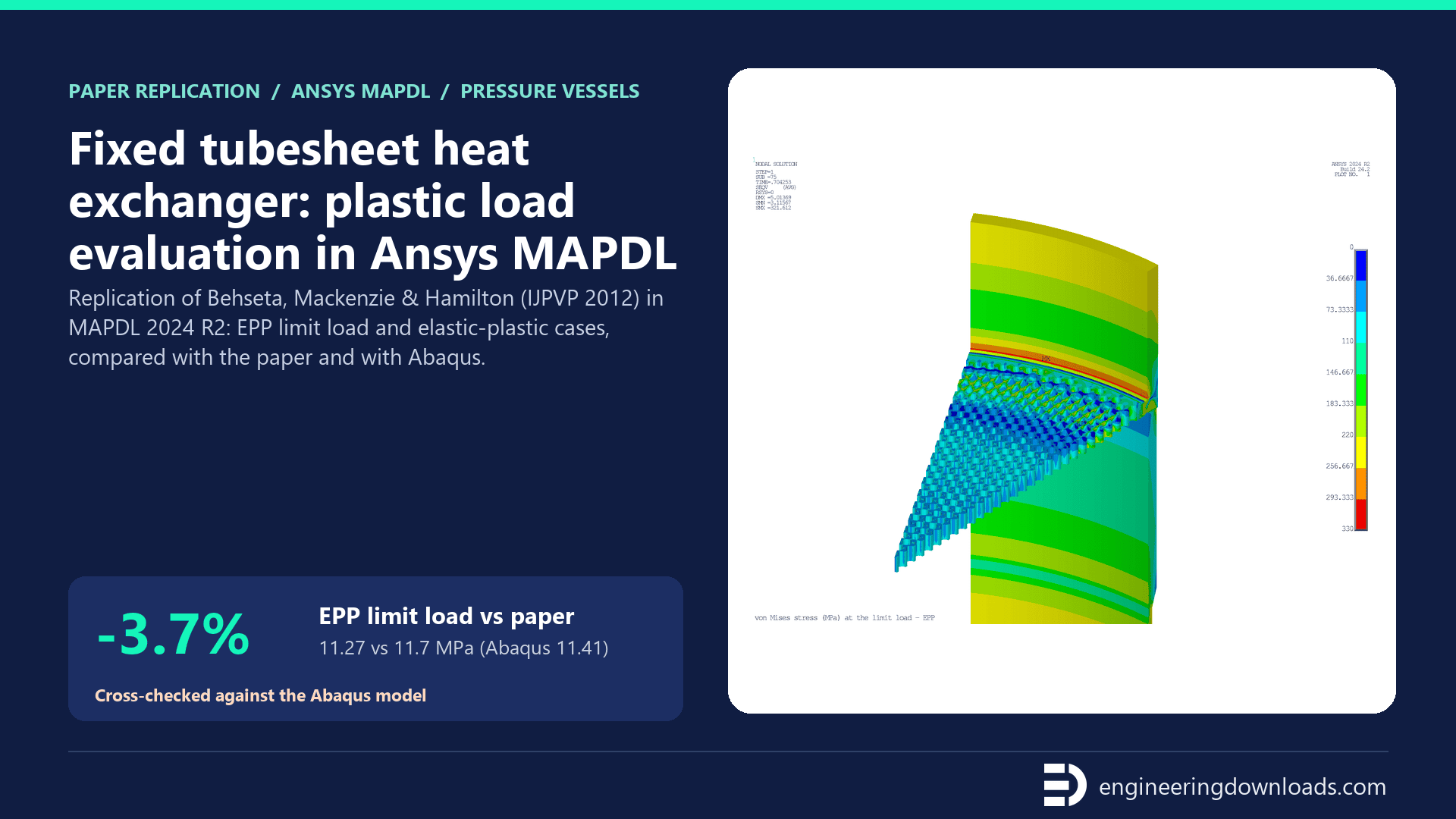
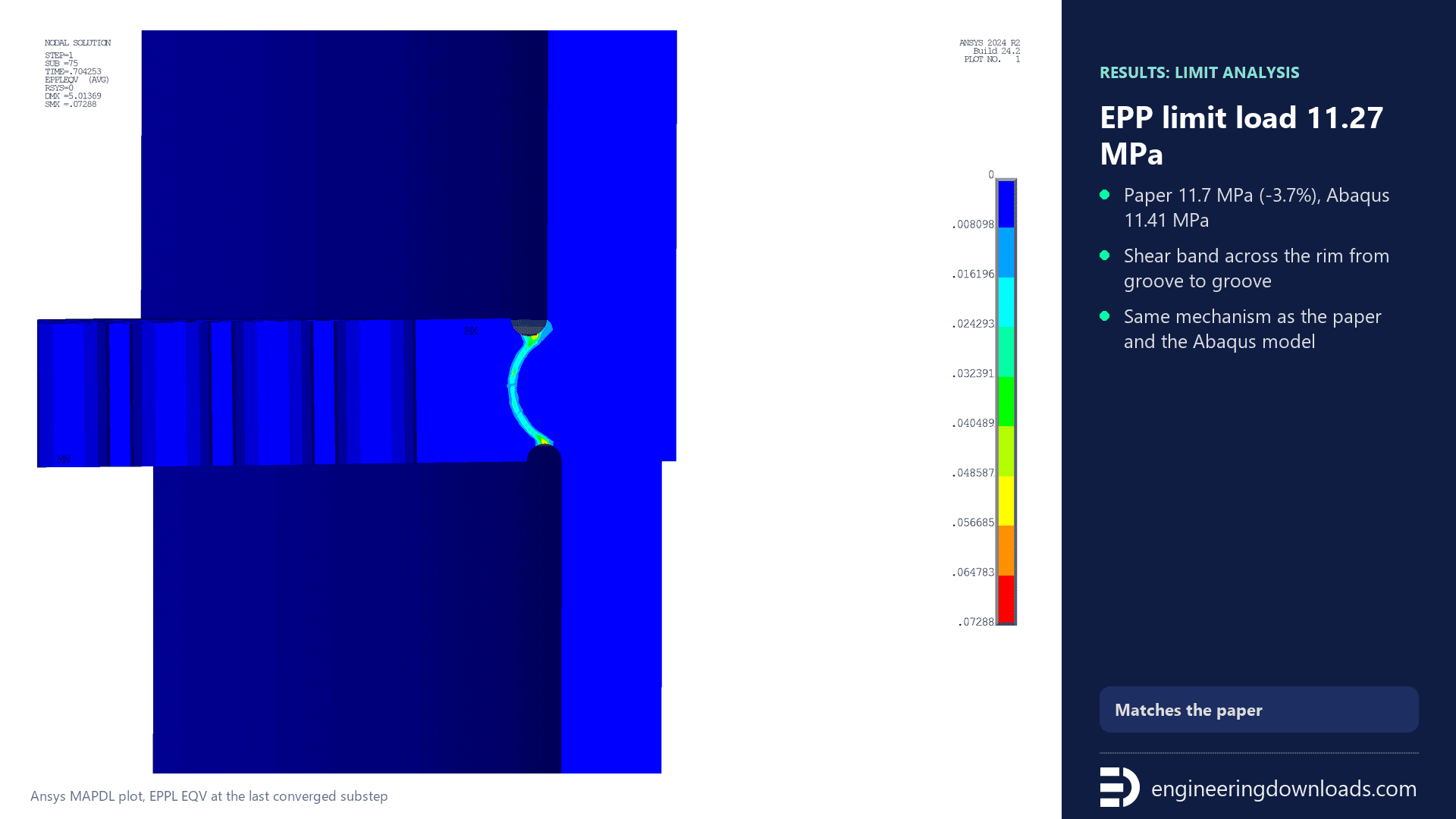
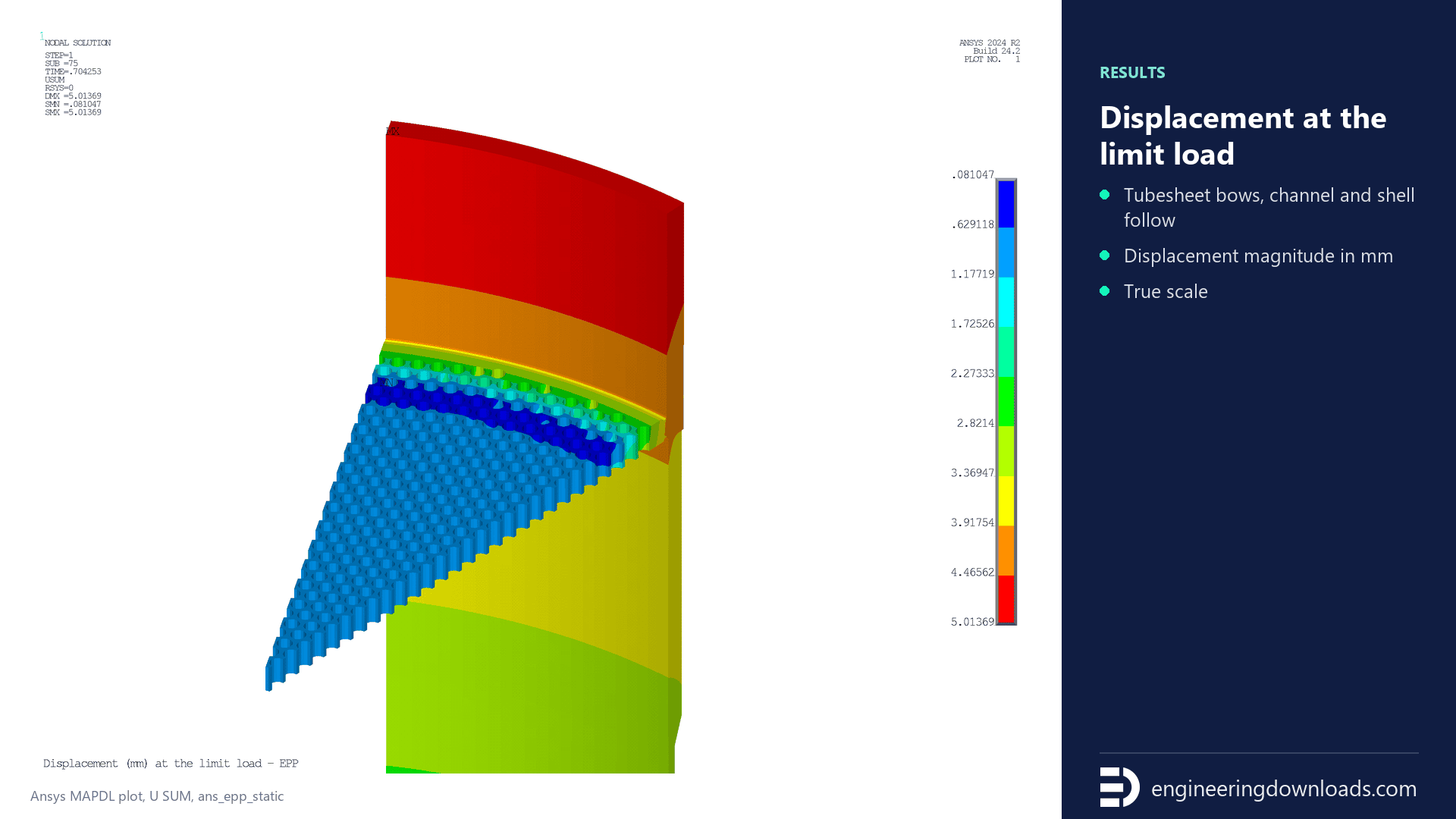
The elastic-perfectly plastic analysis stops converging at 11.27 MPa. Plastic strain concentrates at both grooves and forms a shear band across the rim between them, the mechanism the paper describes and the Abaqus model shows.
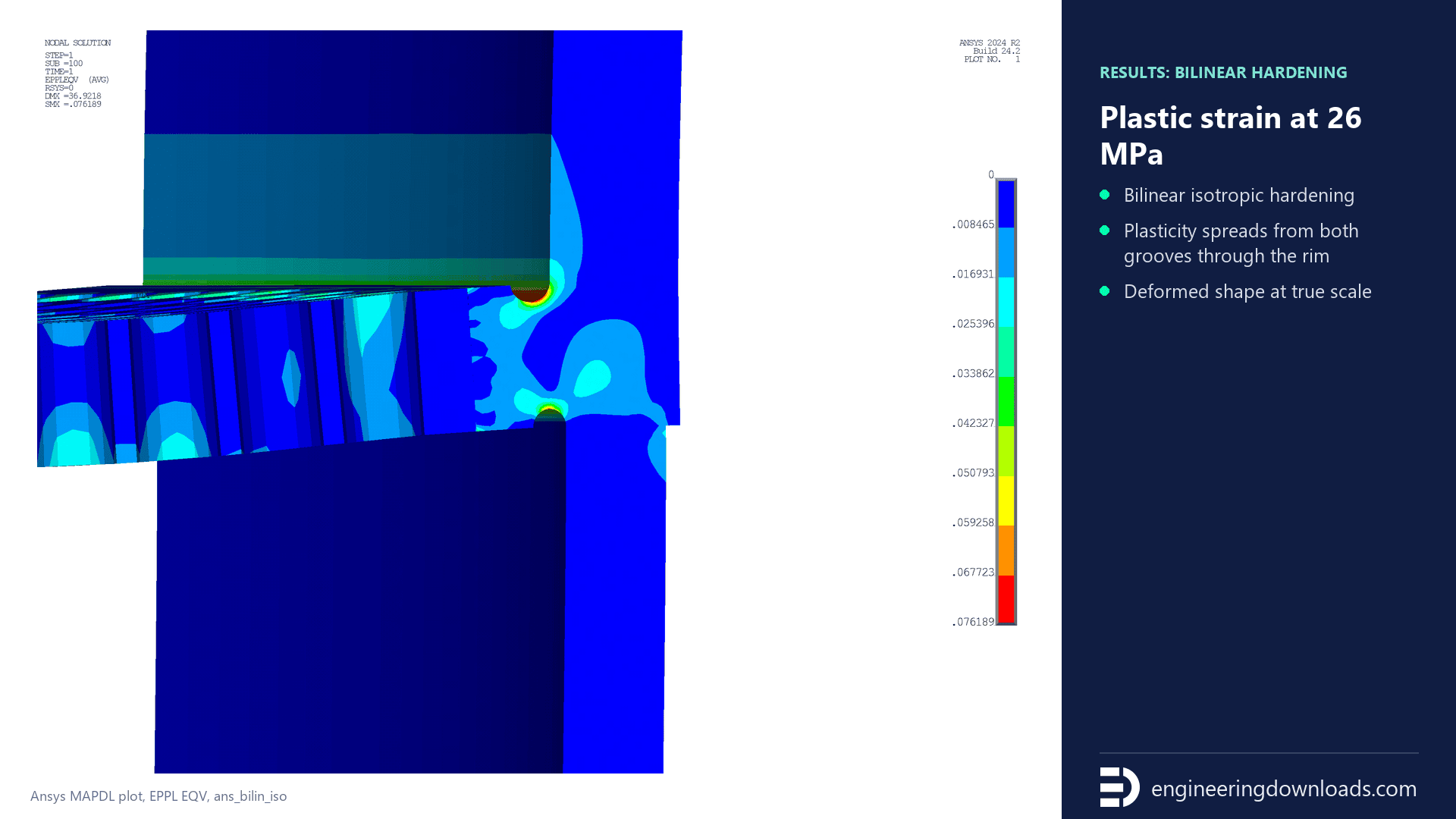
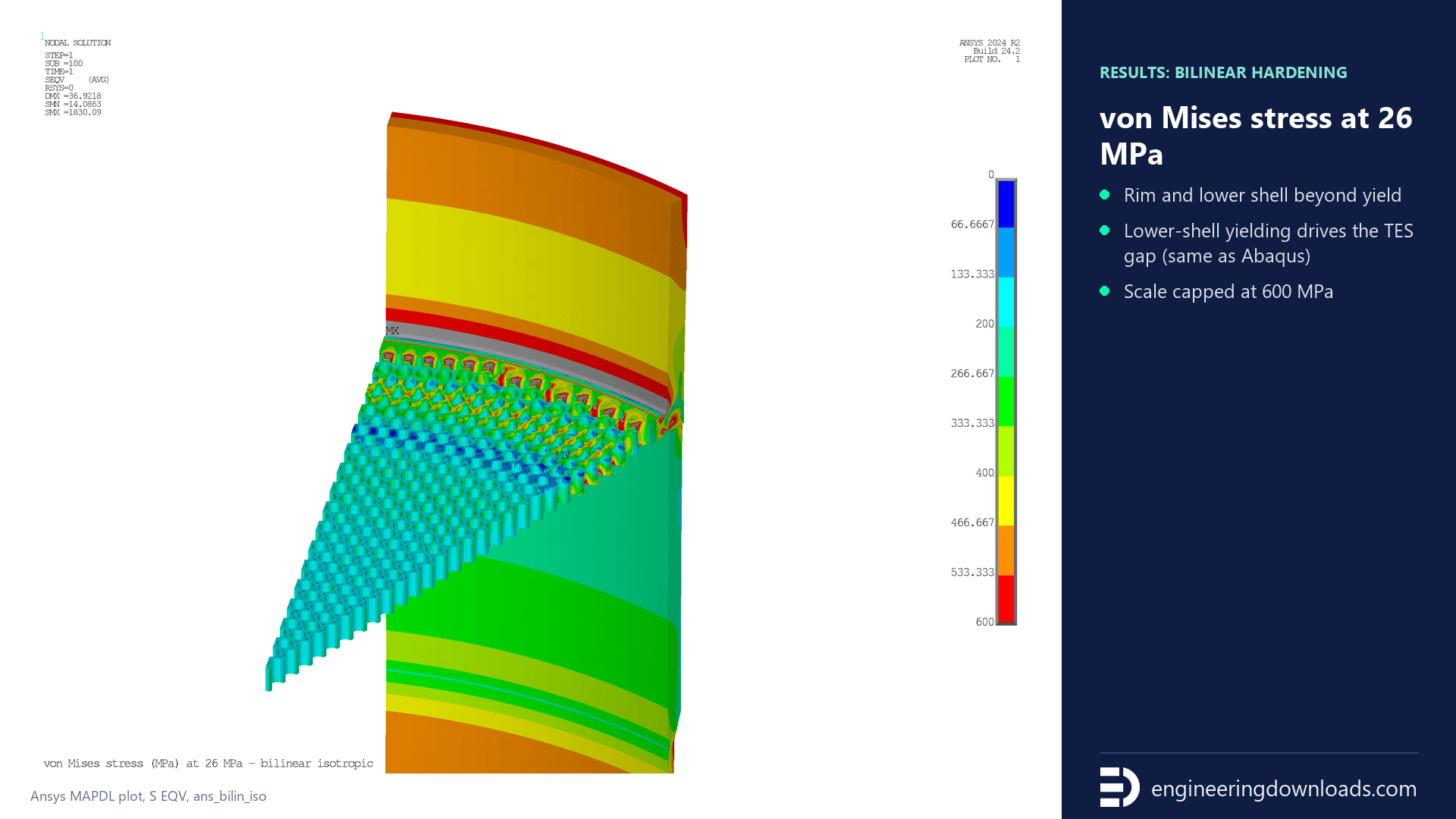
With bilinear hardening the structure keeps carrying load past the limit load. At 26 MPa plasticity has spread through the rim and the 34 mm lower shell yields in membrane tension.
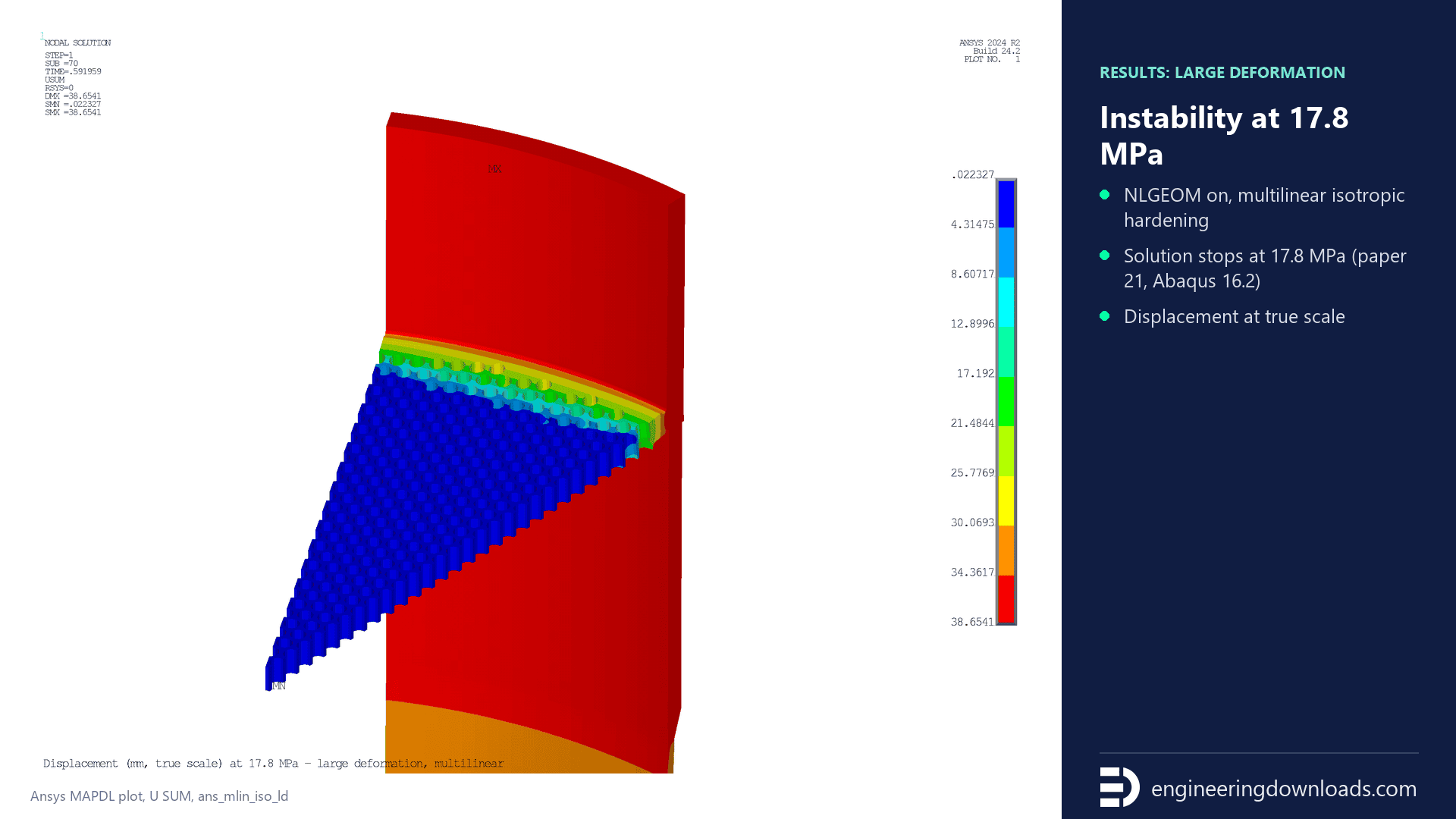
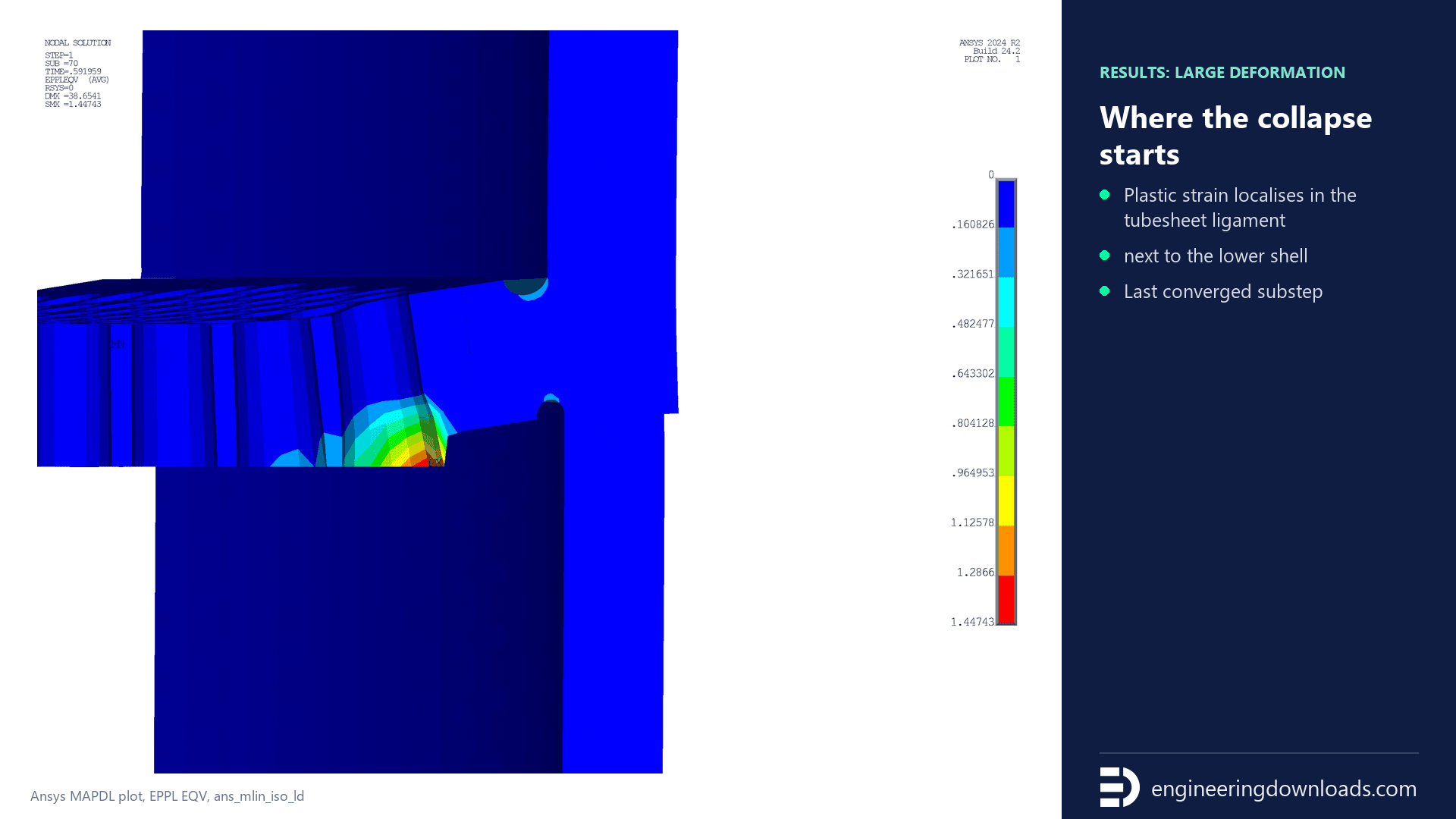
In large deformation with multilinear hardening the solution stops at 17.8 MPa with excessive element distortion in the tubesheet ligament next to the lower shell: that is the instability load (paper 21 MPa, Abaqus 16.2 MPa).
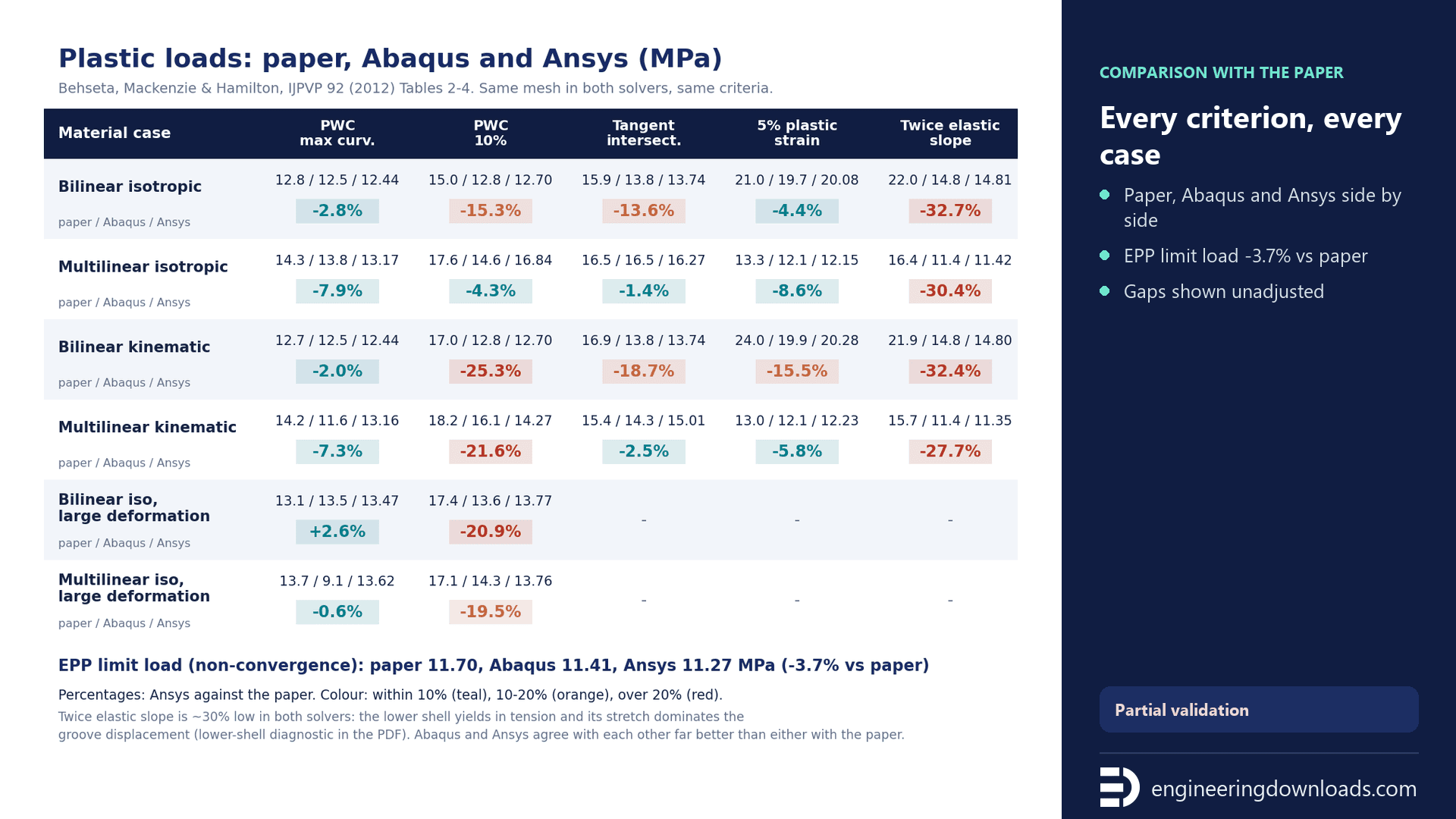
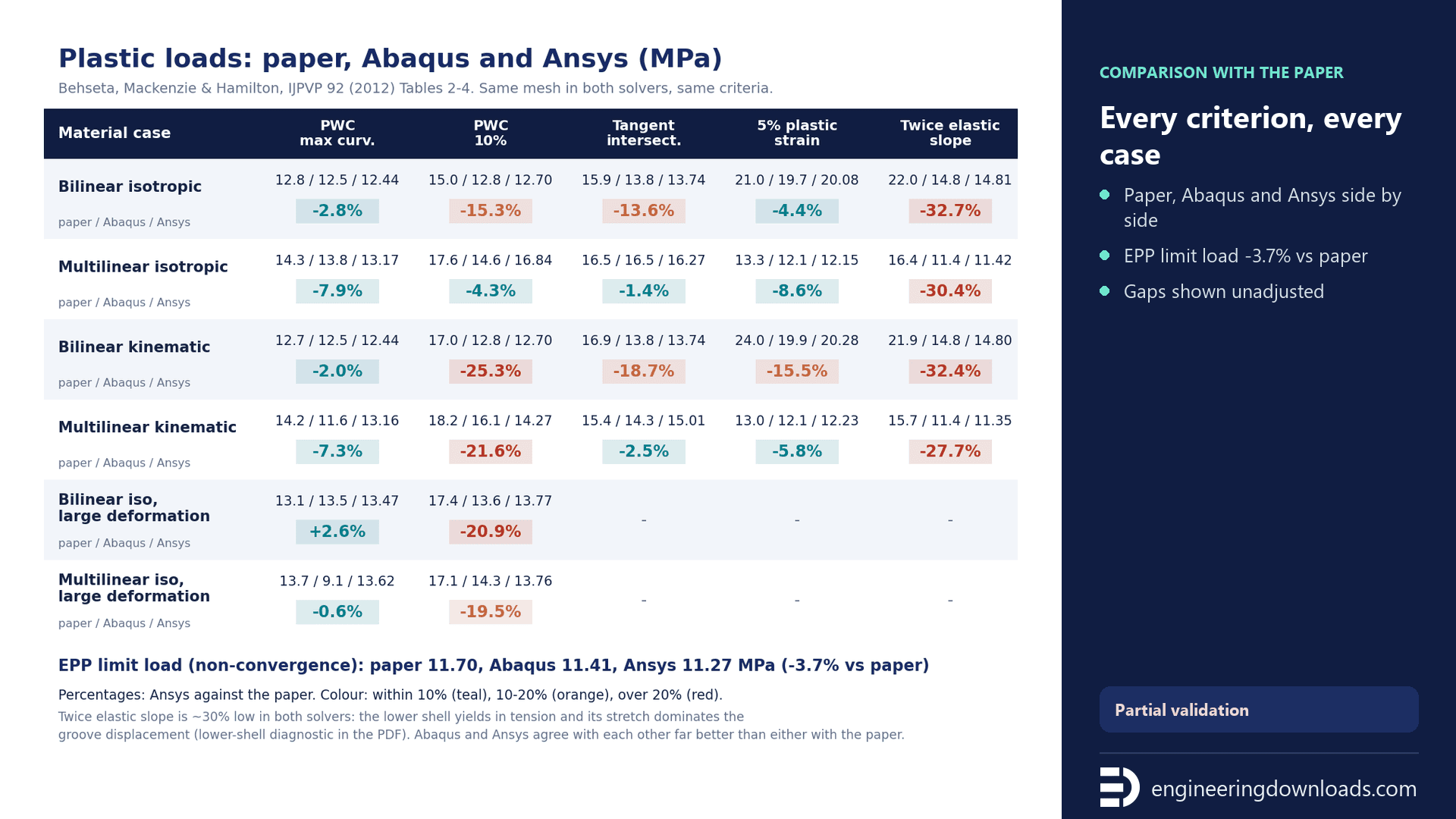
Paper / Abaqus / Ansys in MPa, with the Ansys difference from the paper. Small deformation, Tables 2 and 3 of the paper.
| Case | PWC max curvature | PWC 10% | Tangent intersection | 5% plastic strain | Twice elastic slope |
|---|---|---|---|---|---|
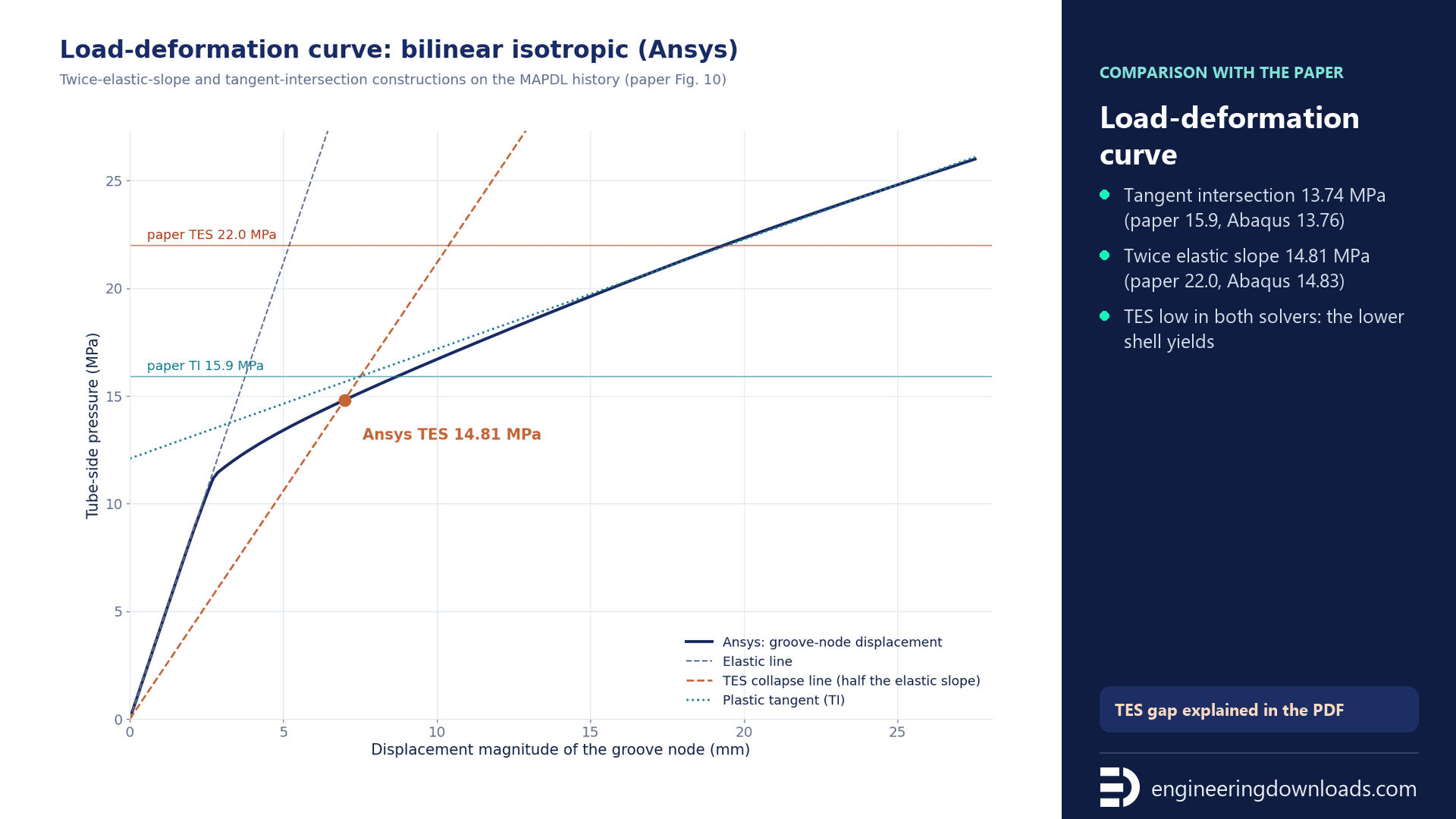
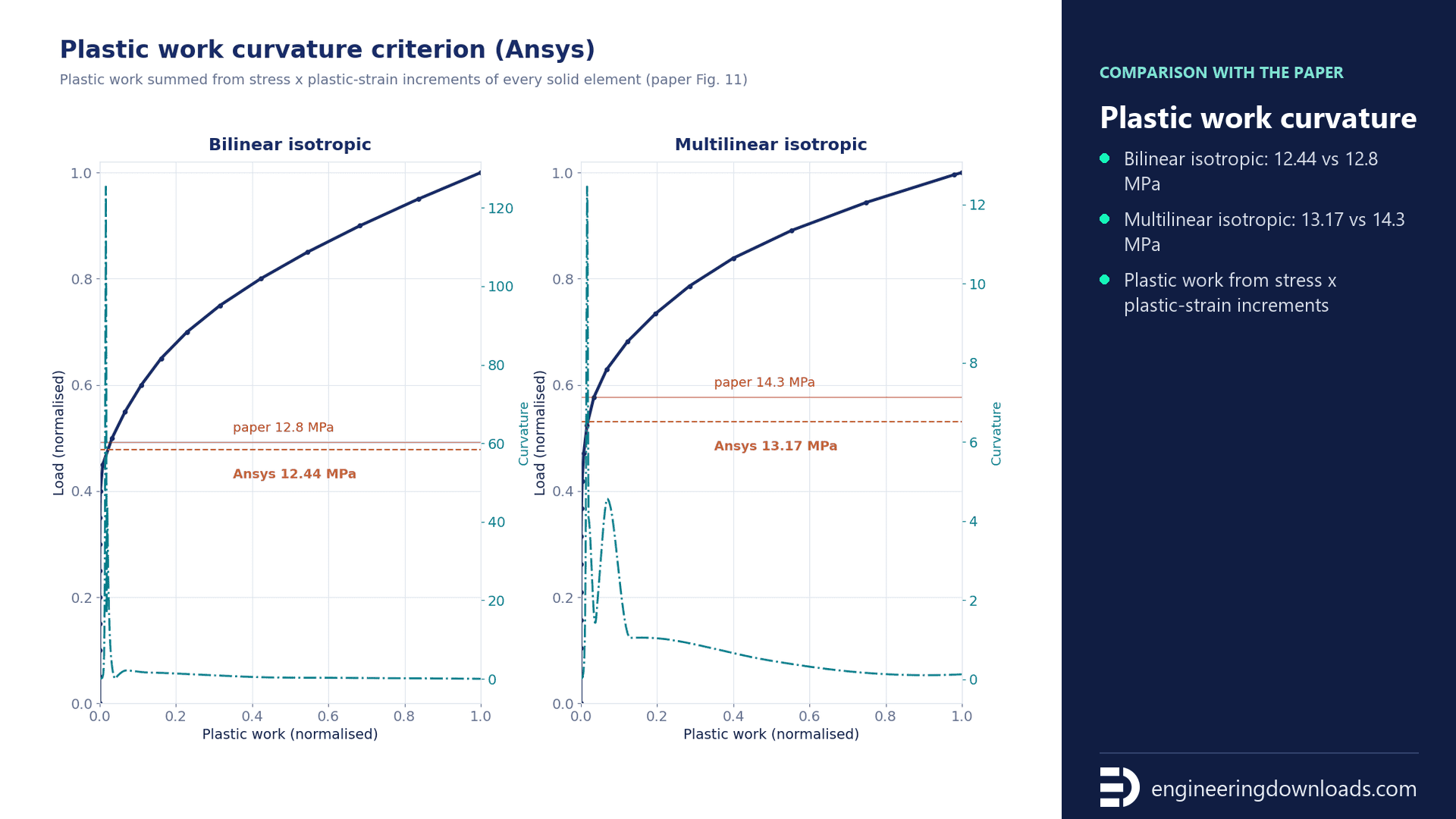
| Bilinear isotropic | 12.80 / 12.54 / 12.44 (-2.8%) | 15.00 / 12.84 / 12.70 (-15.3%) | 15.90 / 13.76 / 13.74 (-13.6%) | 21.00 / 19.75 / 20.08 (-4.4%) | 22.00 / 14.83 / 14.81 (-32.7%) |
| Multilinear isotropic | 14.30 / 13.78 / 13.17 (-7.9%) | 17.60 / 14.59 / 16.84 (-4.3%) | 16.50 / 16.49 / 16.27 (-1.4%) | 13.30 / 12.14 / 12.15 (-8.6%) | 16.40 / 11.43 / 11.42 (-30.4%) |
| Bilinear kinematic | 12.70 / 12.54 / 12.44 (-2.0%) | 17.00 / 12.84 / 12.70 (-25.3%) | 16.90 / 13.76 / 13.74 (-18.7%) | 24.00 / 19.95 / 20.28 (-15.5%) | 21.90 / 14.82 / 14.80 (-32.4%) |
| Multilinear kinematic | 14.20 / 11.61 / 13.16 (-7.3%) | 18.20 / 16.06 / 14.27 (-21.6%) | 15.40 / 14.29 / 15.01 (-2.5%) | 12.99 / 12.14 / 12.23 (-5.8%) | 15.70 / 11.36 / 11.35 (-27.7%) |
| Other checks | Paper | Abaqus | Ansys | Ansys vs paper |
|---|---|---|---|---|
| EPP limit load | 11.70 | 11.41 | 11.27 | -3.7% |
| Bilinear, large deformation: PWC max curvature | 13.12 | 13.50 | 13.47 | +2.6% |
| Bilinear, large deformation: numerical instability | 24 | completes to 30 | completes to 30 | – |
| Multilinear, large deformation: PWC max curvature | 13.70 | 9.14 | 13.62 | -0.6% |
| Multilinear, large deformation: numerical instability | 21.0 | 16.18 | 17.76 | -15.4% |
ans_*.dat) for the 7 validation cases, the 1 MPa elastic check and the elastic-lower-shell diagnostic, plus the shared mesh.mac.<job>_hist.csv with pressure, groove displacement, peak plastic strain and plastic work, ready for the criteria.No result files are included (2-3 GB each); every result can be regenerated from the decks.
Requirements: Ansys Mechanical APDL 2024 R2 or newer; a 4-core licence is enough.
Need more than the files?
There are two ways we can help. Book a one hour online consultation if you want to talk a problem through with a CAE engineer, using the checkbox in the order box. Order a project if you need a full simulation built for you, delivered to an agreed scope, price and deadline under a written contract.
We work on FEA and CFD for engineers, researchers and companies. Order your project, or message us on WhatsApp for a quick reply.
Other packages engineers working on this topic also download.
 Fixed Tubesheet Heat Exchanger in Abaqus: Plastic Load and Limit Load Replication of a Journal Paper€99,00
 Plastic limit pressure of a nozzle on a cylindrical pressure vessel, Abaqus Riks models€129,00
 Bolted Header Box Flange: Stress Linearisation in Abaqus€129,00
 Tank Wind Buckling in ANSYS: EN 1993-1-6 MNA-LBA Model of a Cylindrical Oil Tank€129,00
 Wind Turbine Tower Man Door and Ventilation Opening Buckling in Ansys: GMNIA after Gantes et al. (2024)€129,00
 Creep Damage of a Welded Steam Pipe Branch in ANSYS APDL: HAZ Failure, All-Hex Mesh and Paper Comparison€149,00
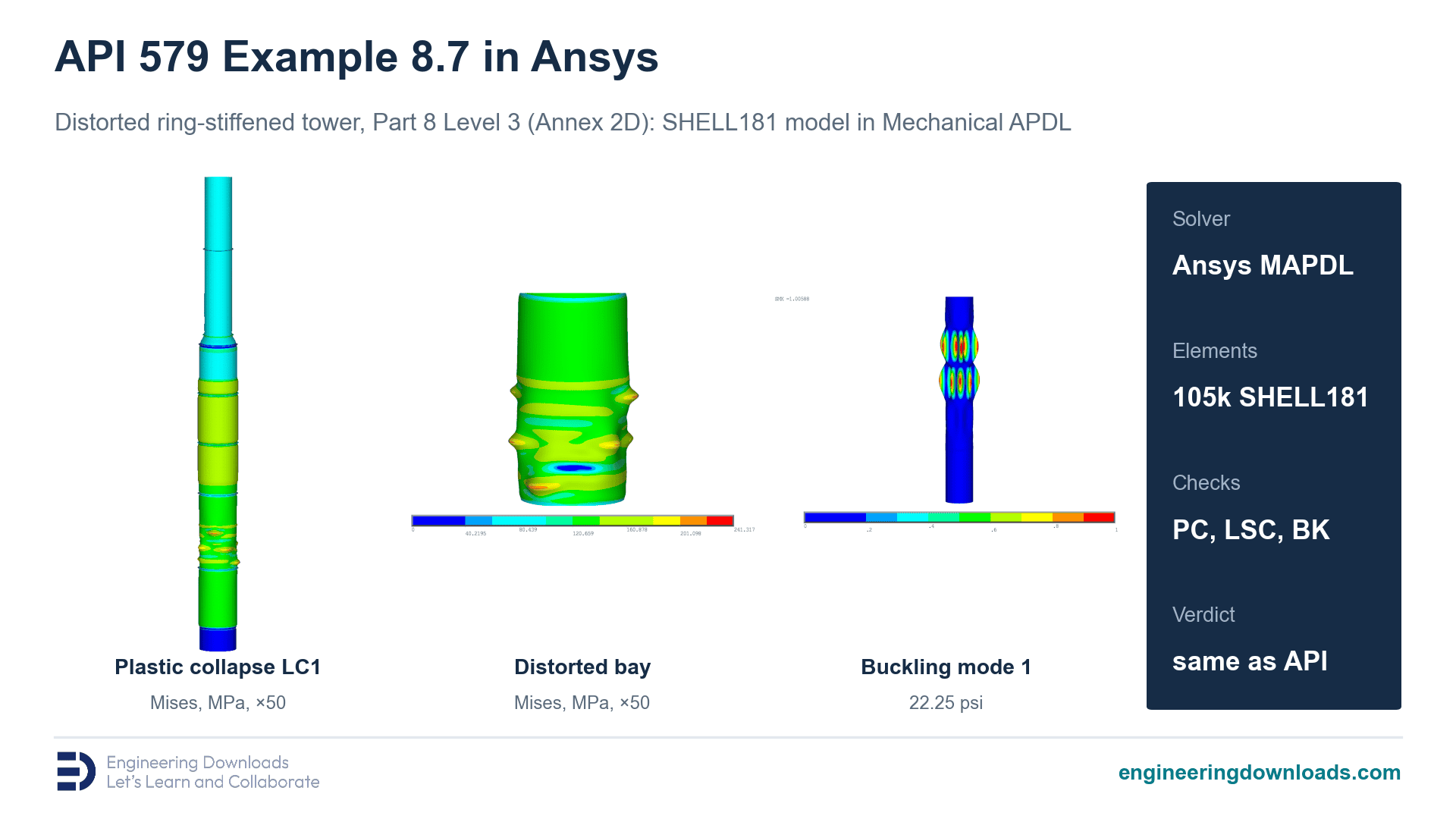 API 579 Example 8.7 in Ansys: Ring-Stiffened Tower with General Shell Distortion, Level 3 FFS€129,00
 API 579 Example 4.7 in Ansys: Corroded Conical Transition, Level 3 FFS

Need a full custom project? See the options below.

€129,00

€179,00

€149,00

€119,00
€129,00
See more
Want to receive push notifications for all major on-site activities?