


Need a full custom project? See the options below.
Need a full custom project? See the options below.
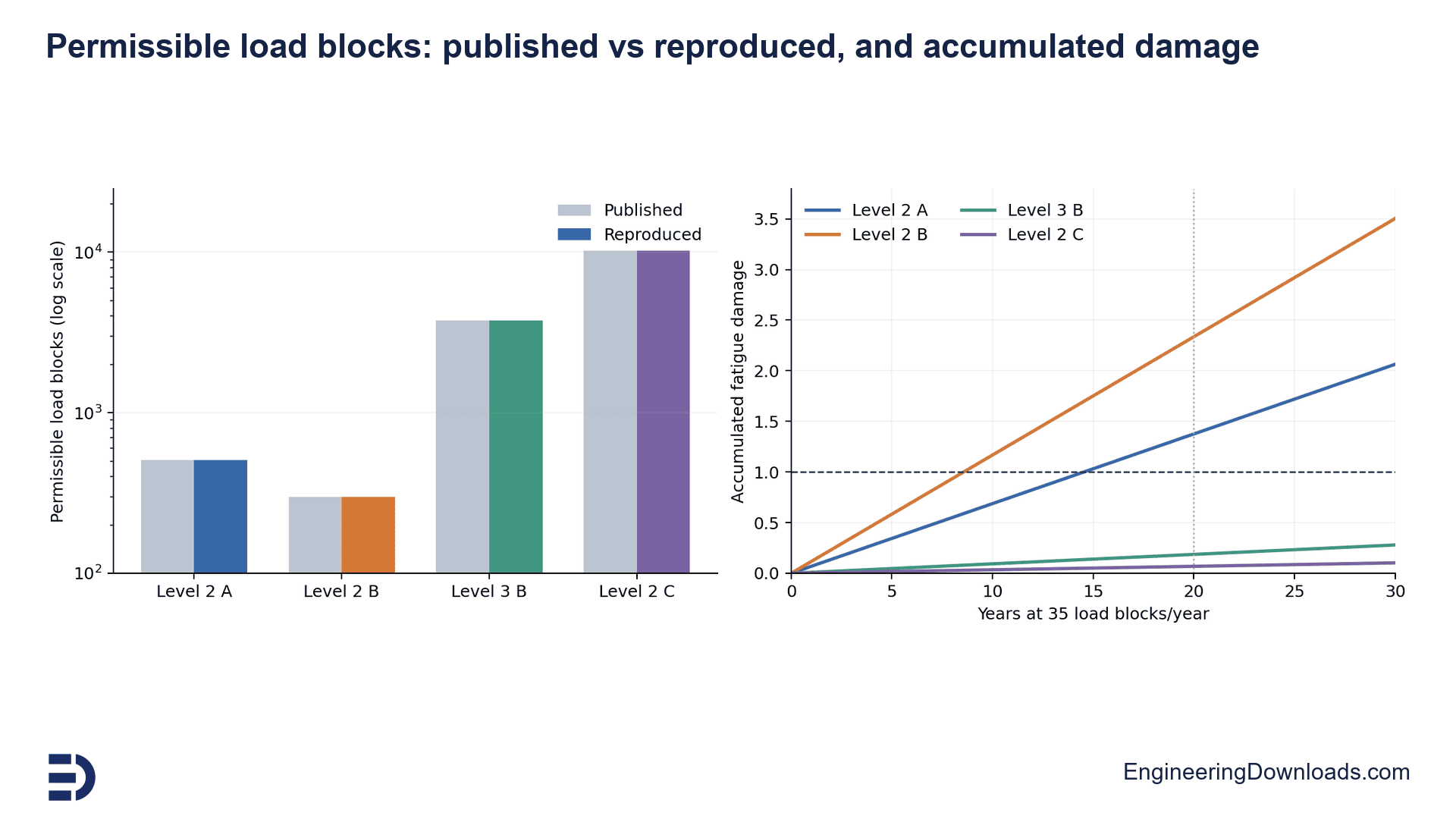
Every pressure and load block uses up part of a nozzle’s fatigue life. API 579-1/ASME FFS-1 Part 14 turns the stress and strain histories into permissible load blocks and accumulated damage. This package rebuilds the published API 579-2 Example 14.5, a petal-forged nozzle in a thick hemispherical head, as an axisymmetric Abaqus model and adds a one-click Python script that runs Level 2 Method A, Level 2 Method B, Level 3 Method B (critical plane search) and the weld Method C and prints the result next to the published value. You get Abaqus INP and CAE files, the script, key images and a 6-page PDF tutorial.
Source: API 579-2/ASME PTB-14 Fitness-For-Service Example Problem Manual, Part 14 Fatigue, Example 14.5. A hemispherical head (inside diameter 96 in, wall 3 in) carries a 24 in petal-forged nozzle with 0.5 in corner fillets. The example gives the stress and strain histories of one load block and works out the permissible number of blocks with each Part 14 method.
| Item | API 579-2 Example 14.5 | This package |
|---|---|---|
| Component | Petal-forged nozzle in a hemispherical head, 96 in ID, 3 in wall | Axisymmetric meridian section from the equator to the nozzle top |
| Loading | Ten-turning-point block: pressure 0 and 1550 psi plus cyclic axial traction | Same block as total-time tabular amplitudes, closed-end thrust included |
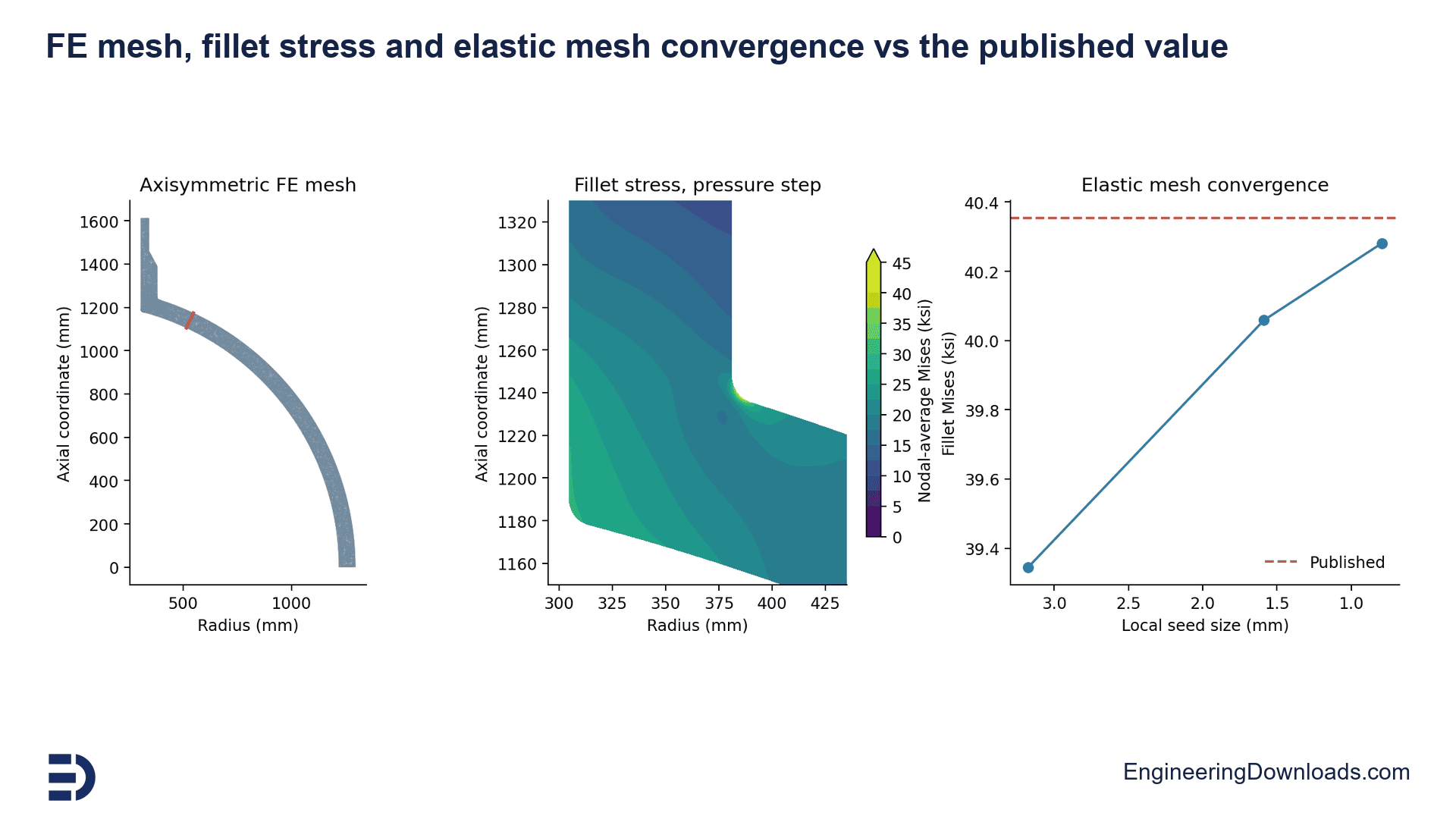
| Elastic models | Level 2 Method A stress histories | Coarse, medium and fine meshes (2,172, 3,875 and 8,982 elements) |
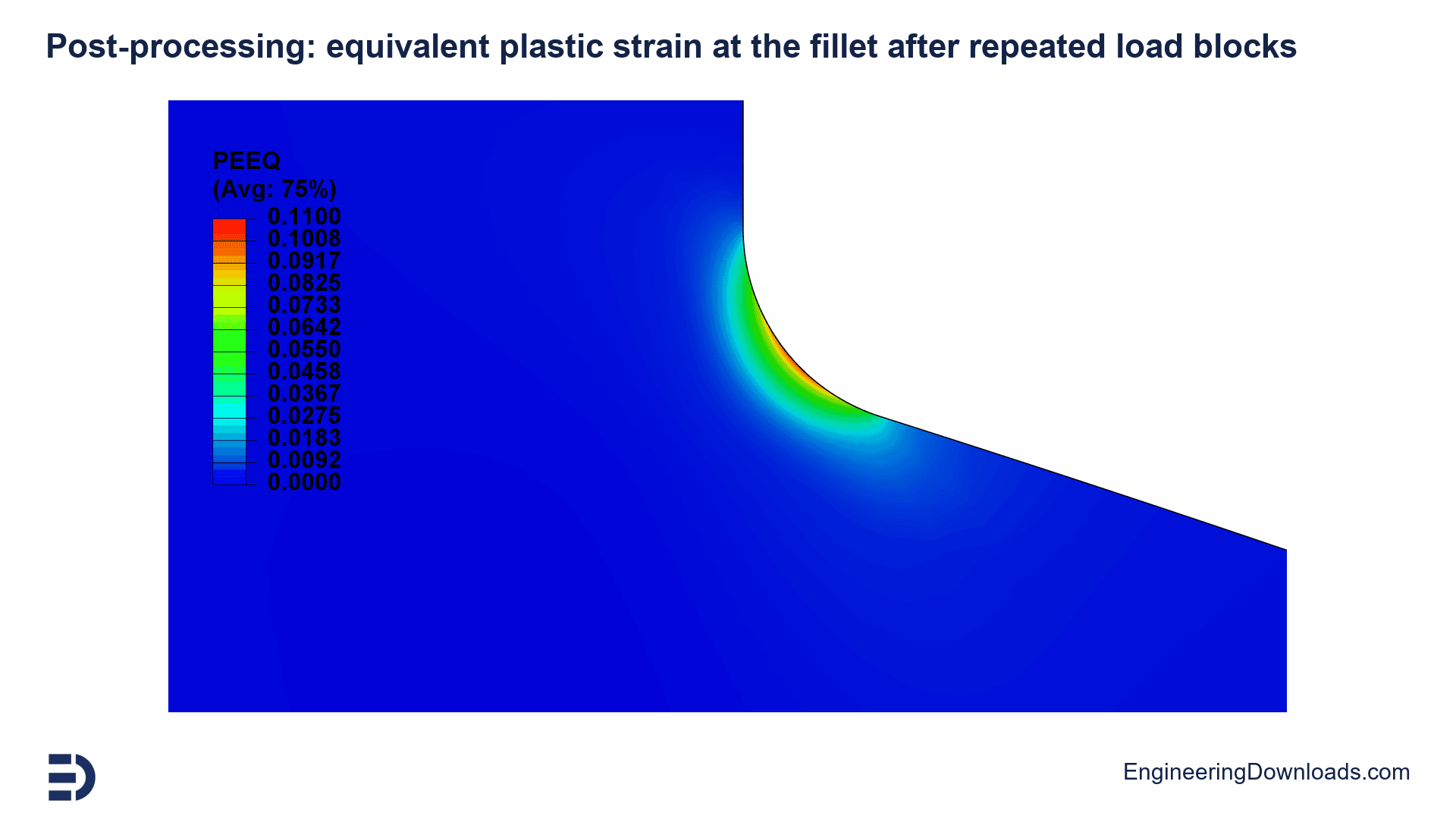
| Elasto-plastic models | Level 2 B and Level 3 B strain histories | Medium mesh with 5 repeated blocks and fine mesh with 16 repeated blocks, isotropic hardening from Annex 2E |
| Fatigue evaluation | Methods A, B, Level 3 B, C | run_fatigue_assessment.py: all four methods in one click |
| Software | – | Abaqus and Python 3 (numpy, scipy) |
| Quantity | Example 14.5 | This package | Difference |
|---|---|---|---|
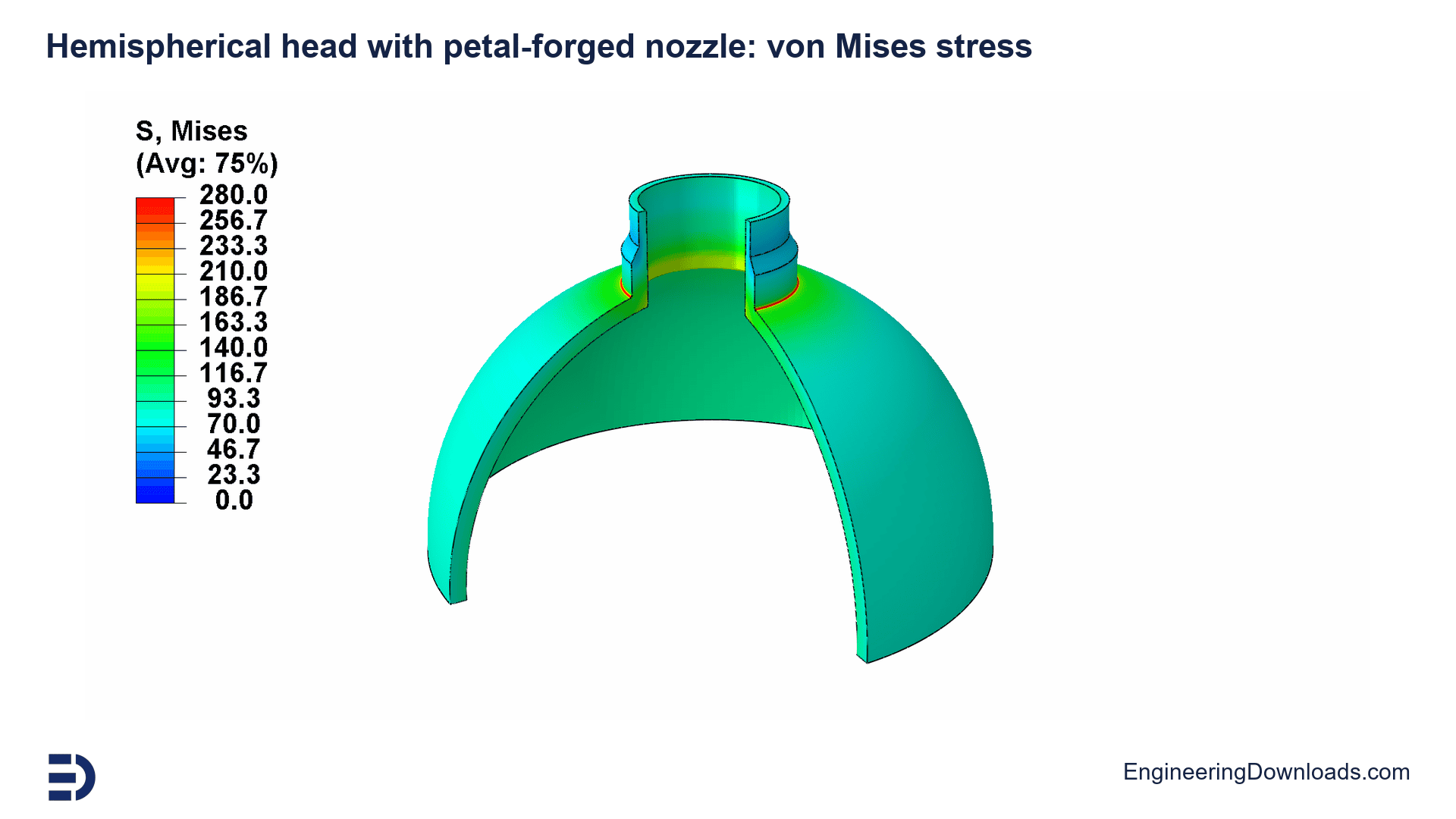
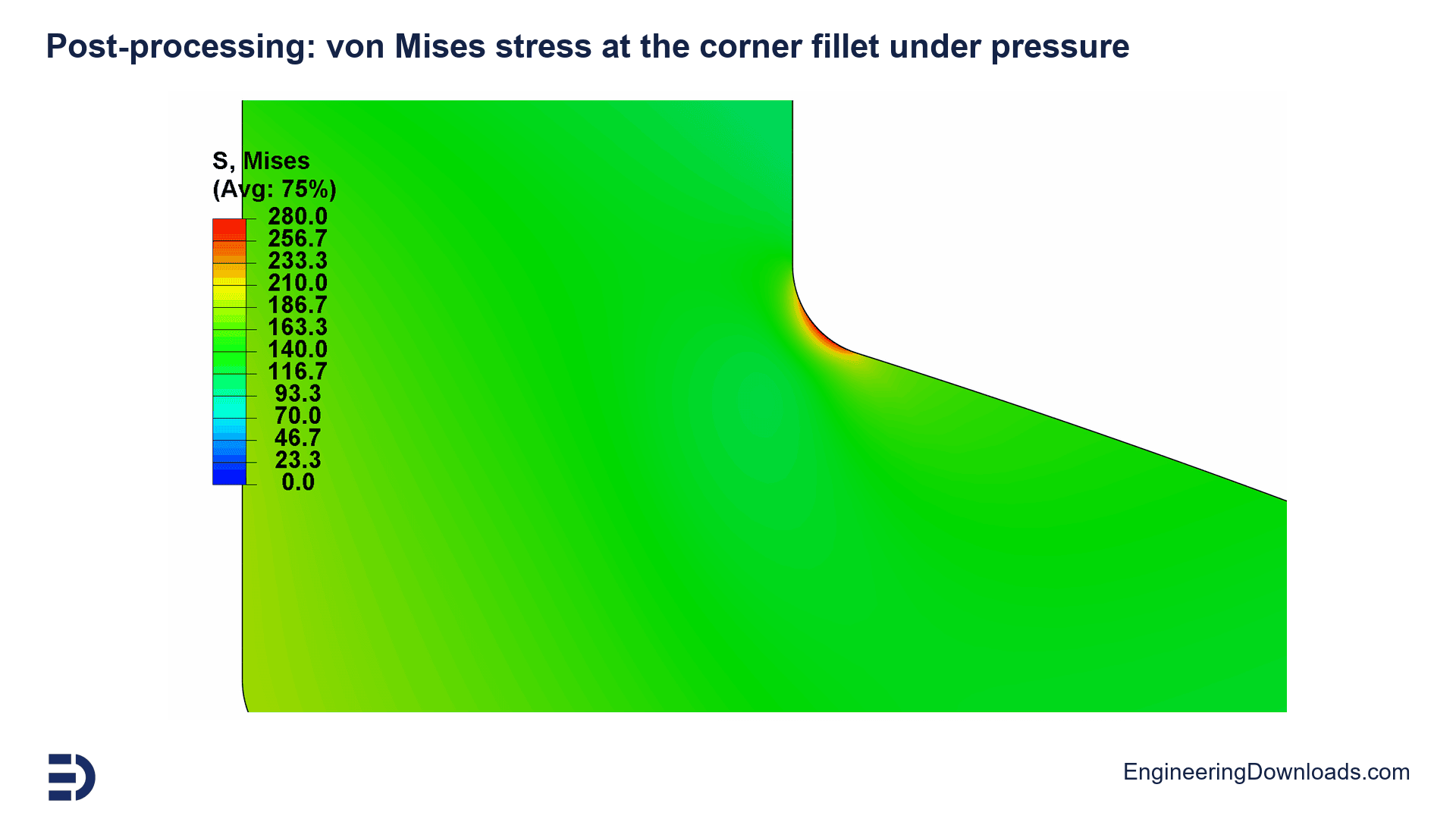
| Fillet von Mises stress, pressure step | 40.354 ksi | 40.282 ksi (fine mesh) | −0.18% |
| Level 2 A permissible blocks, elastic model | 508 | 510.72 | +0.54% |
| Level 2 A permissible blocks, script | 508 | 508.90 | +0.17% |
| Level 2 B permissible blocks, script | 299 | 299.78 | +0.26% |
| Level 3 B permissible blocks, script | 3,756 | 3,758.65 | +0.07% |
| Level 2 C weld permissible blocks, script | 10,225 | 10,225.05 | +0.0004% |
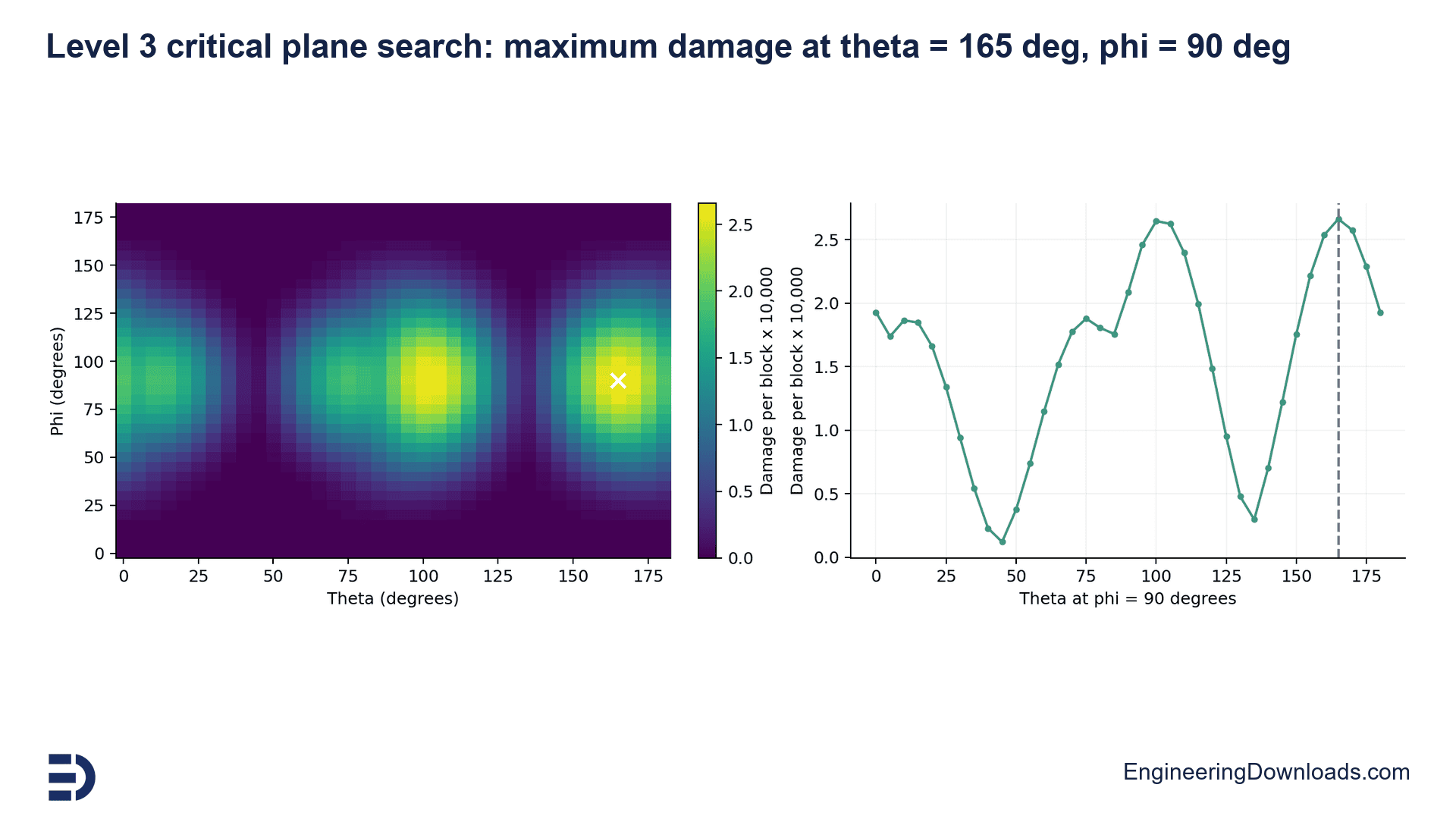
| Level 3 B critical plane | θ 165°, φ 90° | θ 165°, φ 90° | same plane |
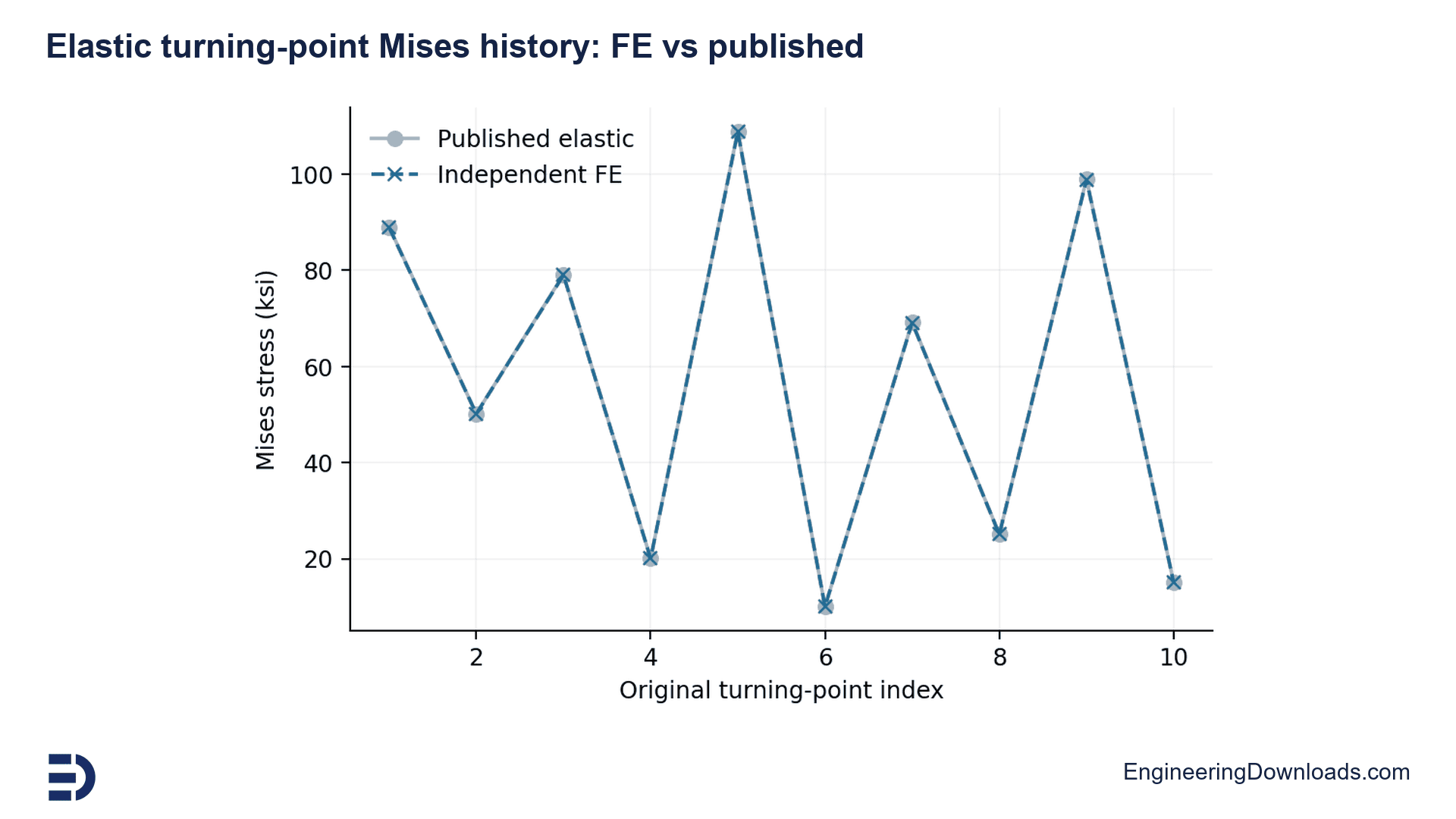
The fine-mesh fillet stress changes by only +0.56% from the medium mesh, and the elastic Mises history at the ten turning points follows the published values within 0.16%. The script reproduces all four published damage totals within 0.13%. All 31 numerical checks of the model set and all 15 checks of the script pass.
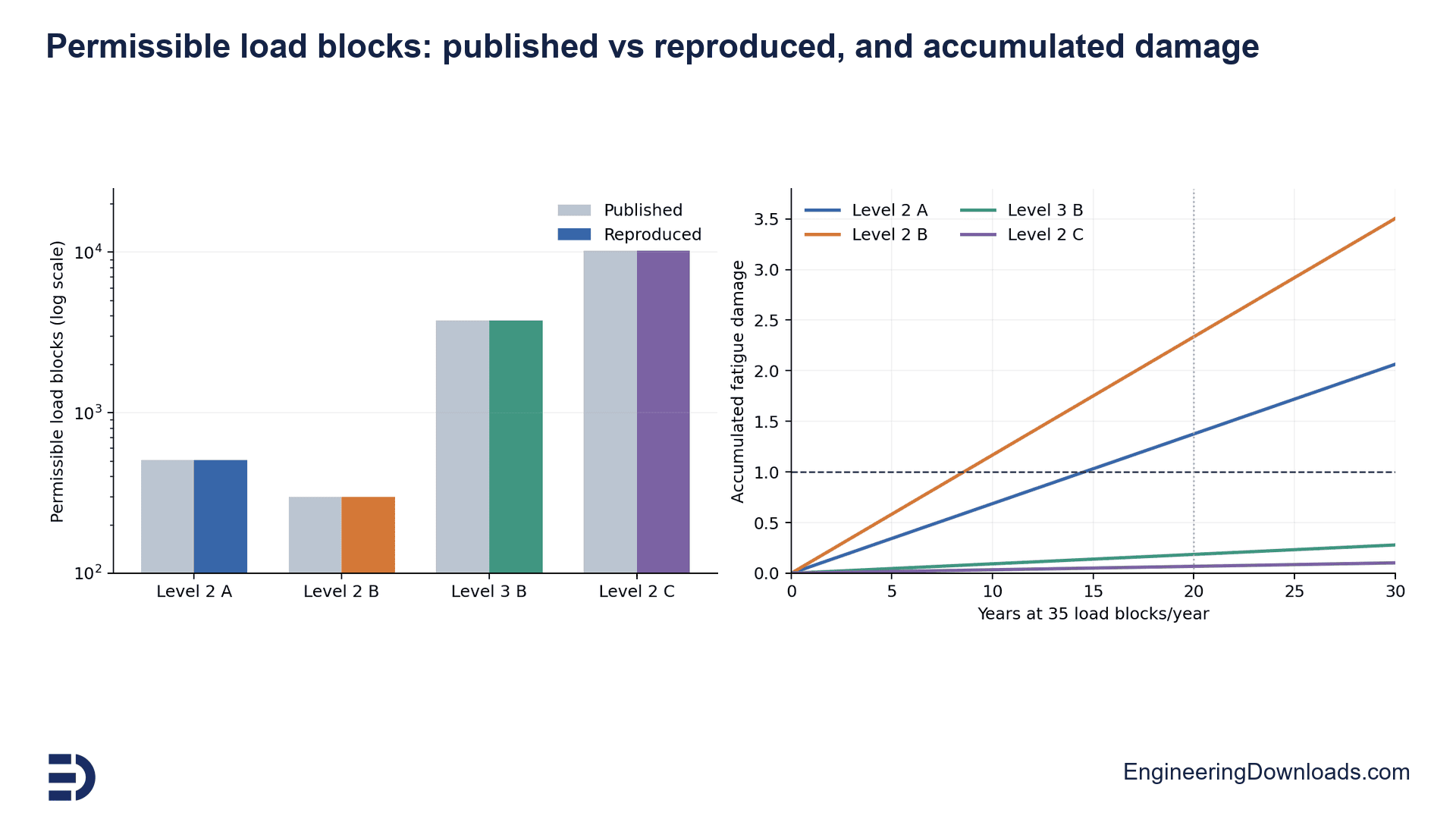
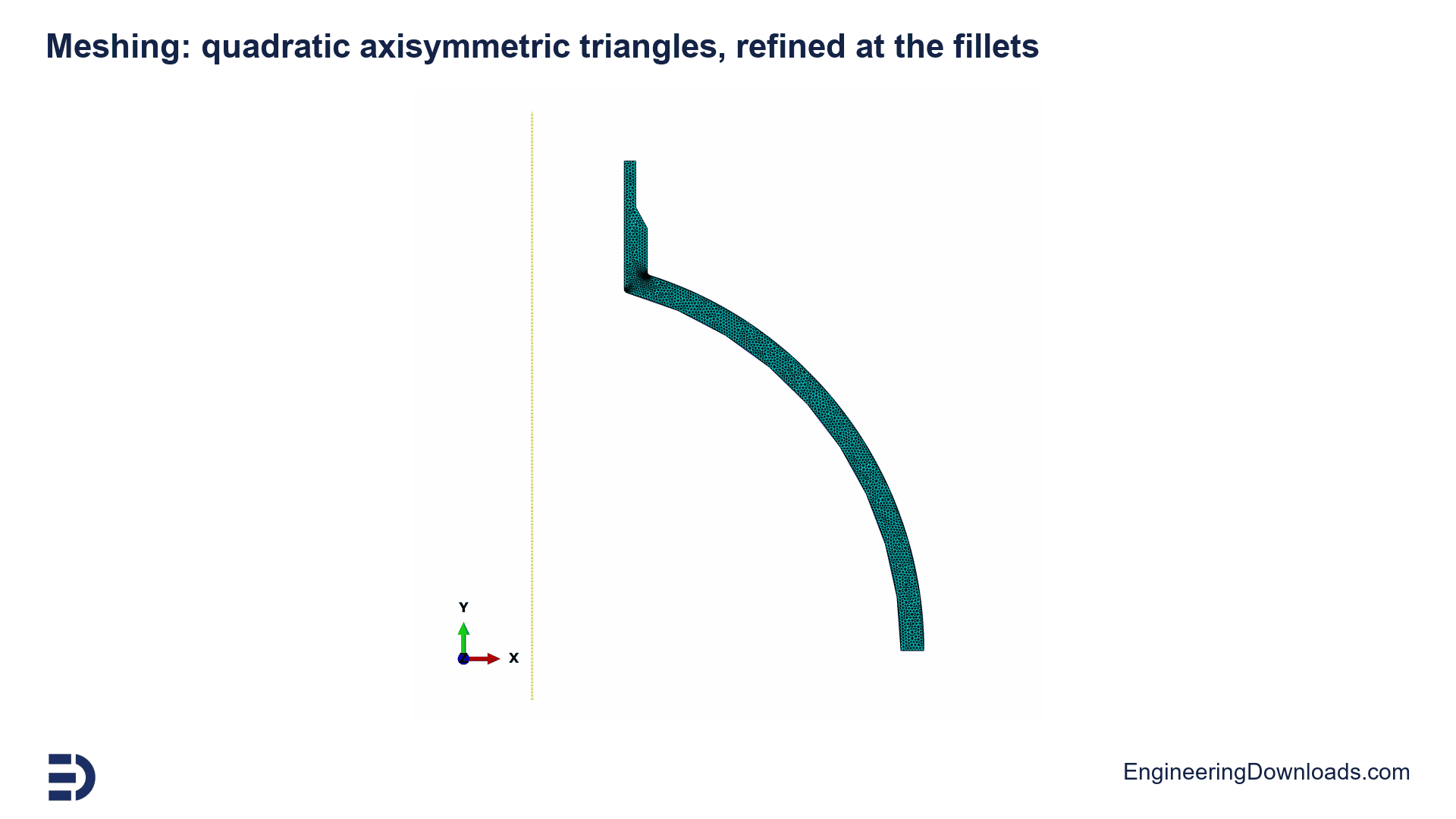
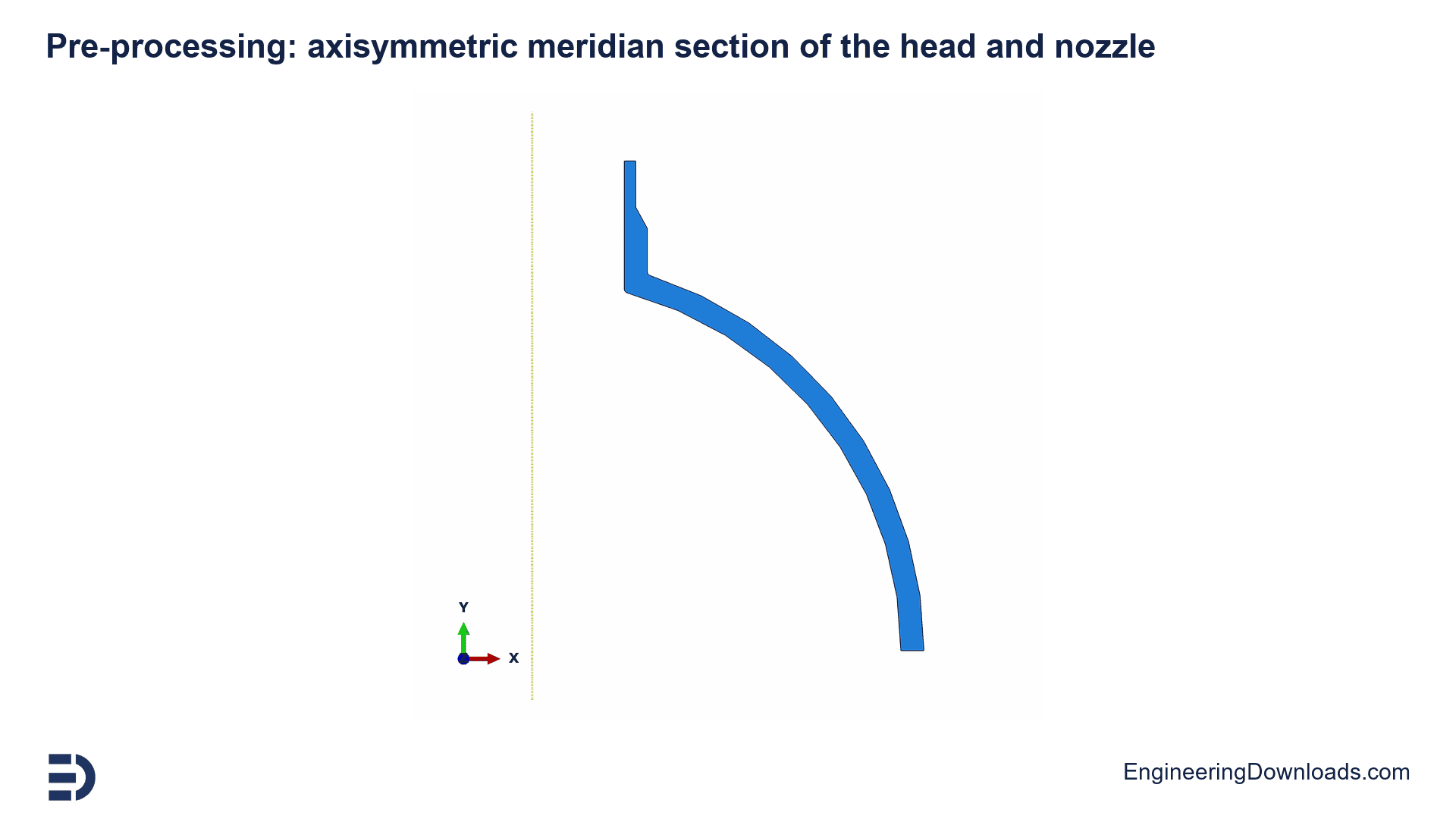
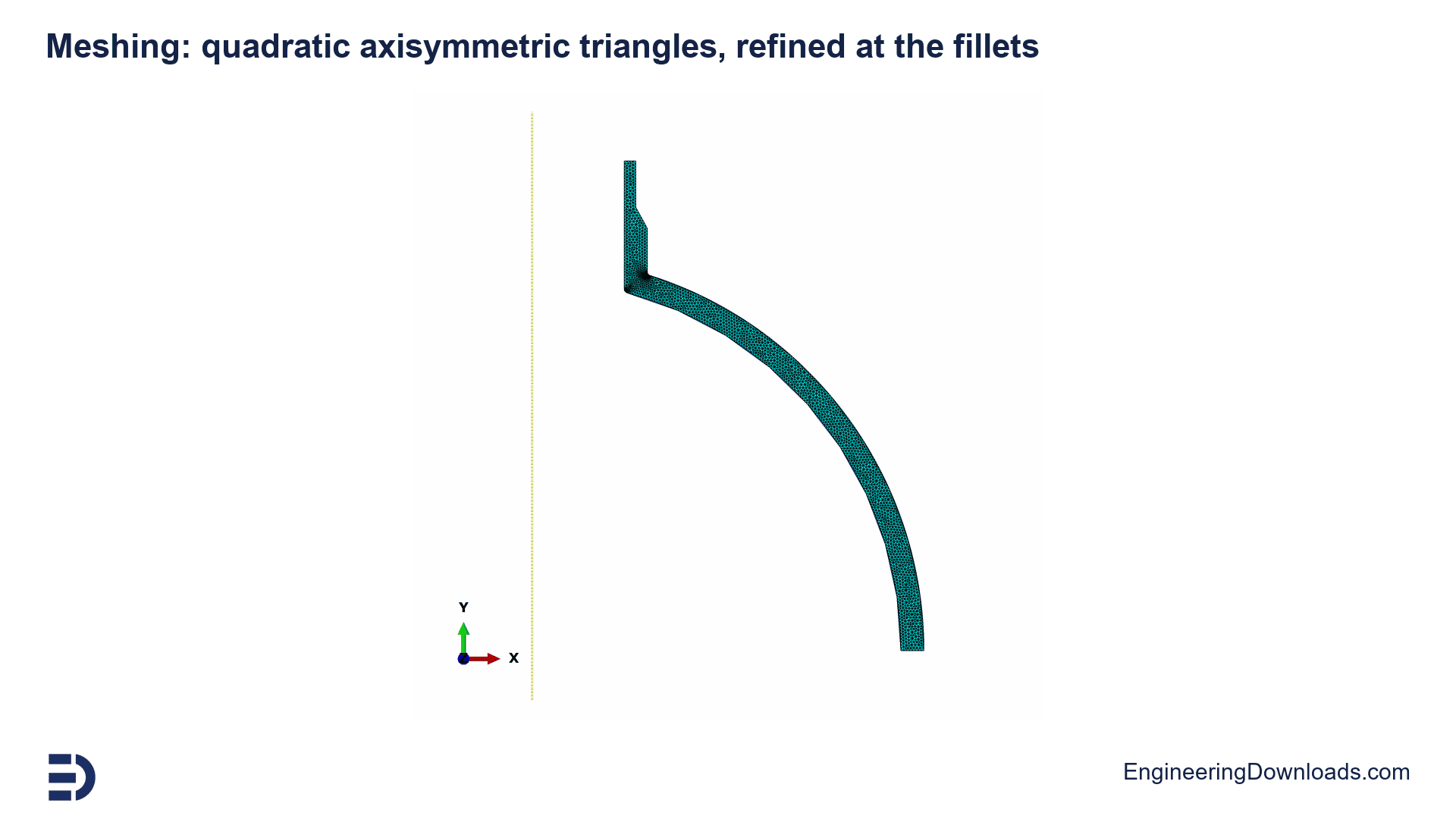
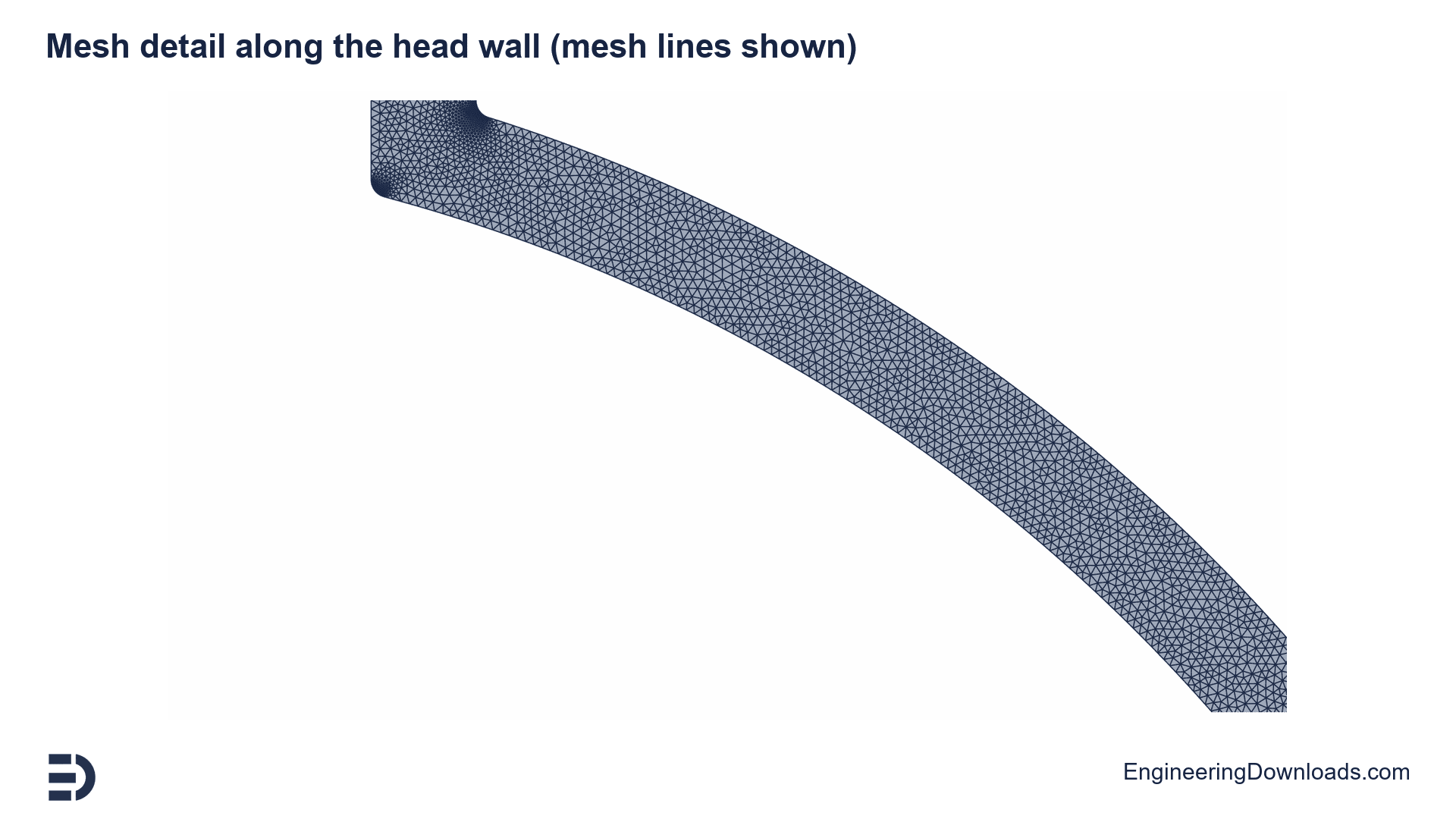
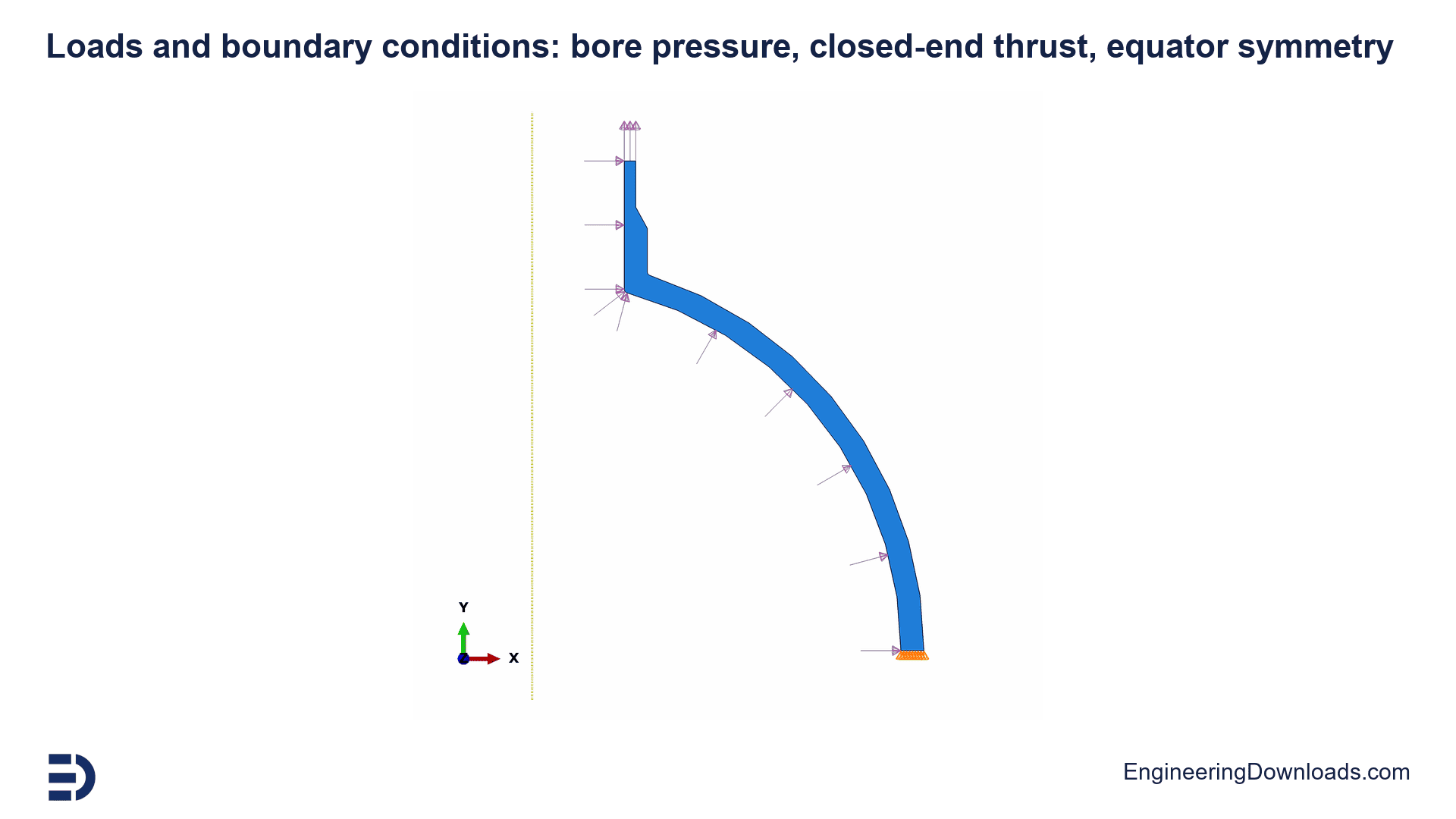
The meridian section carries the 0.5 in true circular fillets at the inside and outside corners. Quadratic axisymmetric triangles are refined at the fillets. Pressure acts on the bore, the closed-end thrust and the cyclic axial traction act on the nozzle top, and the equator is held by U2 = 0 with the radial expansion free.
The models and the script run in your own Abaqus and Python installation. The files are for educational and benchmarking use.
What does this package assess? Fatigue of a thick hemispherical head with a petal-forged nozzle under repeated load blocks. It gives the permissible number of load blocks and the accumulated damage with API 579-1/ASME FFS-1 Part 14: Level 2 Method A, Level 2 Method B, Level 3 Method B with a critical plane search, and the weld Method C.
What is the one-click script? run_fatigue_assessment.py contains the stress and strain histories of Example 14.5. Run it with Python 3 (numpy and scipy) and in a few seconds it prints the permissible blocks of all four methods beside the published values and writes a CSV file. No edits are needed.
How close is the result to the example? The fine-mesh elastic model gives 40.282 ksi at the fillet against 40.354 ksi (-0.18%) and 510.72 permissible Method A blocks against 508. The script reproduces the published damage of all four methods within 0.13% and finds the Level 3 critical plane at theta 165 degrees, phi 90 degrees.
Which Abaqus files do I get? INP and CAE files of three elastic meshes (coarse, medium, fine) and two elasto-plastic cyclic models (medium mesh with 5 blocks, fine mesh with 16 blocks). You solve them in your own Abaqus installation.
Which loading does the model use? The ten-turning-point block of the example: internal pressure of 1550 psi at the positive points and zero at the negative points, the closed-end thrust added with the pressure, and the example's cyclic axial traction on the nozzle top. All loading uses total-time tabular amplitudes so that the zero-pressure valleys are exact.
Which inputs are assumed? The example does not tabulate the hardening curve, so the elasto-plastic models use the API 579-1 Annex 2E estimate from the stated yield and tensile strengths. The upper nozzle length and the weld location are taken from the example figure. The tutorial lists them.
Can I use it for my own nozzle? Yes. Change the dimensions, pressure and material constants, re-mesh, and feed the new stress and strain histories to the fatigue evaluation. The script structure shows the Part 14 steps one by one.
What if the package is not what I expected? Write to us. Engineering Downloads refunds clients who are not satisfied with a delivered product.
Is this a design or acceptance result? No. It is a worked benchmark and training package and does not replace an assessment by a qualified engineer.
Need more than the files?
There are two ways we can help. Book a one hour online consultation if you want to talk a problem through with a CAE engineer, using the checkbox in the order box. Order a project if you need a full simulation built for you, delivered to an agreed scope, price and deadline under a written contract.
We work on FEA and CFD for engineers, researchers and companies. Order your project, or message us on WhatsApp for a quick reply.
Other packages engineers working on this topic also download.
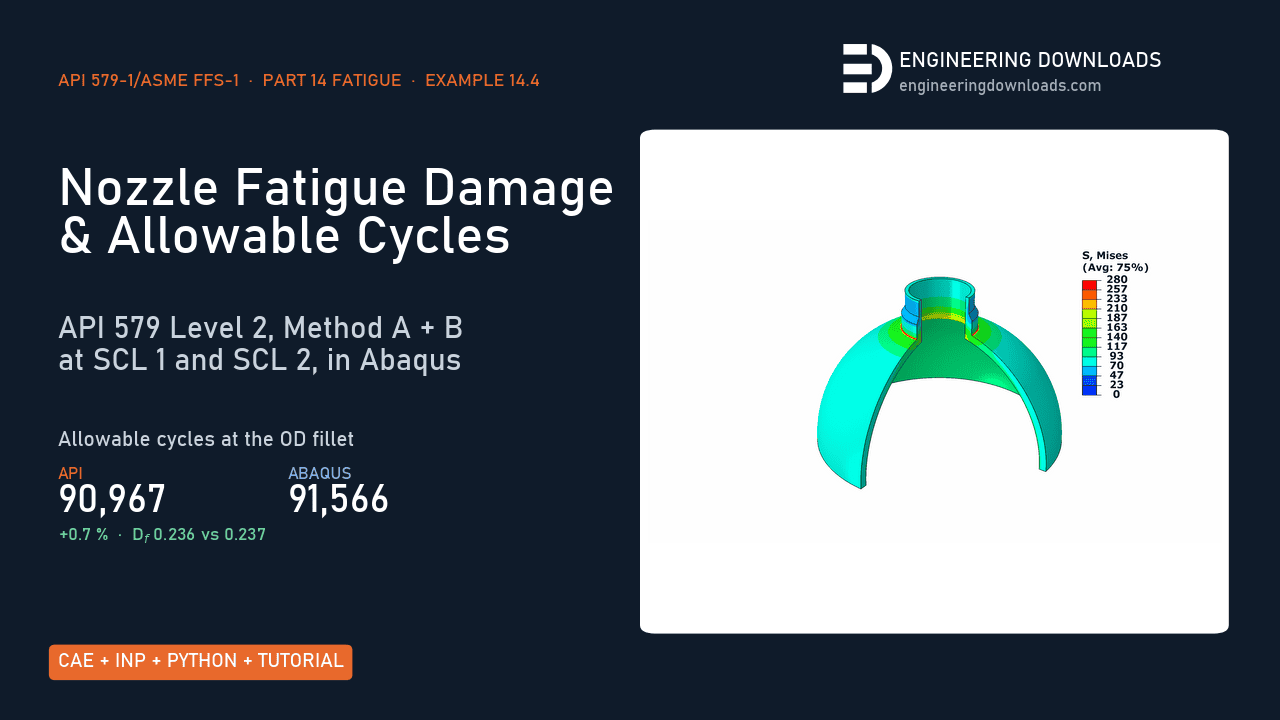 API 579 Example 14.4 in Abaqus: Nozzle Fatigue Damage and Allowable Cycles at SCL 1 and SCL 2, Level 2 Method A and B
 Cyclic loading analysis of a welded steel plate in the middle
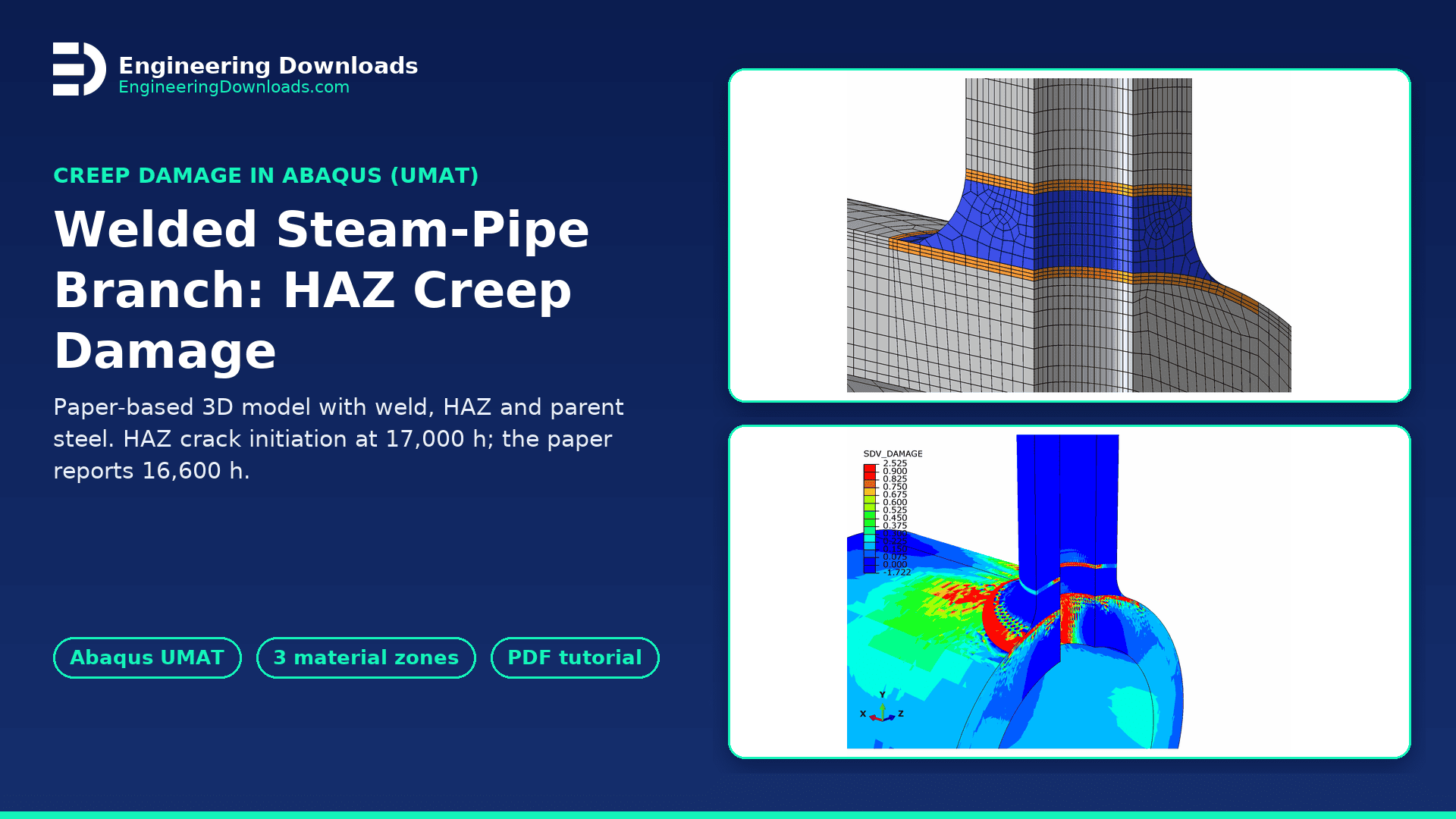 Creep Damage Analysis of a Welded Steam Pipe Branch in Abaqus: UMAT, HAZ Hex Mesh and Paper Comparison€149,00
 Plastic limit pressure of a nozzle on a cylindrical pressure vessel, Abaqus Riks models€129,00
 Pressure Vessel with Elliptical Reinforcing Pads in Abaqus: Nozzle Stress and Mass Saving vs a Published Paper€129,00
 Creep Damage of a Welded Steam Pipe Branch in ANSYS APDL: HAZ Failure, All-Hex Mesh and Paper Comparison€149,00
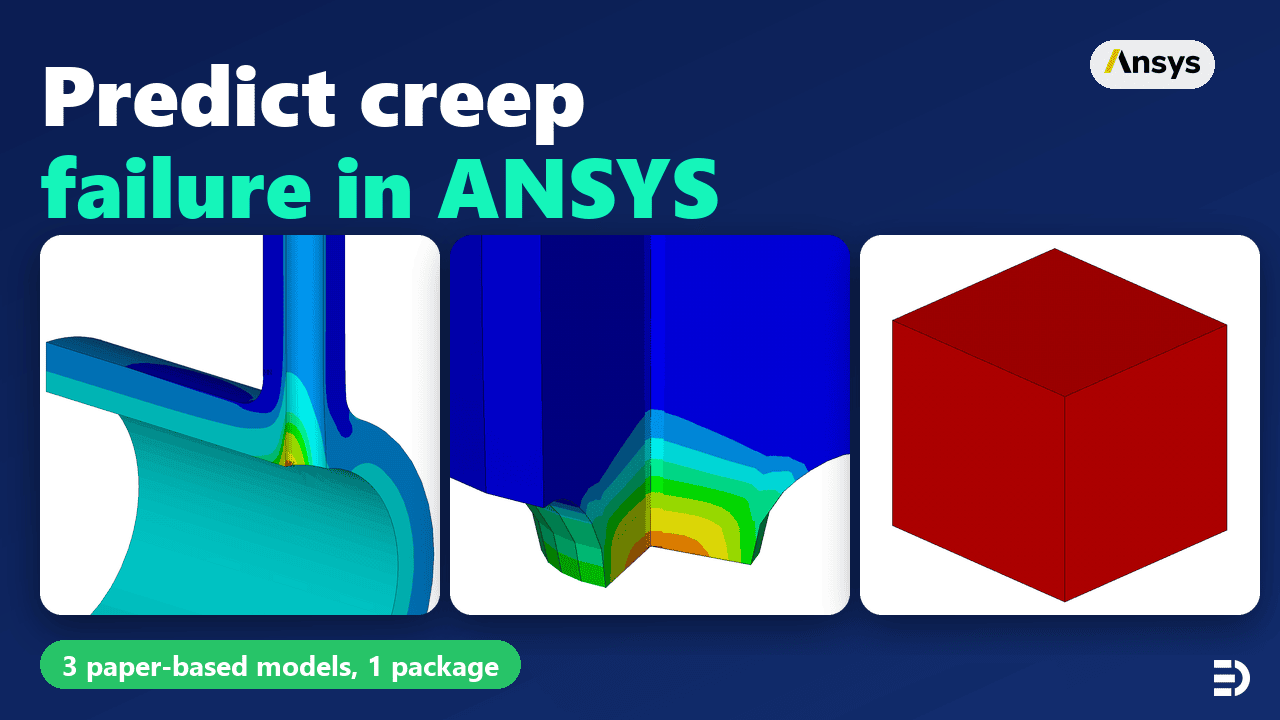 ANSYS Creep Damage Package: 3 Paper-Based APDL Models (Welded Pipe Branch, Notched Bar, Failure Horizon)€299,00
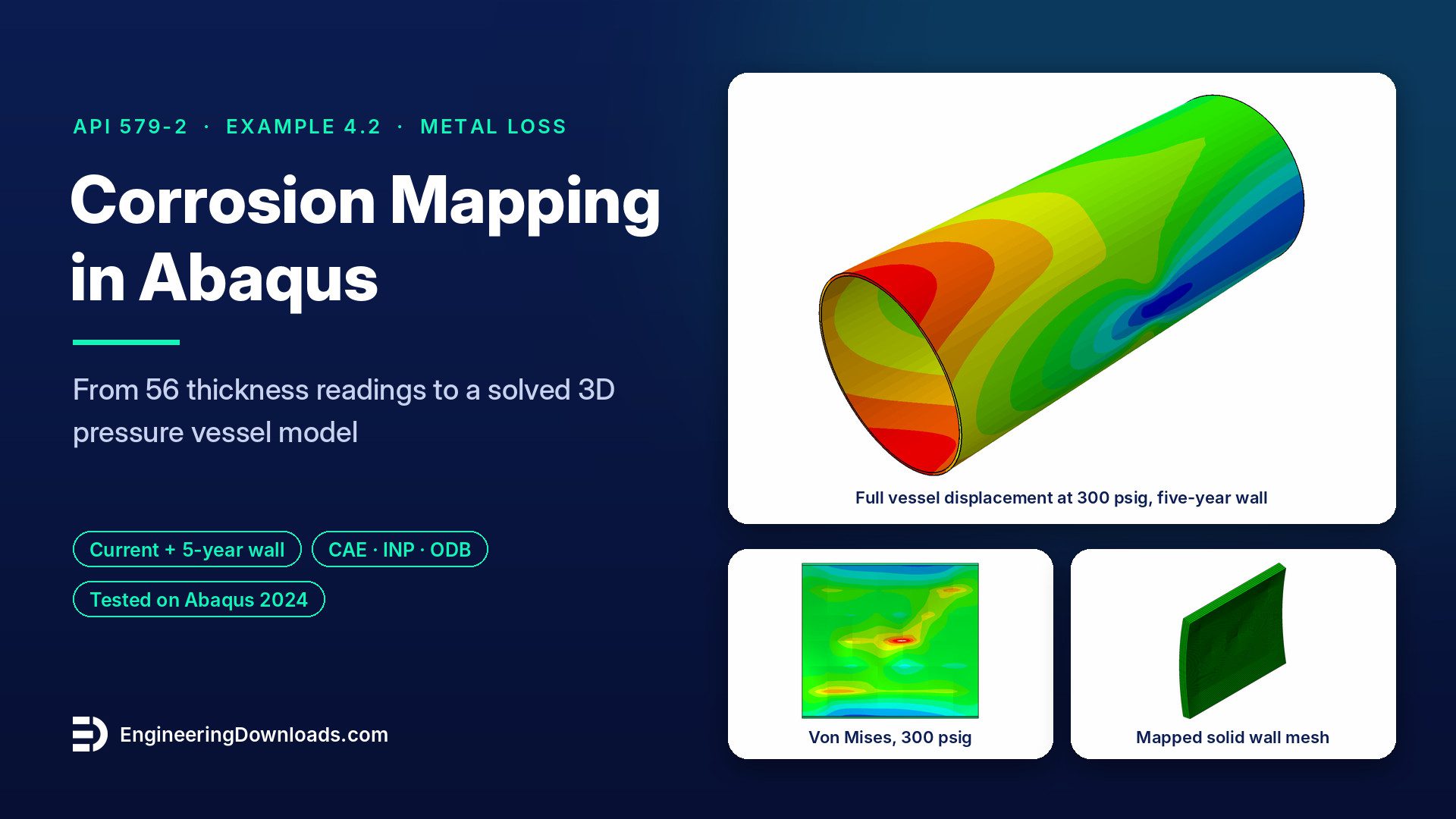 API 579 Example 4.2 in Abaqus: Corrosion Mapping of a Metal Loss Pressure Vessel

Need a full custom project? See the options below.

€129,00

€179,00

€149,00

€119,00

€129,00

€149,00
See more
Want to receive push notifications for all major on-site activities?



