

Need a full custom project? See the options below.
Need a full custom project? See the options below.
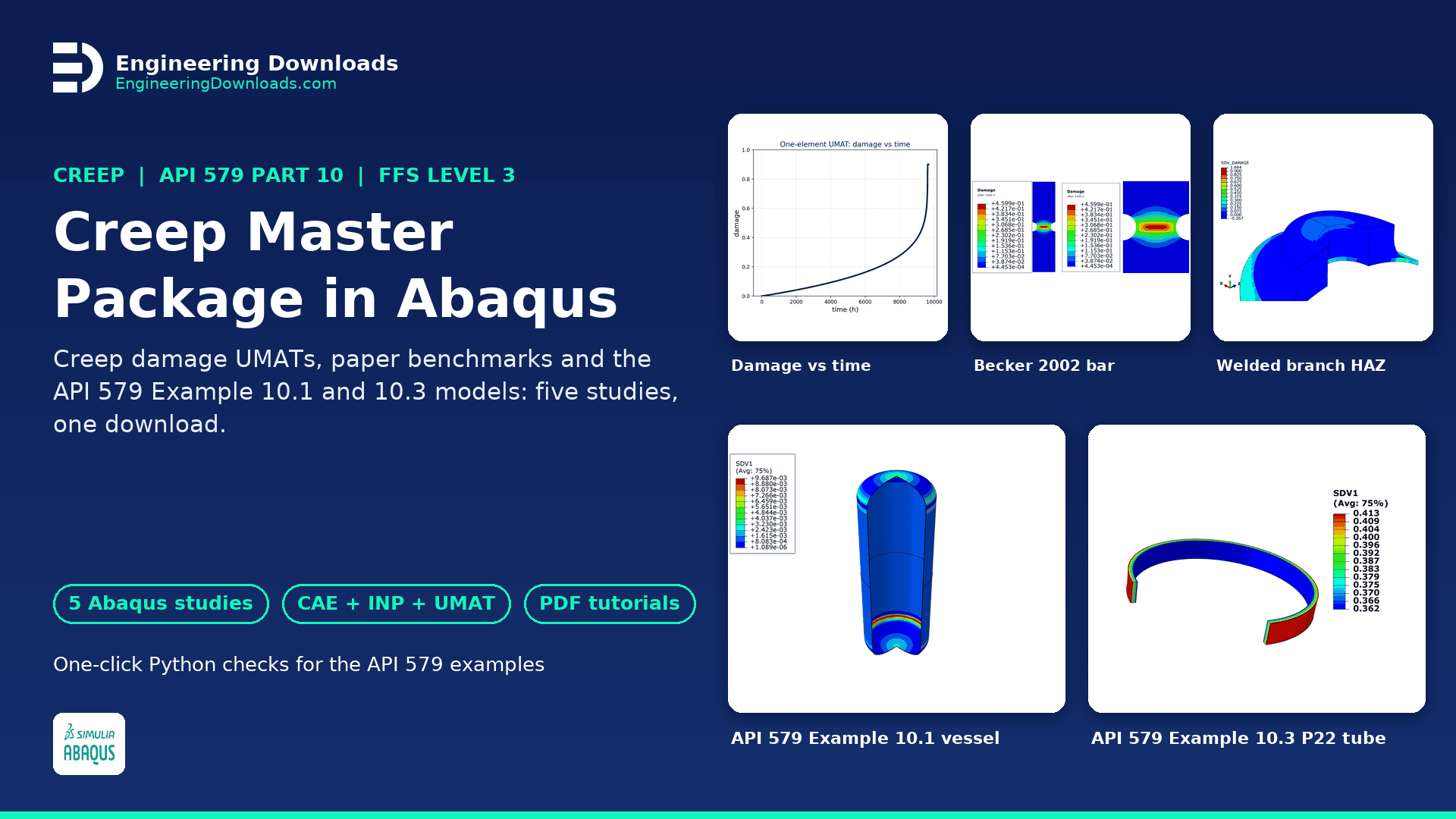
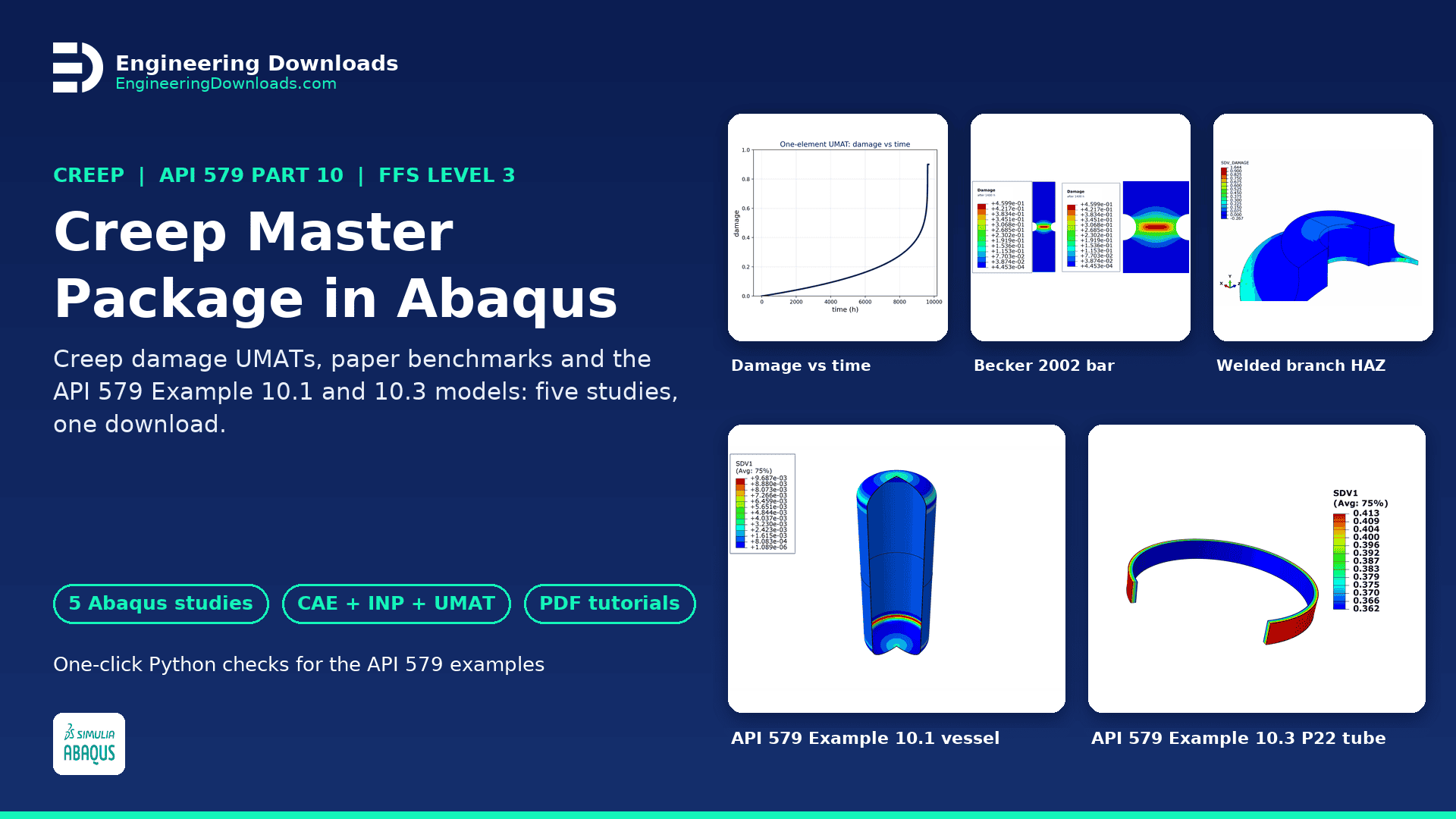
Creep is where fitness-for-service gets difficult: damage builds slowly, hides inside the wall, and then accelerates. This package puts five Abaqus creep studies in one download, in the order you would learn them: the creep-damage law at a single material point, a published notched-bar benchmark, a 3D welded steam-pipe branch with a heat-affected zone, and the two worked creep examples of API 579-2/ASME PTB-14 Part 10, Example 10.1 (vessel temperature upset) and Example 10.3 (P22 heater tube). Every study comes with its Abaqus input files, the user subroutine, key images and a PDF tutorial, and the two API 579 studies add a one-click Python check.
One README and five PDF tutorials (39 pages in total) are included. The models run in your own Abaqus installation, because the input files, CAE files and subroutine source are delivered.
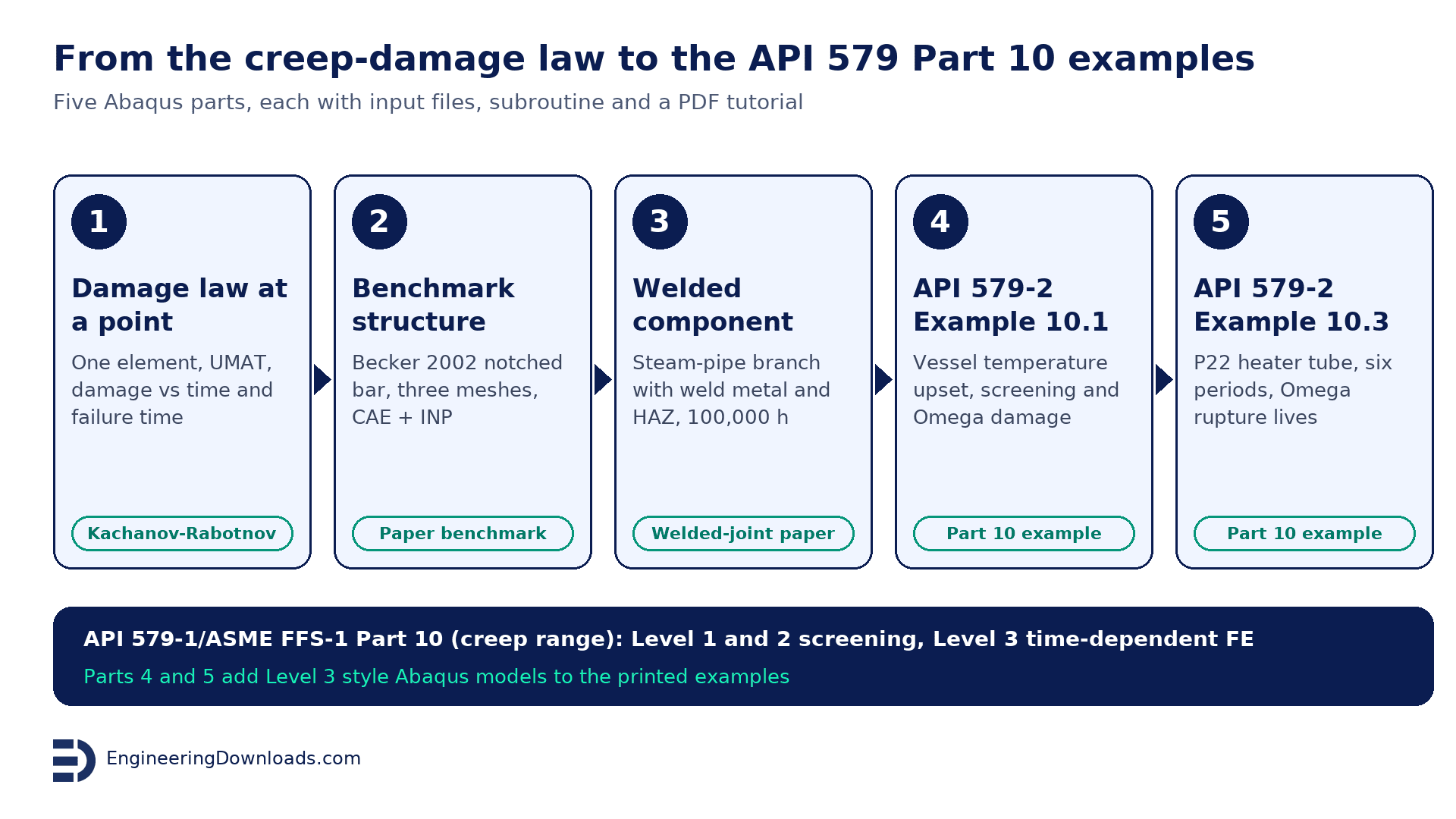
API 579-1/ASME FFS-1 Part 10 deals with components that operate in the creep range. Like the other parts it offers three assessment levels: screening and simplified checks at Levels 1 and 2, and at Level 3 a detailed stress analysis in which a time-dependent finite element model with a creep law and a damage variable is allowed. The printed Example 10.1 is a Level 1 screening and Example 10.3 is a Level 2 assessment with the Omega method; in this package both are reproduced and then extended with independent Abaqus models that resolve stress, creep strain and damage through the wall, which is the Level 3 style of analysis. Parts 1 to 3 illustrate the continuum creep-damage UMAT workflow used in detailed analysis: the law, a published benchmark and a welded component. This is an educational package for learning and review, not a plant-specific assessment, and you need your own copy of API 579-1/ASME FFS-1 and API 579-2/ASME PTB-14.
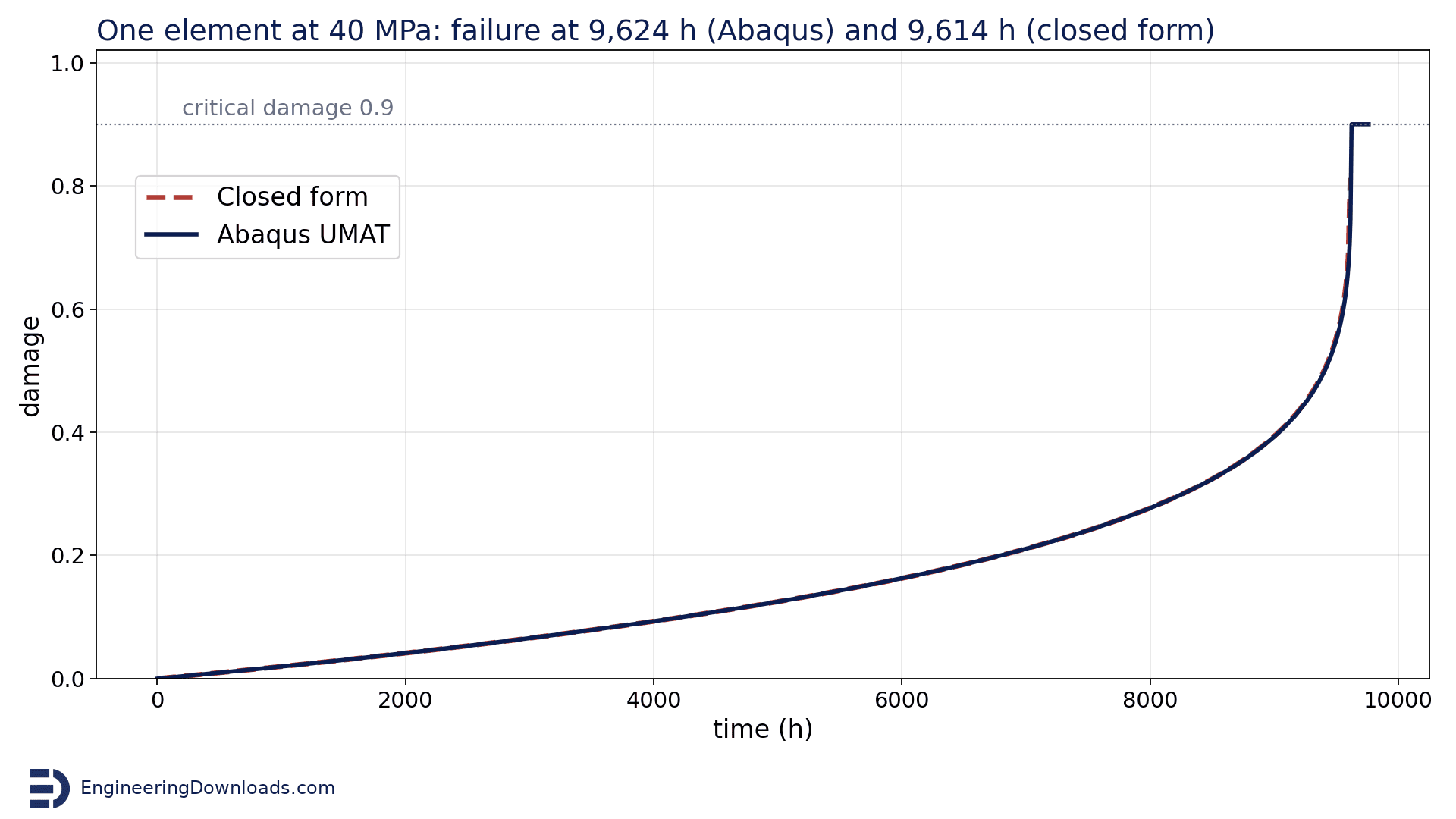
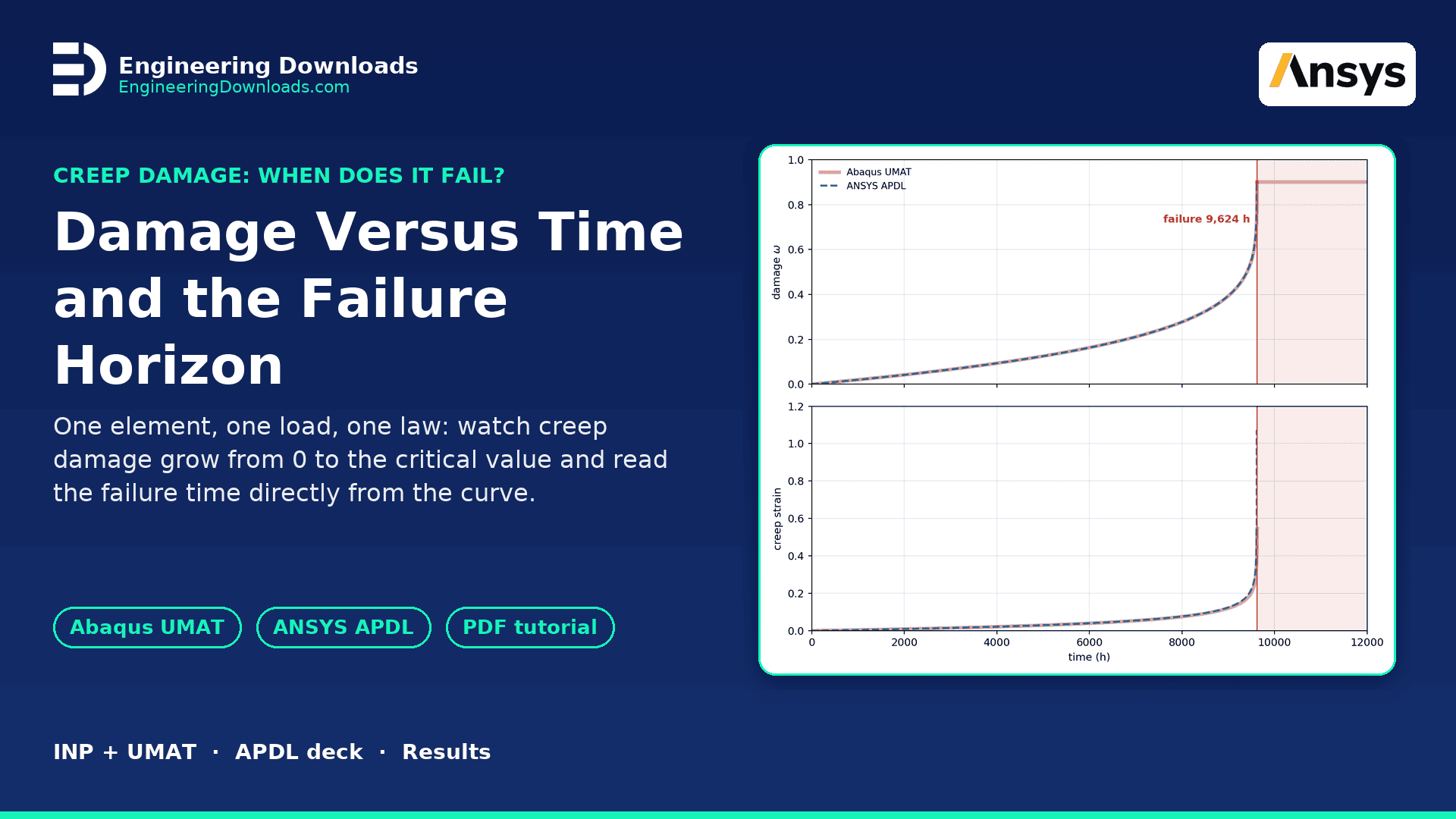
Steel at 640 C under constant load creeps while internal damage grows and speeds the creep up, so the damage curve is flat for most of the life and then turns sharply upward. A single C3D8 element under 40 MPa with a Fortran creep-damage UMAT shows this in seconds, and the failure time can be compared with a closed-form answer. The law follows Becker et al. (2002); the constants follow Hosseini-Toudeshky and Jannesari (2022), Table 3.
Paper: A.A. Becker, T.H. Hyde, W. Sun and P. Andersson (2002), Benchmarks for finite element analysis of creep continuum damage mechanics, Computational Materials Science 25, 34-41, DOI 10.1016/S0927-0256(02)00247-1.
Abstract (paraphrased): The paper explains how creep rupture life can be predicted by letting a damage variable grow from zero to one inside each finite element until a cross-section fails. The numerical difficulty is the very small time steps needed as damage approaches one, so the authors publish benchmark problems with uniaxial, biaxial, triaxial and multi-material behaviour, solved with their own code and with Abaqus plus a user subroutine, as reference solutions for other implementations.
The package rebuilds the notched round bar (bar radius 6.25 mm, notch radius 2.5 mm, 25.2 MPa on the end face, 1/2Cr1/2Mo1/4V steel at 640 C, 1,400 h) as an axisymmetric CAX8R model with a Fortran UMAT, on meshes of 99, 396 and 1,584 elements.
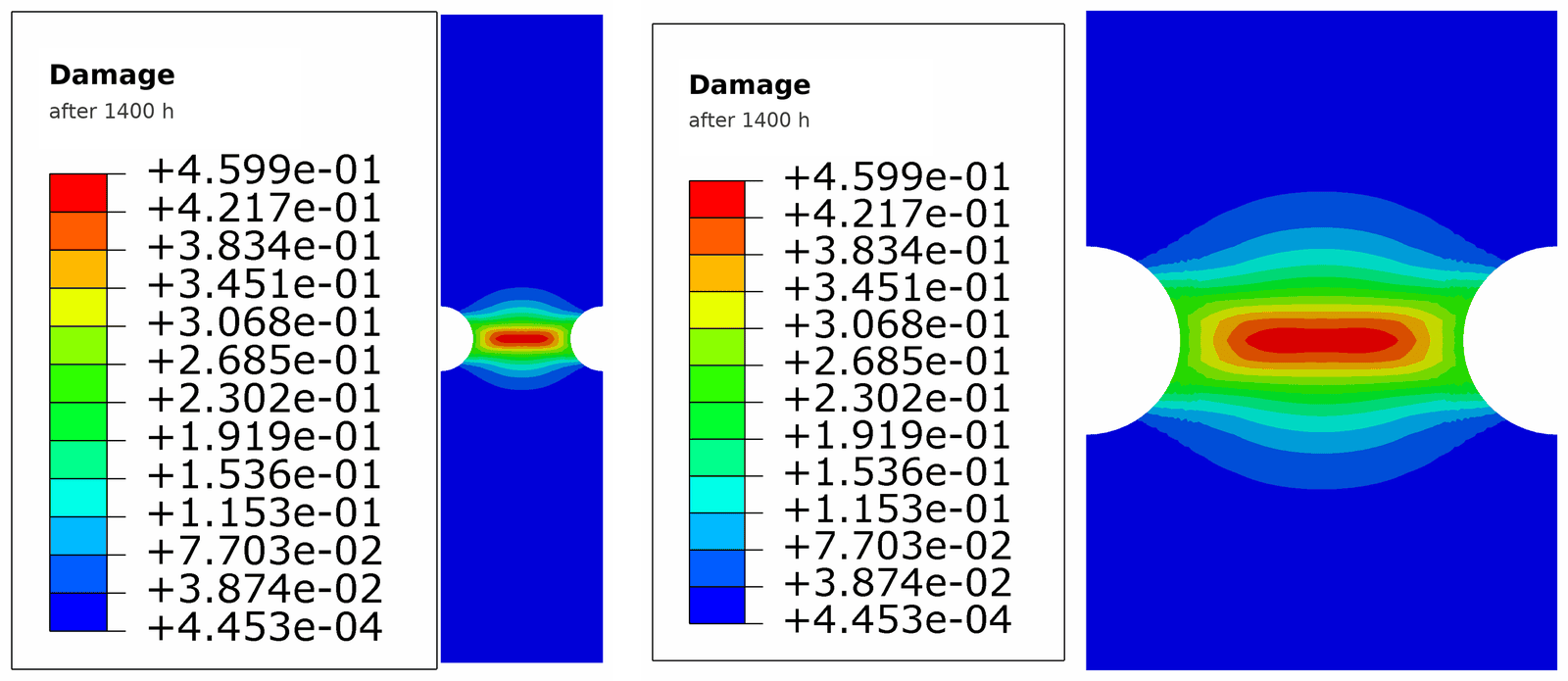
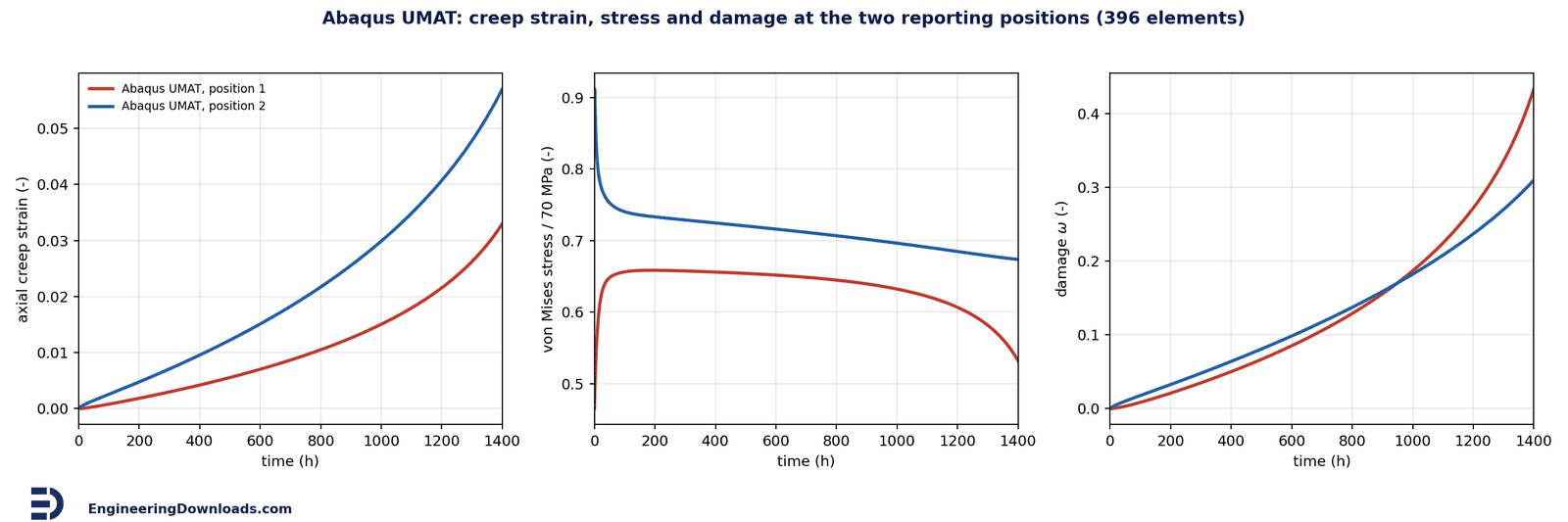
Validated: the Abaqus curves overlay the paper’s Figure 6 markers at both reporting positions over the 1,400 h window; damage at the two positions is 0.437 and 0.311 on the 1,584-element mesh, results between the 396 and 1,584-element meshes change by about 1 % or less, and the reaction force of -3,092.5 N equals the applied 25.2 MPa on the bar area.
Paper: H. Hosseini-Toudeshky and M. Jannesari (2022), An investigation on creep life assessment of welded steam pipeline intersection using classical and progressive damage analyses, Welding in the World 66, 1653-1664, DOI 10.1007/s40194-022-01324-2.
Abstract (paraphrased): The authors analyse a welded steam pipeline intersection (0.5Cr0.5Mo0.25V parent steel, 2.25CrMo weld metal and a heat-affected zone) in three ways: classical creep without damage, creep continuum damage with one material zone and creep continuum damage with several zones. Classical creep with linear damage accumulation tends to over-predict life, while the two damage analyses give crack-initiation lives within about 7.5 % of each other, both shorter than the classical estimate.
The package contains a 3D quarter model with run pipe, nozzle, weld metal and two HAZ bands on an all-hex mesh (14,858 C3D20R elements), a creep-damage UMAT with critical damage 0.9, and three decks (multi-zone, single-zone, classical creep) for the full 100,000 h.
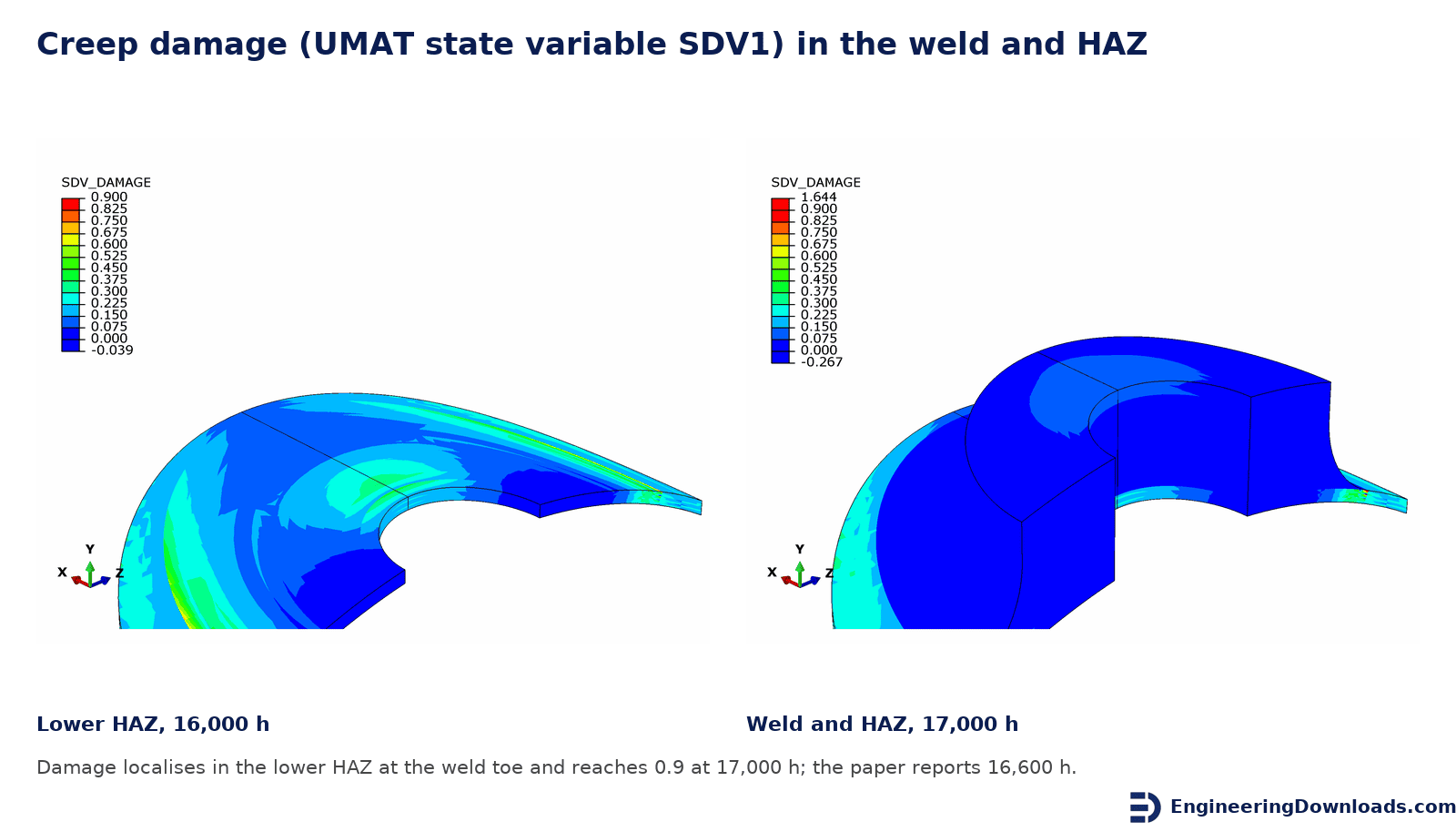
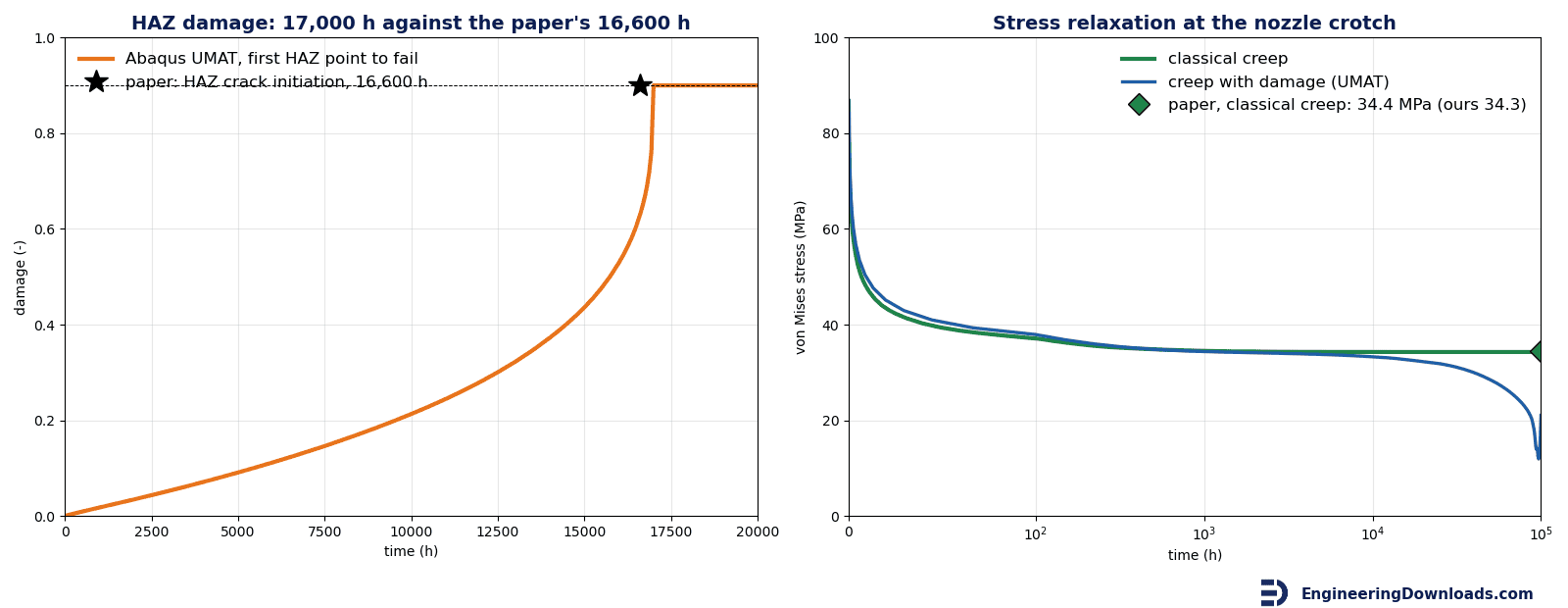
Validated: HAZ crack initiation (damage 0.9) at 17,000 h against the paper’s 16,600 h (+2.4 %); classical-creep von Mises stress at the crotch after 100,000 h of 34.3 MPa against the paper’s 34.4 MPa; life by linear damage accumulation of 15,280 h against 14,600 h (+4.7 %).
Source: API 579-2/ASME PTB-14 Fitness-For-Service Example Problem Manual, Part 10, Example 10.1. A carbon steel knock-out vessel with 2:1 elliptical heads (60.2 in corroded inside diameter, 0.275 in wall) sees 20 hours at 950 F and 82.6 psig. The example computes the shell and head stress, reads the screening time at 975 F from the Part 10 chart and compares it with the exposure.
The package recomputes the screening in one click and adds an axisymmetric Abaqus model (CAX8R, five meshes up to 12,960 elements, plus time-step, 975 F and coupon cases) with a CREEP subroutine for the Omega damage law.
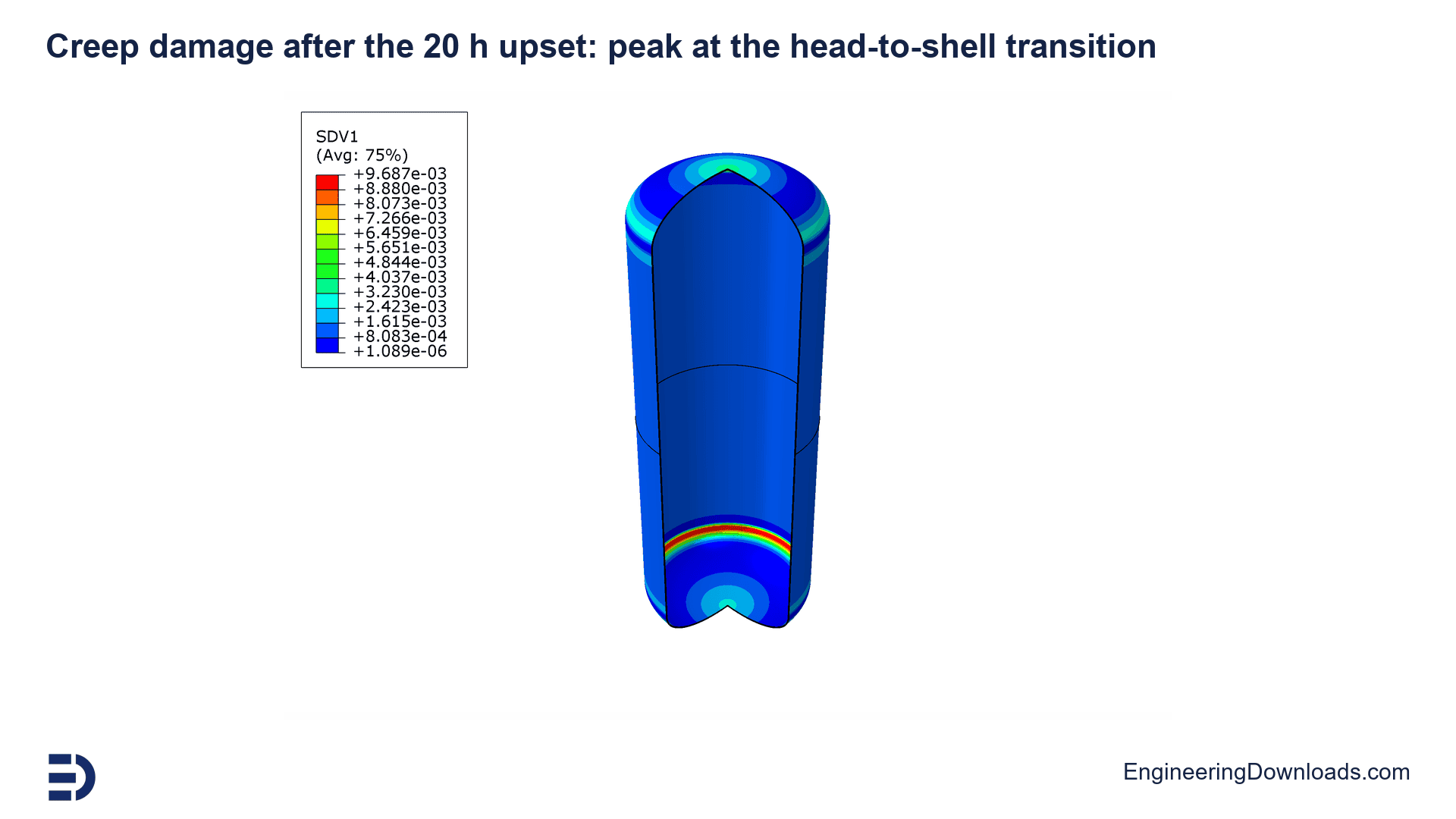
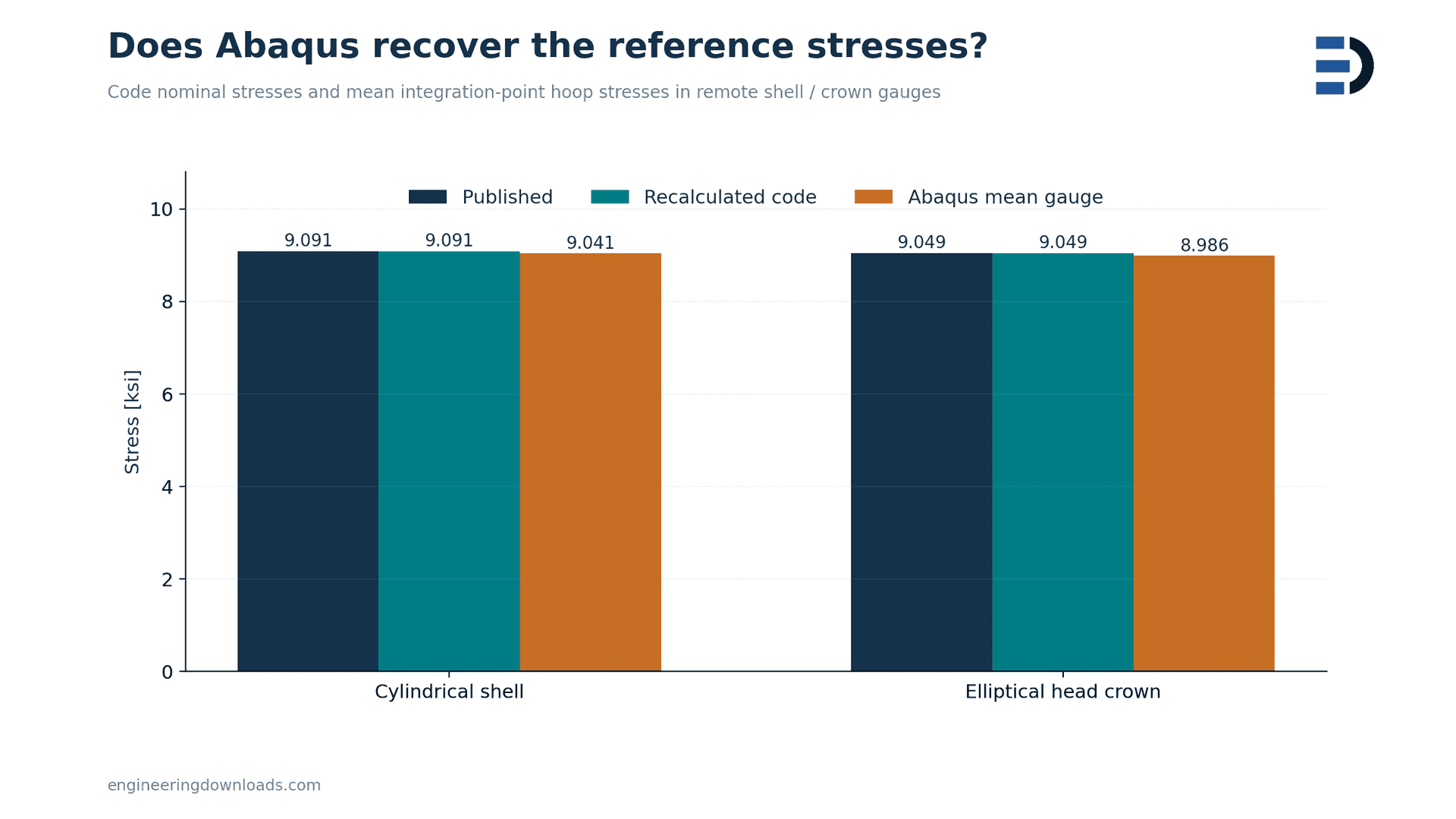
Validated: nominal stresses of 9,090.5 and 9,049.2 psi against the printed 9,091 and 9,049 psi; 975 F screening time of 2,212.7 h against the printed 2,231.8 h for the shell (-0.86 %, chart reading); Omega law against the Abaqus coupon model within 0.001 %; Abaqus gauge hoop stress within 0.55 % in the shell and 0.69 % at the head crown.
Source: API 579-2/ASME PTB-14 Fitness-For-Service Example Problem Manual, Part 10, Example 10.3. An SA-335 Grade P22 heater tube (8.625 in OD, 210 psig) runs six periods over 175,200 h, including a 336 h excursion at 1,200 F, while the bore corrodes from 0.297 in to 0.222 in. The Omega method gives the rupture life of each period and the damage adds up to a total of 0.440.
The package reproduces the six lives with single-element coupons that test the CREEP subroutine, then runs an axisymmetric tube model that carries damage, creep strain and stress from one period to the next (19 Abaqus models).
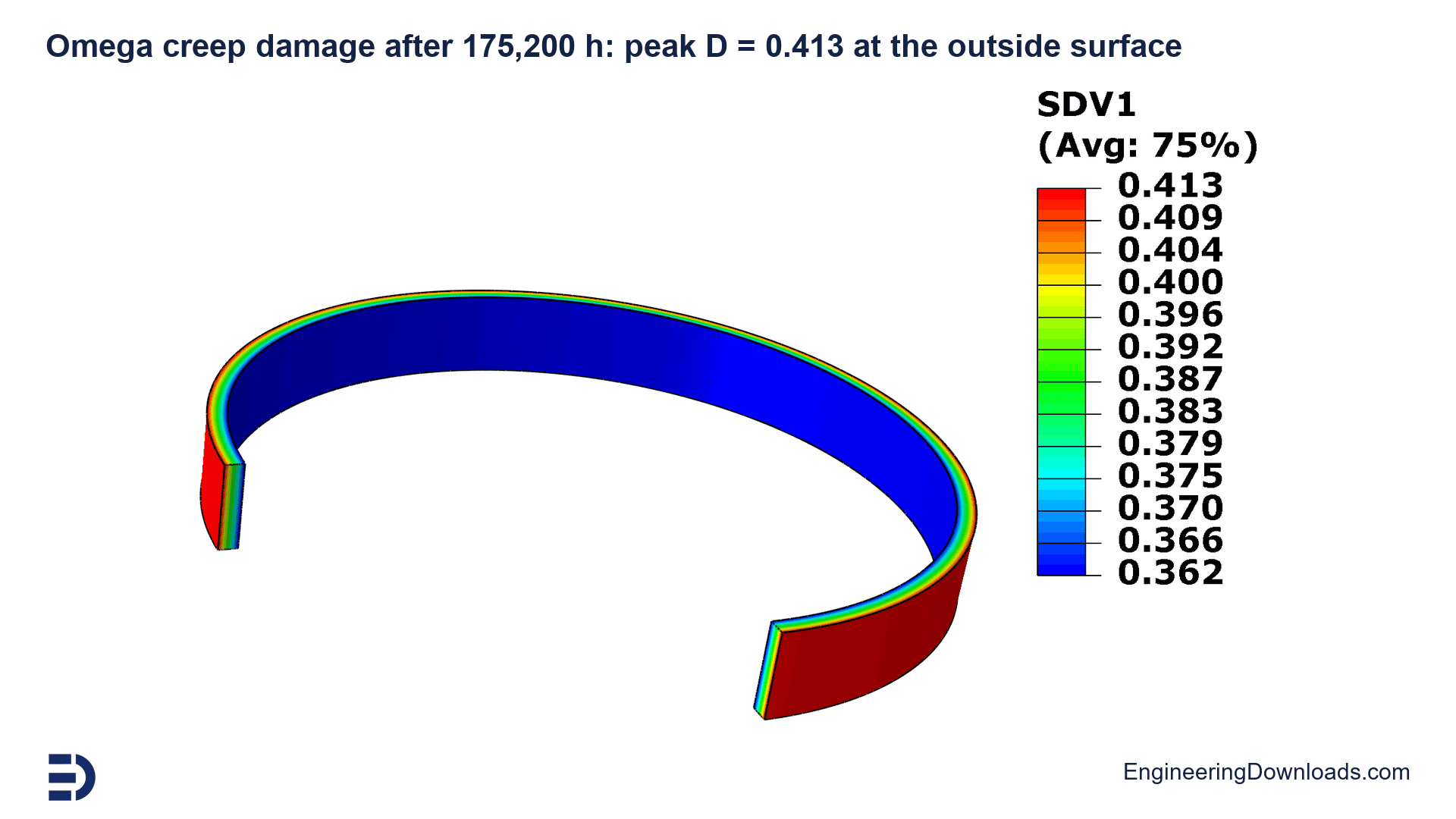
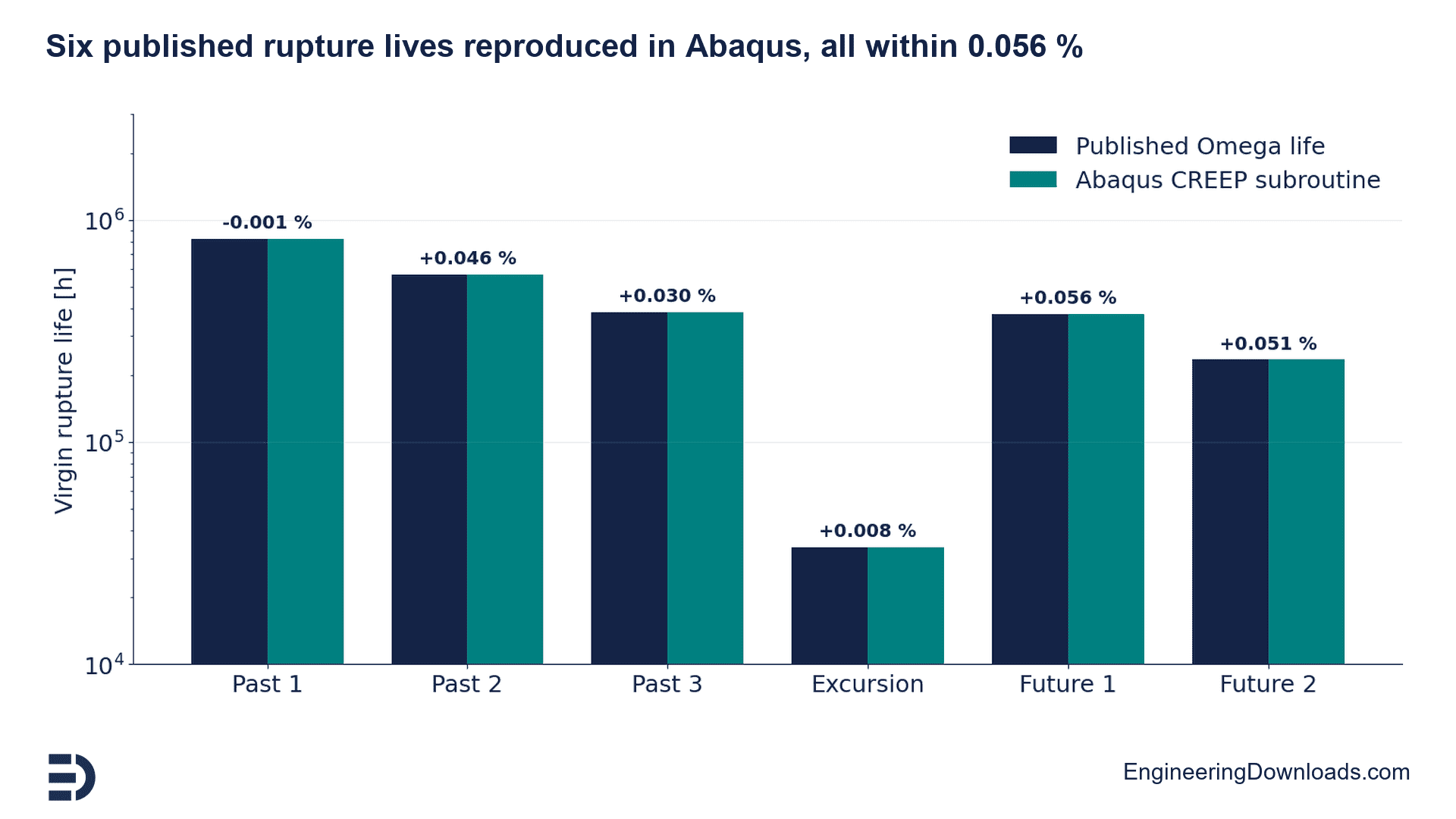
Validated: all six Omega rupture lives agree with the published values within 0.056 %, and the total creep damage is 0.44002 against 0.440. The tube model shows a peak damage of 0.4126 at the outside surface, 6.2 % below the nominal-stress total because the model resolves the stress through the wall.
Integrity and inspection engineers working with API 579 fitness-for-service in the creep range, FEA engineers building creep-damage user subroutines and Level 3 style models in Abaqus, and graduate students in high-temperature structural integrity.
Each part is also sold on its own: creep damage versus time, Becker 2002 notched bar, welded steam-pipe branch, API 579 Example 10.1 and API 579 Example 10.3.
What is in the Creep Master Package? Five Abaqus creep studies in one download: a one-element creep damage UMAT, the Becker 2002 notched bar, a welded steam-pipe branch with HAZ, and API 579-2 Examples 10.1 and 10.3, each with input files, subroutine, images and a PDF tutorial.
How does it relate to API 579-1/ASME FFS-1 Part 10? Part 10 covers components in the creep range. Examples 10.1 and 10.3 are reproduced and extended with independent Level 3 style Abaqus models, and the creep-damage UMAT parts show the continuum damage workflow used in detailed analysis. The standard itself is not included.
Which results are checked against references? The one-element failure time against its closed form, the Becker notched-bar curves against the paper, the welded-branch HAZ crack initiation time and classical crotch stress against the paper, and the Example 10.1 stresses and Example 10.3 rupture lives against the printed values.
Do I need a Fortran compiler? Yes. Abaqus compiles the user subroutines at job start, so a Fortran compiler must be linked to your Abaqus installation.
Can I run it in my own Abaqus? Yes. The INP files, CAE files and subroutine sources are included, so the models run in your own Abaqus installation.
What is the one-click Python check? Examples 10.1 and 10.3 each include a plain Python 3 script that needs no packages and no edits. It recomputes the example values and prints them next to the Abaqus results.
Is this a plant-specific assessment? No. It is an educational package with independent reconstructions of published examples and papers.
What if the package is not what I expected? Write to us. Engineering Downloads refunds clients who are not satisfied with a delivered product.
Need more than the files?
There are two ways we can help. Book a one hour online consultation if you want to talk a problem through with a CAE engineer, using the checkbox in the order box. Order a project if you need a full simulation built for you, delivered to an agreed scope, price and deadline under a written contract.
We work on FEA and CFD for engineers, researchers and companies. Order your project, or message us on WhatsApp for a quick reply.
Other packages engineers working on this topic also download.
API 579 Example 10.1 in Abaqus: Vessel Creep After a Temperature Excursion, Omega Damage Model and One-Click Python Check€129,00API 579 Example 10.3 in Abaqus: P22 Heater-Tube Creep Life, Omega Damage Model and One-Click Python Check€139,00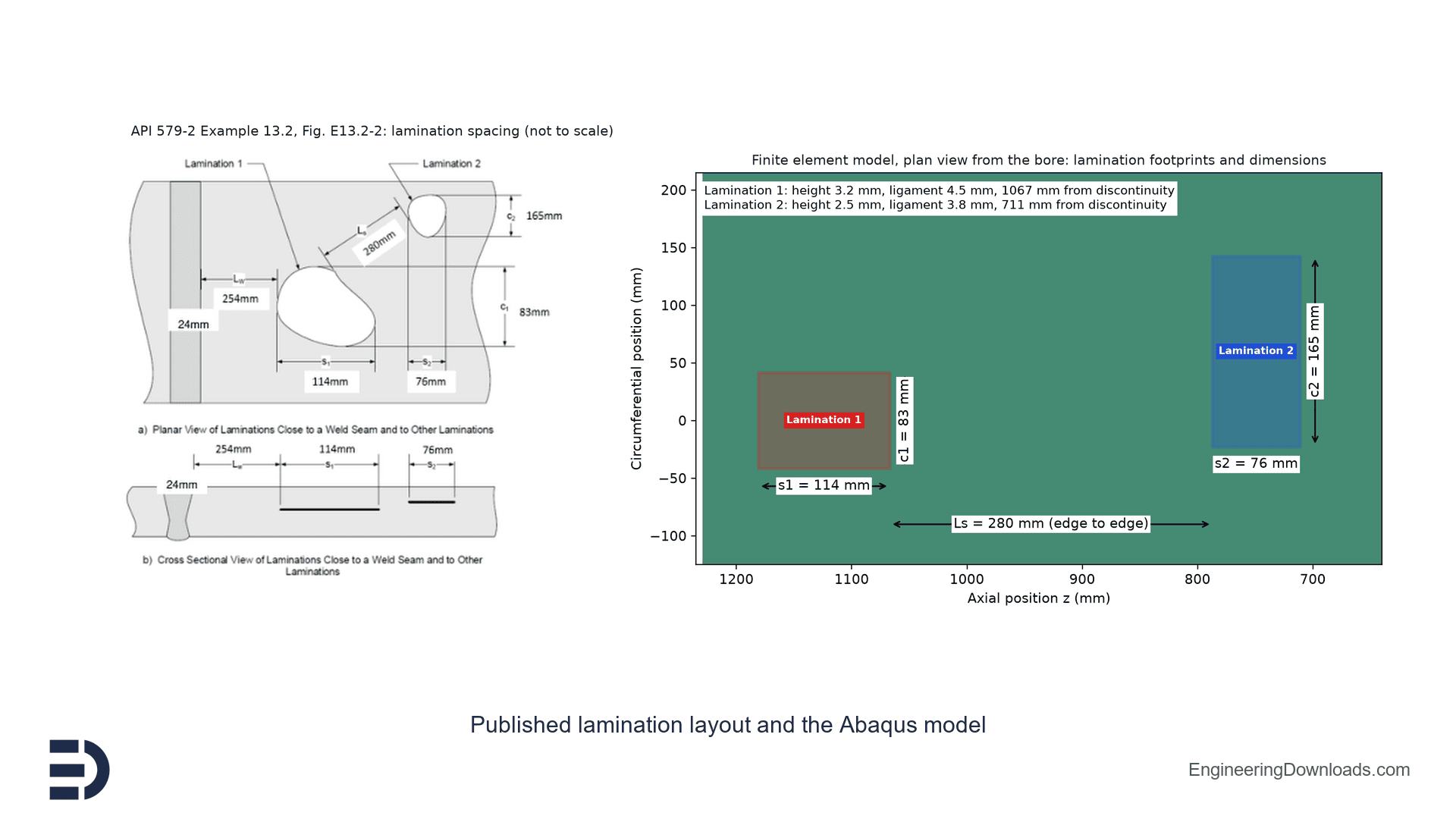 API 579-2 / ASME PTB-14 Example 13.2 Laminations in a Pressure Vessel: Abaqus FEA Model with Contact, Level 1 Screening and MAWP€139,00
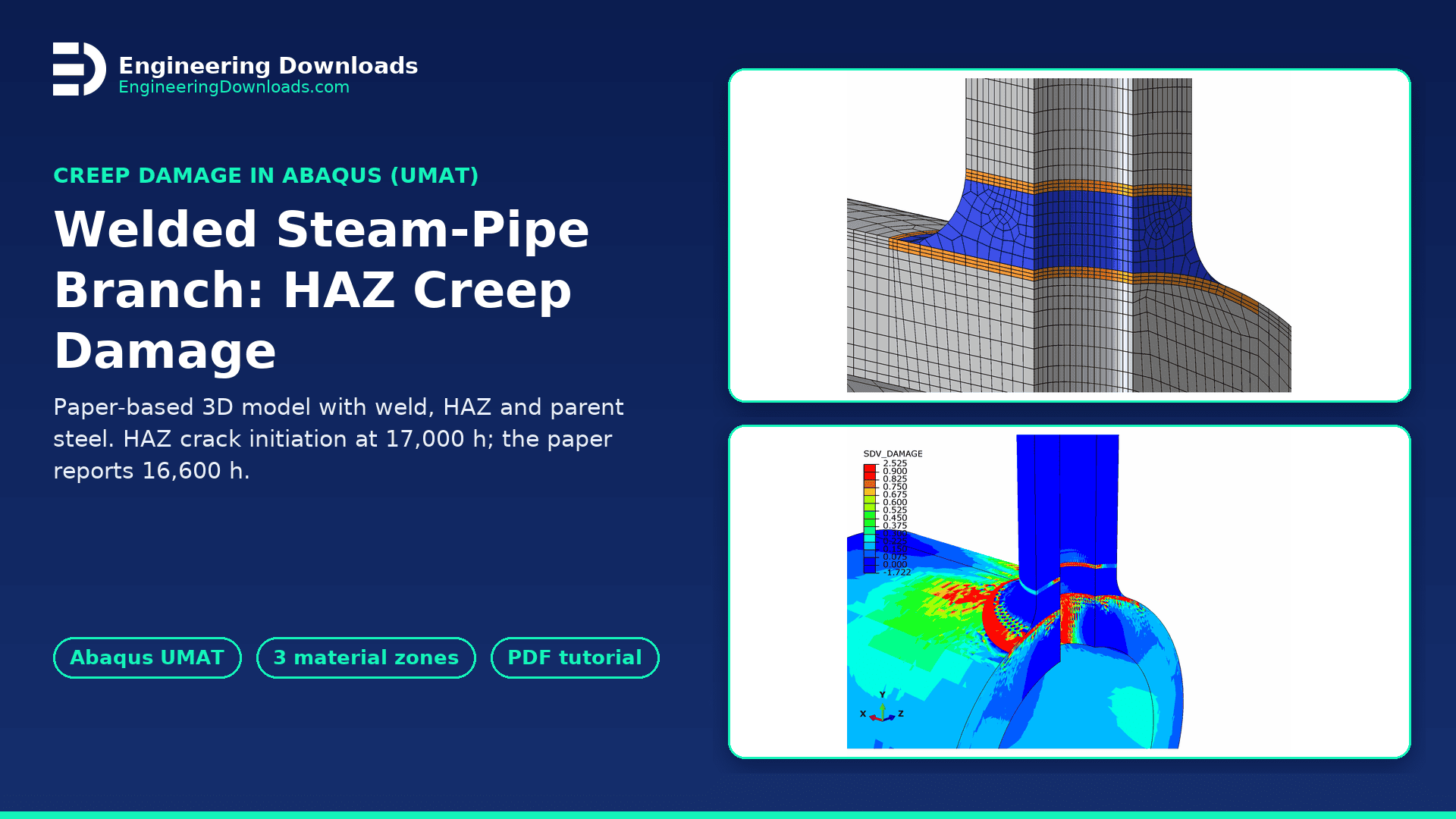 Creep Damage Analysis of a Welded Steam Pipe Branch in Abaqus: UMAT, HAZ Hex Mesh and Paper Comparison€149,00
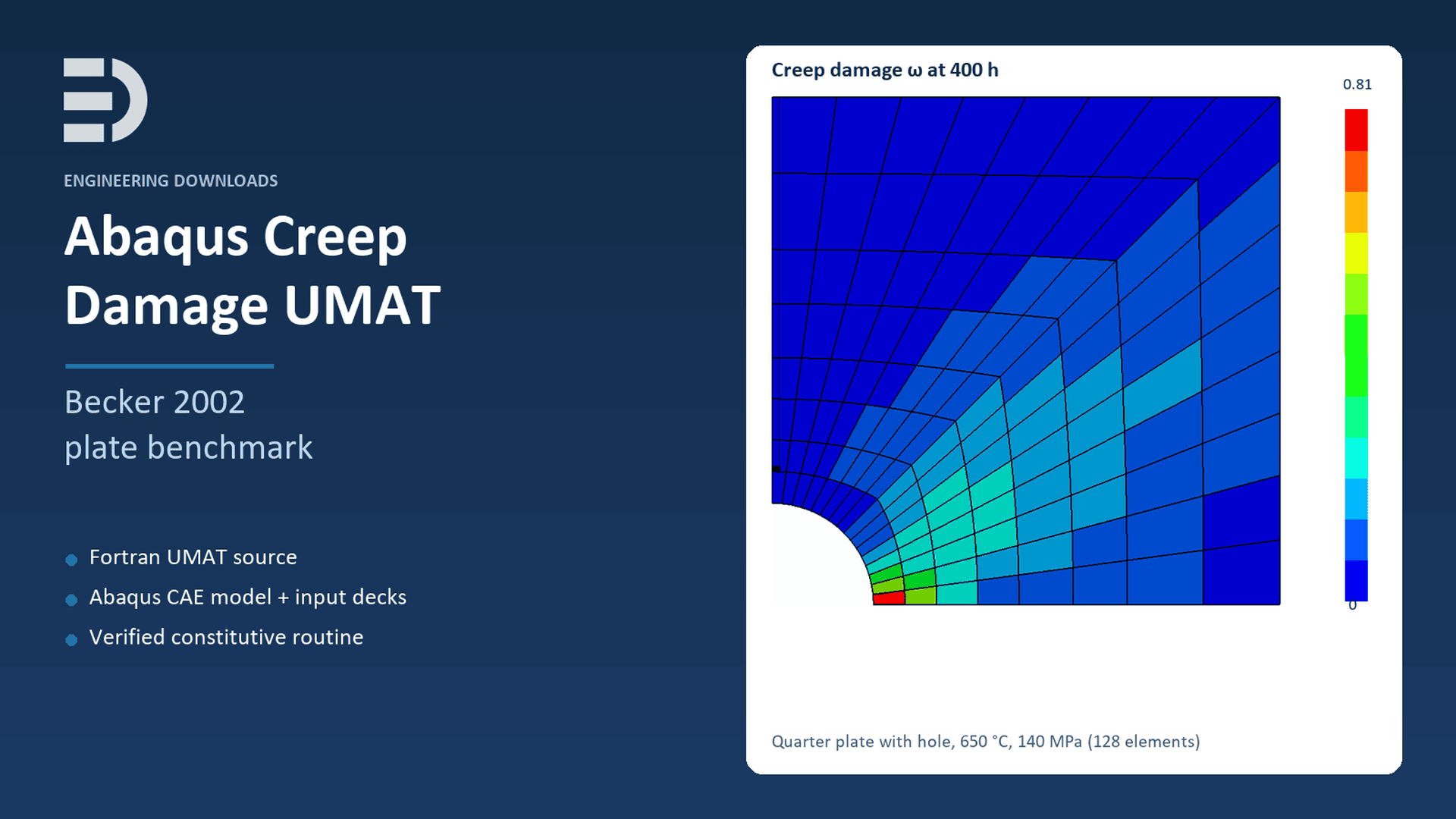 Creep Continuum Damage UMAT in Abaqus: Becker 2002 Perforated Plate Benchmark€49,00
 Composite Fatigue UMAT for Abaqus: Hashin, Tsai-Hill and Maximum-Stress Criteria€159,00
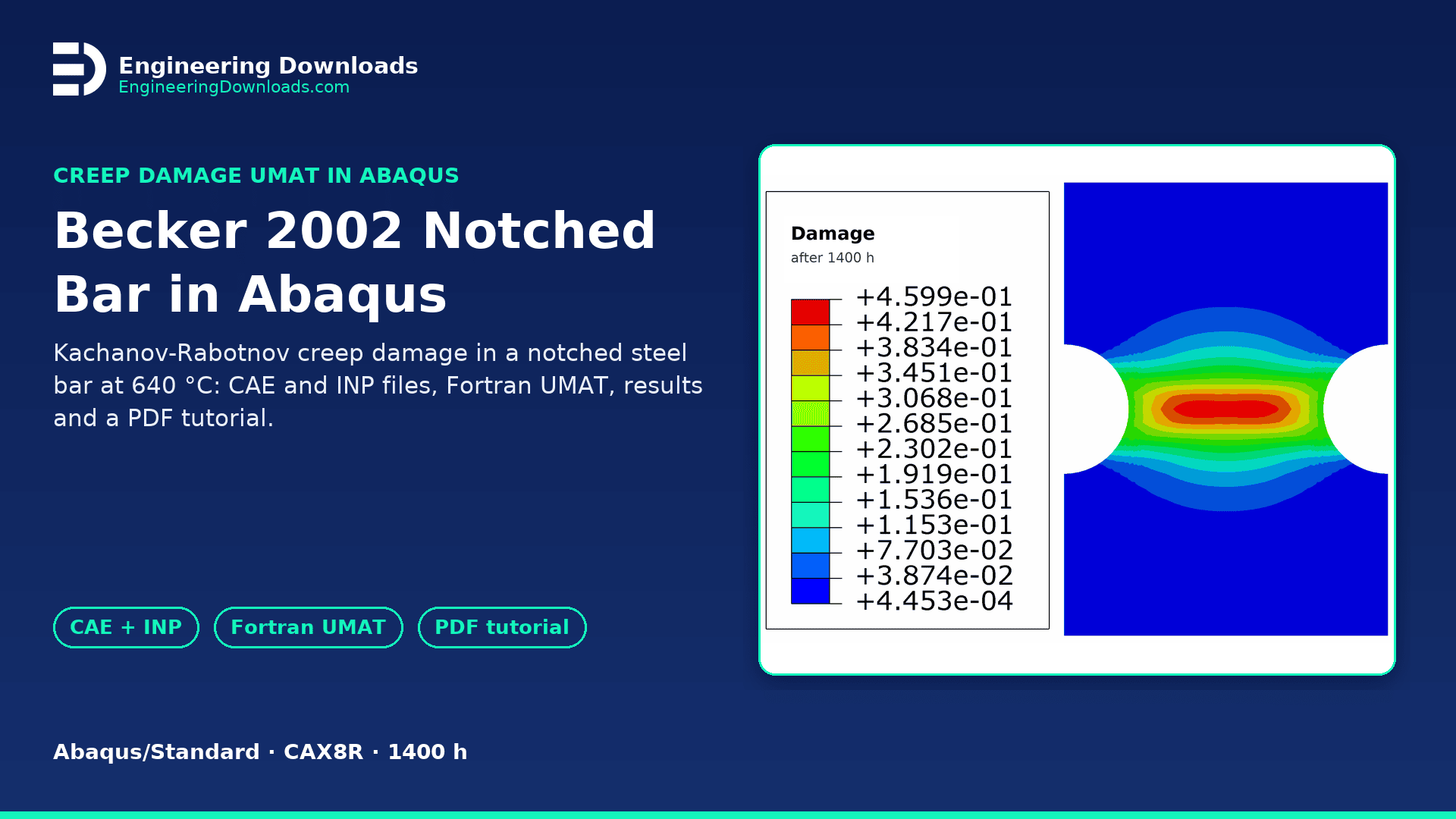 Creep Damage Notched Bar in Abaqus: Becker 2002 Benchmark with UMAT, CAE and INP Files and Paper Comparison€49,00
 Creep Damage Versus Time in Abaqus: Failure Horizon of a Single Element with a Kachanov-Rabotnov UMAT€49,00

Need a full custom project? See the options below.

€129,00

€179,00

€149,00

€119,00

€129,00

€149,00
See more
Want to receive push notifications for all major on-site activities?



