Need a full custom project? See the options below.
Need a full custom project? See the options below.
Ultra-High-Performance Concrete (UHPC) has emerged as one of the most advanced cementitious materials in modern structural engineering due to its exceptional compressive strength, enhanced durability, low permeability, and superior energy absorption capacity. Typical compressive strengths of UHPC exceed 120 MPa and may reach values greater than 150 MPa, making it particularly attractive for applications requiring high load-carrying capacity and long-term durability. However, despite its excellent compressive performance, UHPC remains a brittle material with limited tensile deformation capacity. Consequently, the use of external confinement systems has become an effective strategy for improving its ductility and post-peak behavior.
Composite tubular columns represent an efficient structural solution in which concrete and metallic tubes interact to provide superior strength and stiffness compared with conventional reinforced concrete members. In such systems, the metallic tube acts as permanent formwork and provides lateral confinement to the concrete core, while the concrete delays local buckling of the tube and contributes significantly to the axial load resistance. This interaction results in improved strength, ductility, and energy dissipation characteristics.
Among composite structural members, double-skin tubular columns have gained considerable attention because they combine the advantages of hollow and concrete-filled sections. A double-skin configuration consists of an outer tube and an inner tube separated by a concrete-filled annular region. The hollow central cavity reduces the self-weight of the member while maintaining a high strength-to-weight ratio. Furthermore, the inner and outer tubes provide confinement to the concrete infill, resulting in enhanced compressive performance and improved resistance against local instability.
Although extensive research has been conducted on concrete-filled steel tubular (CFST) and concrete-filled double-skin steel tubular (CFDST) columns, relatively limited studies have investigated the behavior of UHPC-filled double-skin aluminium tubular columns. Aluminium alloys offer several advantages over conventional steel, including lower density, high corrosion resistance, ease of fabrication, and excellent recyclability. These characteristics make aluminium particularly suitable for lightweight and sustainable structural systems. However, the lower elastic modulus and different plastic deformation characteristics of aluminium require a detailed assessment of its interaction with UHPC under compressive loading conditions.
The structural behavior of UHPC-filled double-skin aluminium columns is governed by the composite interaction between the aluminium skins and the UHPC infill. Under axial compression, the aluminium tubes provide lateral confinement to the UHPC, delaying crack propagation and reducing damage localization. Simultaneously, the UHPC core supports the aluminium skins against inward local buckling, thereby enhancing the overall stability of the composite member. The resulting confinement effect increases the load-carrying capacity, stiffness, and ductility of the column compared with individual constituent materials acting alone.
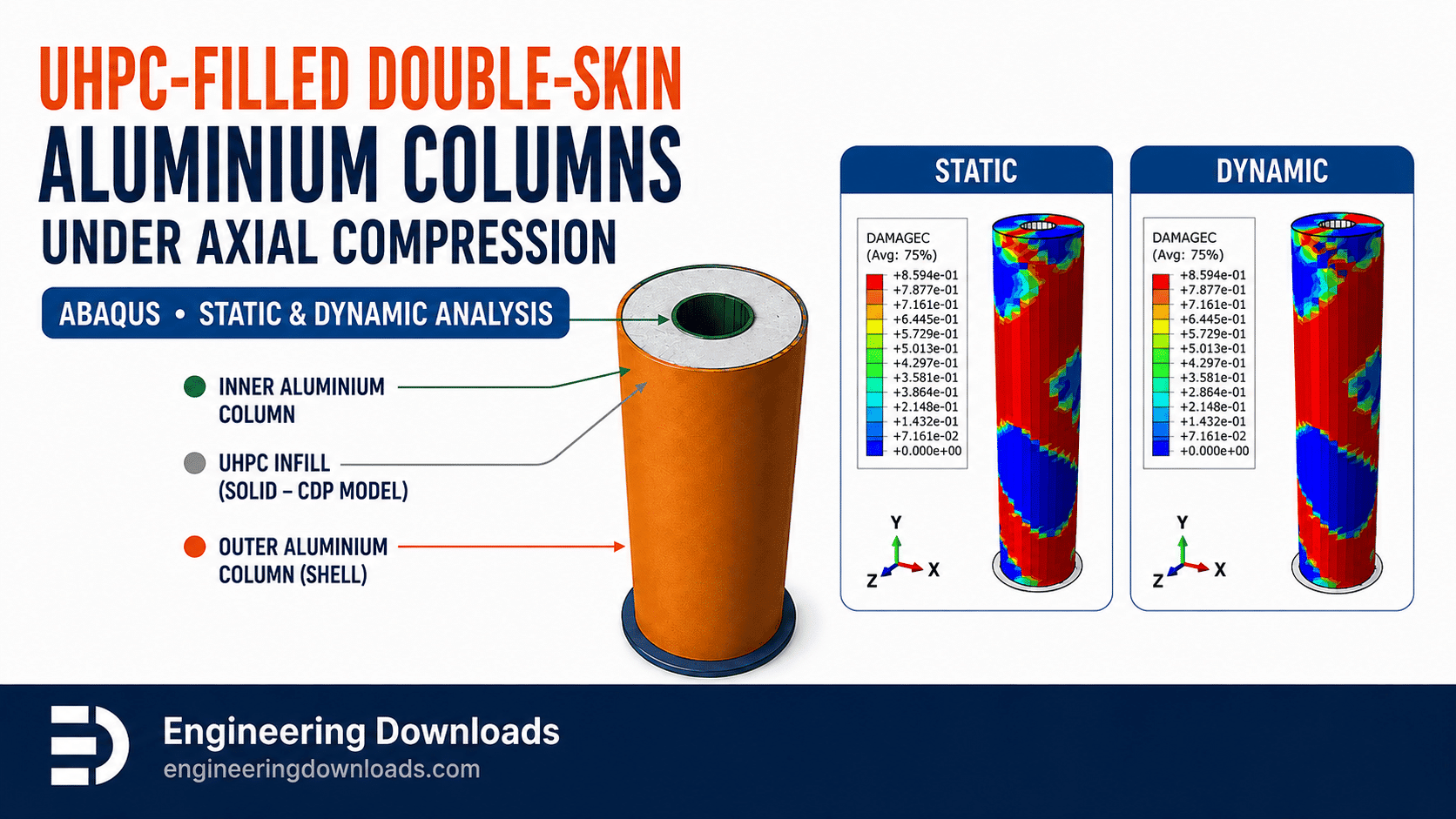
To investigate this behavior, a finite element model can be developed using the Abaqus software package. In the present study, the outer and inner aluminium tubes are modeled using shell elements, while the UHPC infill is represented using three-dimensional solid elements. The nonlinear behavior of UHPC is simulated using the Concrete Damaged Plasticity (CDP) model, which captures both compressive crushing and tensile cracking mechanisms through stiffness degradation variables. The aluminium tubes are modeled using an elastic-plastic constitutive law combined with a ductile damage criterion to represent yielding, strain hardening, damage evolution, and eventual material degradation.
The interaction between the aluminium skins and the UHPC core is represented using surface-to-surface contact formulations, allowing the transfer of normal pressure and tangential shear stresses across the interfaces. This contact definition enables realistic simulation of confinement effects and composite action during loading. Two analysis procedures are considered. The first employs the Abaqus Static General step to evaluate the quasi-static compressive response and failure mechanisms. The second utilizes the Abaqus Explicit solver to investigate the dynamic compressive behavior and damage evolution under rapid loading conditions.
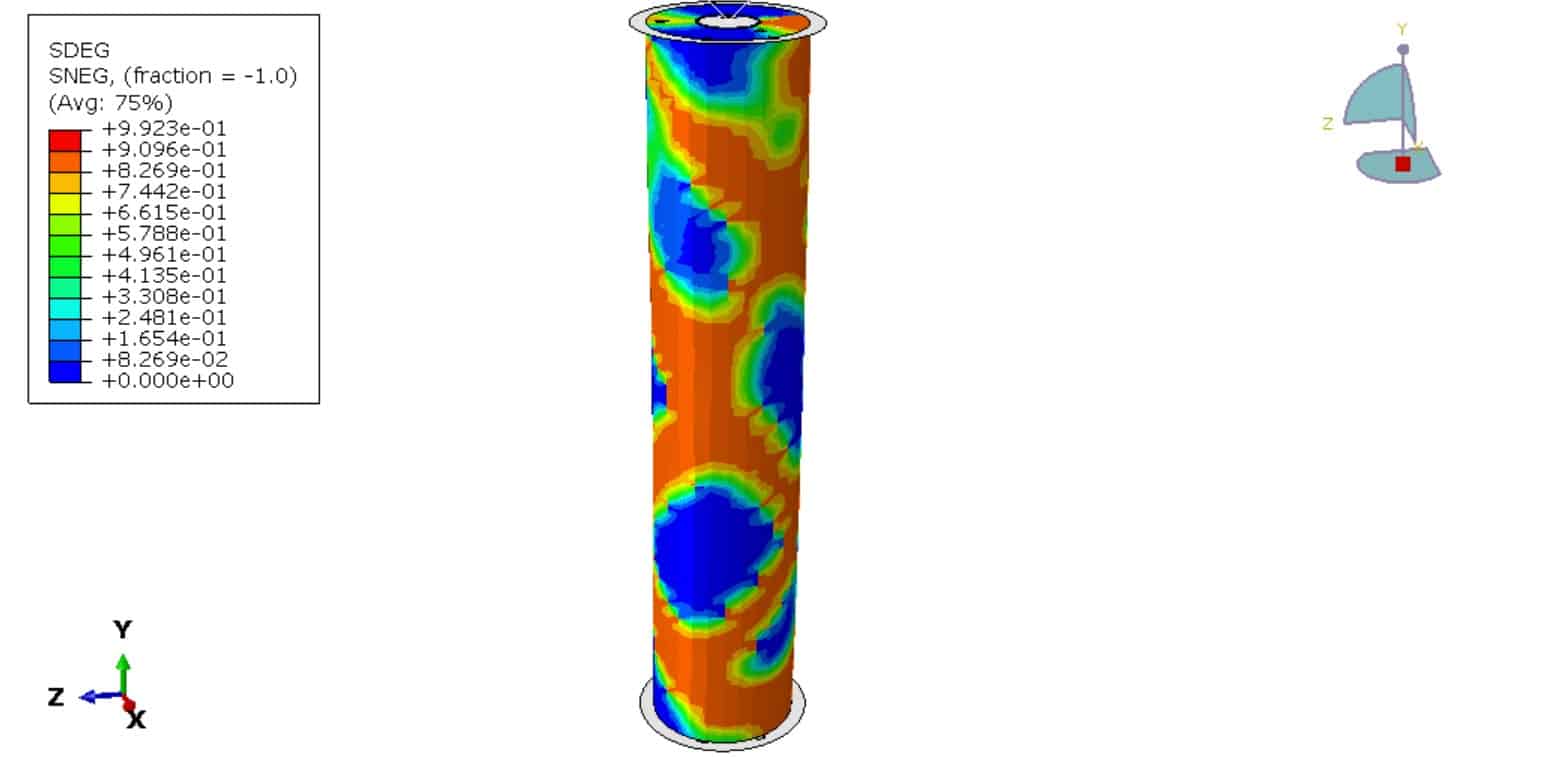
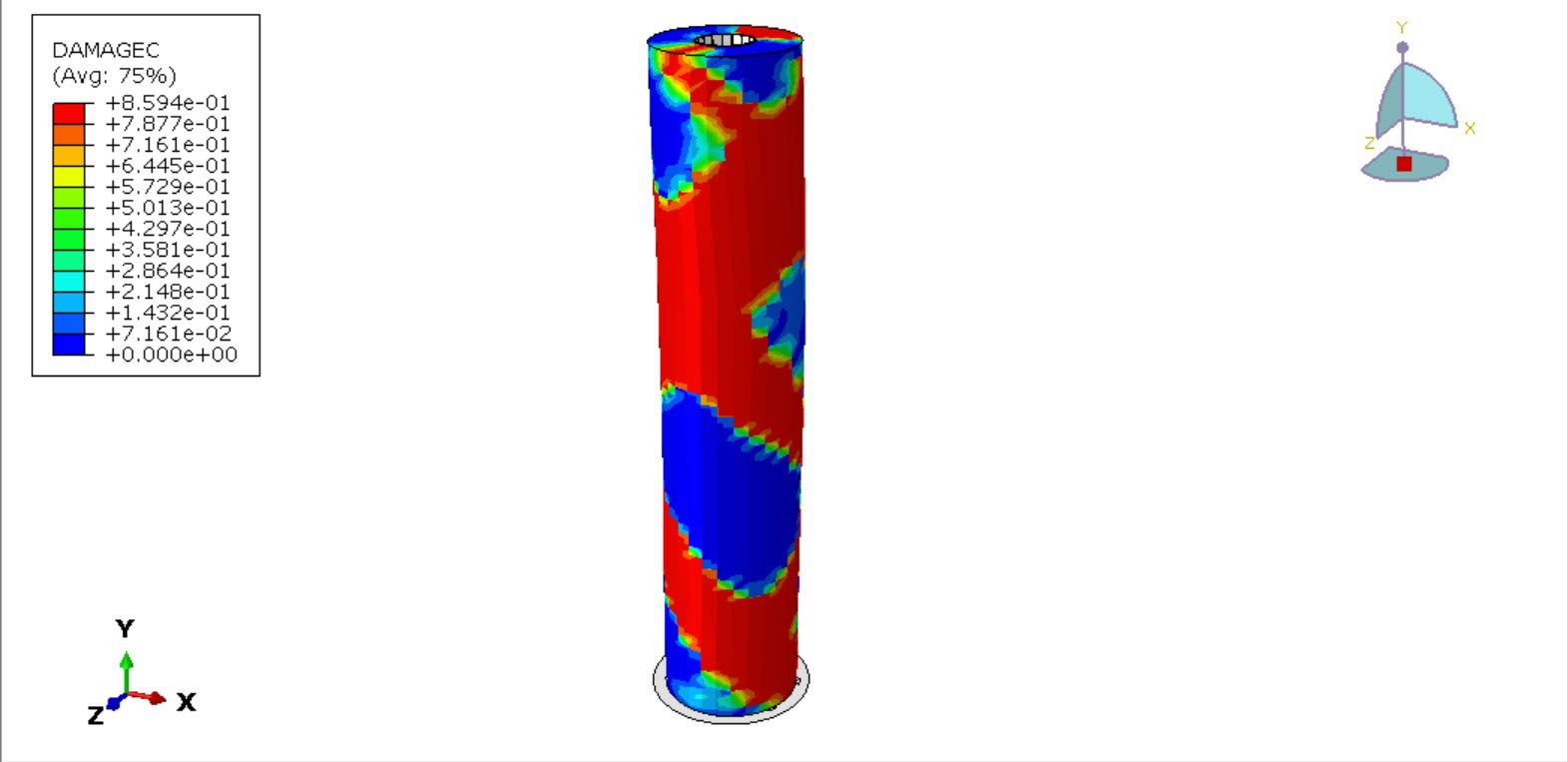
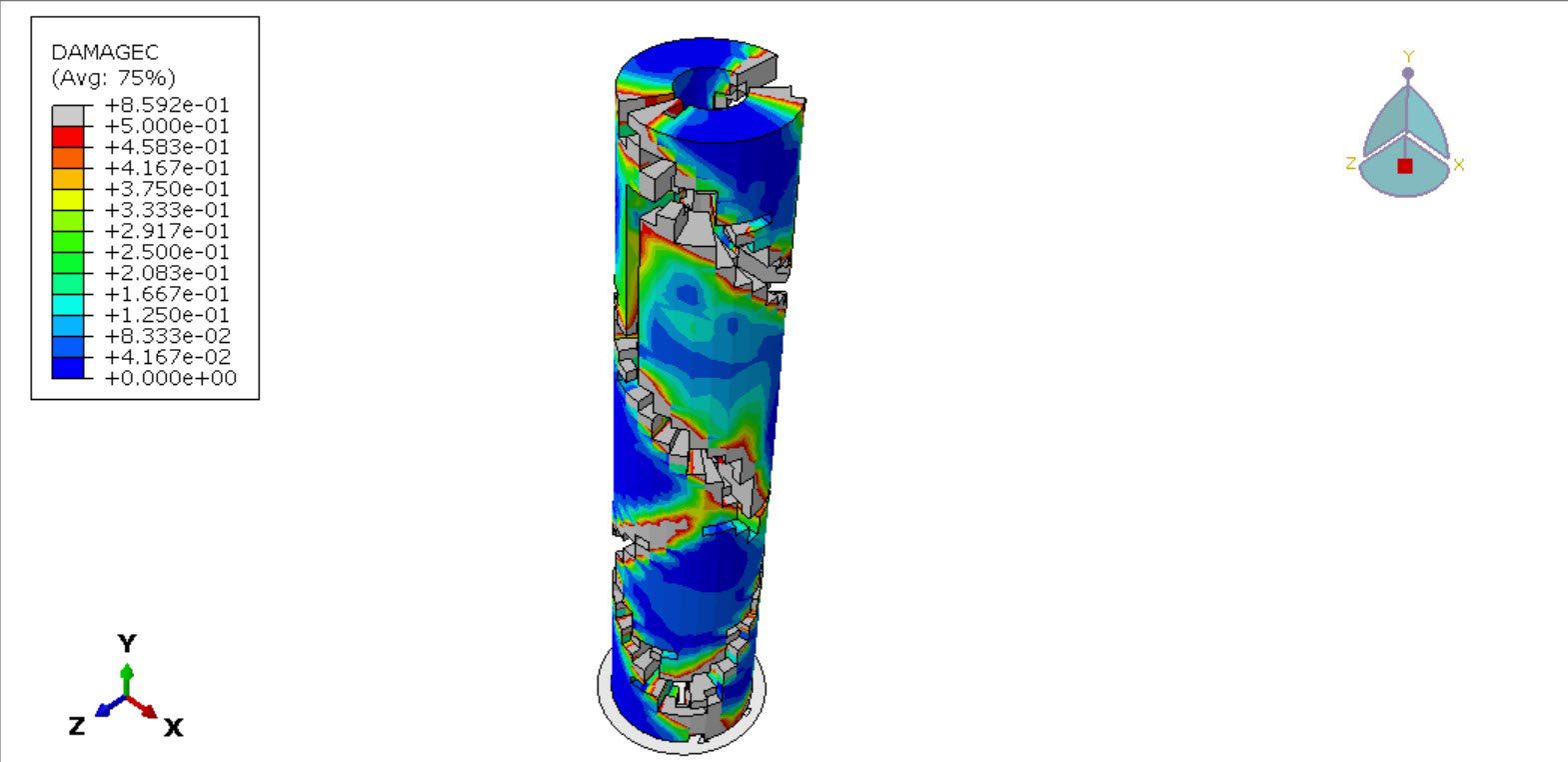
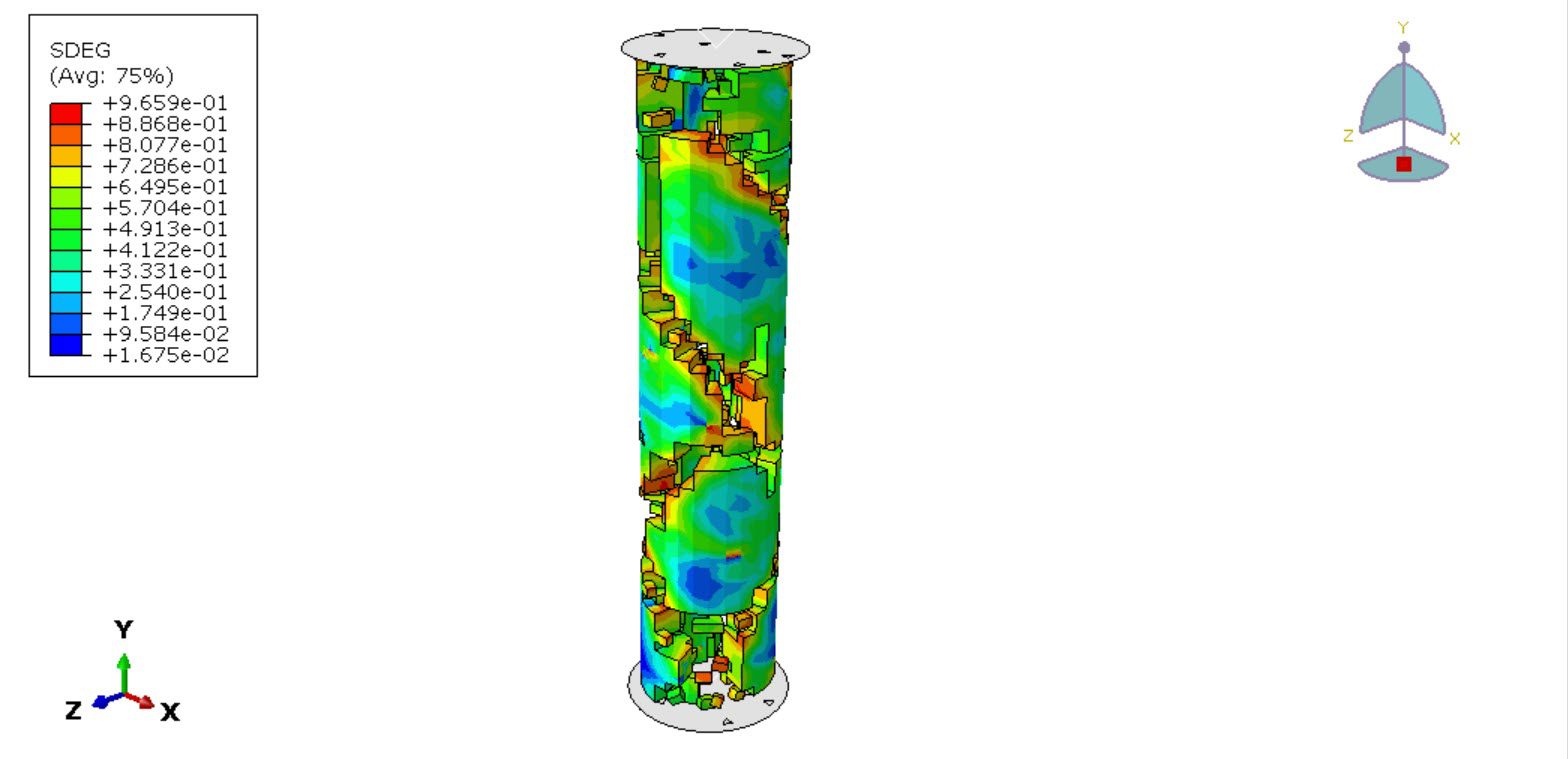
The numerical results provide insight into stress distribution, damage development, confinement effectiveness, and failure modes of UHPC-filled double-skin aluminium columns. Typical failure patterns include progressive UHPC damage, yielding and local buckling of the aluminium tubes, and redistribution of stresses within the composite section. The damage contour shown in the numerical results indicates significant localized crushing and degradation of the UHPC, while the surrounding aluminium tubes continue to provide confinement and maintain structural integrity. Such behavior demonstrates the potential of UHPC-filled double-skin aluminium columns as efficient lightweight structural members capable of sustaining high compressive loads while exhibiting improved ductility and energy absorption characteristics.
Need more than the files?
There are two ways we can help. Book a one hour online consultation if you want to talk a problem through with a CAE engineer, using the checkbox in the order box. Order a project if you need a full simulation built for you, delivered to an agreed scope, price and deadline under a written contract.
We work on FEA and CFD for engineers, researchers and companies. Order your project, or message us on WhatsApp for a quick reply.
Other packages engineers working on this topic also download.
 analysis of a composite column under air blast load
 Numerical analysis of the composite column, which includes normal and ultra-high performance geopolymer concrete under air blast load
 Behavior and punching capacity of flat slabs with the rational use of UHPFRC
 Static and dynamic compression test of a square cold-formed UHPC-filled dual steel stiffened slender column
 Buckling Analysis of a Concrete-Filled Steel Tube (CFST) Column Using Abaqus
 Ultra High Performance Fiber Reinforced Concrete (UHPFRC) Package
 Numerical analysis of square concrete-filled double skin steel tubular columns with rubberized concretese
 Analysis of the UHPC beam-column joint reinforced with steel angle and bolts

Need a full custom project? See the options below.

€129,00

€179,00

€149,00

€119,00

€129,00
See more
Want to receive push notifications for all major on-site activities?