

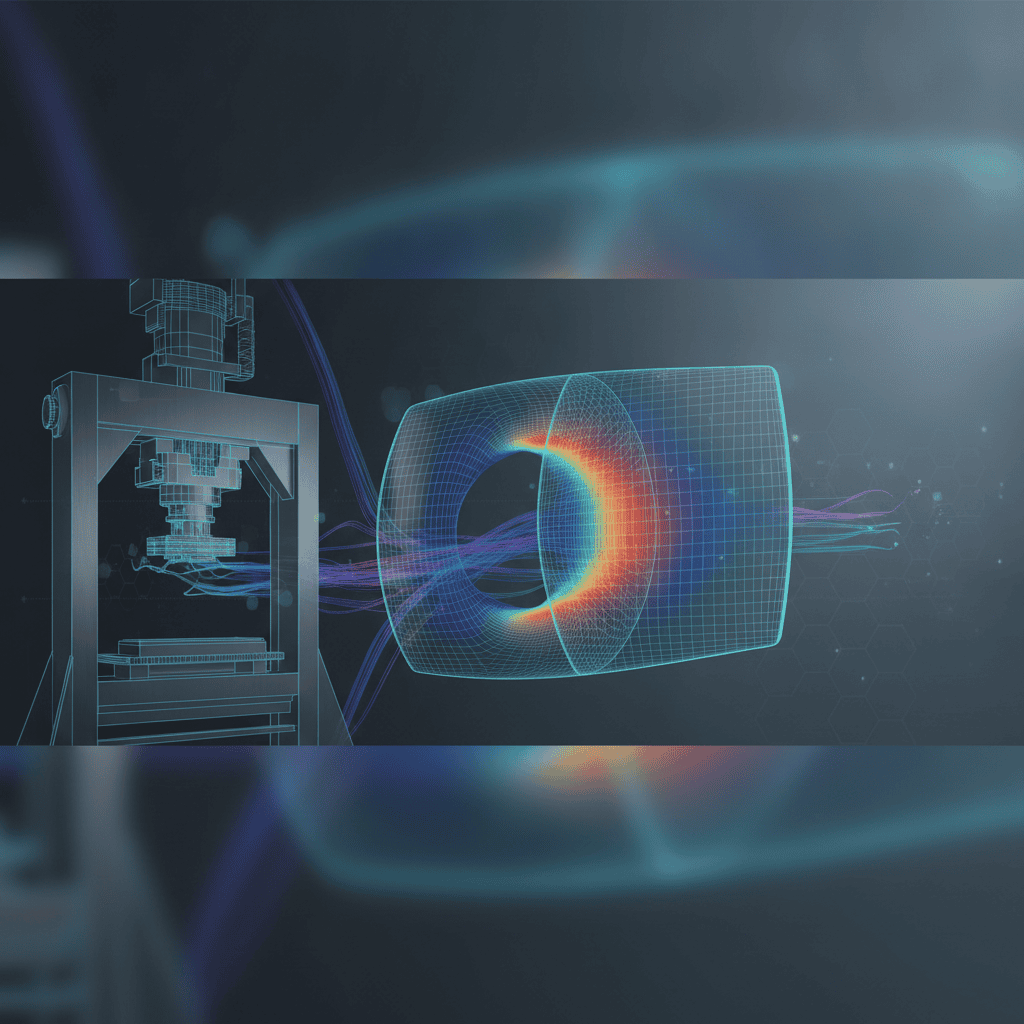
You’re probably scratching your head trying to simulate glass. It breaks too easily, and getting the material properties right feels like an uphill battle. You’re not alone. Glass is a uniquely challenging material for simulation engineers.
Accurately predicting how glass behaves under stress, impact, or temperature changes is crucial. Mistakes can lead to costly design flaws or even safety hazards. This guide is here to help you navigate the complexities of glass simulation in Abaqus, making your life a little easier.
Understanding Glass Simulation in Abaqus
So, what exactly is glass simulation? In simple terms, it’s using software like Abaqus to predict how glass structures will react to real-world conditions. This includes forces, heat, and impacts, all before you even build a physical prototype.
Why does it matter so much? Because glass is a brittle material. That means it doesn’t deform much before it fails. It often fails suddenly and catastrophically. Understanding these failure mechanisms is key for designing safe and reliable products, from architectural windows to smartphone screens or automotive windshields.
Engineers typically need glass simulation when they are:
- Designing new glass products or components.
- Evaluating existing designs for strength and durability.
- Investigating the cause of glass failure (forensic analysis).
- Optimizing manufacturing processes that involve thermal treatments for glass.
- Predicting impact resistance for safety standards.
It helps you predict stress concentrations, deformations, and most importantly, where and when the glass might break. This insight saves a ton of time and money compared to endless physical tests.
Your Step-by-Step Guide to Glass Analysis in Abaqus
Let’s walk through the typical process. Think of this as what a senior engineer would tell a junior engineer. It’s about setting up your model correctly to get reliable results.
1. Define Your Objective Clearly
Before you even open Abaqus, ask yourself: What exactly do I want to learn from this simulation? Are you looking for maximum stress? The exact failure point under a specific load? How it deforms under a uniform pressure? Having a clear goal helps you choose the right analysis type and material models.
2. Create or Import Your Geometry
This is where you bring your glass component into Abaqus. You can model it directly in Abaqus’s Part module or import it from CAD software. Keep your geometry clean and simplified where possible. Remove tiny features that won’t significantly affect your results, especially if they make meshing difficult. For example, small chamfers or fillets can often be ignored in early stages.
3. Define Material Properties: The Heart of Glass Simulation
This is arguably the most critical step for glass. Glass isn’t like steel. It’s brittle and can be very sensitive to temperature. You’ll need to define several properties:
- Elastic Properties: Young’s Modulus (how stiff it is) and Poisson’s Ratio (how it deforms perpendicularly to the load). These are standard for almost any material.
- Brittle Failure Model: This is crucial for glass. Abaqus offers several options. The Brittle Crack model is often used for tensile failure. For compressive crushing, you might look at a Drucker-Prager model. These models help predict when and where cracks will initiate and propagate.
- Thermal Properties: If temperature is a factor, you’ll need thermal expansion coefficients, specific heat, and thermal conductivity. Glass expands and contracts with temperature, causing significant thermal stresses.
- Damage Evolution: Once a crack starts, how does it grow? This helps simulate the post-failure behavior.
Always use reliable data for your material properties. Refer to industry standards or supplier datasheets. Guessing here will lead to inaccurate results.
4. Meshing Your Glass Component
Meshing divides your continuous geometry into small, discrete elements. Think of it like breaking down a complex problem into smaller, solvable pieces. For glass, meshing is super important because stress concentrations can lead to failure. You generally want a finer mesh in areas where you expect high stresses, like corners, edges, or impact zones.
- Element Type: For 3D solids, hexahedral (brick) elements are often preferred for their accuracy and stability. Tetrahedral elements are easier to mesh complex geometries but can be less accurate without careful refinement.
- Element Size: Start with a coarse mesh and refine it incrementally in critical regions. A good practice is to perform a mesh sensitivity study. This means running the simulation with progressively finer meshes until your results stop changing significantly.
- Aspect Ratio: Try to keep element aspect ratios close to 1. Long, thin elements can lead to inaccuracies.
5. Apply Loads and Boundary Conditions
Here, you tell Abaqus how your glass component will be loaded and supported in the real world.
- Loads: These are the forces acting on your part. This could be a uniform pressure (like wind on a window), a concentrated force (like an impact), or a thermal load (temperature change).
- Boundary Conditions: These define how your part is constrained. For example, if a glass panel is fixed along one edge, you’d apply a ‘fixed’ boundary condition to that edge, preventing movement in all directions. Make sure these conditions accurately reflect the physical setup. Over-constraining or under-constraining can lead to misleading results.
6. Define Interactions and Contact
If your glass part is in contact with other components, you need to define how they interact. This is critical for impact simulations or assemblies where glass sits in a frame.
- Contact Definition: Specify which surfaces are in contact.
- Contact Properties: Define friction (how much surfaces resist sliding) and normal behavior (how they respond to pressing against each other, typically ‘hard contact’ where surfaces can’t penetrate each other).
7. Choose Your Analysis Step
Abaqus offers different analysis types, or ‘steps’. Your choice depends on your objective:
- Abaqus/Standard: Good for static, quasi-static, and thermal stress analyses where inertial effects are negligible. Think of a window slowly deforming under wind pressure.
- Abaqus/Explicit: Essential for high-speed, dynamic events like impact or blast simulations. This is often preferred for glass failure problems because brittle fracture is a highly dynamic event.
For most brittle failure simulations, especially those involving crack propagation or impact, Abaqus/Explicit is usually the way to go.
8. Submit and Monitor Your Job
Once everything is set up, you submit your analysis job. Monitor its progress. Keep an eye on warnings and errors. Convergence issues, where the solver struggles to find a solution, are common. Sometimes, a small change in boundary conditions or mesh can resolve these.
9. Post-processing and Interpretation of Results
After the job completes, you use Abaqus/Viewer to visualize your results. Look at stress distribution (especially principal stresses, which indicate tension), deformation patterns, and predicted failure zones. Don’t just look at the pretty pictures; understand what the data means. Compare your simulation results with theoretical calculations or experimental data if available. This validation is key to building confidence in your model.
Common Mistakes and How to Avoid Them
Simulating glass can be tricky. Here are some frequent missteps and how to steer clear of them:
| Common Mistake | Impact on Results | How to Avoid |
|---|---|---|
| Using Ductile Material Models | Overestimates strength, fails to predict brittle fracture. | Always use specific brittle failure models (e.g., Brittle Crack, Concrete Damage Plasticity for glass-like behavior) in Abaqus. |
| Coarse Meshing in Critical Areas | Misses stress concentrations, inaccurate failure prediction. | Refine mesh in areas of expected high stress (corners, load application points). Perform a mesh sensitivity study. |
| Ignoring Temperature Effects | Misses thermal stresses, incorrect deformation and failure. | Include thermal expansion and conductivity if temperature changes are present. Run coupled thermal-mechanical analysis. |
| Incorrect Boundary Conditions | Artificially stiffens or frees the model, leading to inaccurate responses. | Carefully review real-world constraints. Use soft springs or friction for contact instead of full fixities where appropriate. |
| Simplifying Contact Too Much | Leads to inaccurate load transfer and stress distribution. | Define realistic contact interactions, including friction. Consider surface-to-surface contact over node-to-surface for better accuracy. |
| Neglecting Dynamic Effects for Impact | Results in incorrect stress wave propagation and energy absorption. | Use Abaqus/Explicit for impact, blast, or rapid loading scenarios to capture inertial effects accurately. |
Understanding Brittle vs. Ductile Behavior
Glass is a classic brittle material. It means it doesn’t yield much. There’s no significant plastic deformation before it fractures. Ductile materials, like many metals, deform plastically before breaking. If you apply a ductile material model to glass, your simulation will inaccurately predict that the glass can bend and stretch a lot more than it actually can. This is a critical error. Always choose a material model specifically designed for brittle failure in Abaqus.
Mesh Refinement is Not Optional
Stress concentrations are hot spots where stress levels spike. For brittle materials like glass, these are the typical initiation points for cracks. If your mesh is too coarse in these areas, your elements are too big to ‘see’ these high stresses. You’ll get an averaged, lower stress value, completely missing the actual failure point. Always refine your mesh in critical zones. It’s an iterative process, but it pays off in accuracy.
Thermal Stresses Are Real
Glass is often exposed to varying temperatures. Think of a hot sunny day on a window, or a cold drink glass getting hot water poured into it. Glass has a coefficient of thermal expansion. When it heats up, it tries to expand; when it cools, it contracts. If this expansion or contraction is restrained (like by a frame), it creates significant thermal stresses. These stresses can easily be enough to cause brittle fracture. Don’t forget to include these effects if your glass operates in a changing thermal environment.
What You Get in This Package
Setting up a comprehensive glass simulation from scratch can be incredibly time-consuming. You need to gather material data, select appropriate failure models, create the geometry, define complex interactions, and refine your mesh. This is especially true for advanced scenarios like impact or thermal shock.
That’s where ready-to-run simulation packages come in. A package like the Glass Analysis Package in Abaqus is designed to shortcut this entire process for you. Typically, you’d receive:
- Ready-to-Run Abaqus Files: These are pre-built .cae, .inp, or similar files. They already contain the geometry, material definitions, loads, and boundary conditions for common glass analysis scenarios. You don’t have to start from an empty slate.
- Step-by-Step Documentation: Clear, concise instructions guide you through loading the model, running the analysis, and interpreting the results. This is invaluable, especially if you’re new to glass simulation or Abaqus. It’s like having an experienced colleague guide you.
- Example Models: Often, these packages include several variations or common applications. This allows you to quickly adapt a validated model to your specific needs.
- Validation Cases: Many packages provide verification against analytical solutions or experimental data. This gives you confidence that the models are set up correctly and produce accurate results.
Using a pre-built package drastically reduces setup time, helps you avoid common mistakes, and accelerates your learning curve. You can focus on understanding the physics and interpreting results, rather than spending hours debugging a model setup. Take a closer look at what’s available here: Glass Analysis Package in Abaqus
Summary: Master Glass Simulation
Glass simulation in Abaqus, while challenging, is incredibly powerful. By understanding its brittle nature, carefully defining material properties, refining your mesh, and choosing the right analysis type, you can accurately predict its behavior and design more robust products. Remember to always define your objective clearly, avoid common pitfalls like incorrect material models or coarse meshing, and leverage ready-made solutions to save time.
With practice and a structured approach, you’ll gain confidence in simulating glass and unlock a new level of design insight.
Frequently Asked Questions About Glass Simulation
What’s the best material model for glass in Abaqus?
For brittle materials like glass, the Abaqus Brittle Crack model is commonly used to simulate tensile failure. If you’re looking at compressive crushing, you might consider the Concrete Damaged Plasticity model, which can capture glass-like behavior under compression. The choice depends on the specific failure mode you are investigating.
How do I define brittle failure for glass in Abaqus?
In Abaqus, you define brittle failure by adding the ‘Brittle Crack’ sub-option under ‘Mechanical’ -> ‘Plasticity’ for your material properties. You’ll input parameters like the brittle stress (tensile strength) and possibly fracture energy data to describe crack initiation and propagation.
Should I use Abaqus/Standard or Abaqus/Explicit for glass simulation?
For high-speed events like impact, blast, or rapid fracture propagation, Abaqus/Explicit is generally recommended. Its algorithm is well-suited for highly nonlinear, dynamic problems. For static loads, thermal stresses, or quasi-static processes where inertial effects are negligible, Abaqus/Standard can be used, but for complex brittle failure, Explicit often provides more robust solutions.
How important is meshing for accurate glass simulation results?
Meshing is critically important for glass. Because glass is brittle and fails at stress concentrations, a fine mesh is essential in areas where high stresses or crack initiation are expected. A coarse mesh can smooth out stress peaks, leading to an inaccurate prediction of failure location and load. Always perform a mesh sensitivity study.
Can I simulate crack propagation in glass using Abaqus?
Yes, Abaqus offers several methods for simulating crack propagation in brittle materials like glass. The Extended Finite Element Method (XFEM) is a powerful tool that allows cracks to propagate independently of the mesh. Alternatively, damage models coupled with element deletion can also be used to simulate fracture.
What about temperature effects on glass in Abaqus?
Temperature effects are very important for glass. You should define the coefficient of thermal expansion in your material properties. For problems involving significant temperature changes, consider performing a coupled thermal-mechanical analysis. This allows Abaqus to calculate both temperature distribution and the resulting thermal stresses, which can be a primary cause of glass failure.
What is a good external resource for Abaqus brittle material modeling?
For detailed technical insights into brittle material modeling in Abaqus, the official Abaqus Documentation is an excellent resource. Specifically, look into sections on ‘Brittle Cracking’ and ‘Concrete Damaged Plasticity’ models for a deeper understanding of their implementation and application. Abaqus Documentation









