

Abaqus Integration Point vs Nodal Stress: Why Peaks Differ
Compare integration-point, element-nodal and unique-nodal stress in Abaqus, and check whether a contour peak depends on extrapolation, averaging or mesh size.
Harmonic Response Analysis in ANSYS Workbench: A Practical Guide

How to set up harmonic response analysis in ANSYS Workbench: modal link, frequency range, solution method, damping, loads and results, plus the common mistakes.
Abaqus Shell Section Points: Where Your Stress Output Comes From
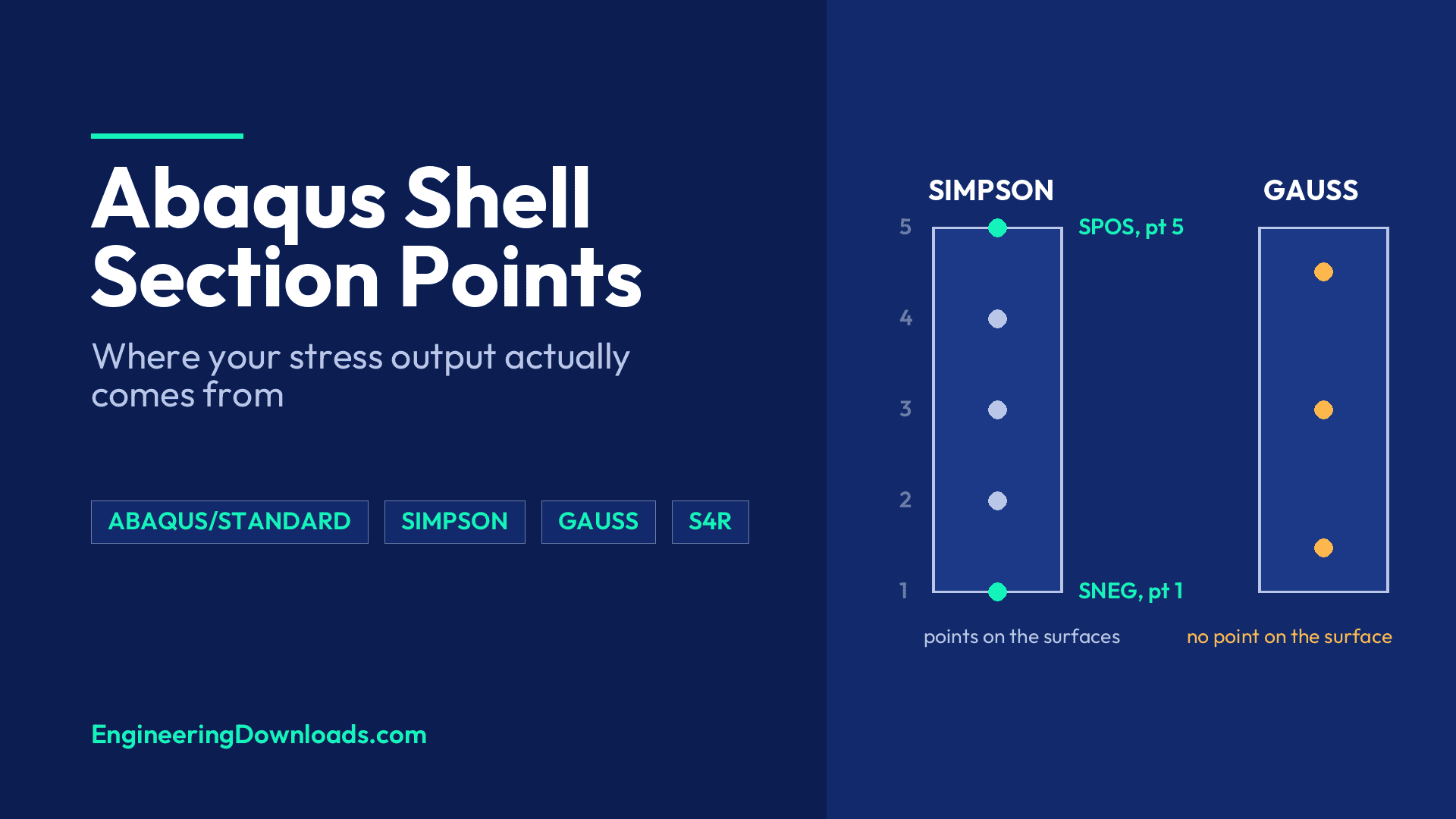
What Abaqus shell section points are, the defaults you never chose, Simpson vs Gauss, SNEG and SPOS, and how to request the output location you actually need.
Abaqus NLGEOM On or Off: When Geometric Nonlinearity Changes Your Answer

What the Abaqus NLGEOM switch really does, why Standard and Explicit have opposite defaults, and how to decide which of your two answers to trust.
ANSYS SMART Crack Growth: A Practical Setup Guide

A practical, step-by-step setup guide for ANSYS SMART crack growth: mesh rules, crack objects, Paris law units, stop criteria and the mistakes that stop the crack from growing.
Abaqus Reduced Integration vs Full Integration: How to Choose
Abaqus reduced integration vs full integration explained: when C3D8R, C3D8I or C3D20R is right, and how to avoid shear locking and hourglassing.
Sequentially Coupled Thermal-Stress Analysis in Abaqus: Step-by-Step Guide
Sequentially coupled thermal-stress analysis in Abaqus, step by step: write NT to the ODB, map temperatures, match step times and avoid zero stress.
Abaqus Field Output vs History Output: A Practical Guide

Abaqus field output vs history output: what each one does, how to request it, how to fix a jagged load-displacement curve and shrink a huge ODB file.
Abaqus Symmetry Boundary Conditions: Practical Guide and Common Traps

Abaqus symmetry boundary conditions explained: XSYMM, YSYMM, ZSYMM, antisymmetry, when symmetry is wrong, and how to read reaction forces right.
Abaqus Tie Constraint: How to Set It Up and Fix Overconstraints
Abaqus tie constraint explained: when to use it, main vs secondary surface, position tolerance, ADJUST, and how to fix overconstraint errors fast.