Need a full custom project? See the options below.
Need a full custom project? See the options below.
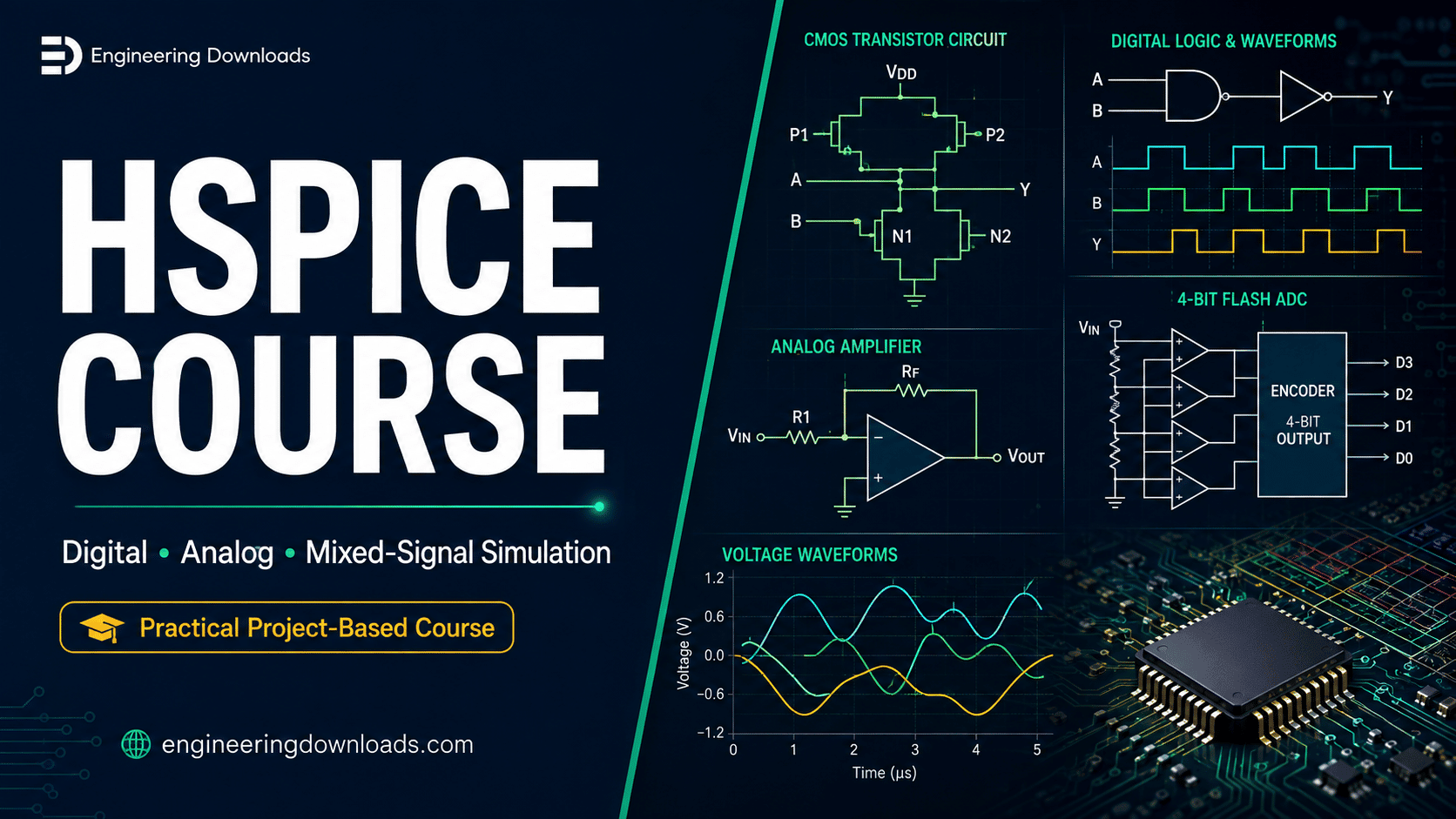
Are you looking for a complete HSPICE course that takes you from zero to designing complex mixed-signal circuits? Whether you are a university student, a research engineer, or a hardware enthusiast, this HSPICE simulation course is designed to give you hands-on experience with real-world projects.
In this HSPICE course for beginners, you don’t just watch theory. You simulate, analyze, and optimize circuits step by step. By the end, you will be able to design a complete 4‑bit Flash ADC, perform Monte Carlo analysis, and export results to MATLAB or Python for advanced post‑processing.
This online HSPICE course is divided into three comprehensive sessions. Each session builds on the previous one, ensuring a smooth learning curve.
Get familiar with the HSPICE environment and essential companion tools (SpiceExplore, EmEditor).
Simulate a CMOS inverter and study the effect of load capacitance on delay.
Learn transient analysis and measure rise time, fall time, and propagation delay.
Simulate basic logic gates: NAND, NOR, AND, OR, XOR.
Use subcircuits to build modular designs like a Half Adder, Full Adder, and a 4‑bit Ripple Carry Adder.
Extend your design to 8‑bit or 16‑bit adders without redesigning from scratch.
Master the .measure command to calculate delay and identify the critical path.
Analyze RC and LC filters: low-pass, high-pass, band-pass, and band-stop.
Extract frequency response using AC analysis and calculate cutoff and resonance frequencies.
Design a single-stage common-source amplifier with resistive and transistor loads.
Dive into differential amplifiers with active loads and current sources.
Learn transistor sizing guidelines for power, gain, and bandwidth.
Design a two‑stage operational amplifier and understand its stability issues.
Apply Miller compensation (with and without series resistor) to improve phase margin.
Run Monte Carlo analysis to evaluate circuit robustness against process variations.
Export HSPICE results to MATLAB or Python for advanced data visualization and statistical processing.
Design and simulate a 4‑bit Flash ADC:
Resistor ladder for reference voltages.
Dynamic comparators for low‑power operation.
Thermometer‑to‑binary encoder with bubble‑error correction using Gray code.
Analyze ADC performance with FFT:
Measure SNR, SNDR, THD, SFDR, and ENOB (Effective Number of Bits).
Simulate with a ramp input to verify static performance.
Apply a sinusoidal input to evaluate dynamic behavior.
Explore emerging technologies:
CNTFET (Carbon Nanotube FET) and FinFET models in HSPICE.
Compare delay and power consumption with conventional CMOS.
Learn how to define and simulate advanced device models in HSPICE.
✅ Project‑Based Learning – Every concept is reinforced with practical simulations.
✅ Step‑by‑Step Guidance – No prior HSPICE experience required.
✅ Complete Simulation Files – All netlists, scripts, and exercise files are included.
✅ MATLAB & Python Integration – Learn to export and process simulation data.
✅ Covers Both Digital & Analog – A truly comprehensive HSPICE course.
✅ Emerging Technologies – Stay ahead with CNTFET and FinFET simulations.
✅ Lifetime Access – Learn at your own pace, anytime, anywhere.
Electronics and Electrical Engineering students who want to master circuit simulation.
Graduate students and researchers working on analog, digital, or mixed‑signal IC design.
Hardware design engineers looking to upgrade their simulation skills.
Anyone interested in learning HSPICE from the ground up with a practical approach.
🎥 High‑quality video lectures (over 6 hours of content).
📁 Downloadable netlists and simulation scripts.
📊 MATLAB and Python scripts for post‑processing.
📝 Practice exercises and projects with solutions.
🔧 Lifetime updates and access to future content.
Karwan Javanmardi is an experienced circuit design instructor with a passion for teaching practical, industry‑relevant skills. This HSPICE course is the result of years of teaching and research experience, distilled into a clear, structured, and engaging learning path.
Don’t waste time with fragmented tutorials or outdated resources. Join this complete HSPICE simulation course and start designing your own circuits with confidence.
Want a hands-on electronics project to go with this course? See the Arduino digital multimeter with ACS712 and ATmega328P (Proteus simulation + source code).
Need more than the files?
There are two ways we can help. Book a one hour online consultation if you want to talk a problem through with a CAE engineer, using the checkbox in the order box. Order a project if you need a full simulation built for you, delivered to an agreed scope, price and deadline under a written contract.
We work on FEA and CFD for engineers, researchers and companies. Order your project, or message us on WhatsApp for a quick reply.
Other packages engineers working on this topic also download.
 Arduino Digital Multimeter (PowerLens): ATmega328P & ACS712 Proteus Simulation + Source Code
 Fixed Tubesheet Heat Exchanger in Ansys MAPDL: Plastic Load and Limit Load Replication of a Journal Paper€99,00
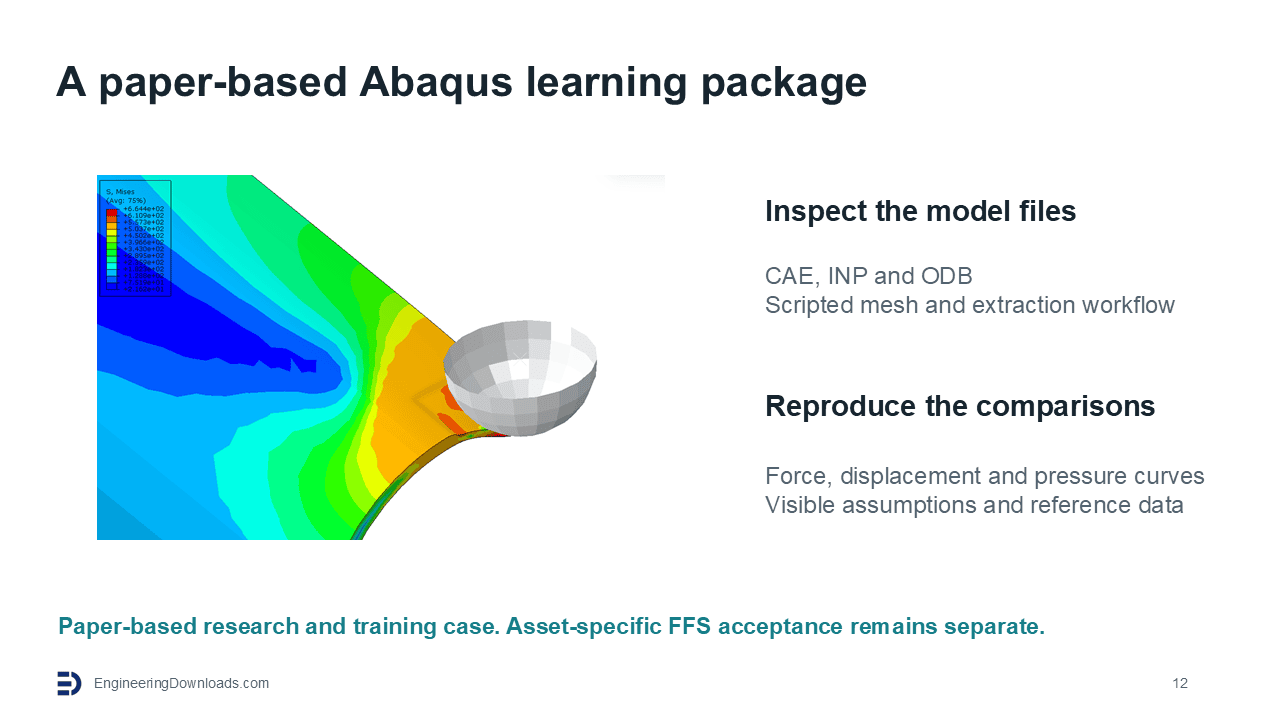 Pipeline Dent and Corrosion Analysis in Abaqus: Level 3 FFS Modelling
 Laser Metal Deposition in Simufact
 Behavior of hollow core square reinforced concrete columns wrapped with CFRP with different fiber orientations
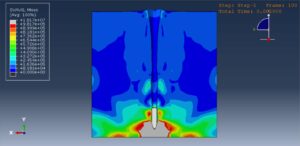 CEL analysis of the large defomation- Bullet penetraion into the soil
 Contact Pressure Distribution on Subgrade Soil Underlying Geocell Reinforced Foundation Beds
 Determination of Johnson–Cook Plasticity Model Parameters for Inconel718

Need a full custom project? See the options below.

€129,00

€179,00

€149,00

€119,00

€129,00

€149,00
See more
Want to receive push notifications for all major on-site activities?