


Need a full custom project? See the options below.
Need a full custom project? See the options below.
This is a ready-to-use Abaqus model of a four-point bending test on a timber-steel composite beam. A timber member and a steel beam are joined with bolts and loaded in four-point bending, so you can see how the two materials and the bolted connection work together as the beam moves from elastic into nonlinear behaviour.
Timber is modelled with orthotropic elasticity and Hill anisotropic plasticity, the steel beam and bolts use an elastic-plastic law, and all parts interact through surface-to-surface contact. The analysis runs as a quasi-static simulation in Abaqus/Explicit. You get the .cae and .inp files, reference papers and a step-by-step video tutorial.
Timber-steel composite beams combine the light weight and low carbon footprint of wood with the strength and stiffness of steel. They are used in floors, bridges, retrofits and hybrid timber buildings. Their bending performance depends heavily on the bolted connection: how much the parts slip, how the timber crushes around each bolt, and how the load is shared between the timber and the steel section.
Building this in Abaqus is not easy. Timber needs direction-dependent stiffness and yield, the bolts need contact with both materials, and a bending test with many contact pairs can struggle to converge in an implicit solver. This package gives you a working model where these choices are already made, so you can focus on the results and your own study.
A three-dimensional bolted timber-steel composite beam is loaded in a four-point bending setup. The two load points create a zone of constant bending moment between them, which is where the composite action and the connection behaviour are easiest to study.
Abaqus/CAE and Abaqus/Explicit. Orthotropic elasticity, Hill potential plasticity and general contact features are all standard Abaqus options, so no user subroutine is needed.
The hard part of a timber-steel beam study is getting anisotropic timber, plastic bolts and many contact pairs to run together. Here that work is done. Use the model to learn the method, save weeks on a research project, or build your own parametric study with different bolt spacing, bolt sizes, timber grades or steel sections.
A note on accuracy: this is a numerical study. For design or published conclusions, validate the model against experimental data and apply suitable timber strength and failure criteria.
Engineering Downloads offers a quality guarantee: if the model does not match its description, contact us and we will make it right.
You need Abaqus/CAE with Abaqus/Explicit. The .inp file is included, which makes it easier to run the model in a different Abaqus version.
A bolted beam has many contact surfaces, and implicit solvers can have convergence problems with them. Running the test as a slow, quasi-static explicit analysis avoids most of these issues. A good habit is to check that kinetic energy stays small compared with internal energy, so inertia does not affect the results.
Timber uses orthotropic elasticity defined by engineering constants, plus plasticity with the Hill criterion. This captures the different stiffness and yield strength of wood along and across the grain.
No. The model focuses on elastic-plastic behaviour, contact and the force-displacement response. Damage or fracture criteria can be added on top of it if your study needs them.
No. This is a four-point bending test. Two load points create a region of constant moment with no shear between them, which is useful for studying composite action and connection behaviour.
Yes. Our team can extend this model or build a custom timber or composite beam simulation through our FEA and CFD consultation services.
Browse more ready-to-use models in the Engineering Downloads shop.
Need more than the files?
There are two ways we can help. Book a one hour online consultation if you want to talk a problem through with a CAE engineer, using the checkbox in the order box. Order a project if you need a full simulation built for you, delivered to an agreed scope, price and deadline under a written contract.
We work on FEA and CFD for engineers, researchers and companies. Order your project, or message us on WhatsApp for a quick reply.
Other packages engineers working on this topic also download.
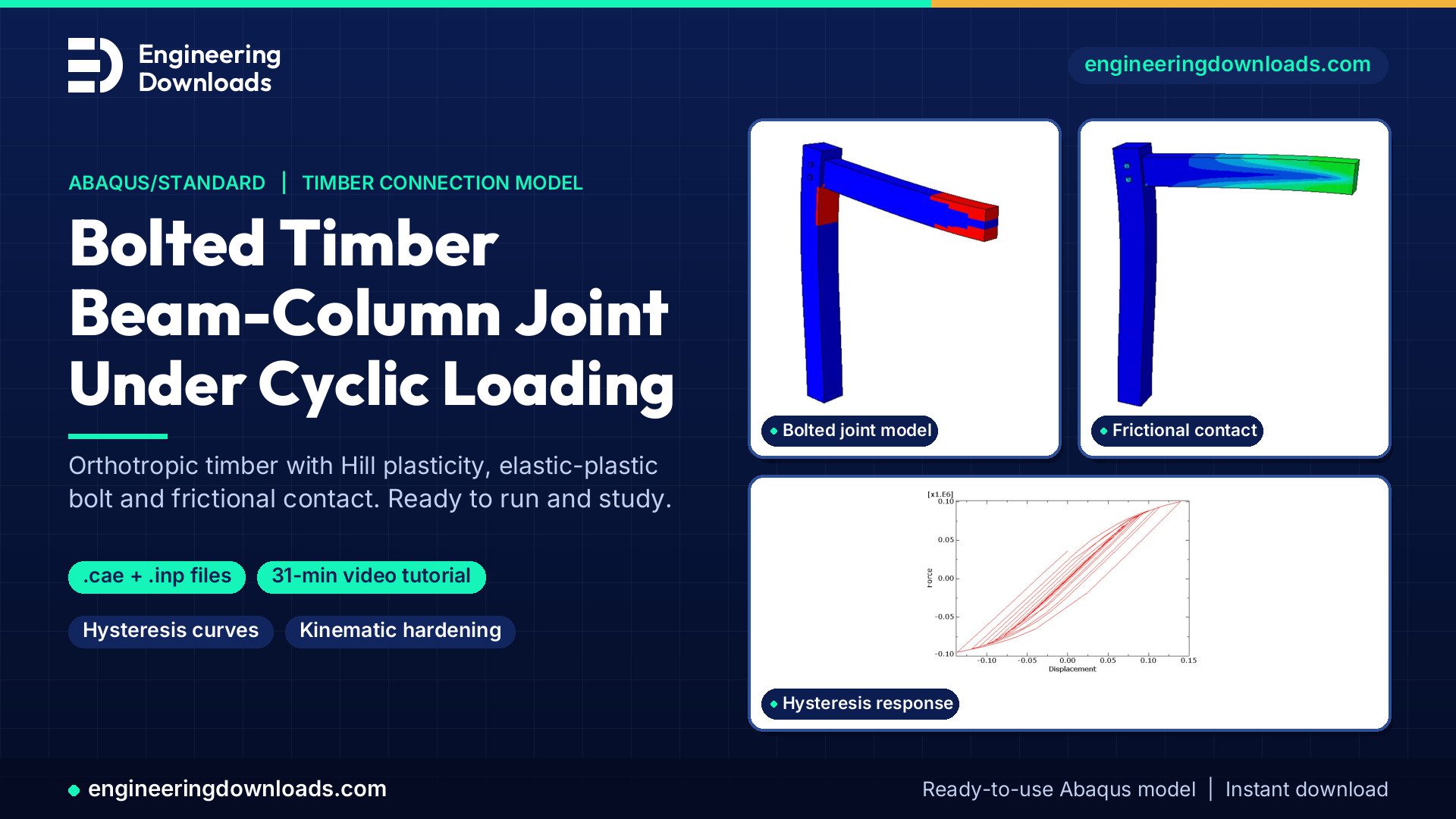 Bolted Timber Beam-Column Joint Under Cyclic Loading in Abaqus: Hill Plasticity & Hysteresis
 Concrete Cover Effect on Steel–Concrete Bond-Slip in SRC Members: Abaqus CDP & Cohesive Model
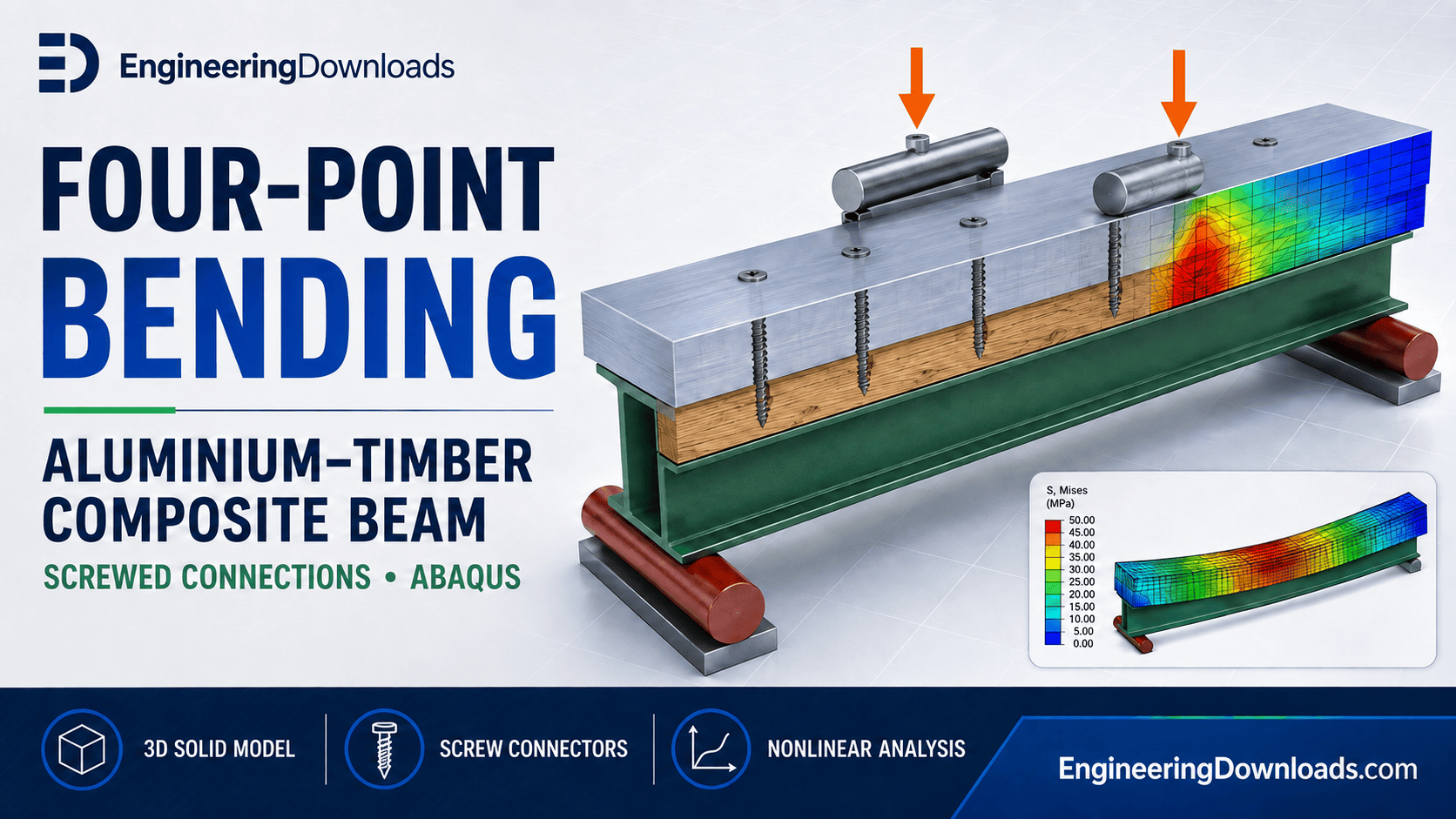 Analysis of aluminium-timber under four-point bending test
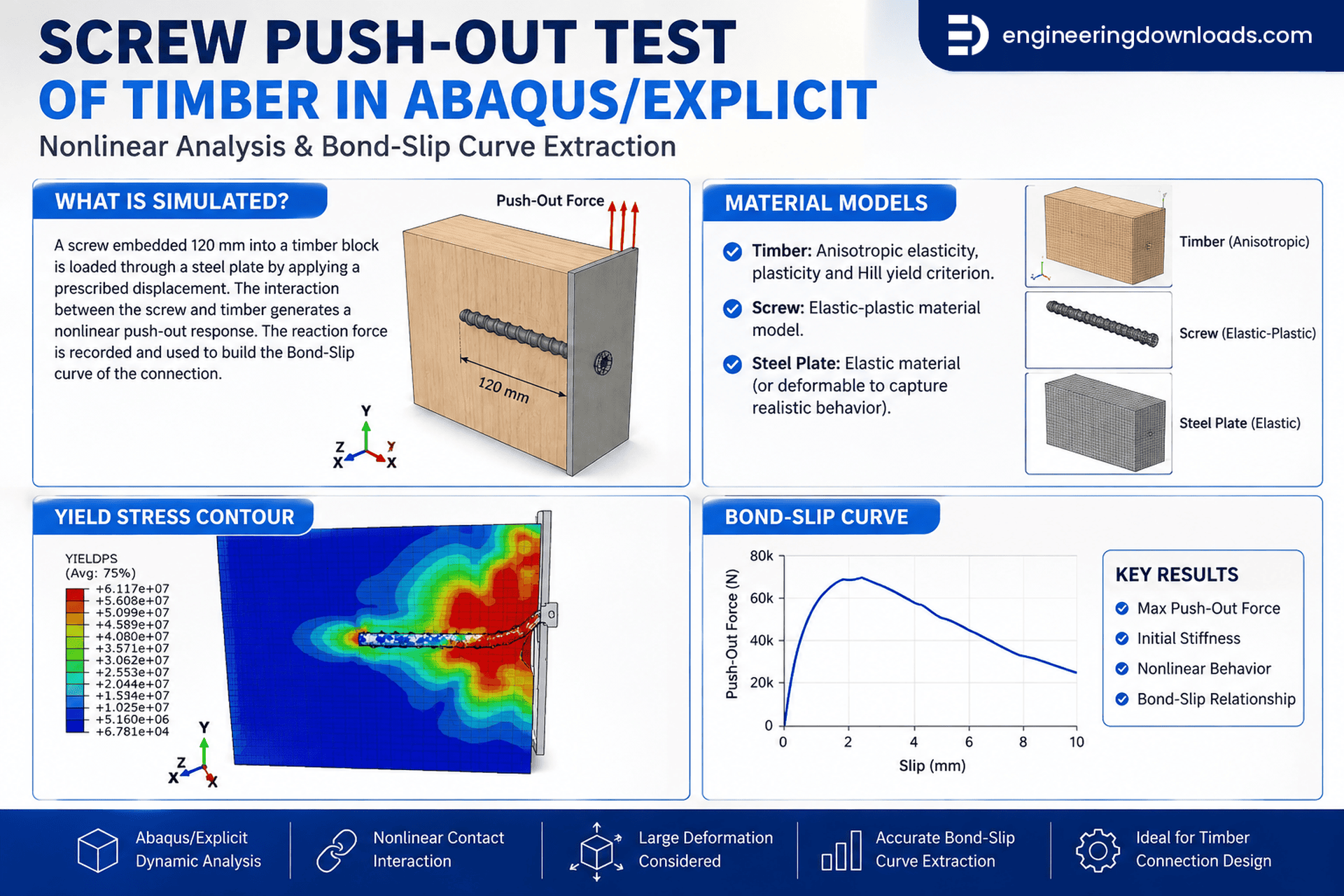 Screw Push-Out Test of Timber in Abaqus/Explicit: Bond-Slip Curve Simulation
 Fire Analysis of Timber–Steel Bolted Connections in Abaqus | Sequential Thermal–Structural Simulation
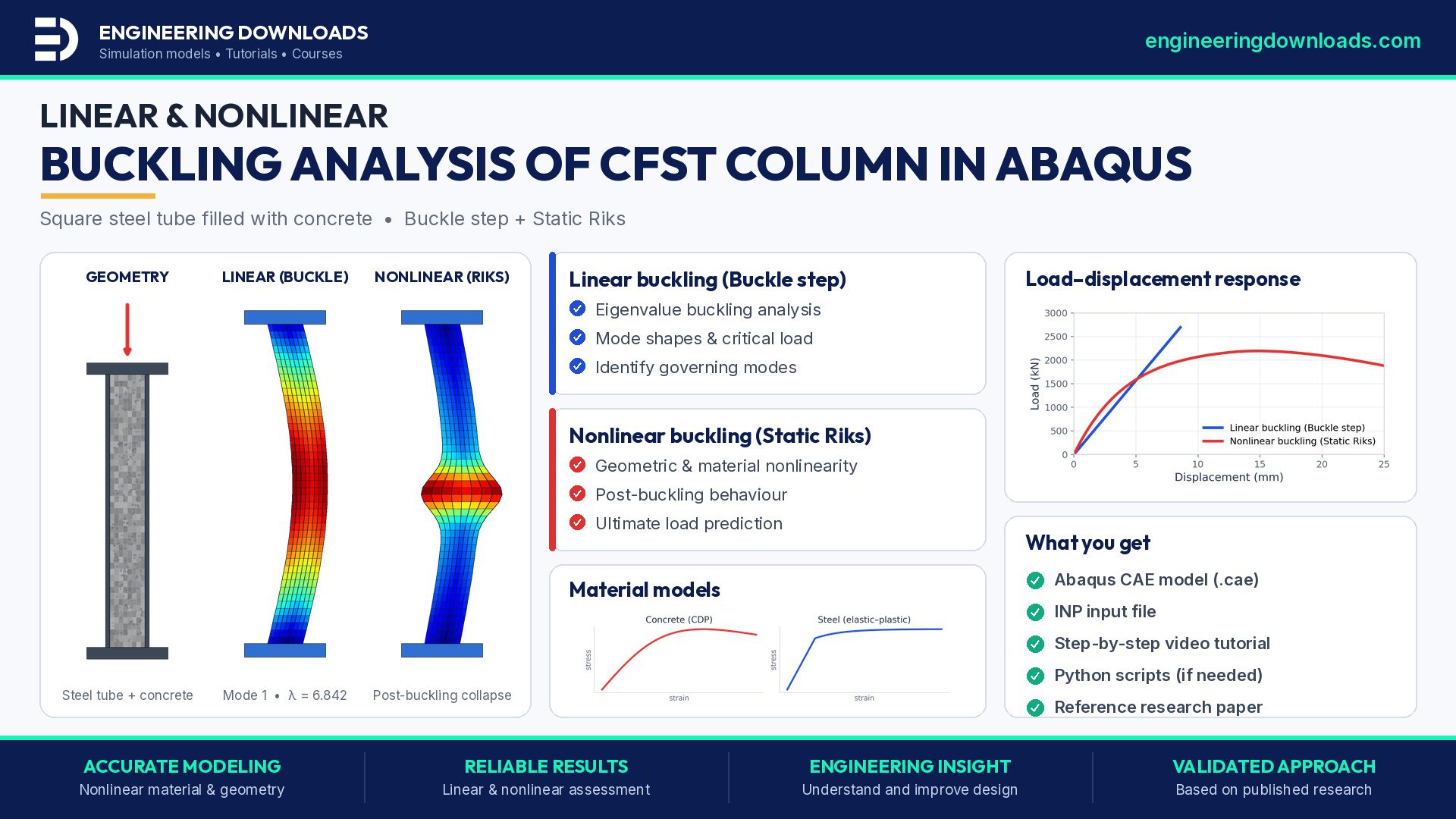 Buckling Analysis of a Concrete-Filled Steel Tube (CFST) Column Using Abaqus
 Abaqus Simulation of a Steel Stud Push-Out Test in a Voided Reinforced Concrete Slab
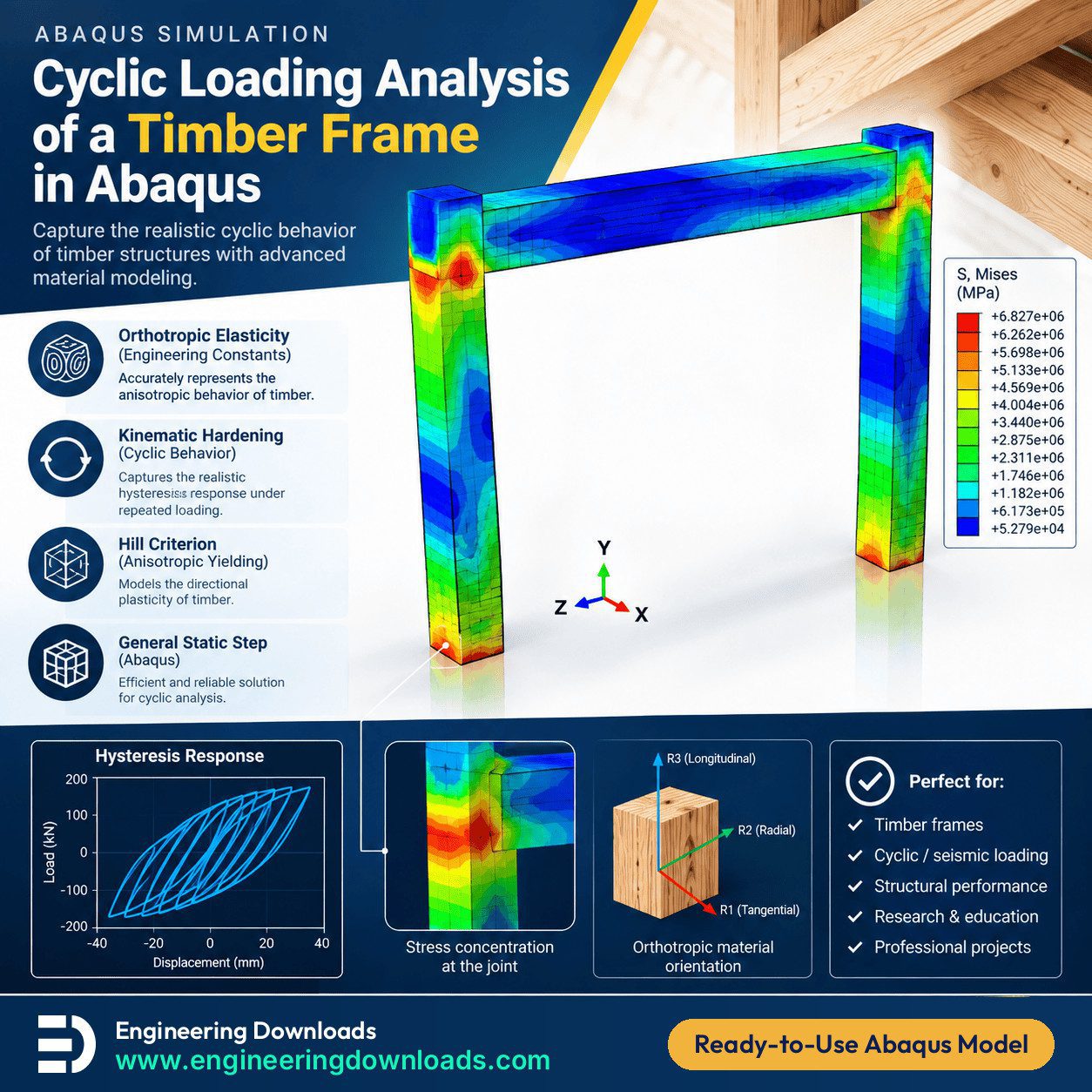 Seismic Cyclic Analysis of a Timber Frame in Abaqus: Hill Plasticity & Hysteresis

Need a full custom project? See the options below.

€129,00

€179,00

€149,00

€119,00

€129,00

€149,00
See more
Want to receive push notifications for all major on-site activities?




