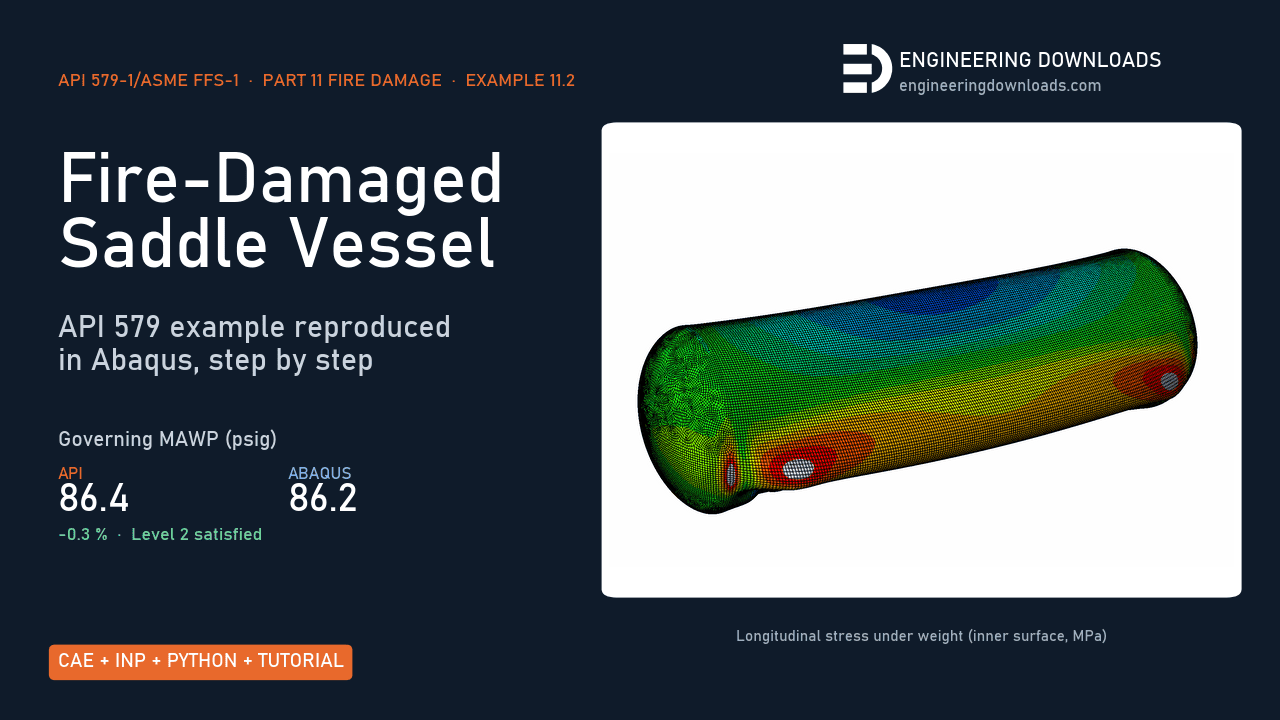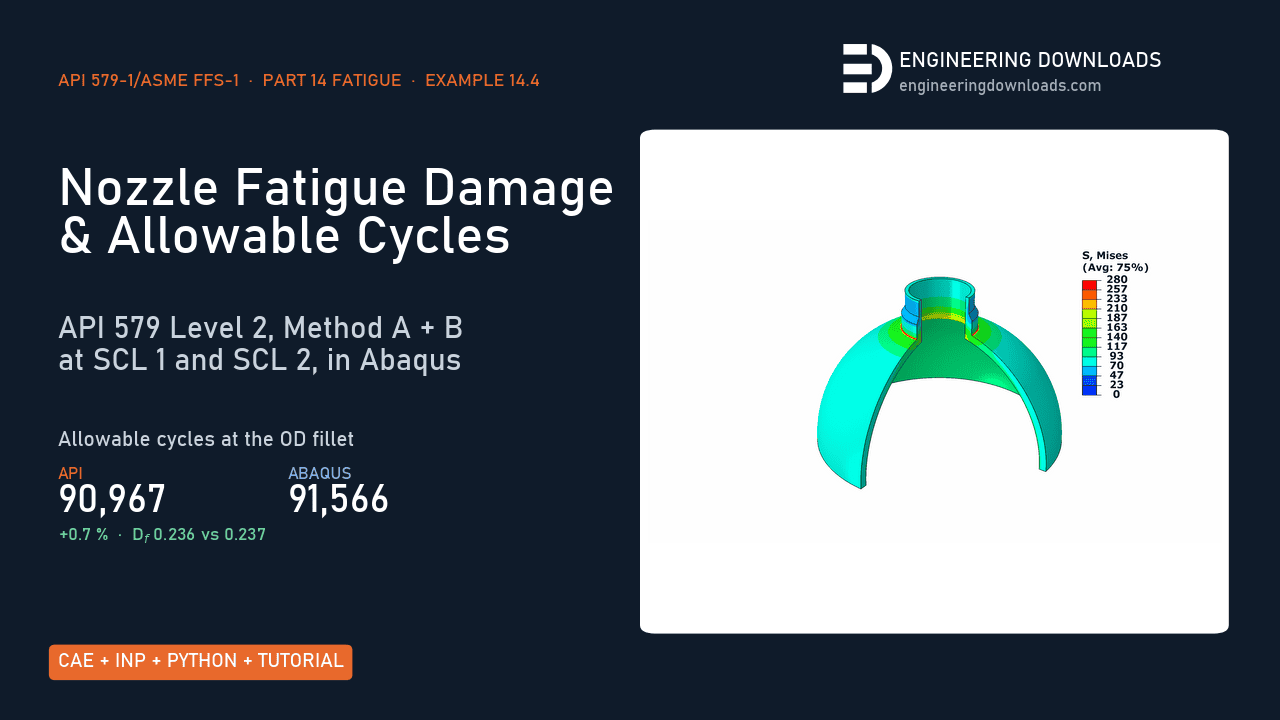
API 579 Example 4.7 in Abaqus: Corroded Conical Transition, Level 3 FFS

€129,00 €149,00
Optional extras

Need a full custom project? See the options below.

€129,00 €149,00
Optional extras

Need a full custom project? See the options below.

7 people watching this product now!

Material Includes

  • PDF tutorial document
  • Abaqus CAE files
  • Abaqus INP files
  • Python scripts and inspection data

Audience

  • Integrity and inspection engineers working with API 579 metal loss
  • FEA engineers who need a checked Level 3 workflow
  • Consultants who want a traceable, validated example
  • MSc and PhD students working on corroded vessels and shell junctions

What You Will Learn?

  • Reproduce the Level 2 assessment of API 579 Example 4.7, all 17 printed values, from the raw inspection grid.
  • Map a 10 x 12 thickness grid onto a 3D Abaqus solid model of a cylinder-cone-cylinder transition.
  • Keep the thinnest reading exact, with a fixed outer surface and the future corrosion allowance applied once.
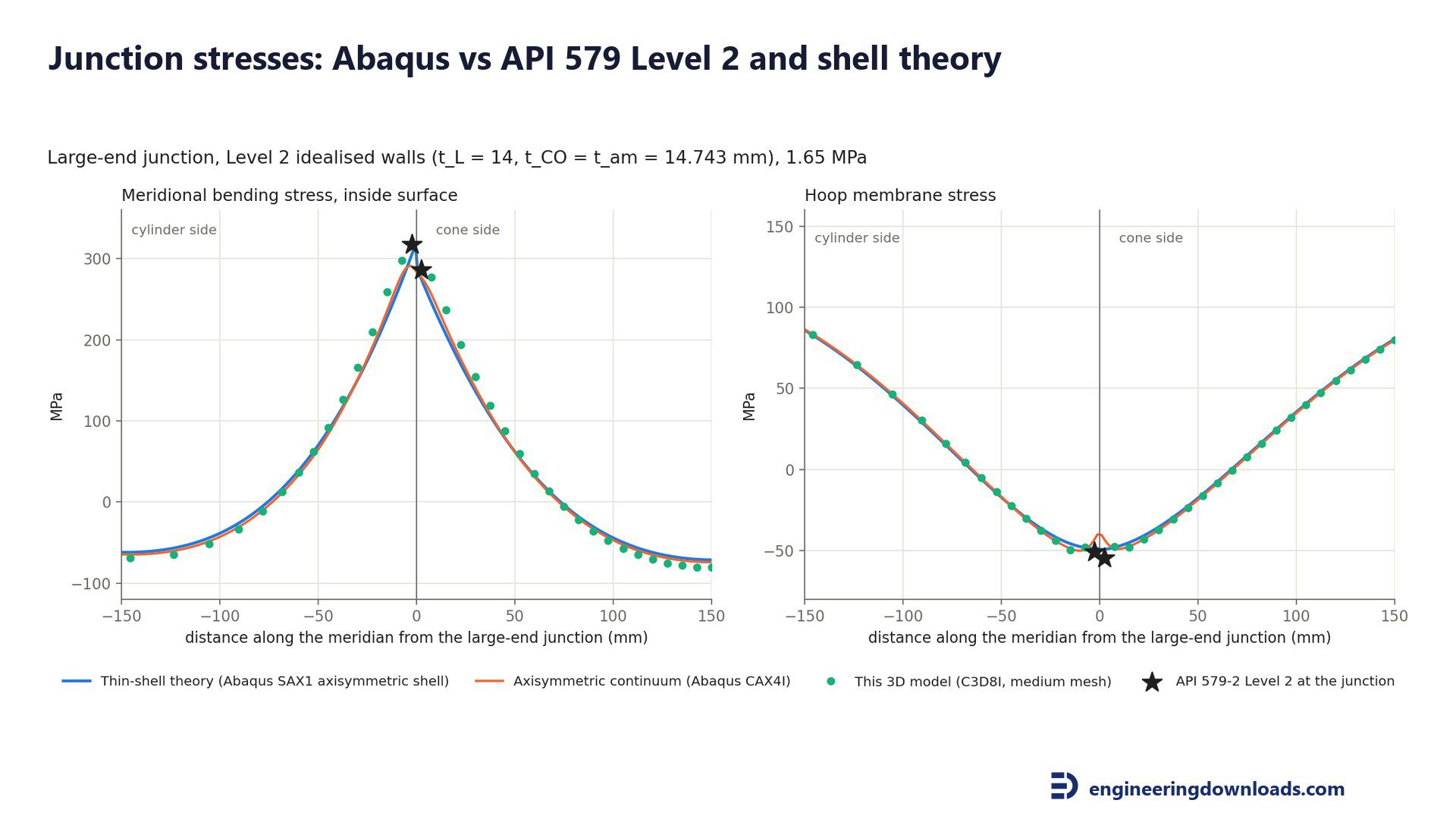
  • Compare the Abaqus junction stresses with the ASME VIII-2 design-by-rule values used in the manual.
  • Run an API 579 limit-load analysis for protection against plastic collapse.
  • Find the collapse pressure with a Riks analysis and bracket it with closed-form limits.
  • Run an elastic-plastic local-failure check with the ASME VIII-2 strain limit and the Annex 3-D stress-strain curve.
  • Linearise stresses through the wall and read results without trusting a single peak value.
  • Validate a model against shell theory, closed-form equilibrium and independent axisymmetric models.

About Course

A corroded patch next to a cone-to-cylinder junction is a hard case for a hand calculation. API 579 Level 2 averages the thin spot into one thickness and checks the junction with shell formulas. It does not show you where the vessel actually yields, or how much margin is left.

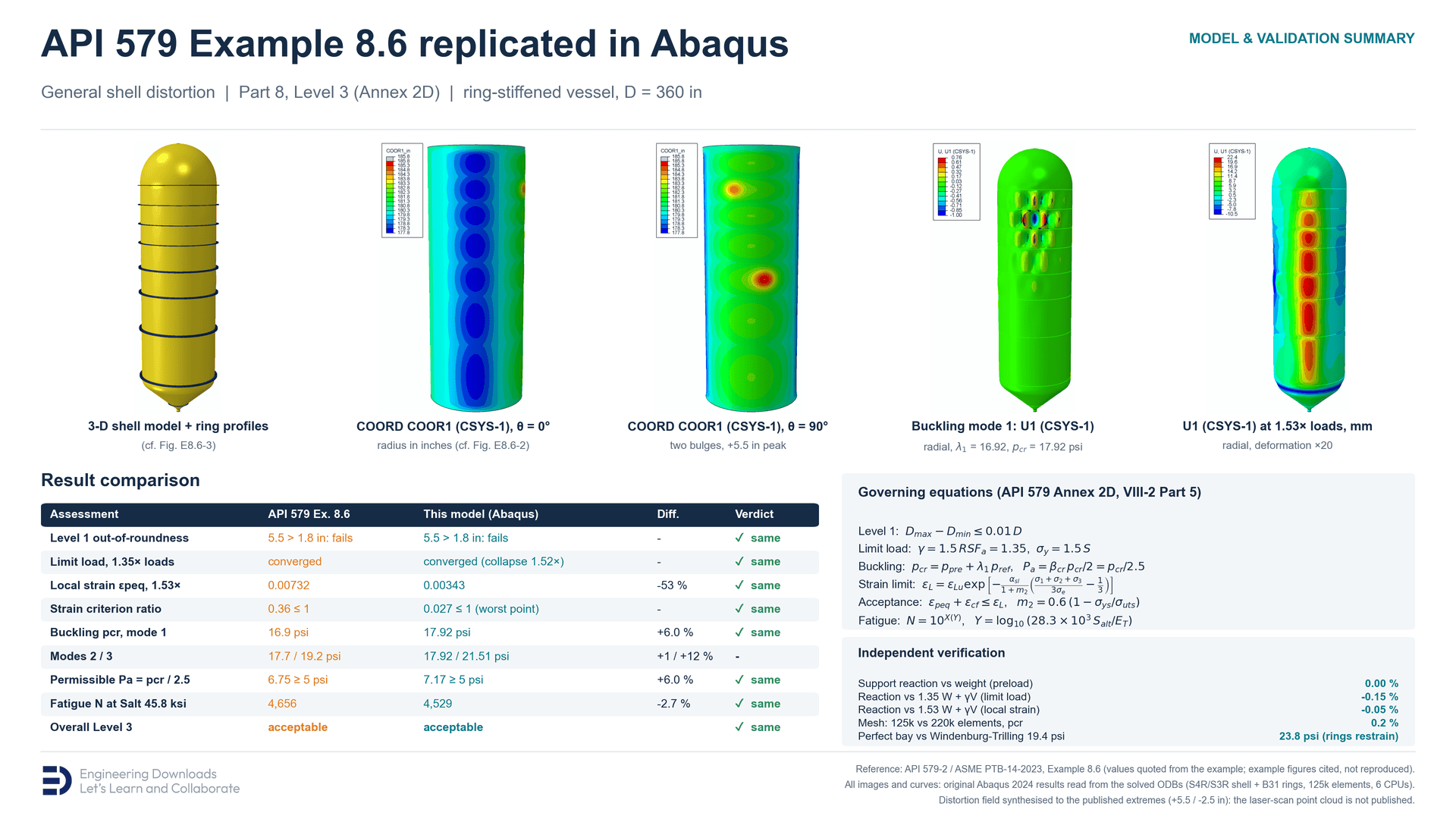
This package takes API 579 Example 4.7 and completes it as a Level 3 assessment in Abaqus. It maps the 120 inspection readings onto a full 3D model of the cylinder-cone-cylinder transition, solves it at the design pressure, then runs the API 579 plastic-collapse and local-failure checks. Every result is validated: against the manual’s own numbers, against closed-form theory, and against two independent Abaqus models.
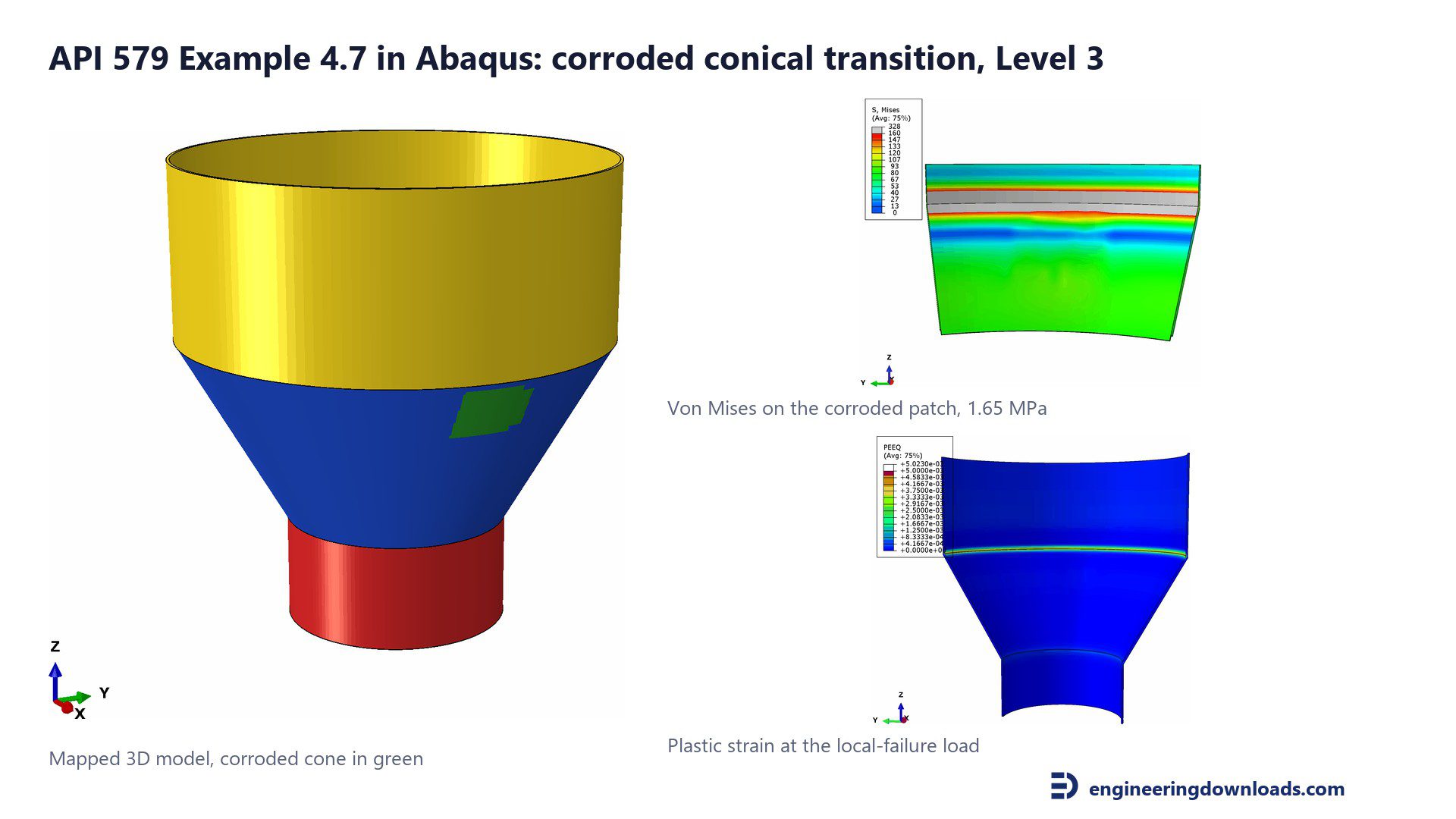
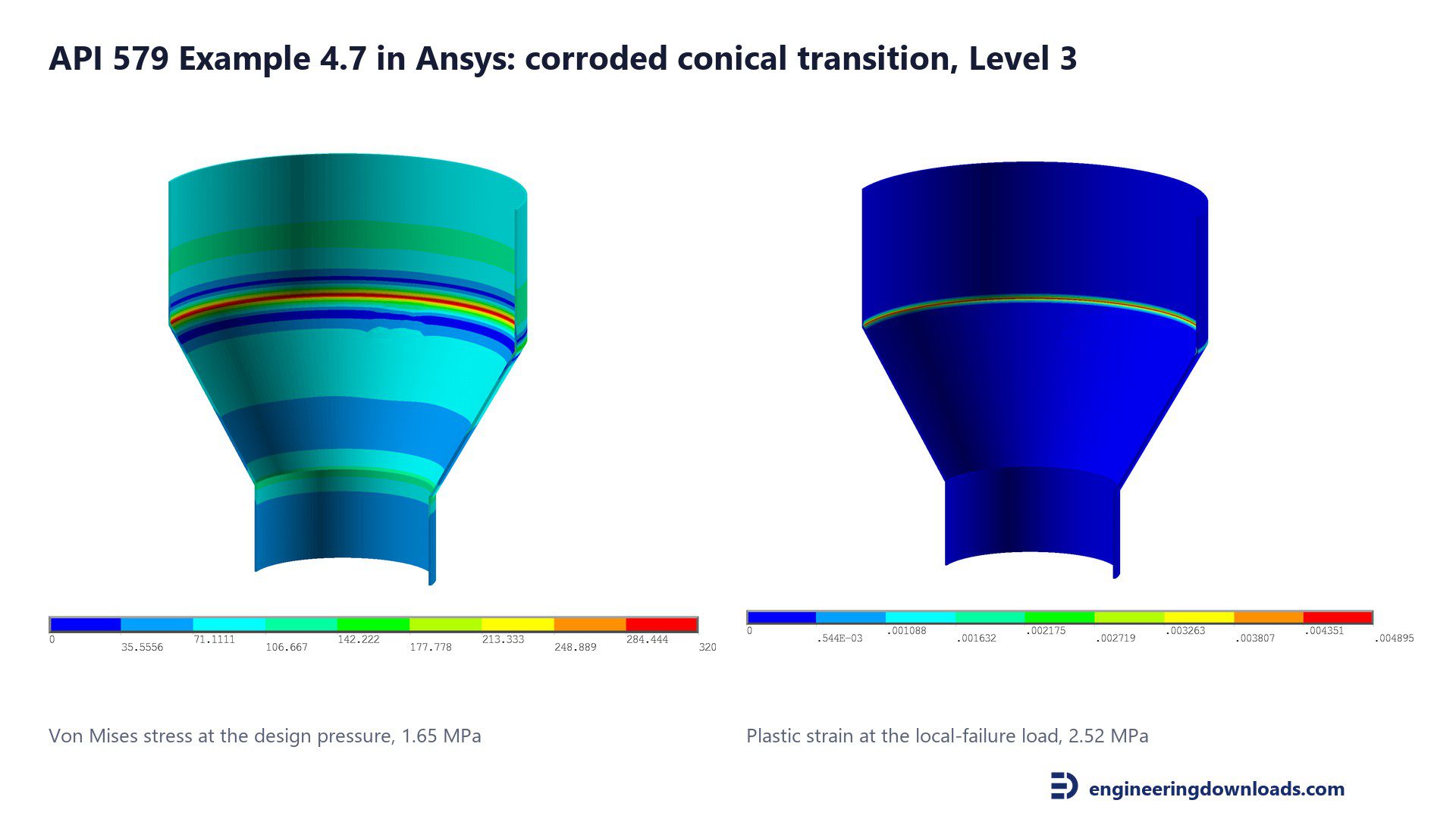
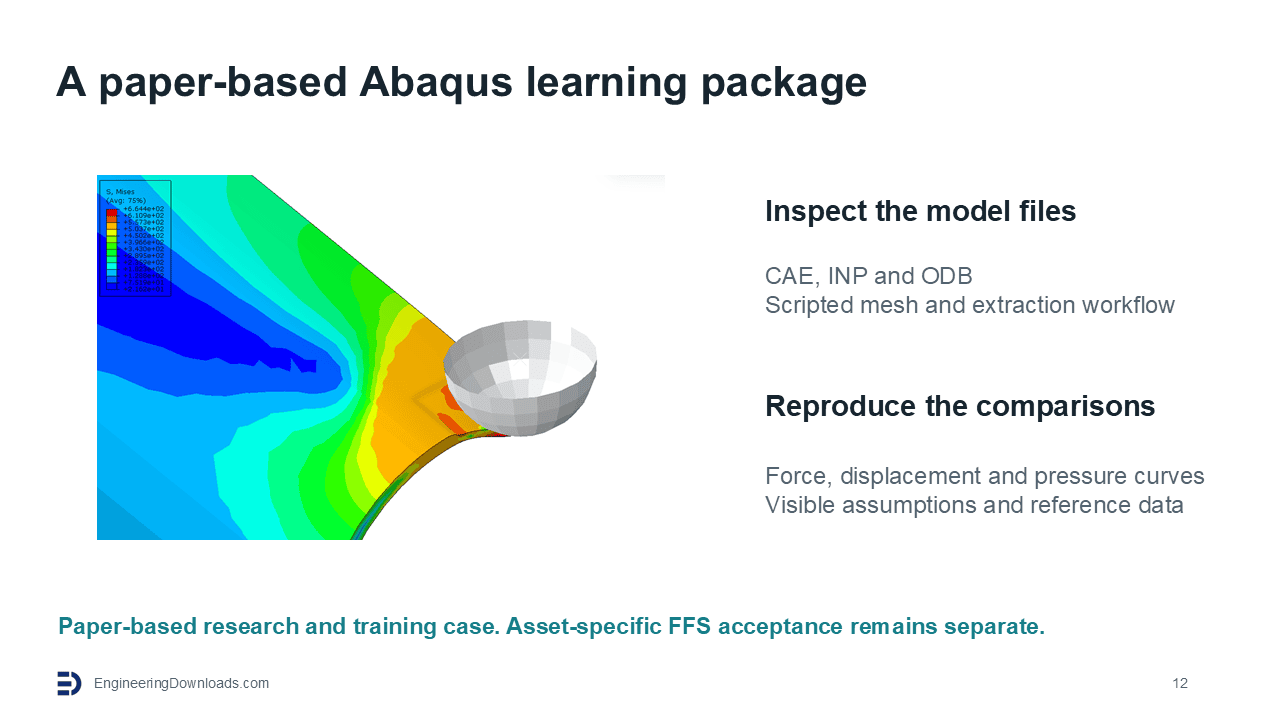
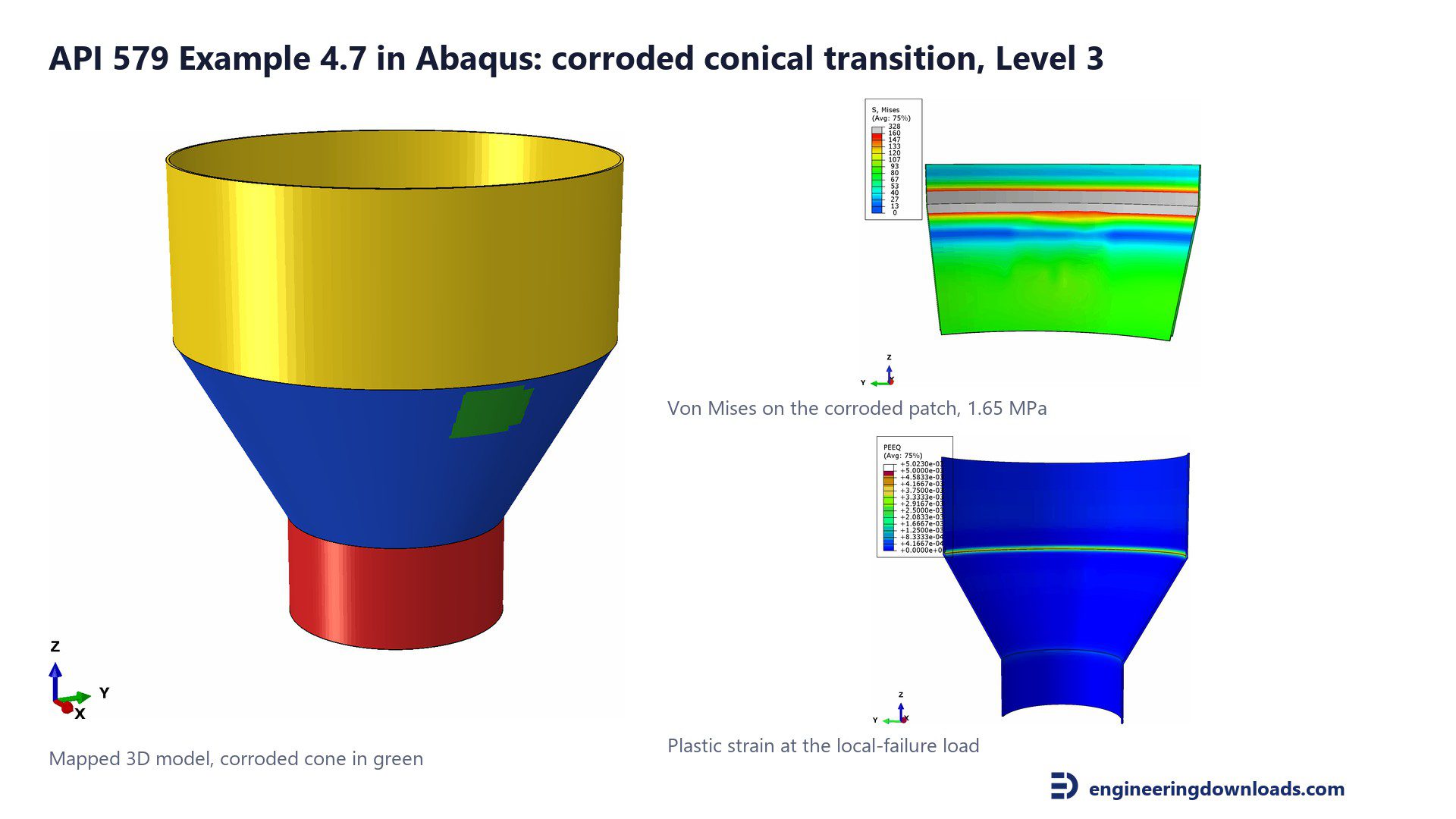
Abaqus model of API 579 Example 4.7: corroded conical transition with mapped metal loss, von Mises stress on the patch and plastic strain at the junction
The mapped 3D model, stress on the corroded patch, and plastic strain at the local-failure load.

What this package is about

The whole chain is open and repeatable, from the inspection table to a code-based verdict:

  • Map — the 10 x 12 thickness grid on the 30° cone becomes a solid wall in Abaqus, with the outer surface fixed and the inner surface following the readings minus the 1 mm future corrosion allowance.
  • Check the hand calculation — the manual’s Level 2 numbers are recalculated, and a benchmark model with the same idealised walls is compared with the API junction stresses.
  • Assess — elastic stresses at design pressure, a limit-load analysis for plastic collapse, a Riks collapse search, and an elastic-plastic local-failure check with the ASME VIII-2 strain limit.
  • Validate — ten checks, each against a reference the model never saw.

A PDF tutorial walks through each step, and Python scripts let you rebuild every model from the data.

The API 579 Example 4.7 problem

We describe the example in our own words. The standard is not included, so keep your copy of API 579-2 / ASME PTB-14 next to you if you want to read the original. A pressure vessel has a cylinder-cone-cylinder transition with a 30° half-apex cone. Internal corrosion was found on the cone, close to the large-end junction. The question is whether the transition can stay in service.

Inputs of the example

MaterialSA-516 Grade 70, allowable stress 138 MPa, yield 235 MPa at 125 °C
GeometryInside radius 1000 mm (large end) and 500 mm (small end), 30° half-apex cone
Wall thickness15 mm large cylinder, 18 mm cone, 14 mm small cylinder
Design conditions1.65 MPa at 125 °C
Future corrosion allowance1.0 mm, internal
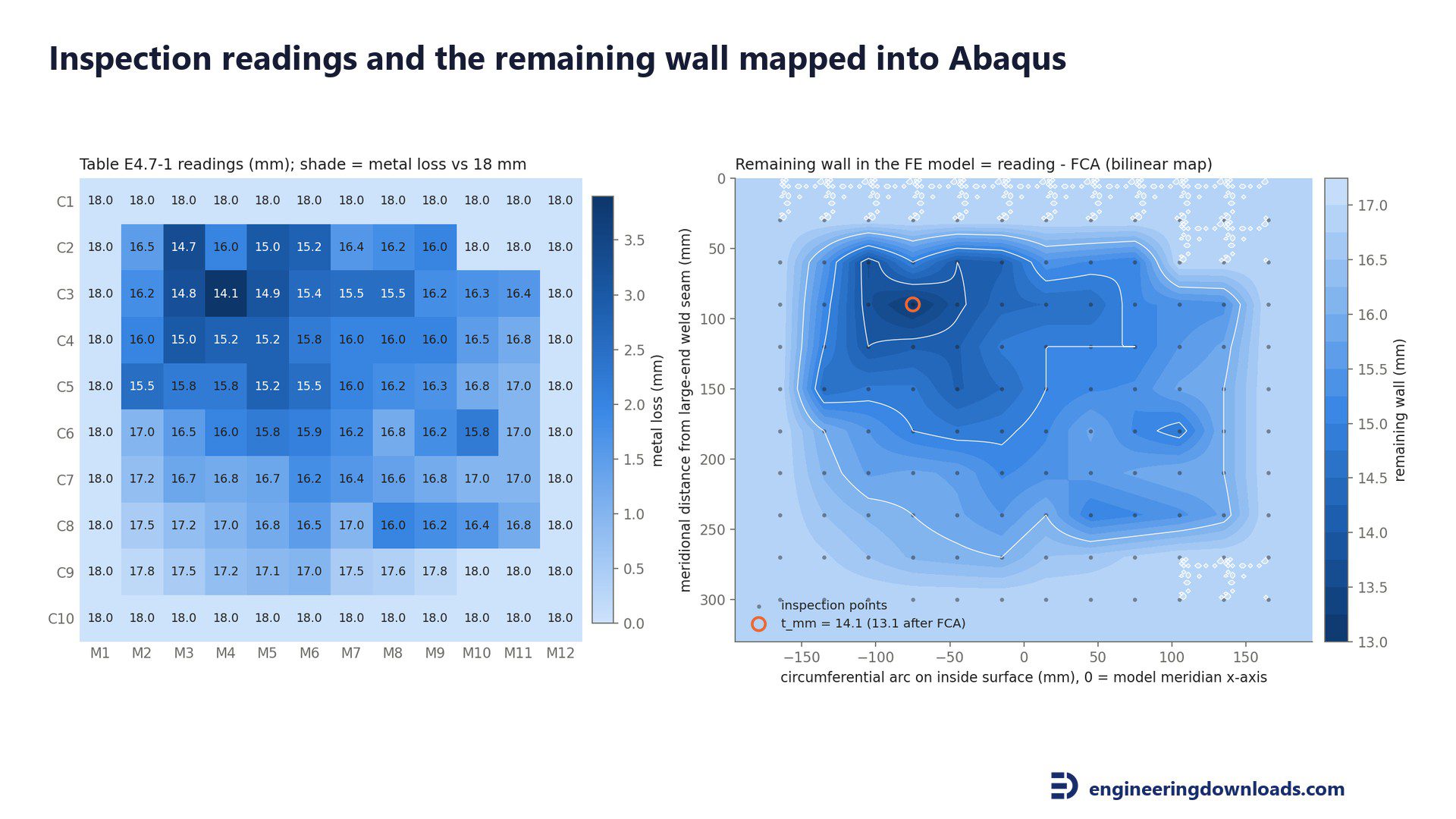
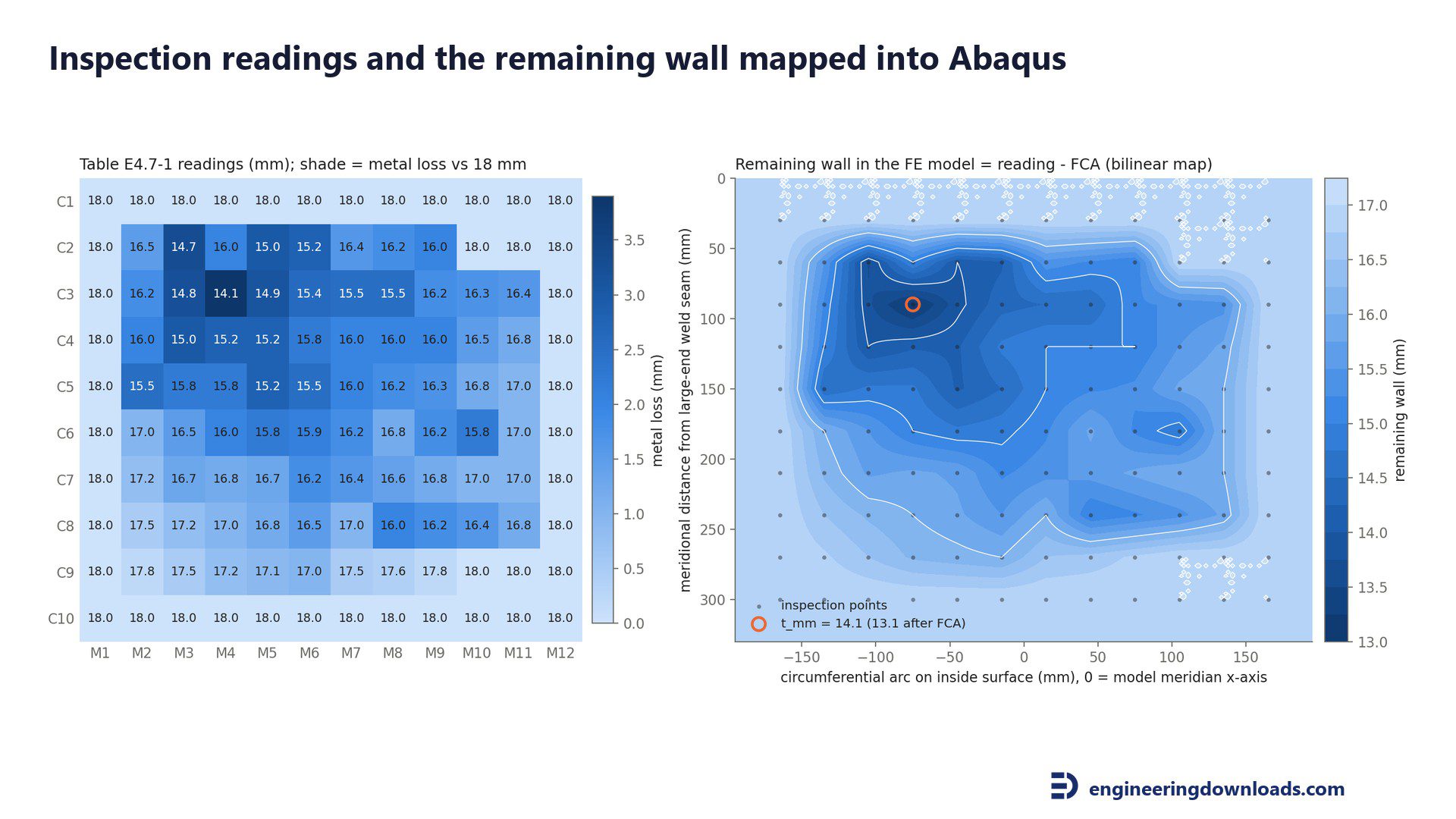
Inspection10 x 12 readings on a 30 mm grid; thinnest reading 14.1 mm, 90 mm from the weld seam
Allowable remaining strength factorRSFa = 0.9
API 579 Example 4.7 inspection readings and the remaining wall mapped into the Abaqus model
Left: the inspection readings. Right: the remaining wall used by the Abaqus model, reading minus FCA.

What the example concludes

The manual works through a Level 2 assessment. It averages the critical thickness profile over a set length (tam = 14.743 mm) and checks the large-end junction with the ASME VIII-2 design-by-rule equations. The junction passes, and the component is acceptable at Level 2. Our package reproduces all 17 printed values of that calculation, to within 0.015 %.

What we built in Abaqus

  • The full transition. Large cylinder, cone and small cylinder, full 360°, meshed with C3D8I solid elements. The cylinders are long enough that the cut ends do not affect the junctions.
  • Real internal metal loss. The outer surface stays fixed. The inner surface follows the measured wall minus the 1 mm allowance. Through-wall node lines lie on the wall normal.
  • The thinnest point kept exactly. The 14.1 mm reading becomes exactly 13.1 mm in the model. Over all 120 readings the mesh is within 0.018 mm on average.
  • Pressure and end thrust. Pressure acts on the real inner faces, and the closed-end thrust is applied at the large cut end. The axial reaction matches the exact value to better than 0.0004 %.
  • Three mesh levels. 35,000, 114,000 and 422,000 elements, so you can see what changes with refinement and what does not.
  • Easy to open. Named sets METAL_LOSS, PATCH, JUNCTION_LARGE and MIN_POINT, and the surface CORRODED_INNER_SURFACE, isolate the regions you need.
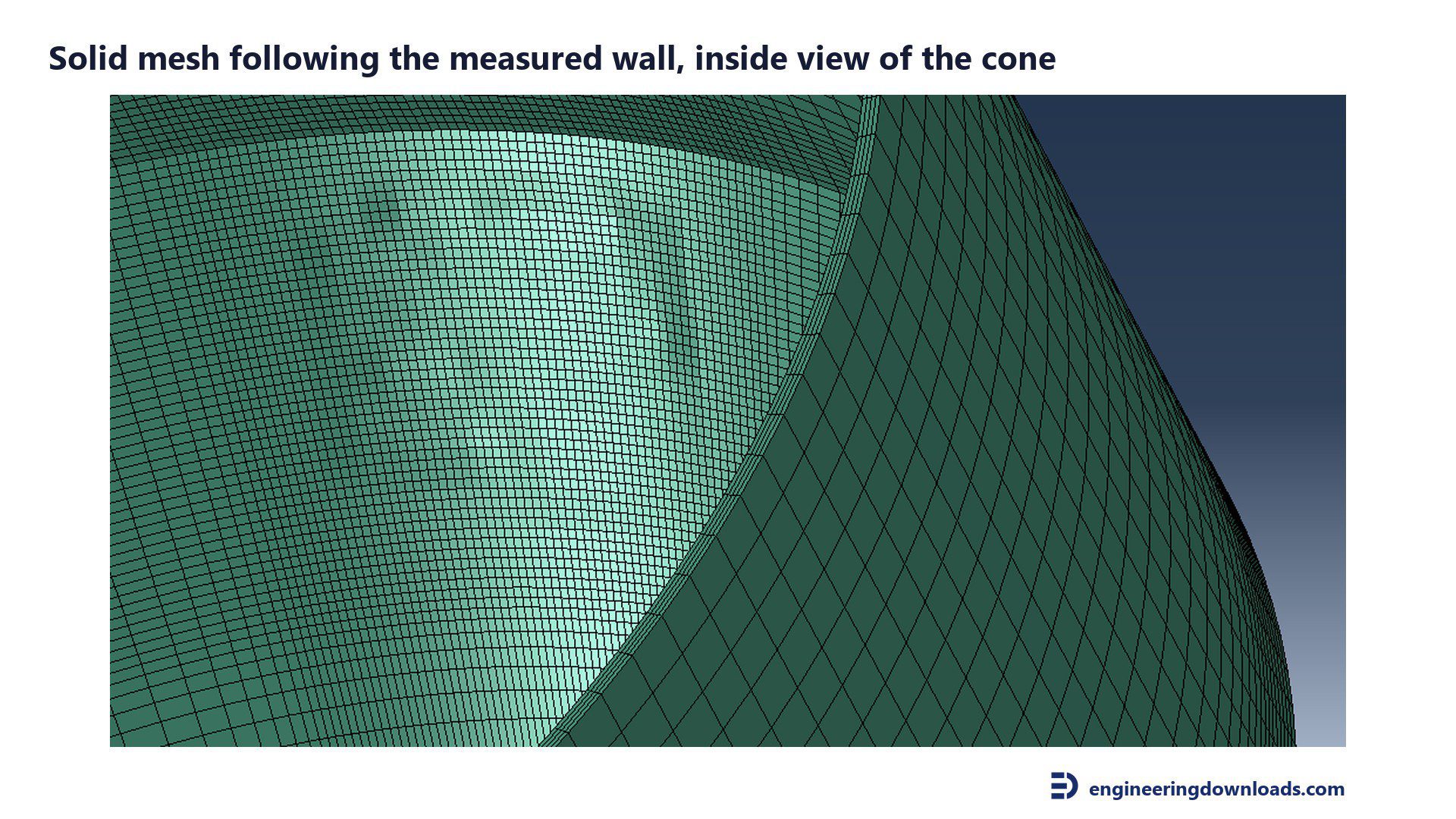
Abaqus solid mesh of the corroded cone following the measured wall thickness, inside view
Inside view of the cone: the mesh follows the measured wall.

Level 3 results

The assessment follows API 579-1 Annex 2D: a limit-load analysis for protection against plastic collapse, and an elastic-plastic analysis for protection against local failure.

CheckBasisResult
Plastic collapseLimit load, 1.5 x RSFa x P = 2.23 MPaConverged at the full factored load: pass
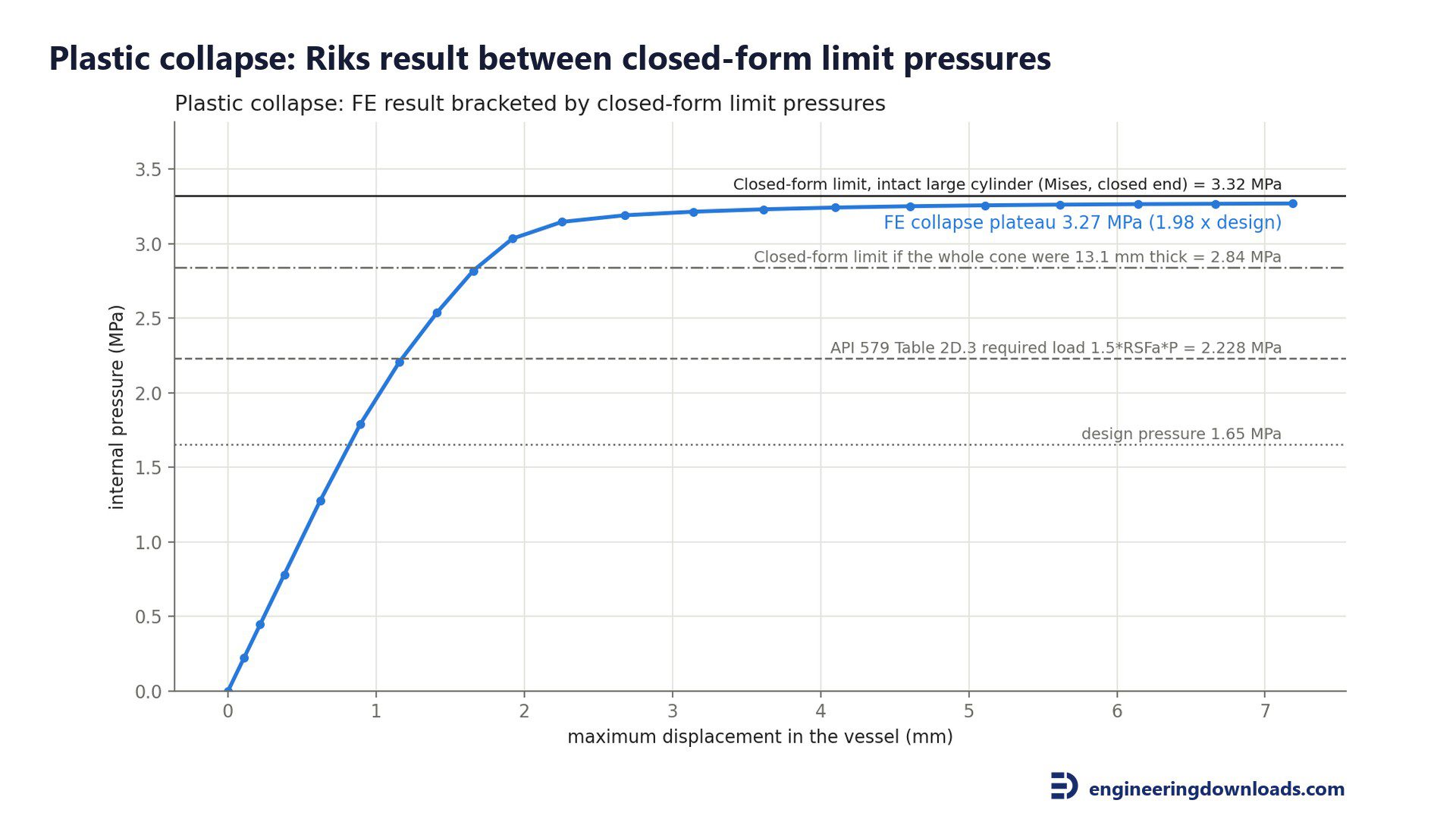
Collapse pressureRiks analysis3.27 MPa, 1.98 x design pressure
Local failureASME VIII-2 strain limit at 1.7 x RSFa x PWorst ratio 0.04 (limit 1.0): pass
Membrane stress in the corroded areaLinearised Pm93.7 MPa against 138 MPa

What the model shows that a hand calculation cannot. The corrosion is not what governs. The thin spot sits in a zone where the junction puts the hoop stress into compression, so it carries little load. Plastic strain concentrates in a ring at the large-end junction, and that ring sets the collapse pressure. Because the model uses the real 17 mm wall at the junction instead of the averaged 14.74 mm, its junction stresses come out 10 to 17 % below the Level 2 estimate.
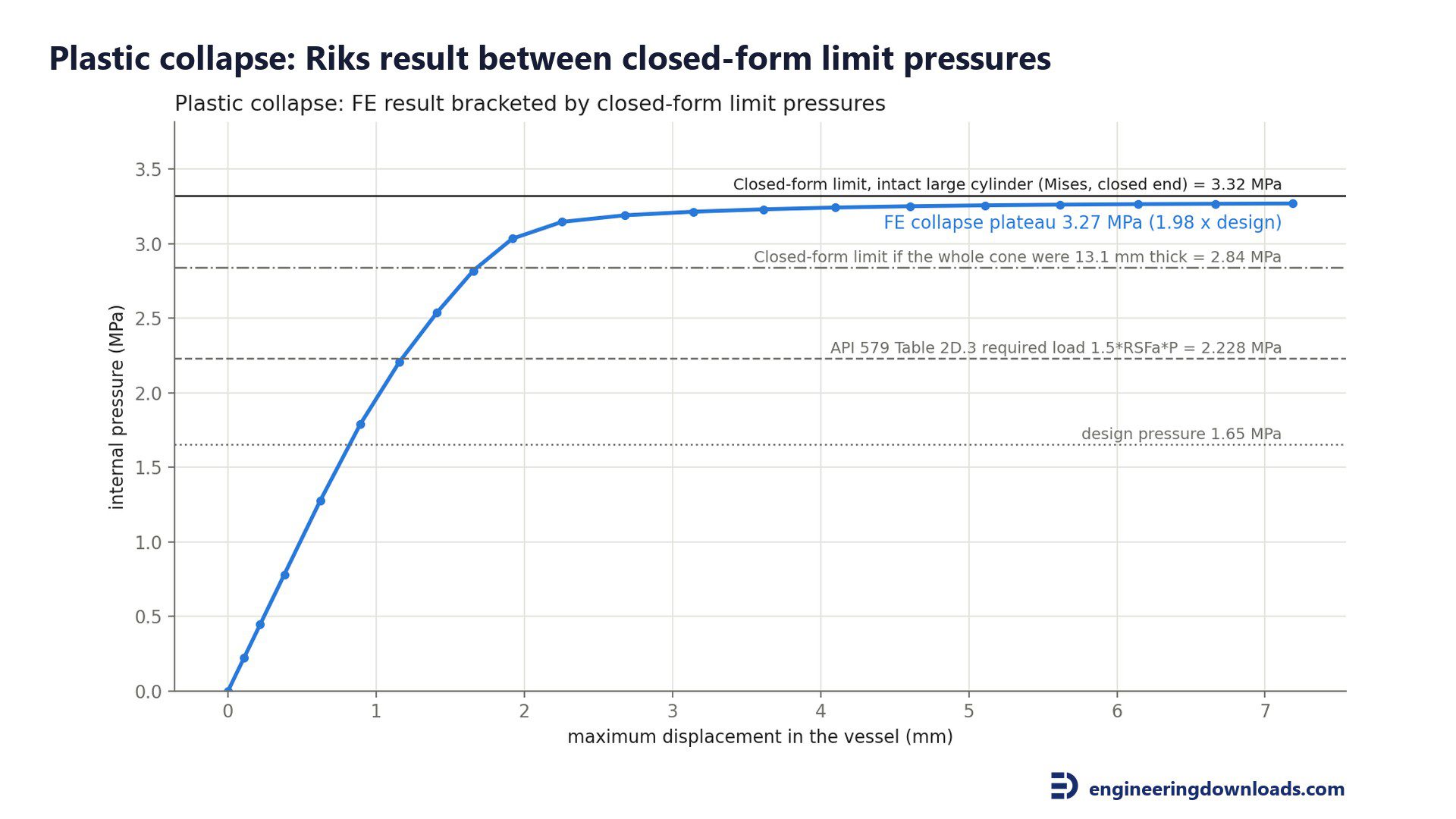
Riks plastic collapse curve of the corroded conical transition between closed-form limit pressures
The collapse pressure sits between two closed-form limits, well above the required factored load.

How the model was validated

A good-looking contour is not proof. These are the checks in the package:
  • The API arithmetic. All 17 printed Level 2 values reproduced, worst difference 0.015 %.
  • The junction. With the same idealised walls as the manual, the Abaqus model gives membrane plus bending stresses within 1.7 % (cylinder) and 2.6 % (cone) of the API values.
  • Shell theory and an independent solid model. An axisymmetric thin-shell model reproduces the manual’s junction moment to 0.006 %. An independent axisymmetric solid model confirms the 3D stress distribution along the whole meridian.
  • The far field. Away from the junctions, the membrane stress matches closed-form equilibrium within 0.01 % in the cylinders.
  • Mesh independence. Every quantity used for acceptance changes by less than 2 % from the medium to the fine mesh.
  • Collapse. The Riks result lies between two closed-form limit pressures: 2.84 MPa if the whole cone were thinned, and 3.32 MPa for the intact cylinder.
Junction stresses of API 579 Example 4.7: Abaqus 3D model against the API Level 2 values, thin-shell theory and an axisymmetric solid model
Junction stresses along the meridian: this 3D model, thin-shell theory, an independent axisymmetric solid model and the API Level 2 values (stars).

What is included

  • Ready-built Abaqus CAE and INP files for eight cases: the Level 2 benchmark, the corroded wall at design pressure on three meshes, the limit-load case, the local-failure case on two meshes, and the Riks collapse case.
  • A PDF tutorial (11 pages) covering inputs, mapping, building, solving, post-processing, the Level 3 checks and validation.
  • The inspection data and every modelling assumption in one JSON file.
  • Python scripts to rebuild any case from the data and to post-process results: linearised stresses, peak values, the strain-limit ratio and the reaction check.

What this package does not do

  • It does not replace a signed fitness-for-service assessment of a real vessel.
  • It does not model weld geometry. The junctions are sharp, as in the manual.
  • It does not model buckling under the junction hoop compression. The manual’s Level 2 check covers it.
  • It does not include the text of API 579.

Who this package is for

  • Integrity and inspection engineers working with API 579 Part 4 metal loss
  • FEA engineers who need a checked Level 3 workflow, from limit load to strain limit
  • Consultants who want a traceable, validated example to compare against
  • MSc and PhD students working on corroded vessels and shell junctions

Software required

Abaqus (tested on 2024). Python is needed only if you want to rebuild models from the data or run the post-processing scripts.

Frequently asked questions

Is this the actual text of API 579 Example 4.7?

No. It is an independent reproduction. We describe the example in our own words and use its inputs and published results. The standard is not included.

Does the manual publish a Level 3 result to compare with?

No. The manual stops at Level 2. We matched its Level 2 numbers exactly, then validated the Level 3 model against shell theory, closed-form limits and two independent Abaqus models.

Does this replace an API 579 fitness-for-service assessment?

No. A real assessment needs your own asset data, material properties at temperature, load cases and a full review. This package is a training and verification example. Need that assessment on a live vessel? See our FEA and fitness-for-service projects.

Can I use my own inspection data?

Yes. Replace the thickness grid in the JSON file and rebuild. Radii, wall thicknesses, cone angle, pressure, FCA and material are also inputs. A different geometry needs your own verification, which the benchmark case helps you do.

Why a solid model and not a shell model?

A solid wall represents the corroded inner surface directly and lets you read stress through the thickness. We also include an axisymmetric shell model, and we show where shell theory and a solid model agree and where they differ.

Which Abaqus version do I need?

The package was tested on Abaqus 2024 only. Older and newer versions are not claimed.

What if the package is not what I expected?

Write to us. Engineering Downloads refunds clients who are not satisfied with a delivered product.

Related packages and reading

Background reading: understanding API 579 and FFS assessment levels, what assessors expect at API 579 Level 3 and corrosion assessment for engineers.

Need more than the files?

There are two ways we can help. Book a one hour online consultation if you want to talk a problem through with a CAE engineer, using the checkbox in the order box. Order a project if you need a full simulation built for you, delivered to an agreed scope, price and deadline under a written contract.

We work on FEA and CFD for engineers, researchers and companies. Order your project, or message us on WhatsApp for a quick reply.

Course Content

Product files

  • Abaqus CAE+INP
  • Tutorial document

Reviews

No Review Yet
No Review Yet
€129,00 €149,00
Optional extras

Need a full custom project? See the options below.

7 people watching this product now!

Material Includes

  • PDF tutorial document
  • Abaqus CAE files
  • Abaqus INP files
  • Python scripts and inspection data

Audience

  • Integrity and inspection engineers working with API 579 metal loss
  • FEA engineers who need a checked Level 3 workflow
  • Consultants who want a traceable, validated example
  • MSc and PhD students working on corroded vessels and shell junctions

Related  Products

See more

Want to receive push notifications for all major on-site activities?

✕