

Need a full custom project? See the options below.
Need a full custom project? See the options below.
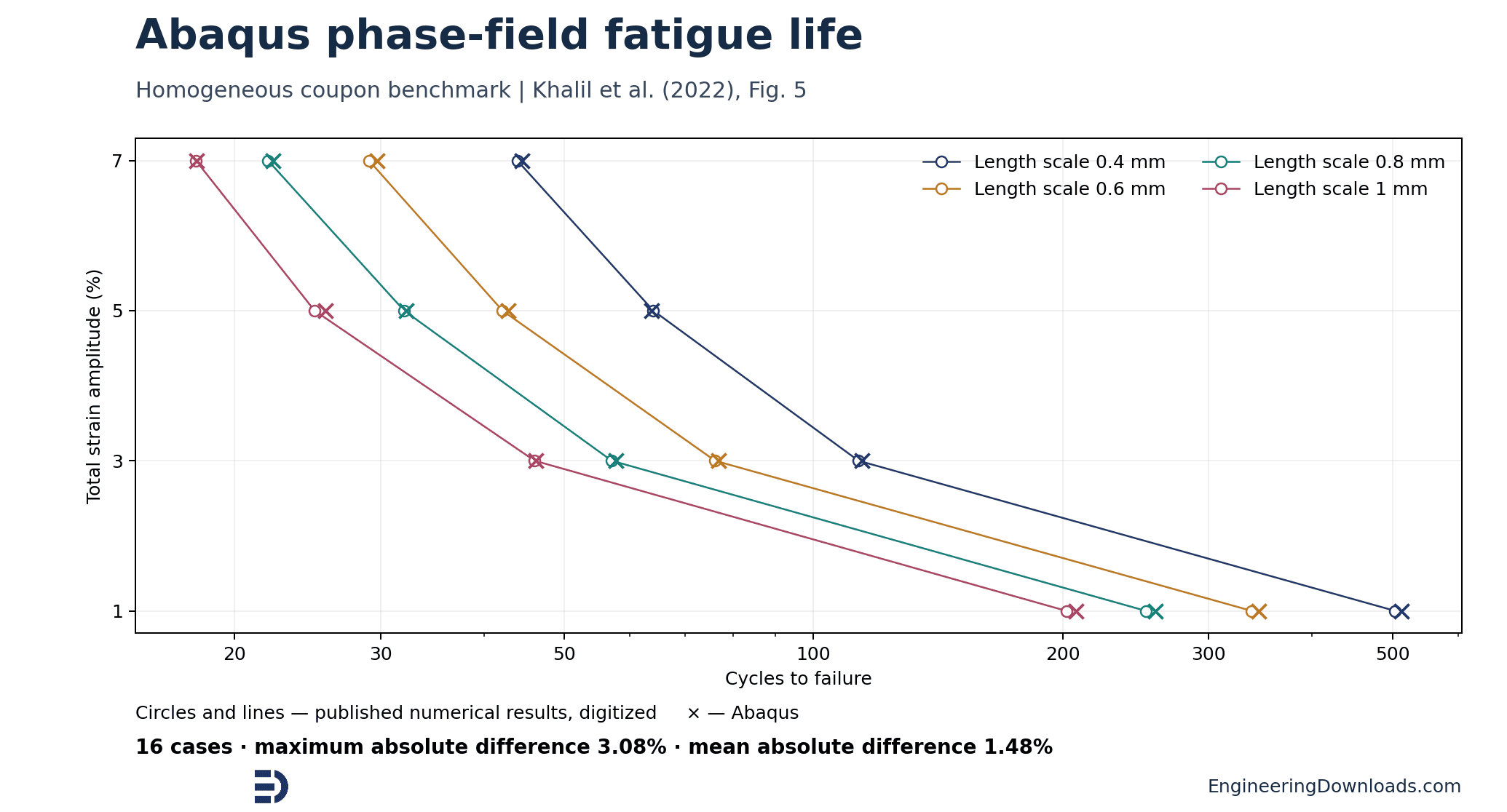
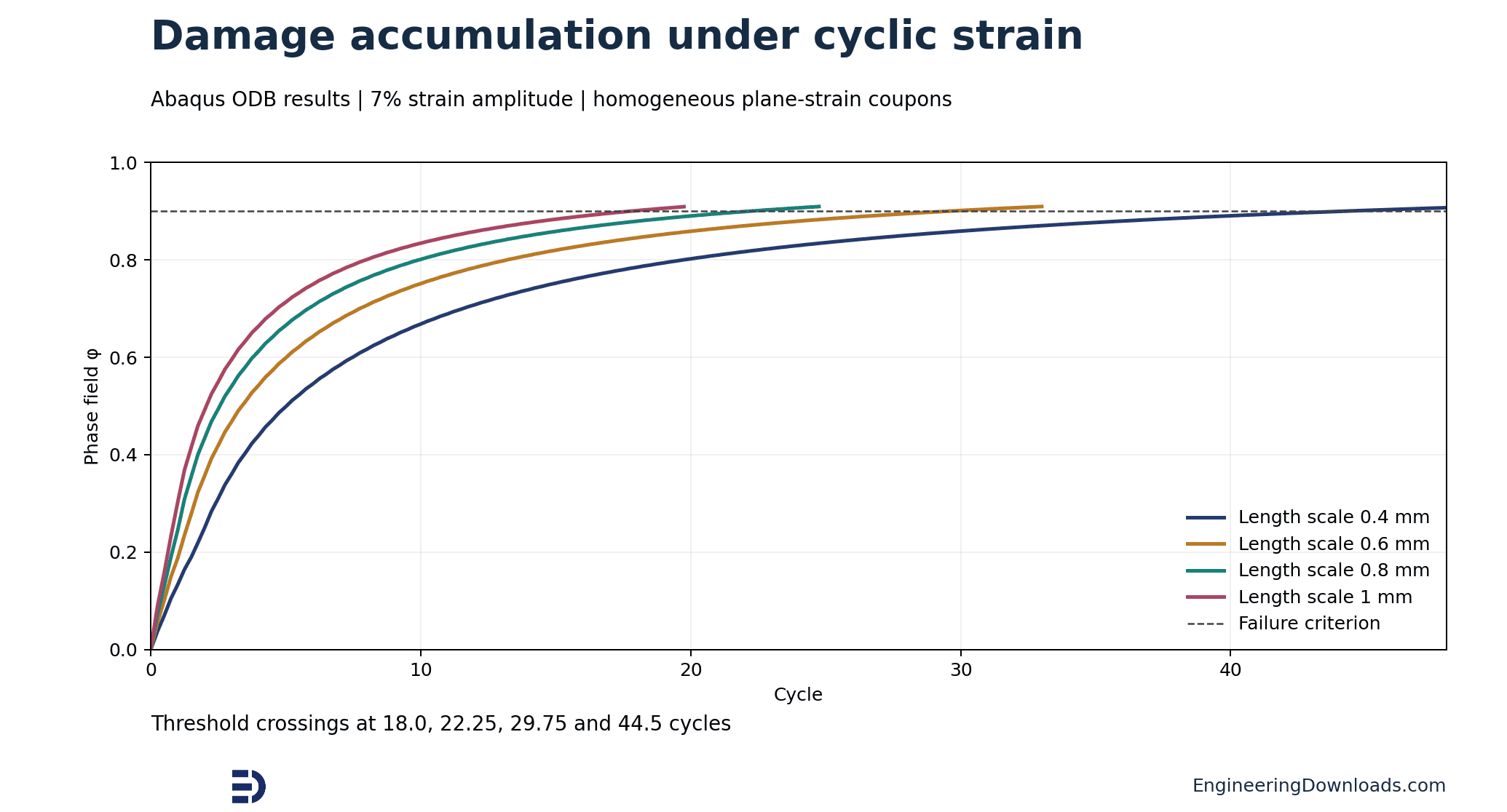
Explore low-cycle fatigue in structural steel with an Abaqus UELMAT workshop validated against the homogeneous coupon fatigue-life results of Khalil, Elghazouli and Martínez-Pañeda. Sixteen cases span four strain amplitudes and four phase-field length scales, with maximum absolute difference of 3.08% and mean absolute difference of 1.48% from the digitized published numerical data.
The automated workflow runs the supplied input decks, extracts the phase-field failure criterion from Abaqus results, and writes the numerical comparison. Model inputs and Fortran source are included for use in your own configured Abaqus installation.
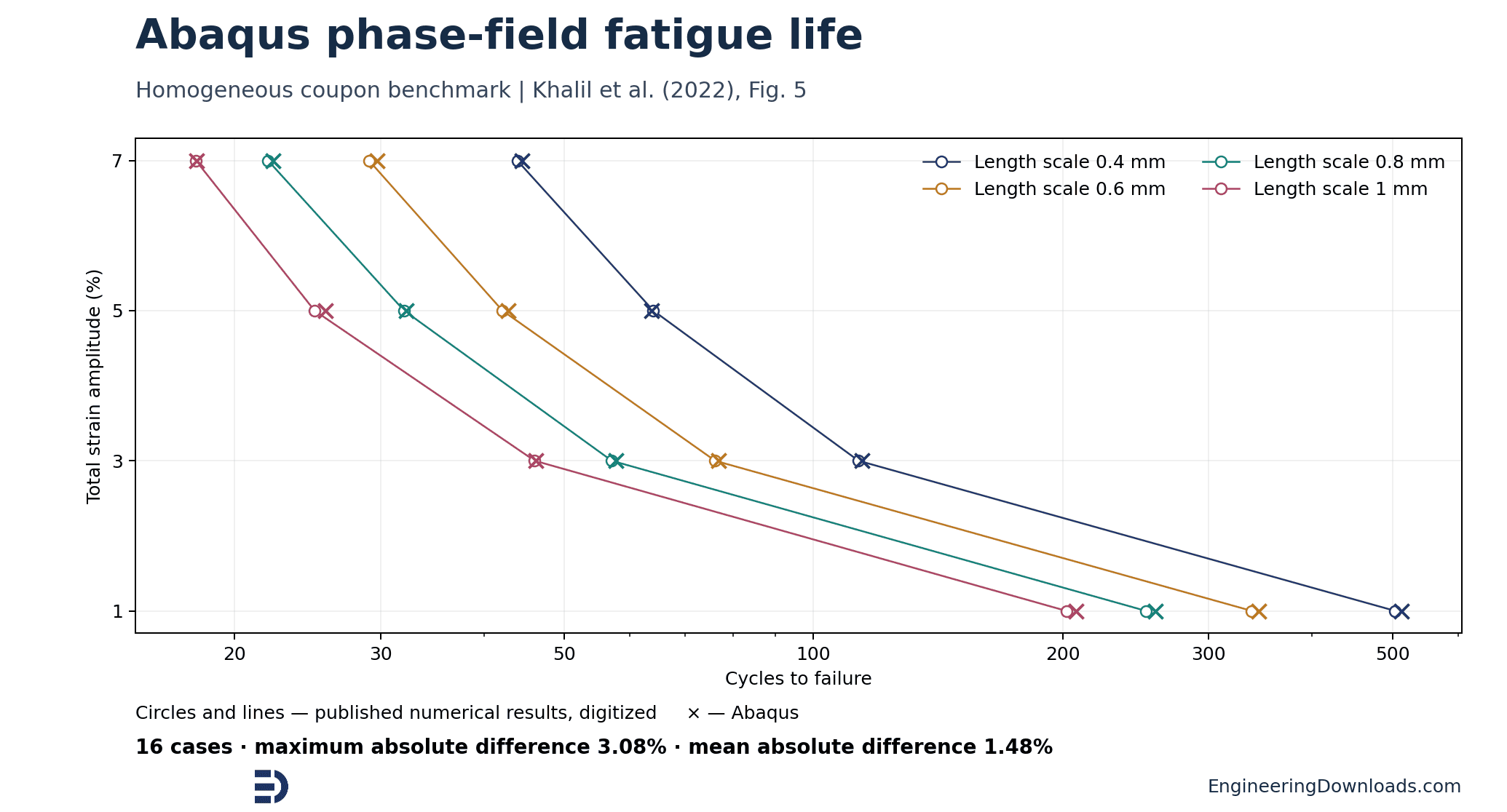
The validation covers Section 4.1, Fig. 5 of A generalised phase field model for fatigue crack growth in elastic–plastic solids with an efficient monolithic solver. The paper develops an elastic–plastic phase-field fatigue framework incorporating cyclic hardening, fatigue degradation laws, several fracture formulations and efficient monolithic solution strategies. This workshop applies its AT2 asymptotic fatigue formulation to homogeneous material patches under fully reversed strain cycling.
Z. Khalil, A.Y. Elghazouli and E. Martínez-Pañeda, Computer Methods in Applied Mechanics and Engineering 388 (2022), 114286. Published paper.
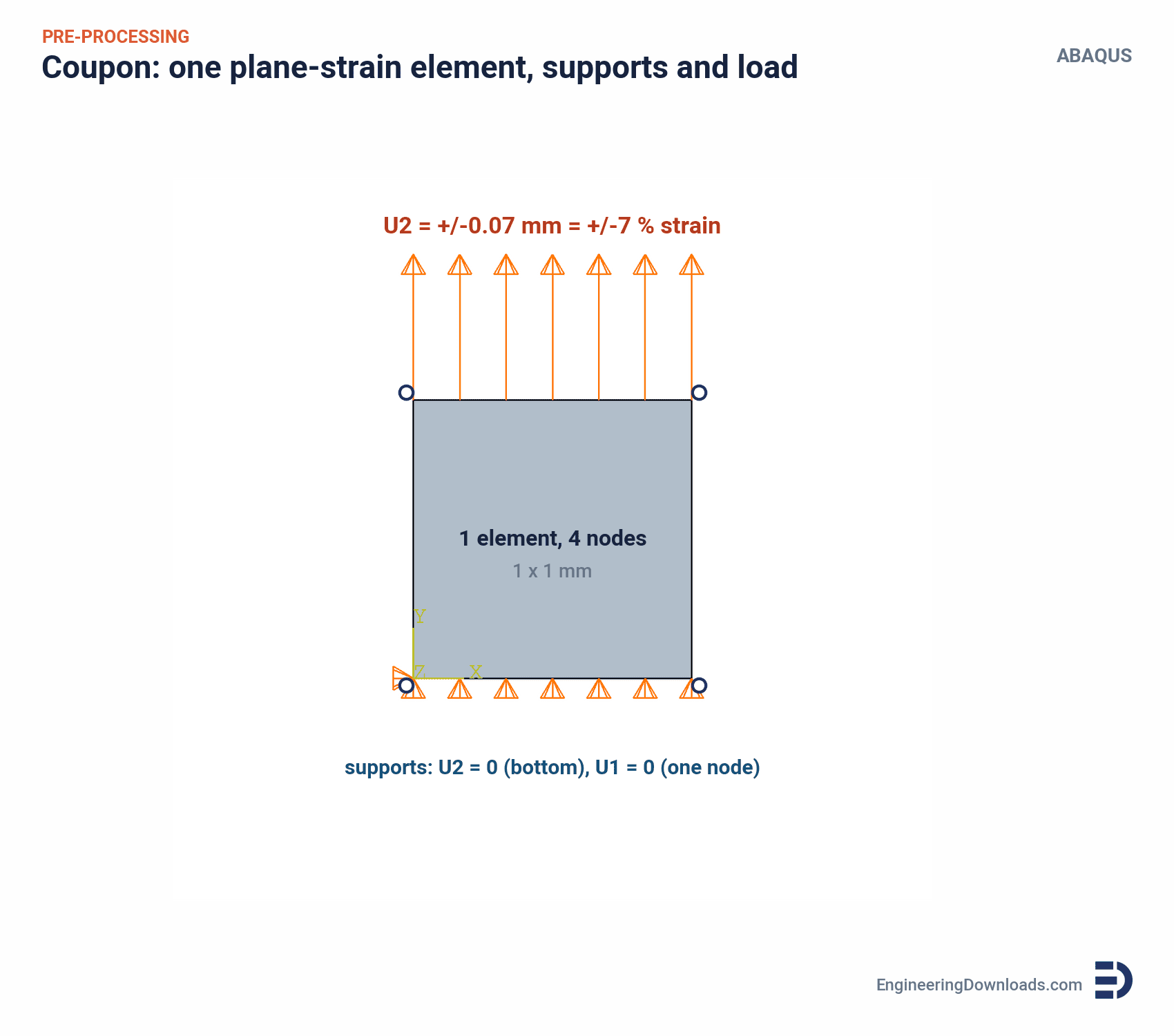
A 1 mm square plane-strain patch uses affine displacement constraints and a spatially uniform phase field. Combined nonlinear isotropic and kinematic hardening follows Table 1. Fully reversed loading uses R = −1 with strain amplitudes of 1%, 3%, 5% and 7%. The four length scales are 0.4, 0.6, 0.8 and 1.0 mm. Failure occurs at the first stored frame with phase field at least 0.9, reported every quarter cycle.
The degradation law is g(φ) = (1 − φ)2. The fatigue threshold is αT = Gc/(12ℓ), and above the threshold the fracture resistance factor is f = [2αT/(ᾱ + αT)]2. For the homogeneous solution, [Gcf/ℓ + 2D]φ = 2D, with D = H + ψp.
Abaqus/Standard, a compatible Fortran compiler configured for Abaqus user subroutines, and Python 3.
Which result is validated? The homogeneous coupon fatigue-life benchmark in Fig. 5, comprising sixteen strain-amplitude and length-scale combinations.
What does the automated script produce? It runs the four supplied input decks sequentially and writes Validation_Results.csv from the resulting Abaqus databases.
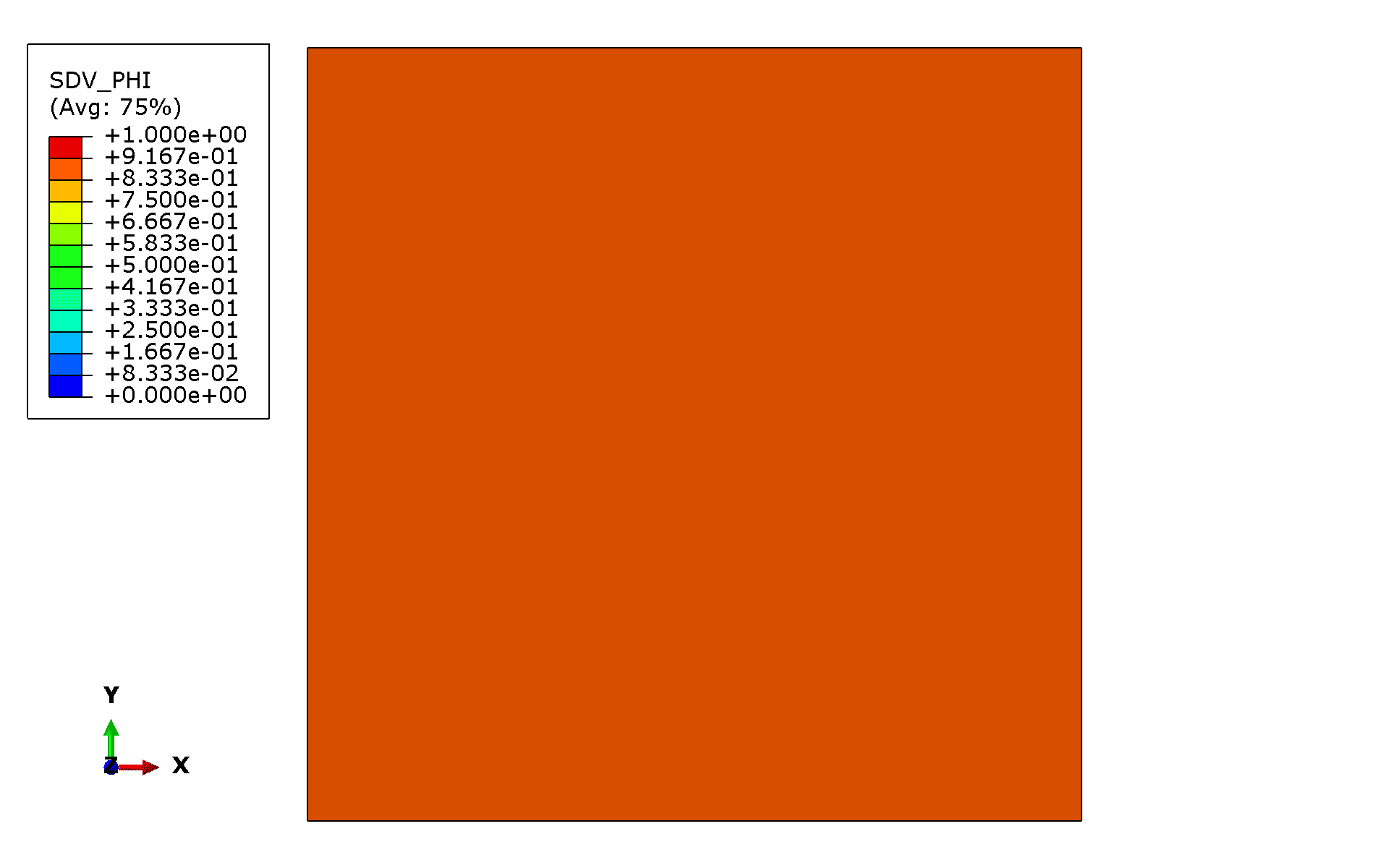
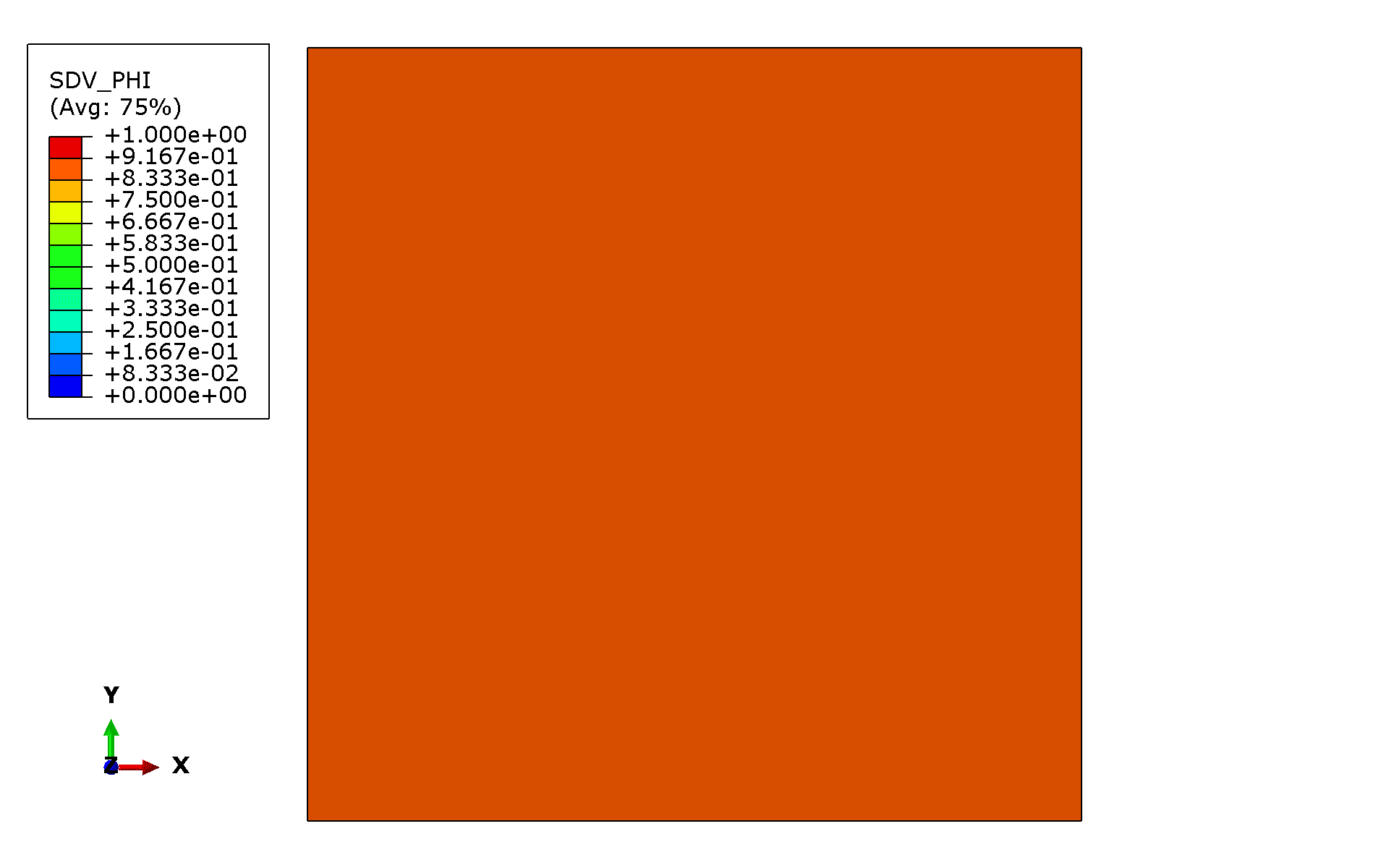
What is the result-image field? SDV_PHI is the phase-field variable. Its spatial uniformity follows from the homogeneous coupon constraints.
Related learning resource: AT1 and AT2 phase-field fracture in Abaqus.
Need more than the files?
There are two ways we can help. Book a one hour online consultation if you want to talk a problem through with a CAE engineer, using the checkbox in the order box. Order a project if you need a full simulation built for you, delivered to an agreed scope, price and deadline under a written contract.
We work on FEA and CFD for engineers, researchers and companies. Order your project, or message us on WhatsApp for a quick reply.
Other packages engineers working on this topic also download.
 Phase Field Fracture in Abaqus: AT1/AT2 UMAT, Crack Initiation and Edge-Cracked Tension Benchmark (Kristensen et al. 2021)€169,00
 Composite Fatigue UMAT for Abaqus: Hashin, Tsai-Hill and Maximum-Stress Criteria€159,00
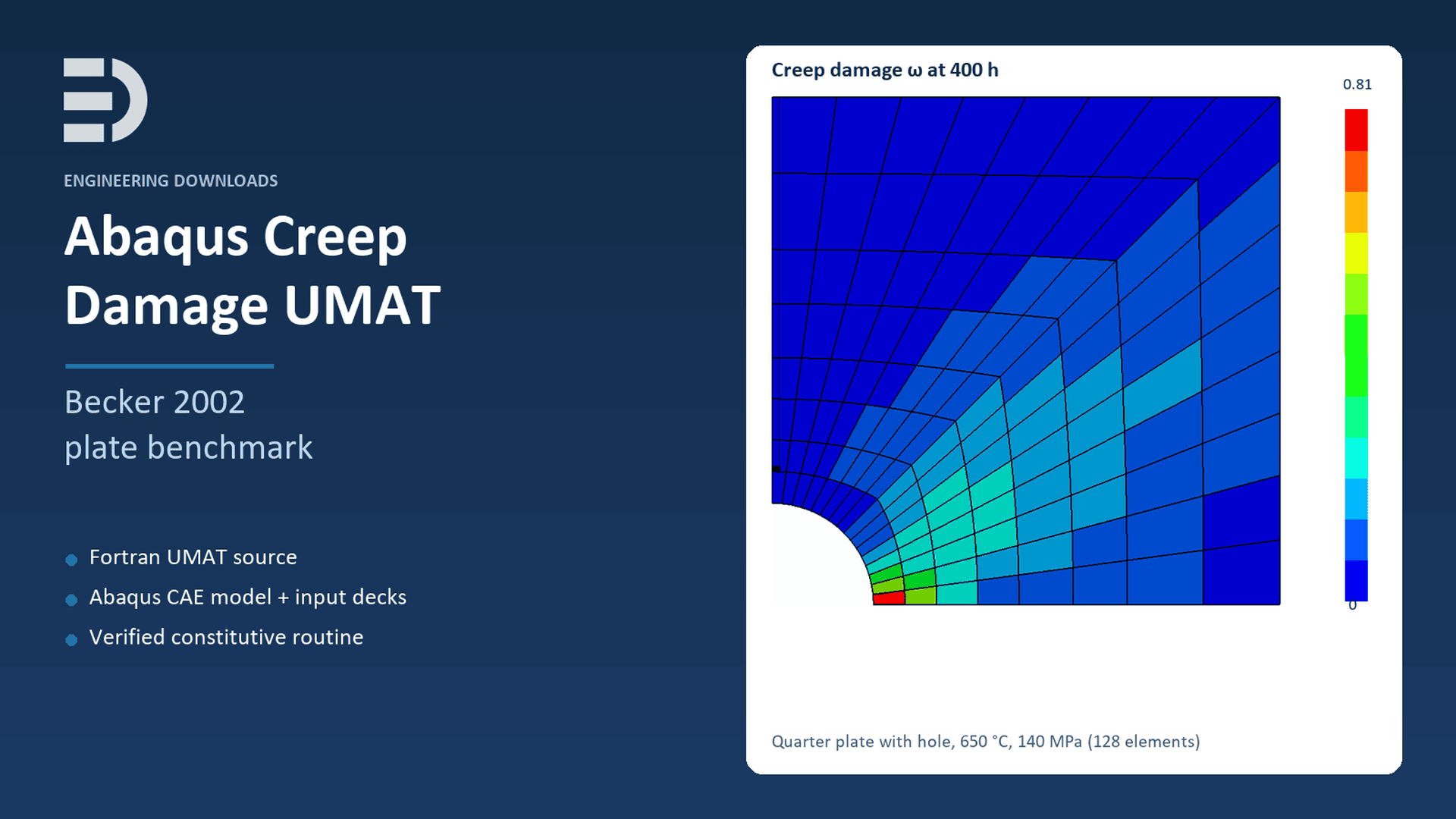 Creep Continuum Damage UMAT in Abaqus: Becker 2002 Perforated Plate Benchmark€49,00
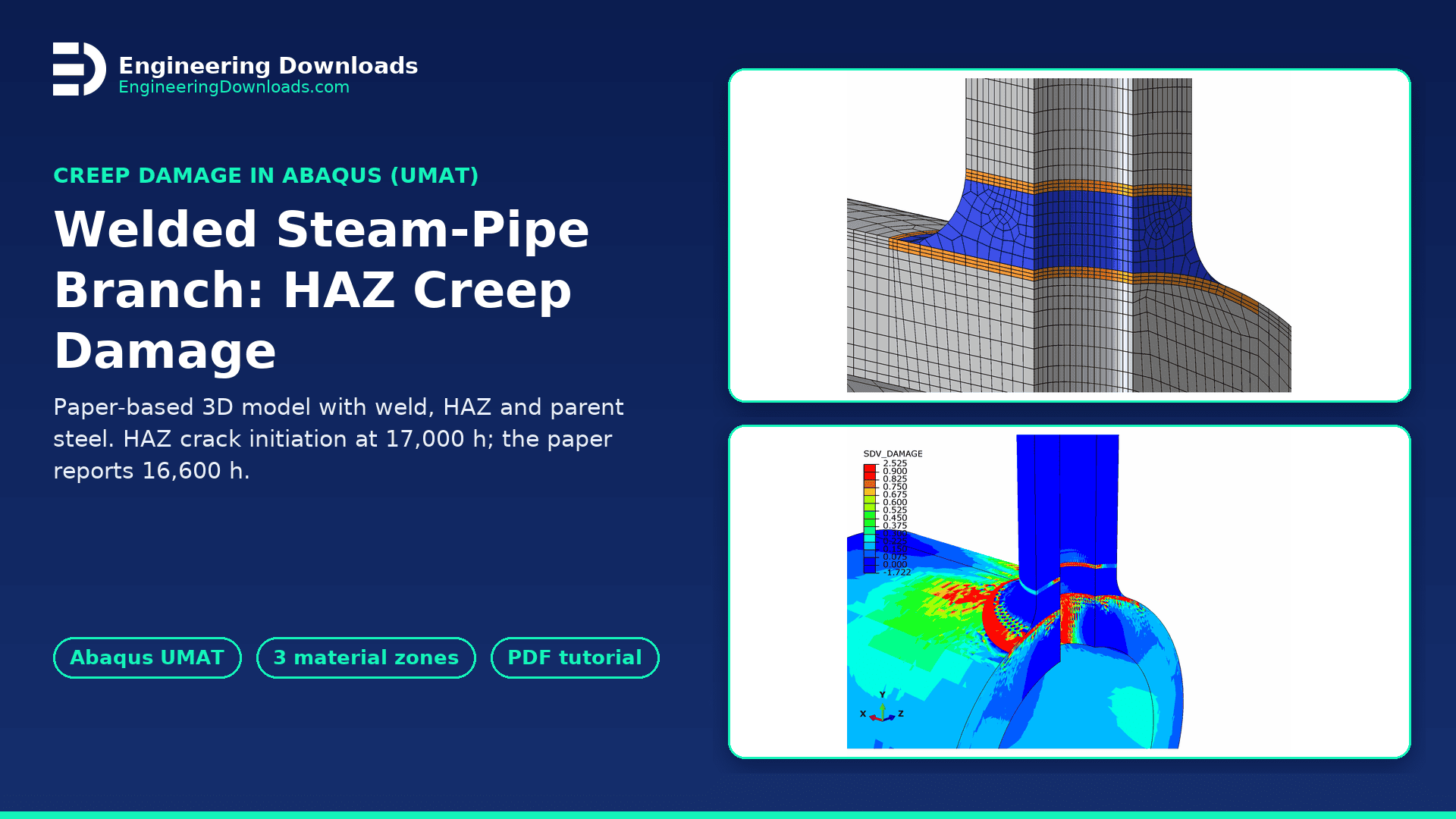 Creep Damage Analysis of a Welded Steam Pipe Branch in Abaqus: UMAT, HAZ Hex Mesh and Paper Comparison€149,00
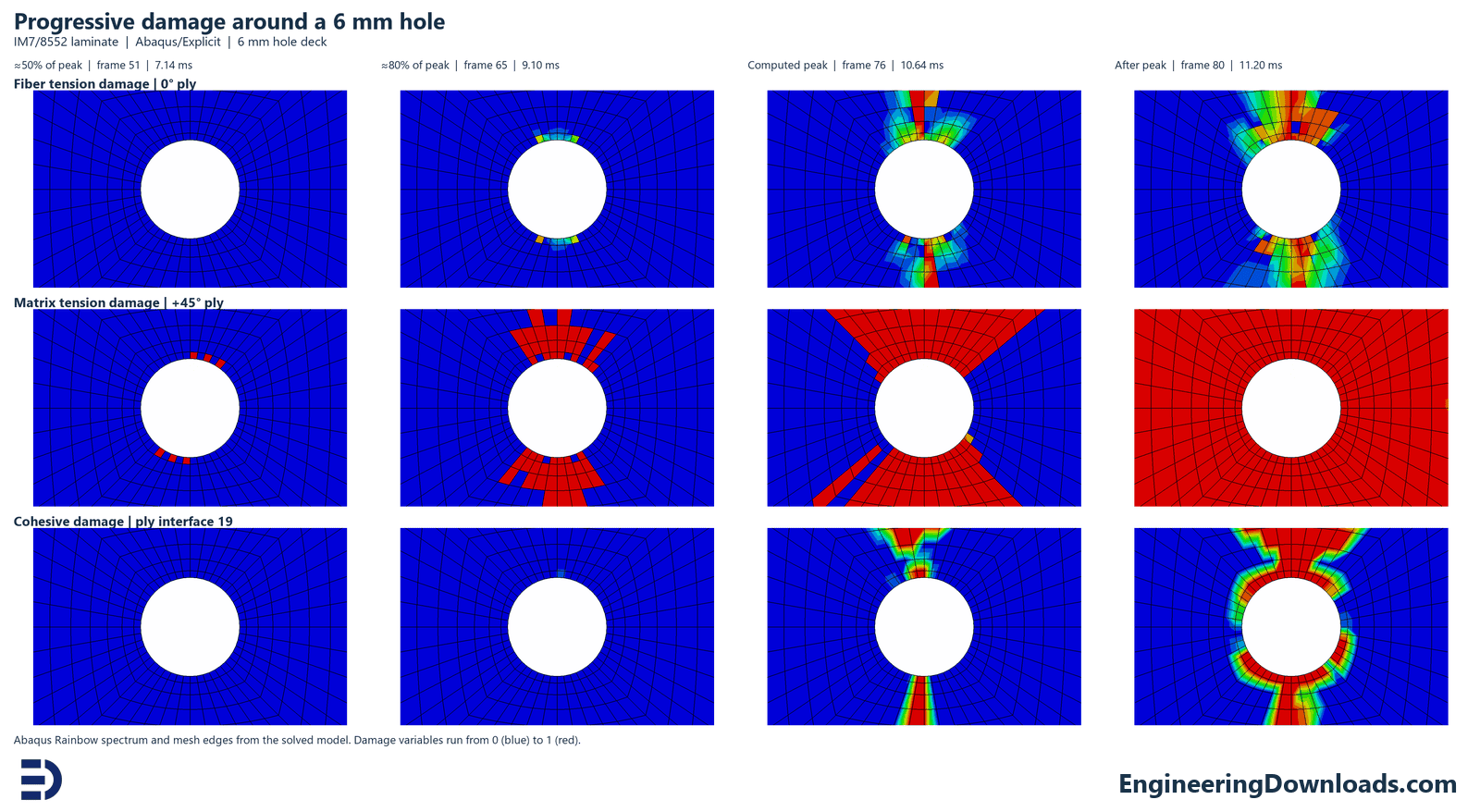 3D Hashin Progressive Damage VUMAT for Abaqus: Open-Hole Laminate with Cohesive Delamination€159,00
 LPBF 316L Residual Stress and Cantilever Distortion in Abaqus: Sequentially Coupled Thermal-Stress Model with DFLUX and USDFLD Subroutines€159,00
 Rib-to-Deck Weld Fatigue Hot-Spot Stress in Abaqus: Orthotropic Steel Bridge Deck, after Kc et al. (2024)€149,00
 Contact Fatigue Limit of a Hardness-Graded Gear Flank: Abaqus Brown-Miller-Morrow Workflow€129,00

Need a full custom project? See the options below.

€129,00

€179,00

€149,00

€119,00

€129,00

€149,00
See more
Want to receive push notifications for all major on-site activities?



