

Need a full custom project? See the options below.
Need a full custom project? See the options below.
A vessel that runs hot for a few hours is not automatically a creep problem, and API 579-1/ASME FFS-1 Part 10 gives a screening check to decide. This package rebuilds the published API 579-2 Example 10.1 (a knock-out vessel with 2:1 elliptical heads, 20 hours at 950 F and 82.6 psig) in two ways: a one-click Python check that recomputes the code stresses, the 975 F screening time and the Omega creep-damage law, and an Abaqus axisymmetric model with a CREEP user subroutine that shows where creep damage actually collects. You get INP and CAE files for eight cases, the subroutine source, the script, key images and an 8-page PDF tutorial.
Source: API 579-2/ASME PTB-14 Fitness-For-Service Example Problem Manual, Part 10, Example 10.1. The example screens the upset exposure: it computes the shell and head stress, reads the screening time at 975 F from the Part 10 chart and compares it with the 20 hours actually spent. It is a Level 1 screening. The Abaqus model in this package is an independent extension that resolves the stress field through the wall and the head transition; it is not a published Level 3 example.
| Item | API 579-2 Example 10.1 | This package |
|---|---|---|
| Component | SA-516 Grade 60 vessel, 60.2 in corroded ID, 0.275 in wall, 2:1 elliptical heads | Half-vessel axisymmetric section: shell with 72 in straight half-length and 2:1 head |
| Event | 20 h at 950 F, 82.6 psig | Pressurise, then 20 h creep hold at uniform 950 F |
| Screening | Nominal stress 9,091 psi shell and 9,049 psi head; screening time at 975 F | run_vessel_creep_check.py recomputes both in one click |
| Creep law | Annex 10B carbon steel Omega method | CREEP subroutine cs60_omega.for with alpha = 2 shell and 3 head |
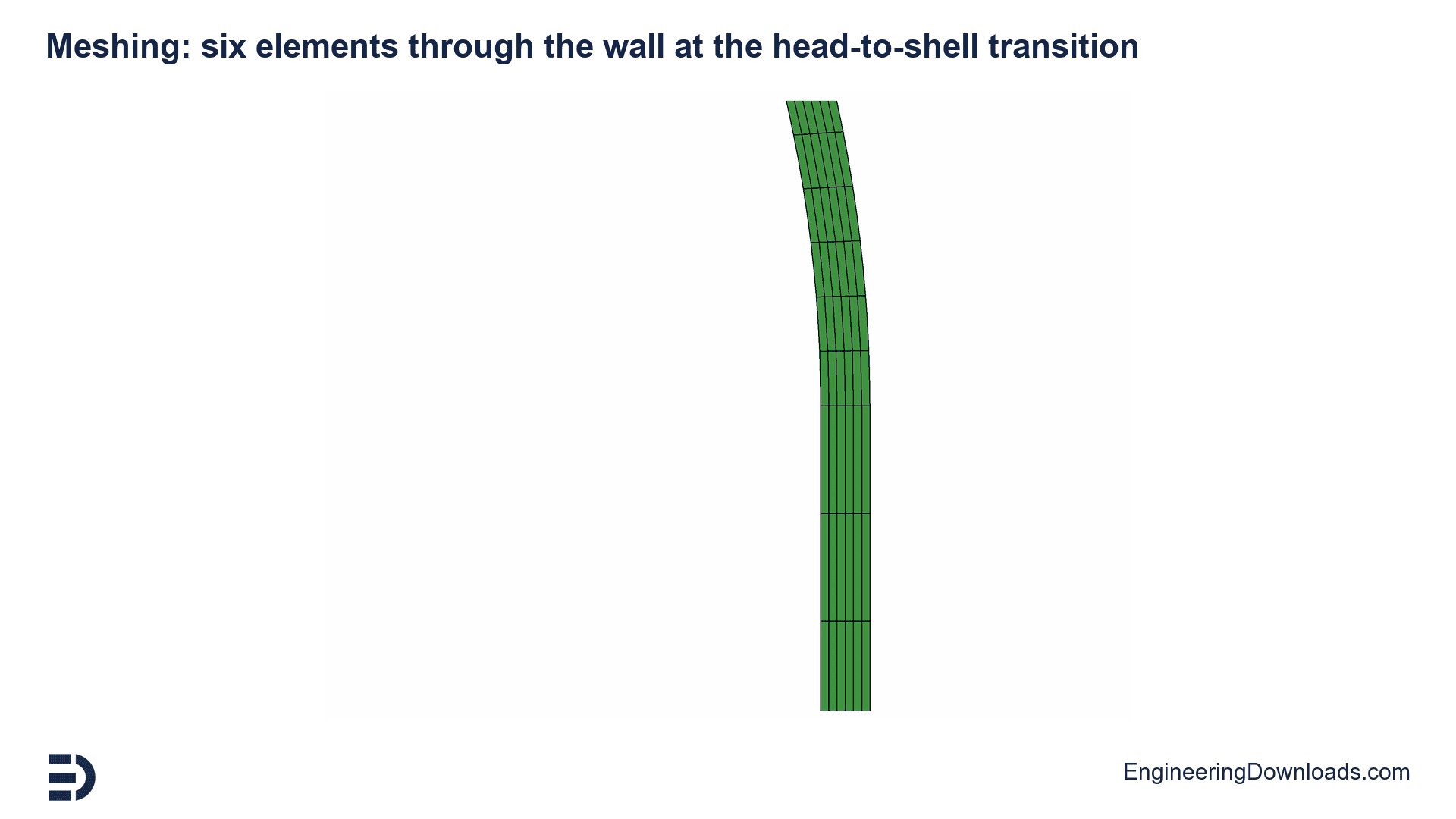
| Meshes | – | CAX8R meshes of 640, 1,440, 2,560, 5,760 and 12,960 elements, plus time-step, 975 F and coupon cases |
| Software | – | Abaqus with a linked Fortran compiler, and Python 3 |
| Quantity | Example 10.1 | This package | Difference |
|---|---|---|---|
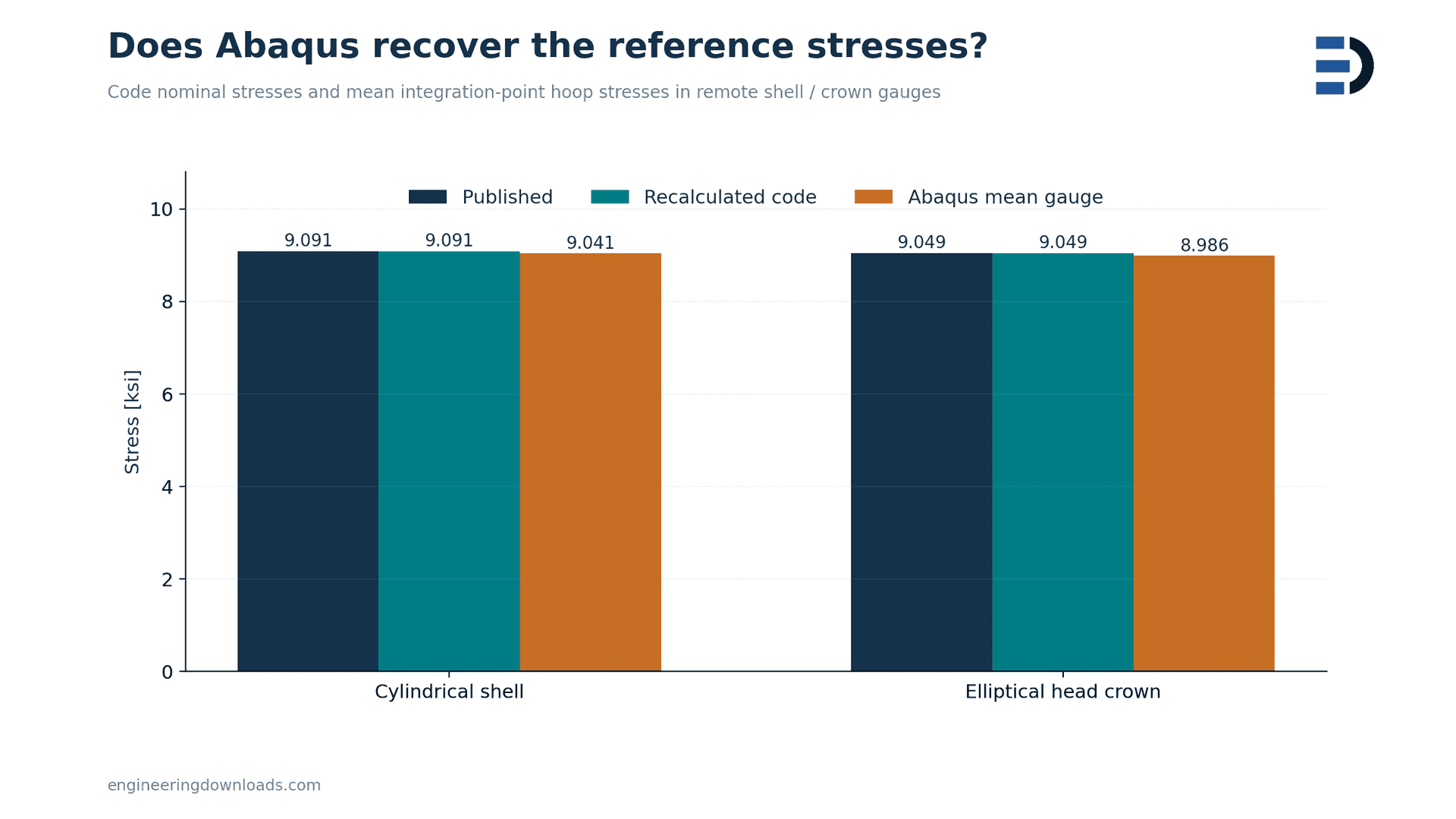
| Shell nominal stress | 9,091 psi | 9,090.5 psi | −0.005% |
| Head nominal stress | 9,049 psi | 9,049.2 psi | +0.002% |
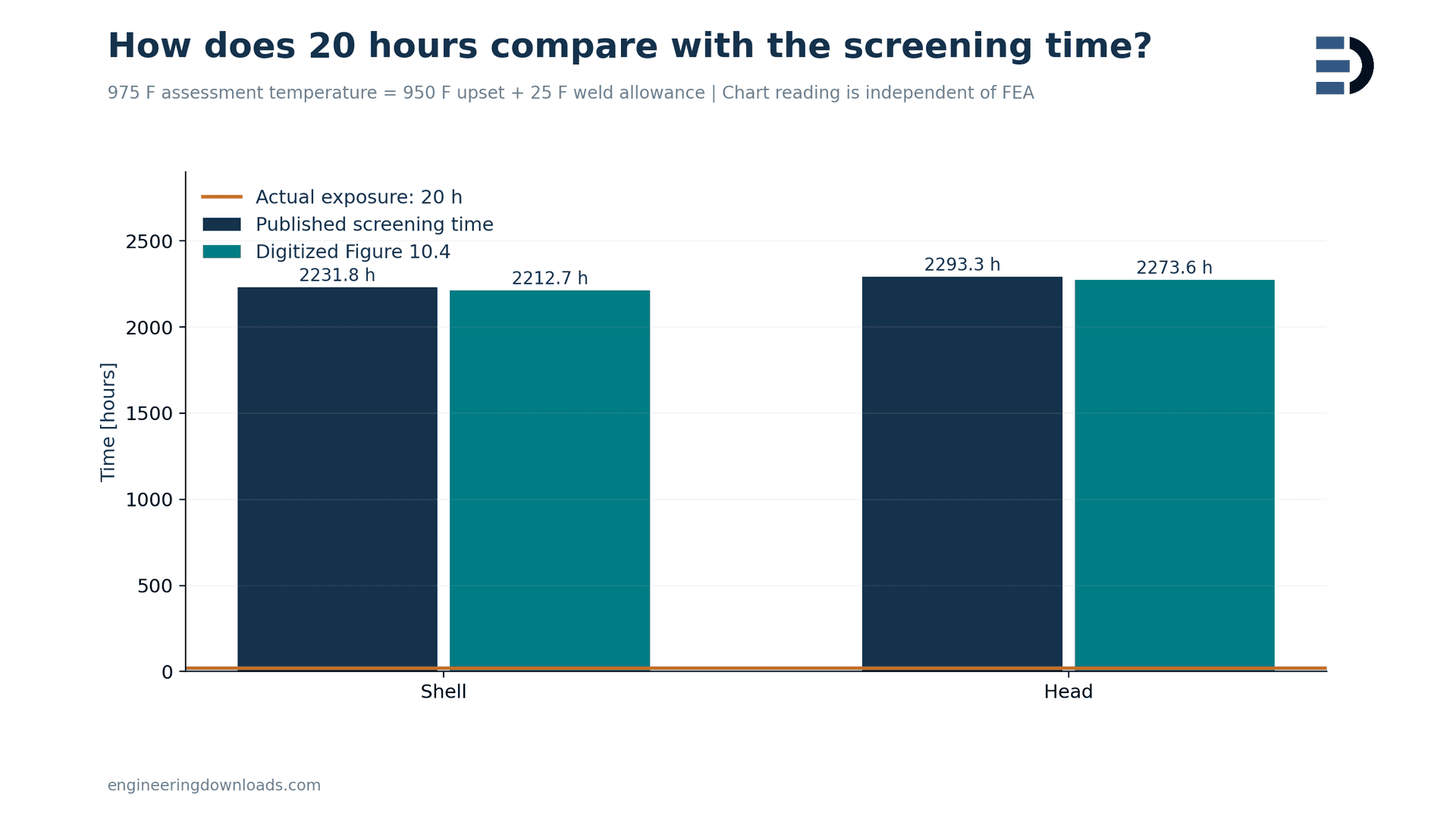
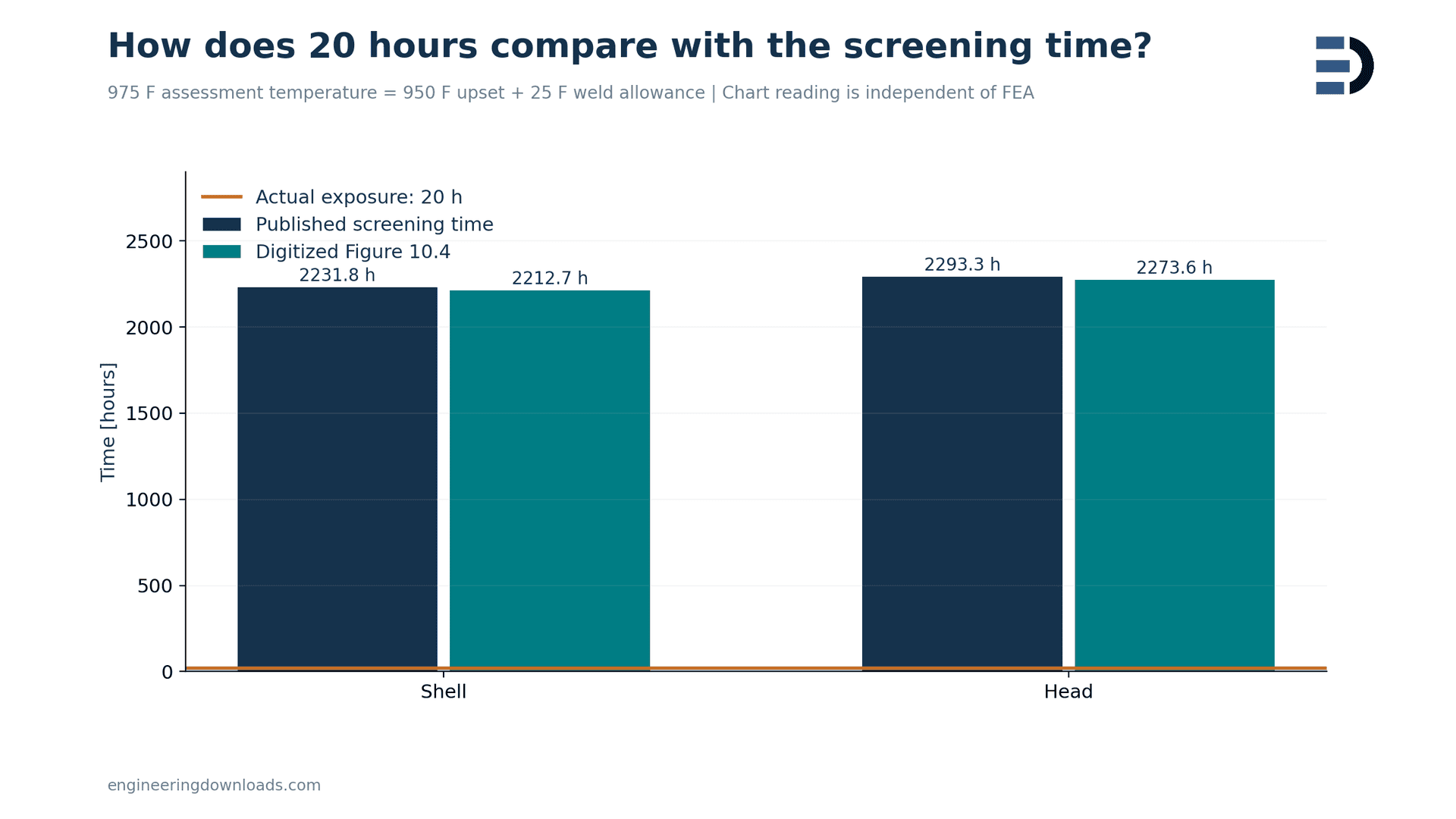
| Shell screening time at 975 F | 2,231.8 h | 2,212.7 h (chart reading) | −0.86% |
| Head screening time at 975 F | 2,293.3 h | 2,273.6 h (chart reading) | −0.86% |
| Omega law against the Abaqus coupon model | – | four stress states, 950 F and 975 F | max 0.001% |
| Abaqus mean gauge hoop stress, shell / head crown | – | 9,041 / 8,986 psi | −0.55% / −0.69% |
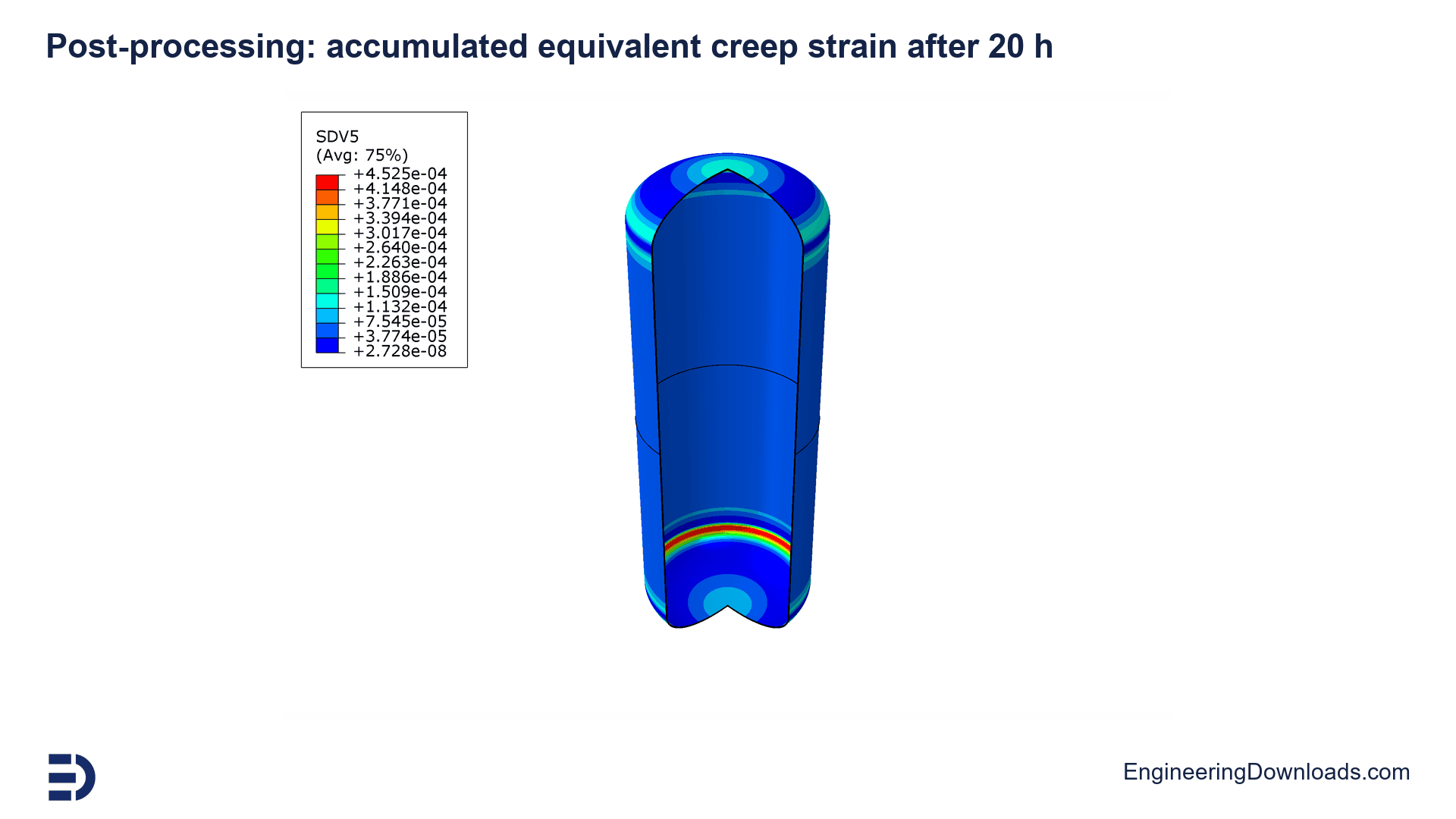
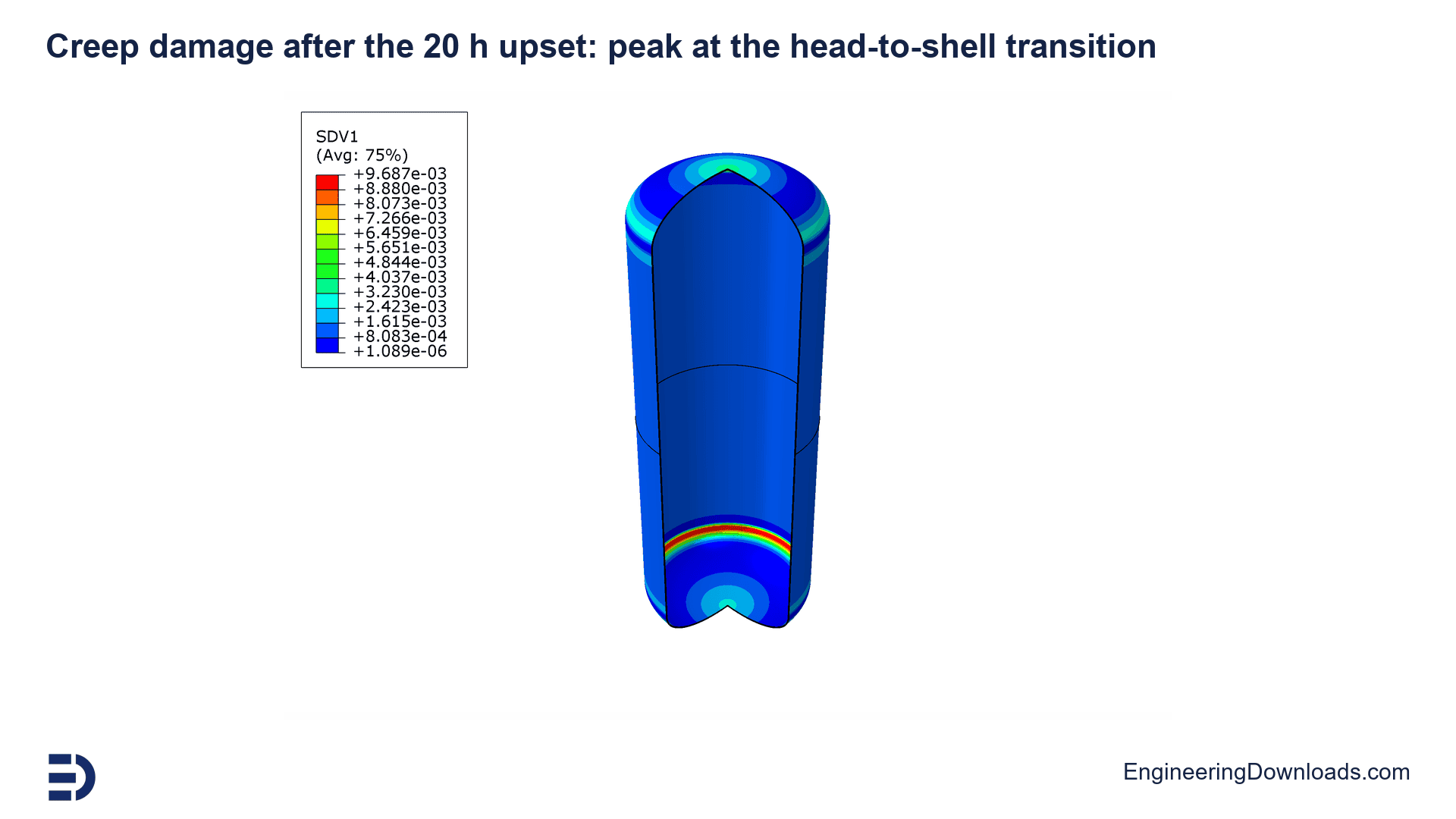
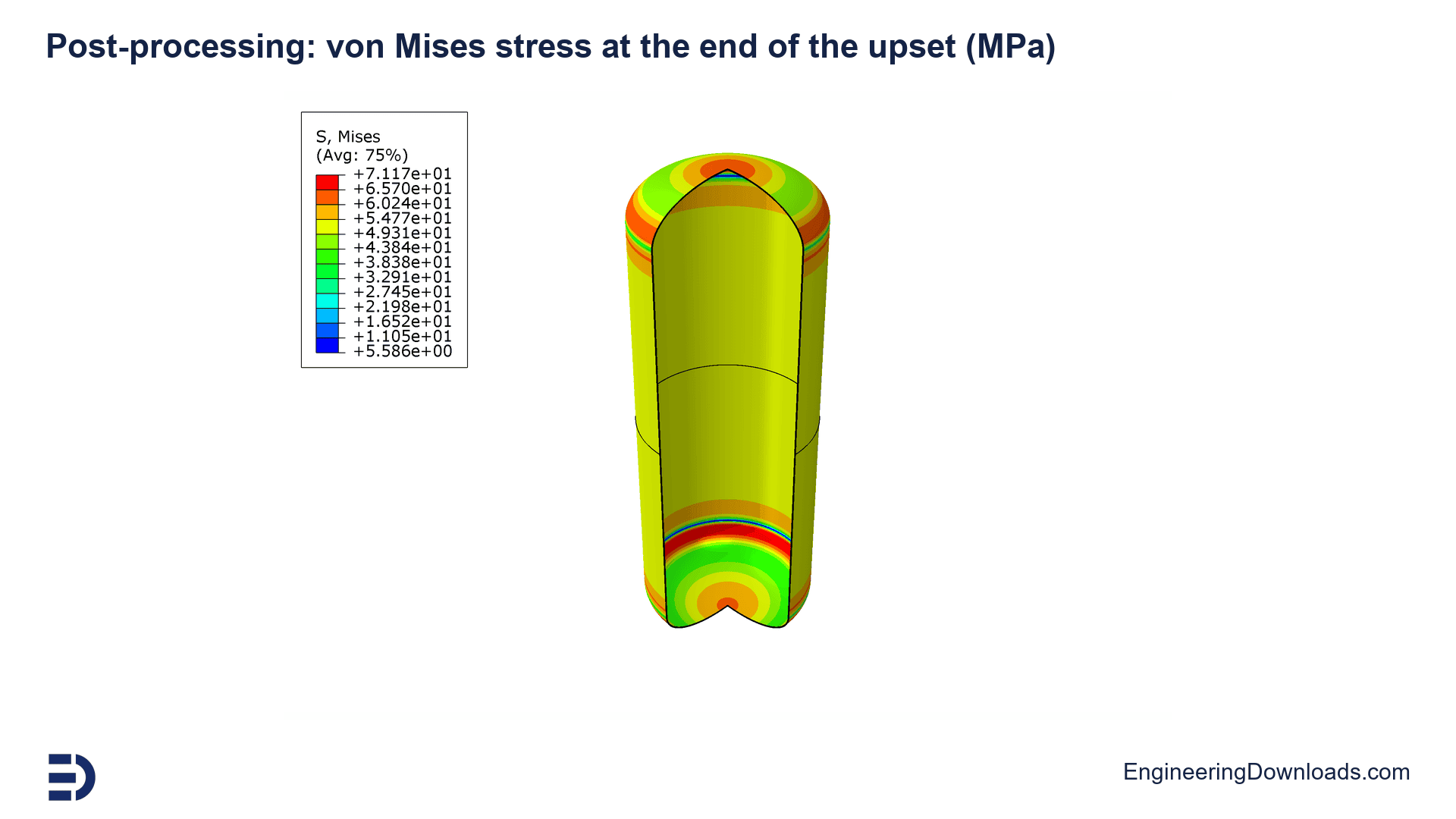
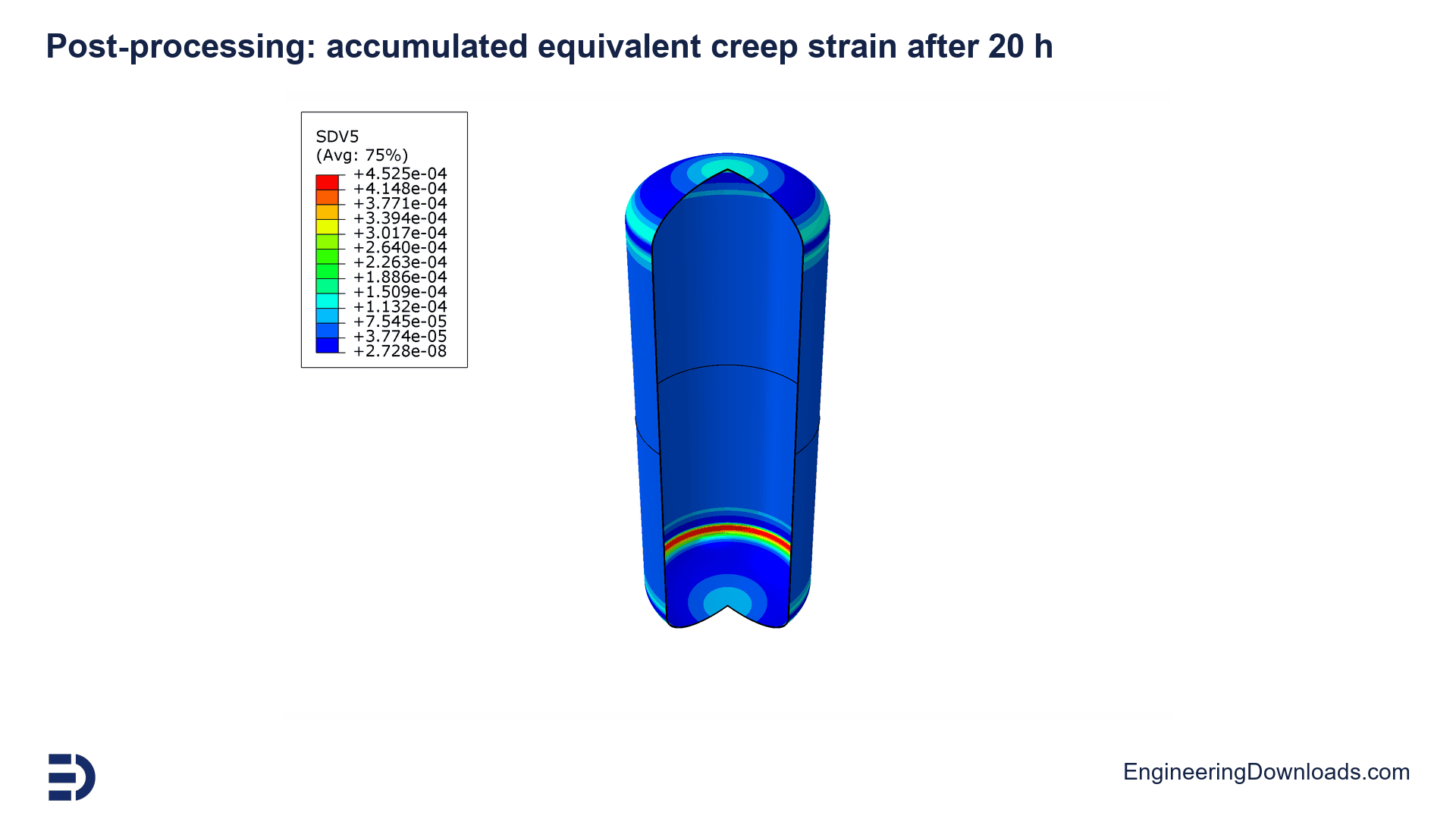
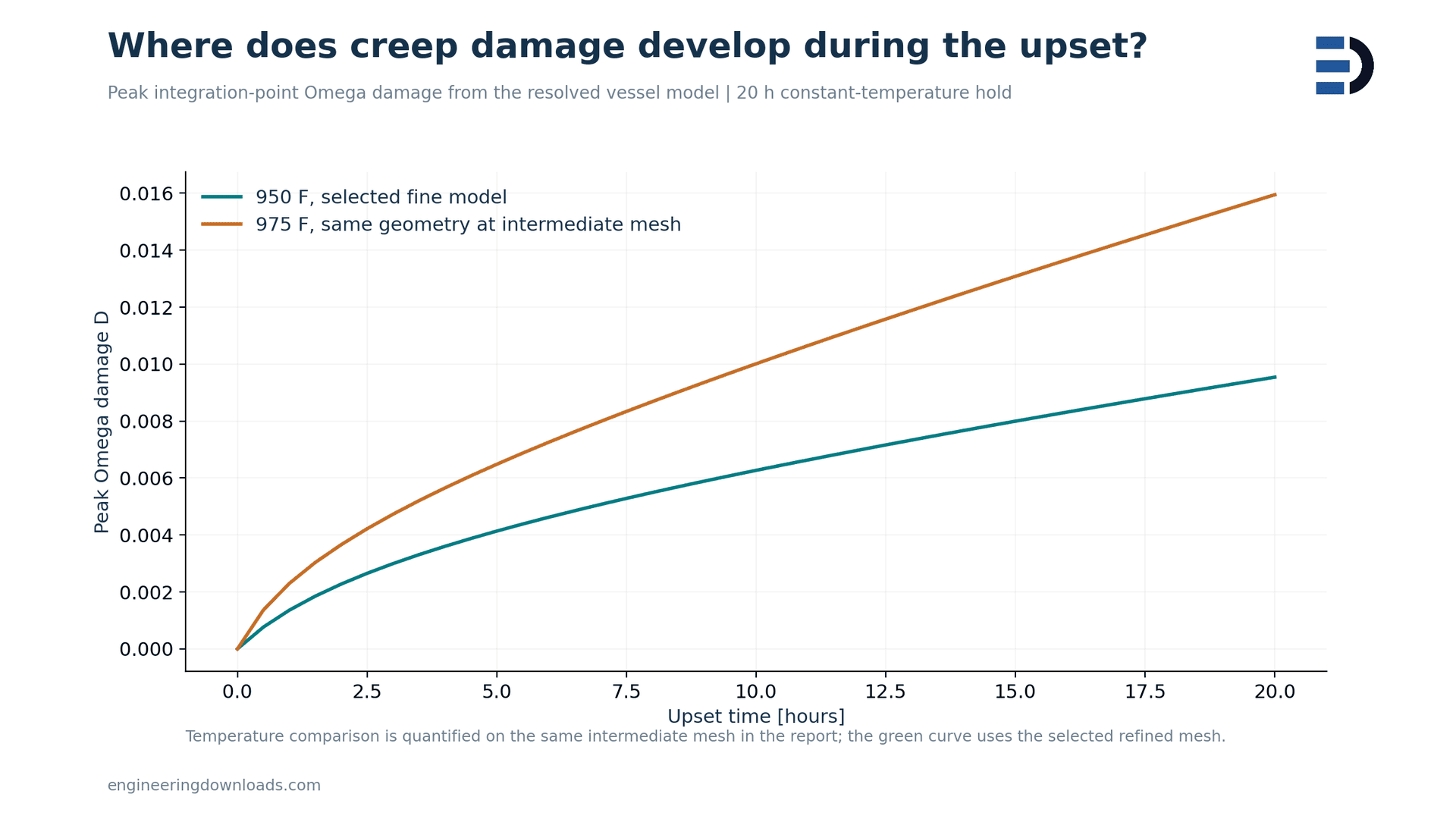
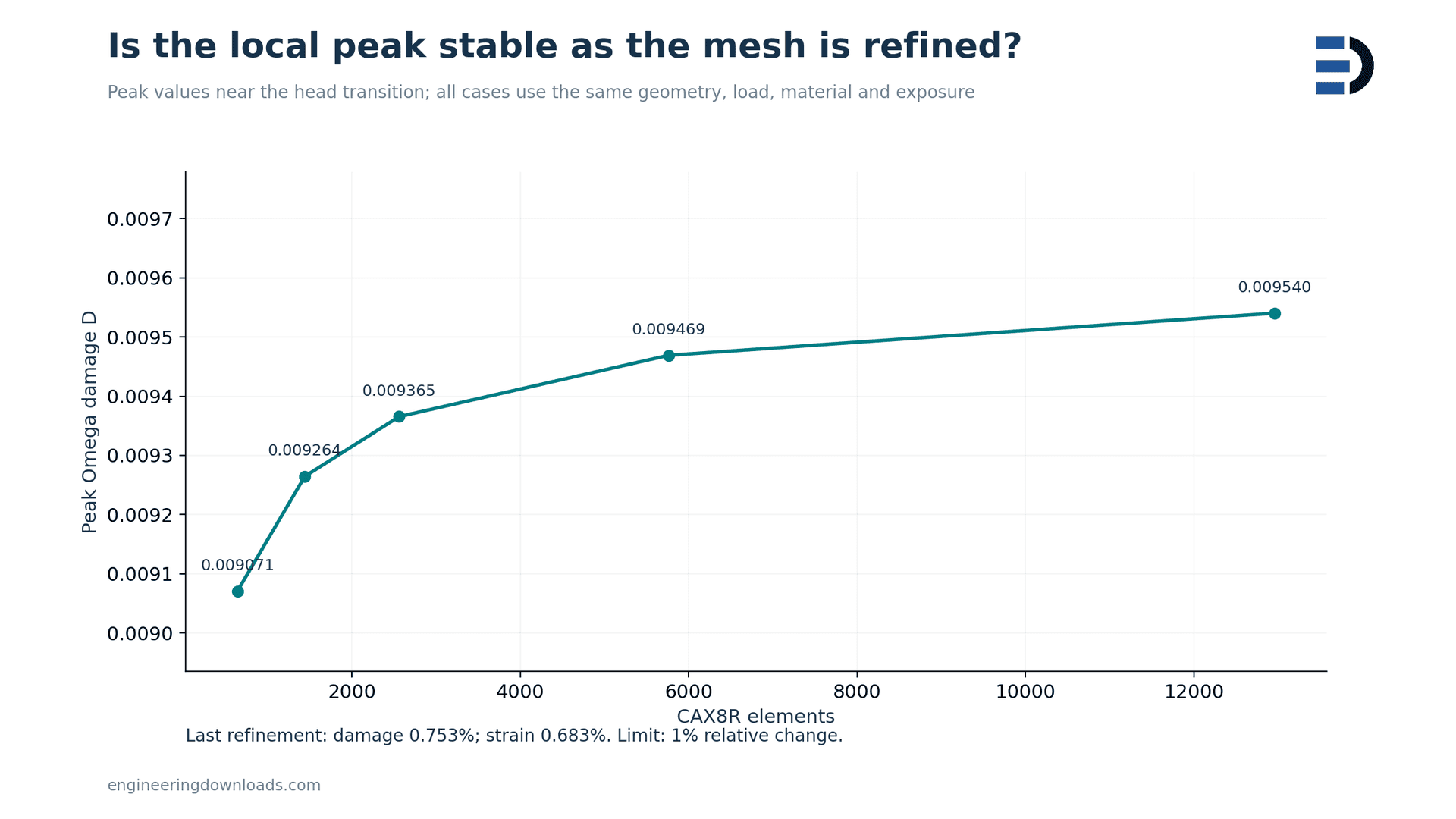
The 20 hour exposure uses about 0.9% of the screening time in both components. In the Abaqus vessel model the peak Omega damage after 20 hours is 0.00954, the peak equivalent creep strain is 4.46e-4 and the peak von Mises stress is 71.1 MPa. The last mesh refinement changes the peak damage by 0.75% and the peak creep strain by 0.68%, below a 1% limit, halving the time increment changes them by 4e-5, and the closed-end axial force balances to 7e-8. Raising the temperature to 975 F on the same geometry lifts the peak damage from 0.00926 to 0.01595 on the 1,440-element mesh.
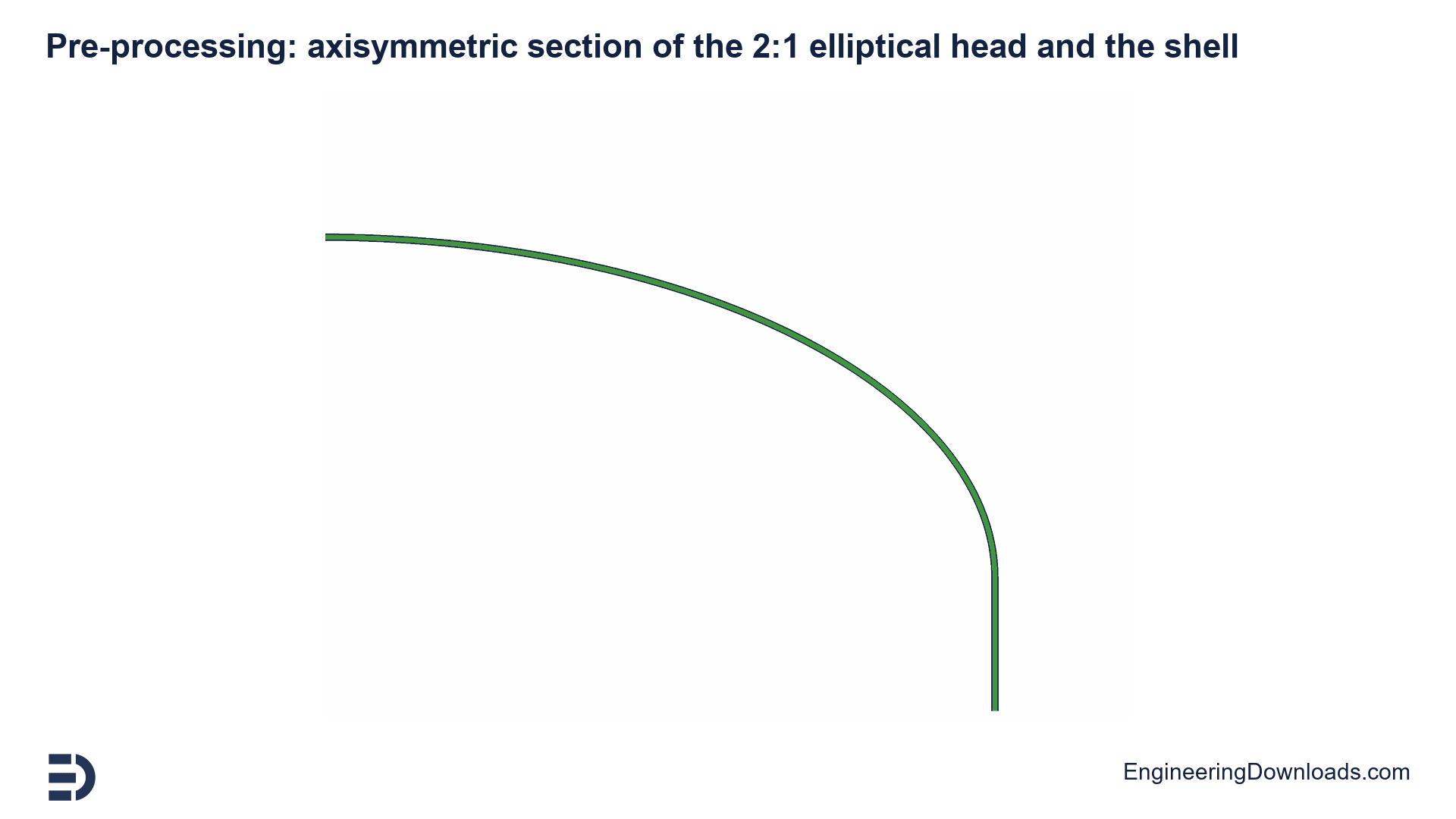
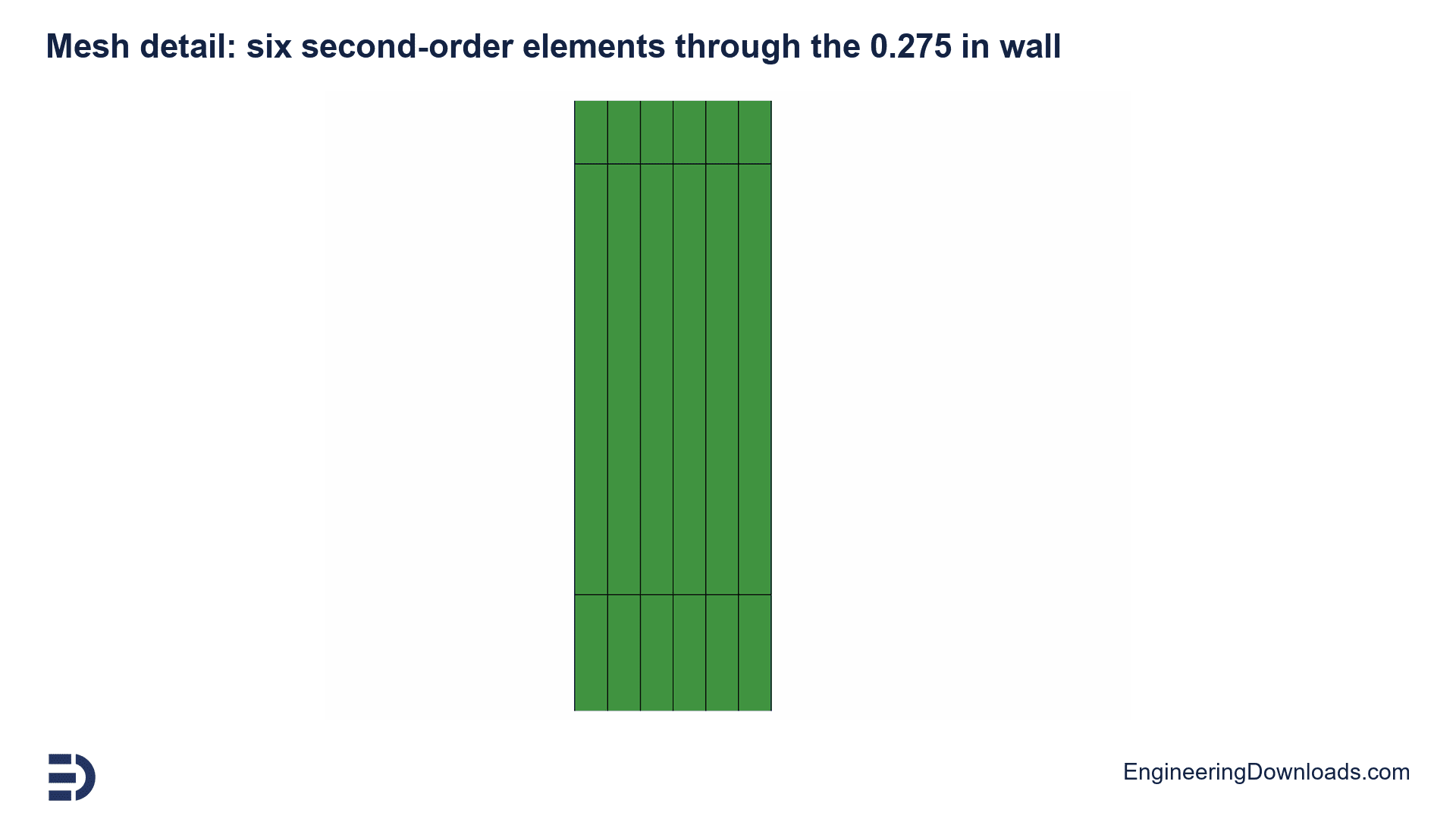
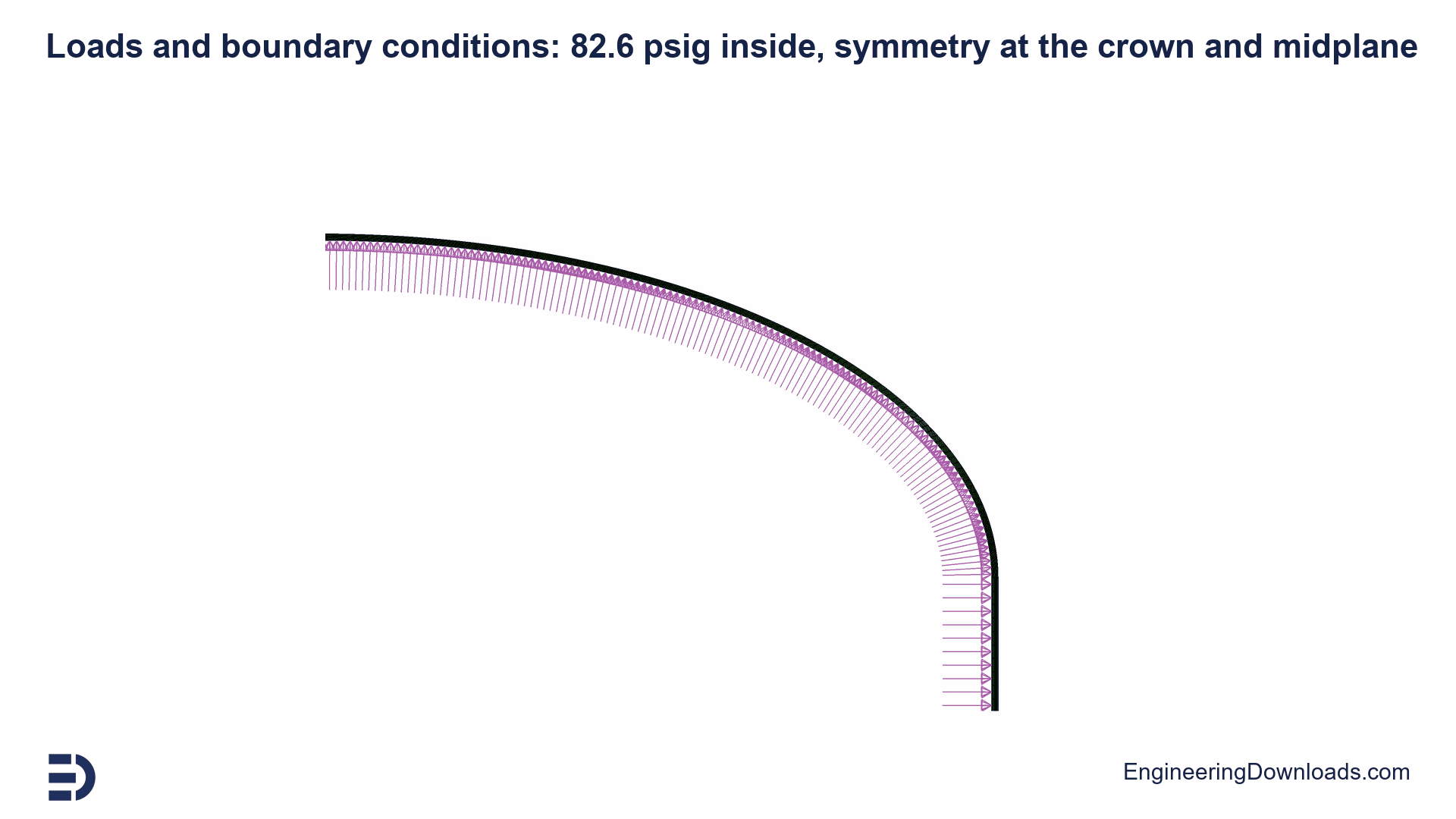
The vessel is a body of revolution, so a half-vessel meridian section is modelled with second-order axisymmetric elements (CAX8R). The inside surface carries 82.6 psig as a surface traction, the crown is held on the axis and the shell end on the midplane. Two stages run: a static pressurisation, then a 20 hour creep hold at uniform temperature using the CREEP subroutine. Young modulus 170 GPa and Poisson ratio 0.3 are assumed because the example does not give them.
This is an educational benchmark. The printed Example 10.1 is a Level 1 screening that the script reproduces; the Omega finite element model is an independent extension with a uniform temperature, an ideal head shape and no weld or heat-affected-zone model, nozzles, primary creep or plasticity. It is not a published Level 3 example and not a component-specific assessment. The models run in your own Abaqus installation (with a Fortran compiler linked for the user subroutine), and you need your own copy of the standard.
What does this package assess? The 20 hour temperature upset of a knock-out vessel in API 579-2 Example 10.1 (Part 10, creep). It reproduces the screening check and adds an Abaqus creep model that shows where Omega damage collects in the shell and the elliptical head.
What is the one-click script? run_vessel_creep_check.py is plain Python 3 with no extra packages. Run it and it prints the shell and head stress and the 975 F screening time next to the printed values, checks the Omega damage law against the Abaqus coupon model and prints the stored mesh study, then writes a CSV. No edits are needed.
How close is the result to the example? The code stresses match the printed 9,091 and 9,049 psi within 0.005%. The screening times read from the chart are within 0.86% of the printed 2,231.8 and 2,293.3 hours. The Omega law matches the Abaqus coupon model within 0.001%, and the Abaqus gauge hoop stress is within 0.7% of the published stress.
Which Abaqus files do I get? INP and CAE files of five meshes (640 to 12,960 axisymmetric elements), a time-step case, a 975 F case and a four-state coupon model, plus the CREEP subroutine source. You solve them in your own Abaqus installation with a Fortran compiler linked.
Which inputs are assumed? The example does not give Young modulus or Poisson ratio, so 170 GPa and 0.3 are assumed. The head is an ideal 2:1 ellipse with uniform wall, the temperature is uniform, and weld or heat-affected-zone behaviour, nozzles, primary creep and plasticity are not modelled. The tutorial lists the assumptions.
Can I use it for my own vessel? Yes for the screening part: change the pressure, diameter, thickness, exposure and chart anchors in the input block of the script. For the finite element part, change the geometry and loads in the model, re-mesh and re-solve with the subroutine.
Is this a Level 3 assessment? No. The printed example is a Level 1 screening. The Omega finite element model is an independent extension that shows how creep damage is resolved in the shell and head, and it does not replace a component-specific assessment by a qualified engineer.
Do I need the standard? Yes. API 579-1/ASME FFS-1 and API 579-2/ASME PTB-14 are not included. Keep your own copy to follow the equations and the screening chart.
What if the package is not what I expected? Write to us. Engineering Downloads refunds clients who are not satisfied with a delivered product.
Need more than the files?
There are two ways we can help. Book a one hour online consultation if you want to talk a problem through with a CAE engineer, using the checkbox in the order box. Order a project if you need a full simulation built for you, delivered to an agreed scope, price and deadline under a written contract.
We work on FEA and CFD for engineers, researchers and companies. Order your project, or message us on WhatsApp for a quick reply.
Other packages engineers working on this topic also download.
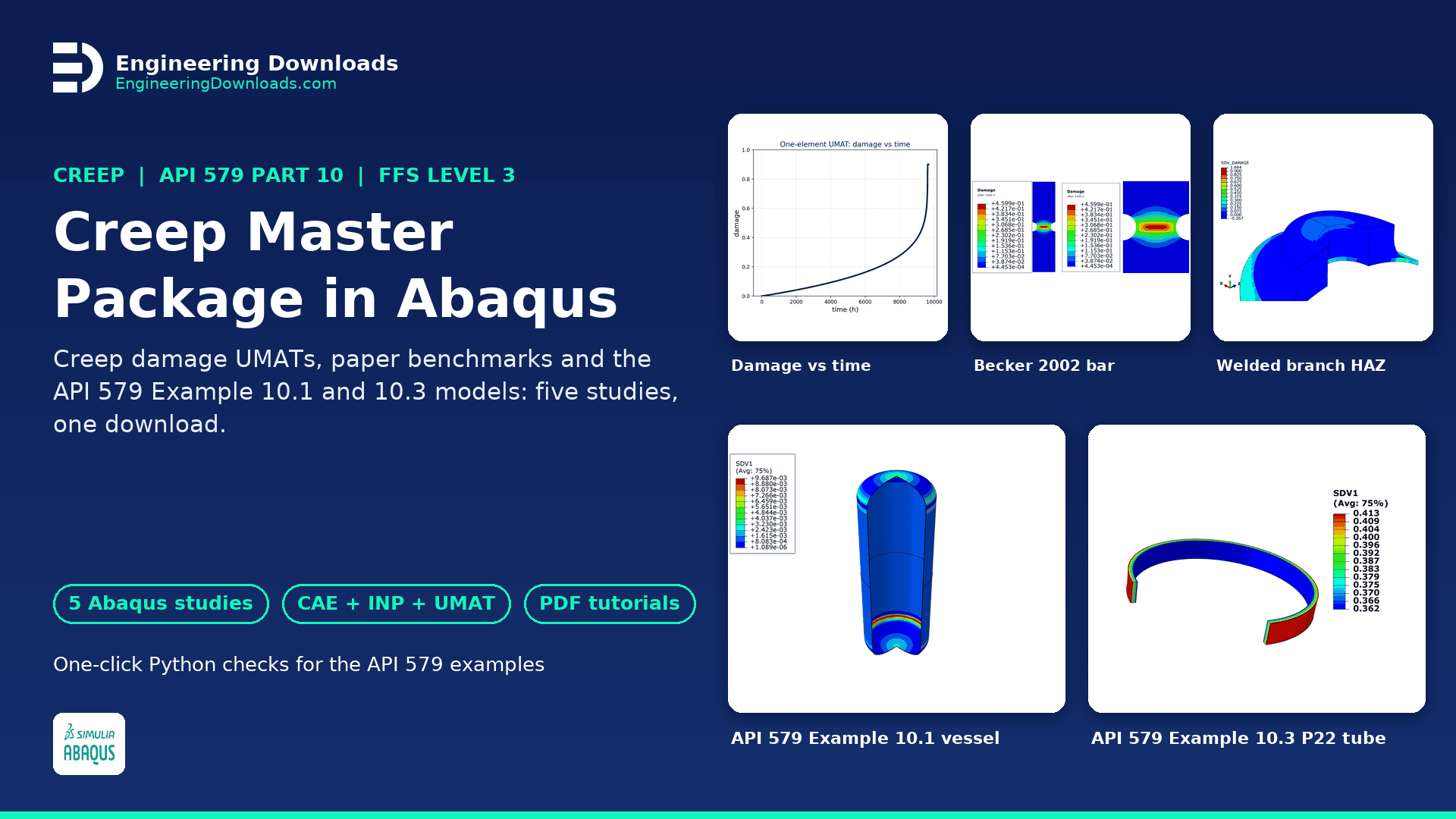 Creep Master Package in Abaqus: API 579 Part 10 Examples 10.1 and 10.3, Creep Damage UMAT and Paper Benchmarks€299,00
 API 579 Example 10.3 in Abaqus: P22 Heater-Tube Creep Life, Omega Damage Model and One-Click Python Check€139,00
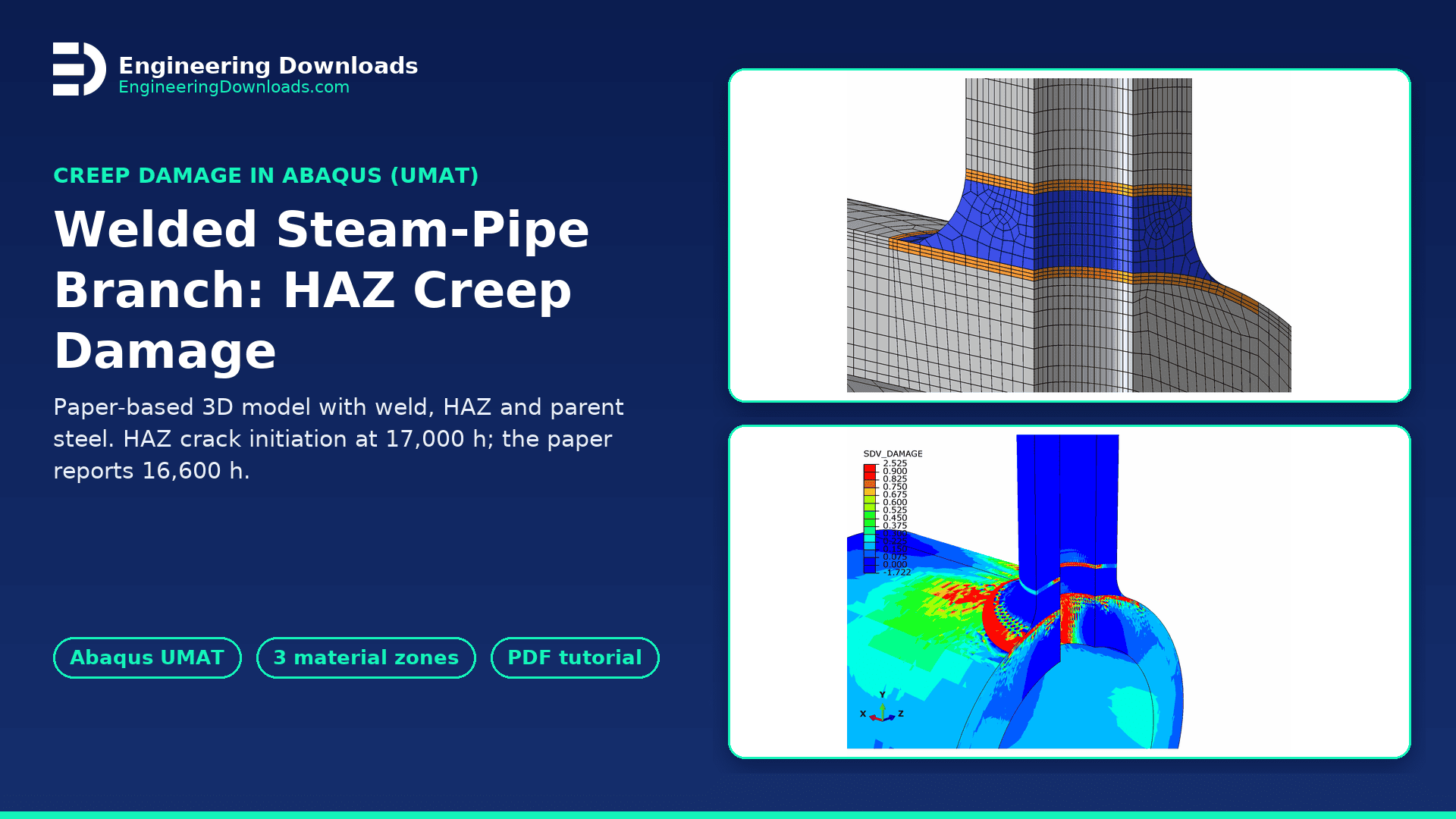 Creep Damage Analysis of a Welded Steam Pipe Branch in Abaqus: UMAT, HAZ Hex Mesh and Paper Comparison€149,00
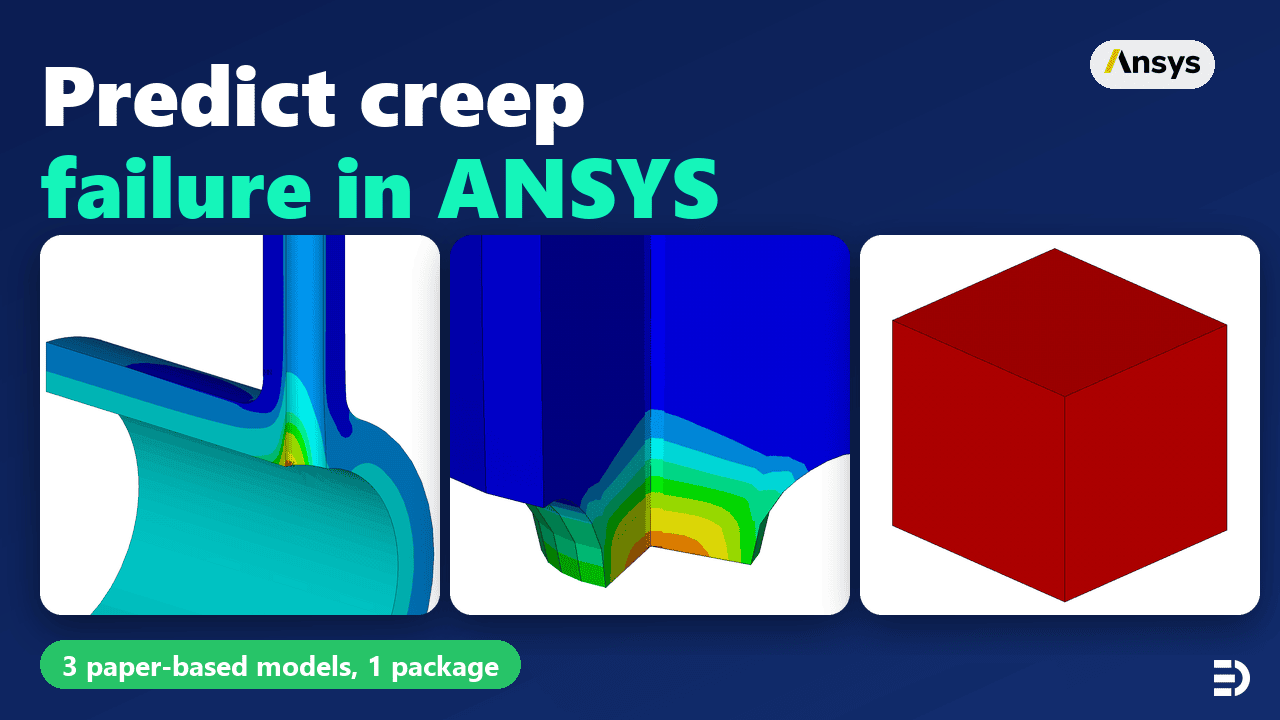 ANSYS Creep Damage Package: 3 Paper-Based APDL Models (Welded Pipe Branch, Notched Bar, Failure Horizon)€299,00
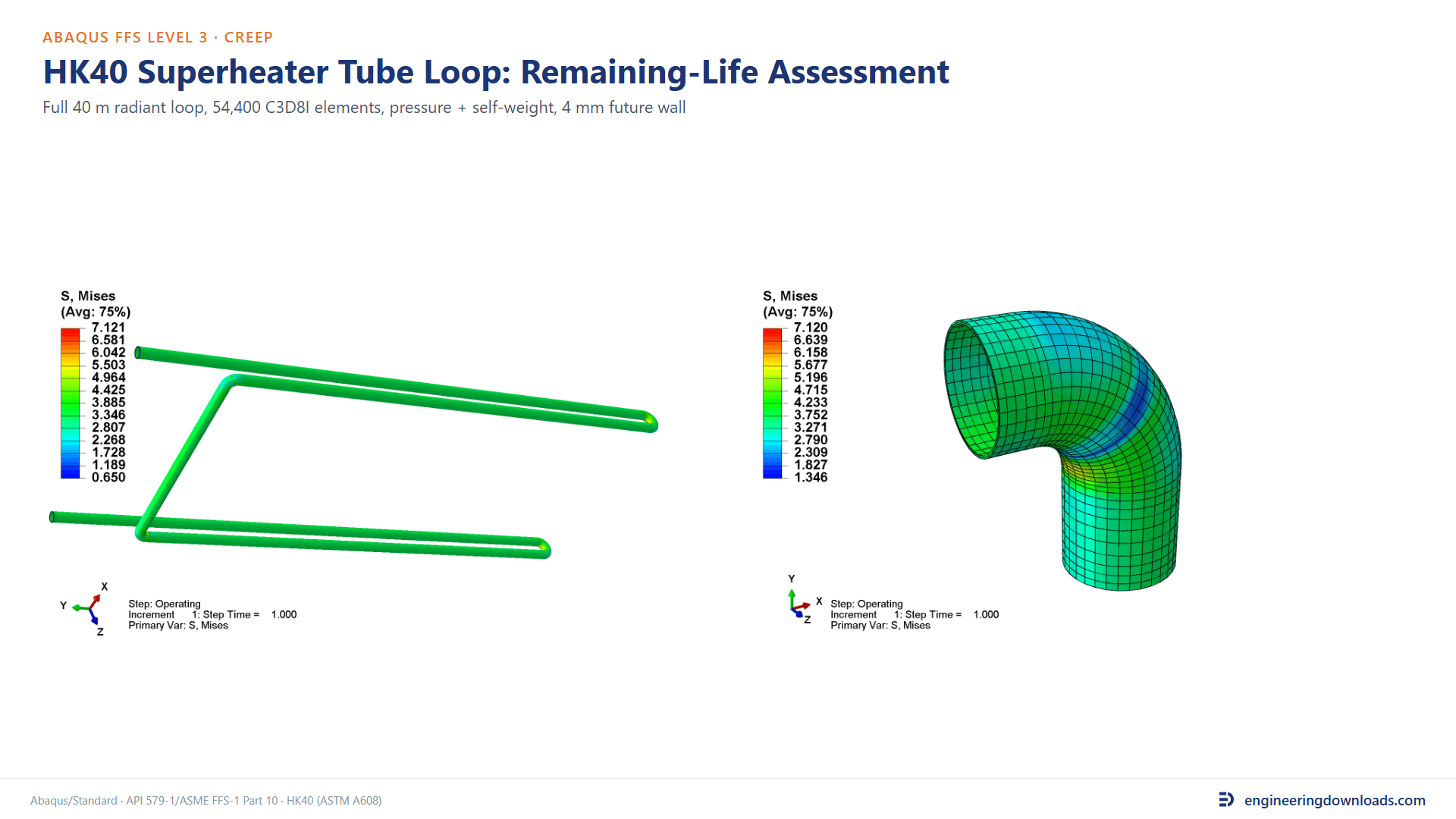 HK40 Superheater Tubes: API 579 FFS Level 3 and Creep Remaining Life in Abaqus€139,00
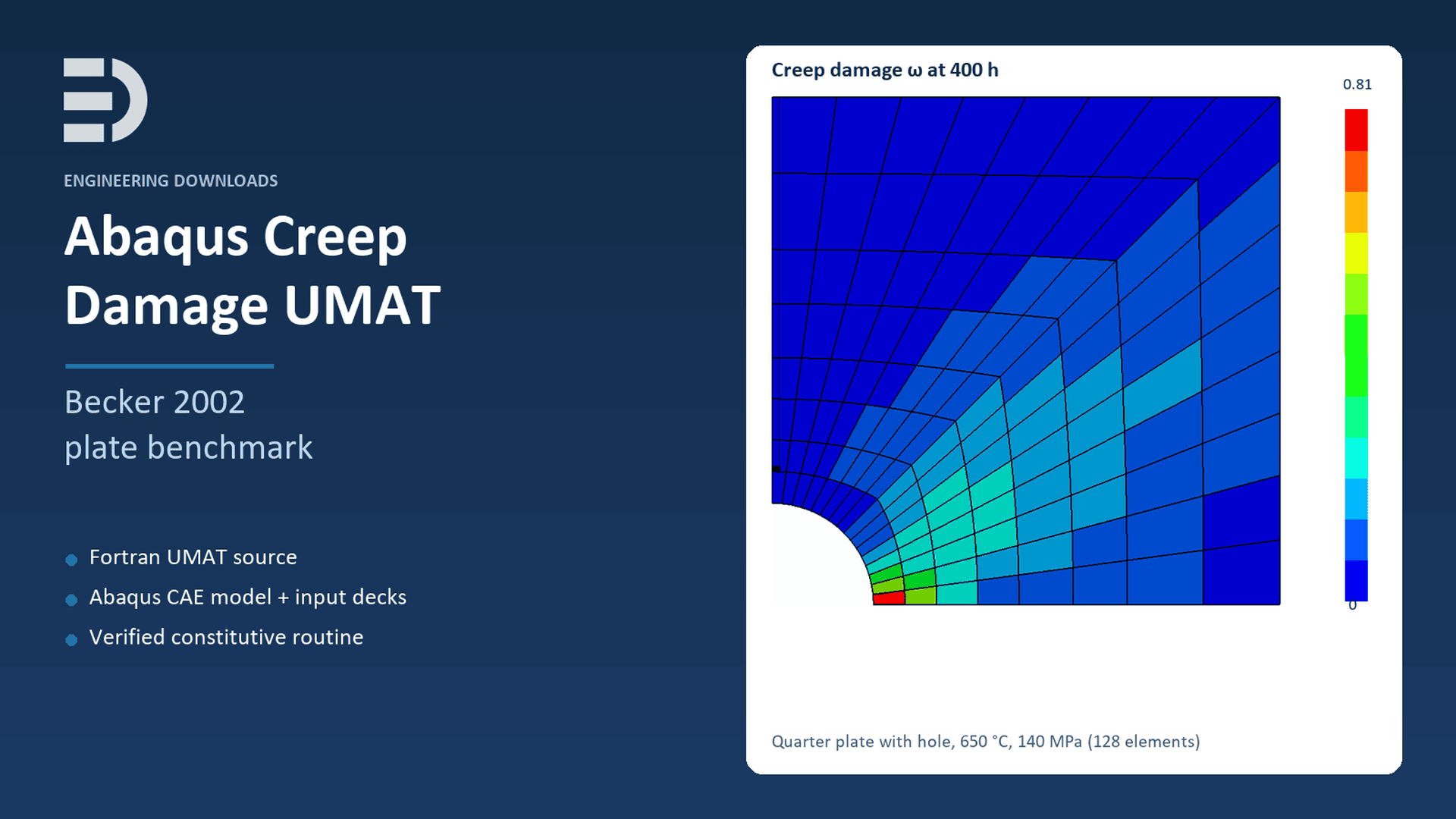 Creep Continuum Damage UMAT in Abaqus: Becker 2002 Perforated Plate Benchmark€49,00
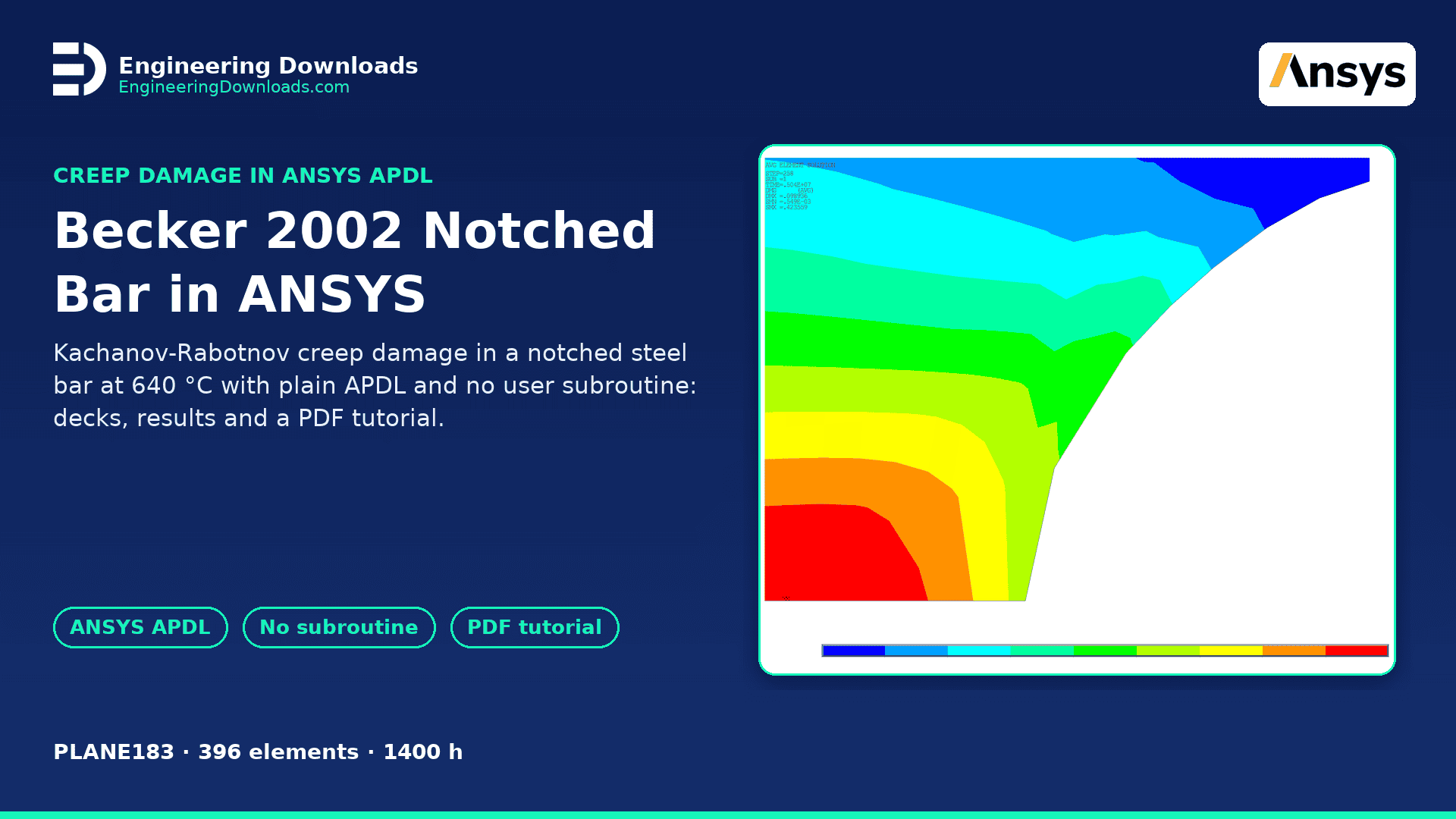 Creep Damage Notched Bar in ANSYS APDL: Becker 2002 Benchmark with No User Subroutine, Decks and Paper Comparison€49,00
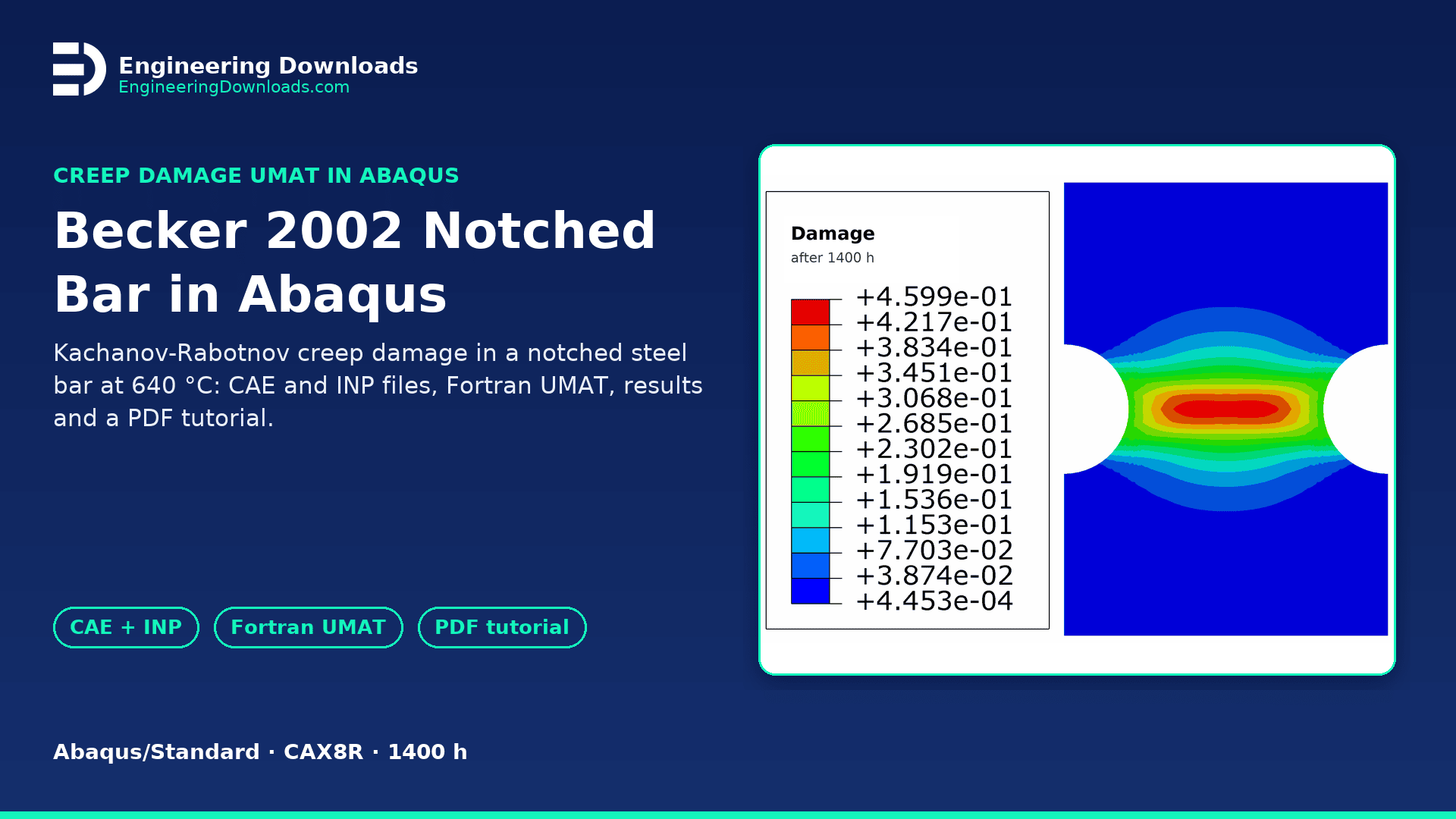 Creep Damage Notched Bar in Abaqus: Becker 2002 Benchmark with UMAT, CAE and INP Files and Paper Comparison€49,00

Need a full custom project? See the options below.

€129,00

€179,00

€149,00

€119,00

€129,00
See more
Want to receive push notifications for all major on-site activities?