

Need a full custom project? See the options below.
Need a full custom project? See the options below.
This product is an Abaqus finite element model of Example 13.2 in Part 13 (laminations) of API 579-2/ASME PTB-14. The example covers a metric vessel, V-101, with a 3000 mm bore and a 13 mm wall of SA-516 Gr 70, a 1.6 mm future corrosion allowance and two internal laminations close to a weld.
The published example works through a Level 1 screening of both laminations and a MAWP calculation. The manual contains no finite element model, so this package adds one: an independent FE extension of the example geometry in which both laminations are represented as unbonded internal seams with frictionless hard contact. The results are compared with the published example and with closed-end Lame theory.
Abaqus input files and the script are included, so everything runs in your own Abaqus installation.
Source: API 579-2/ASME PTB-14, Example Problem 13.2, Part 13, printed pages 13-9 to 13-16. The following is a paraphrase of the example, not a reproduction.
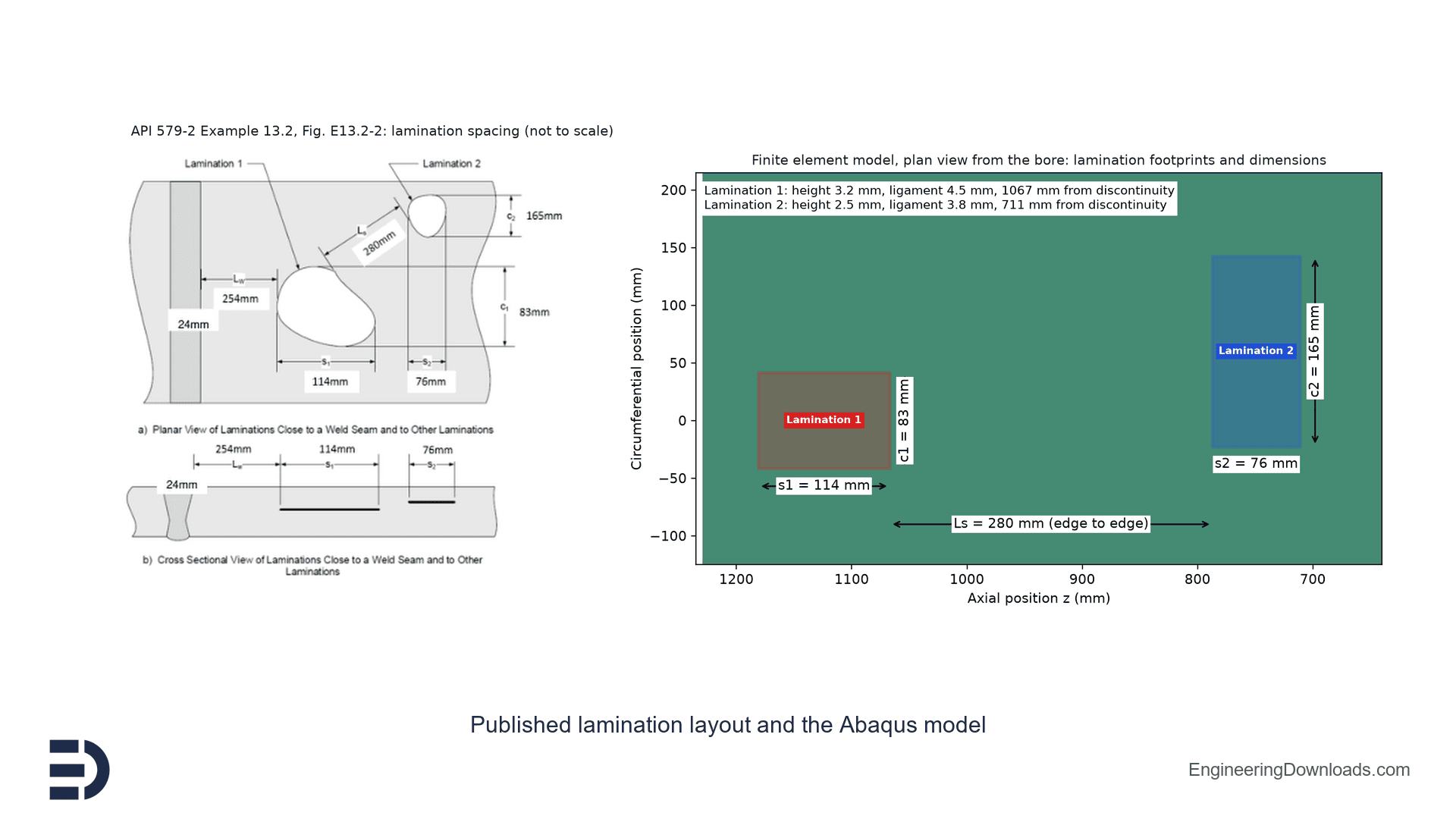
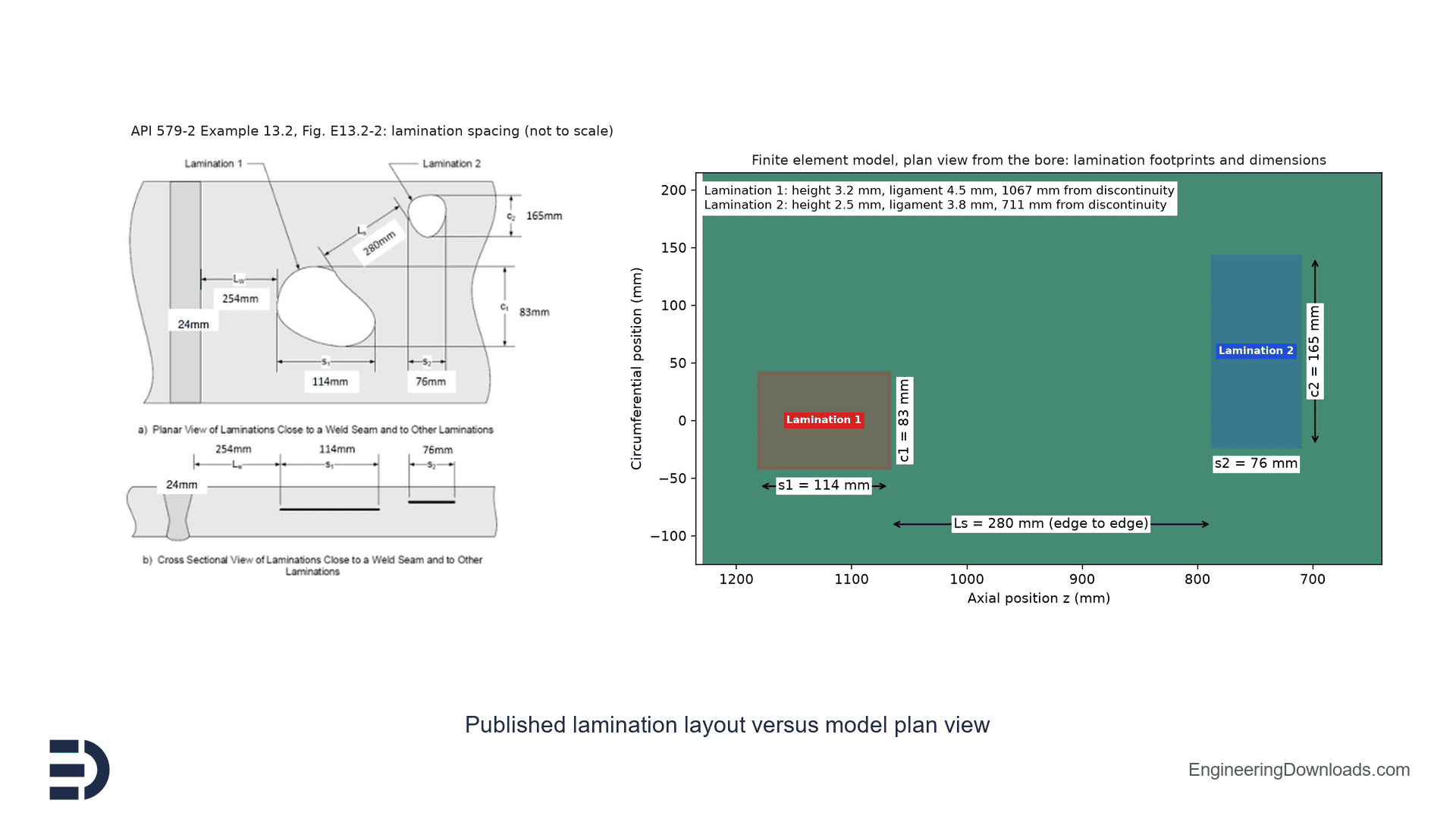
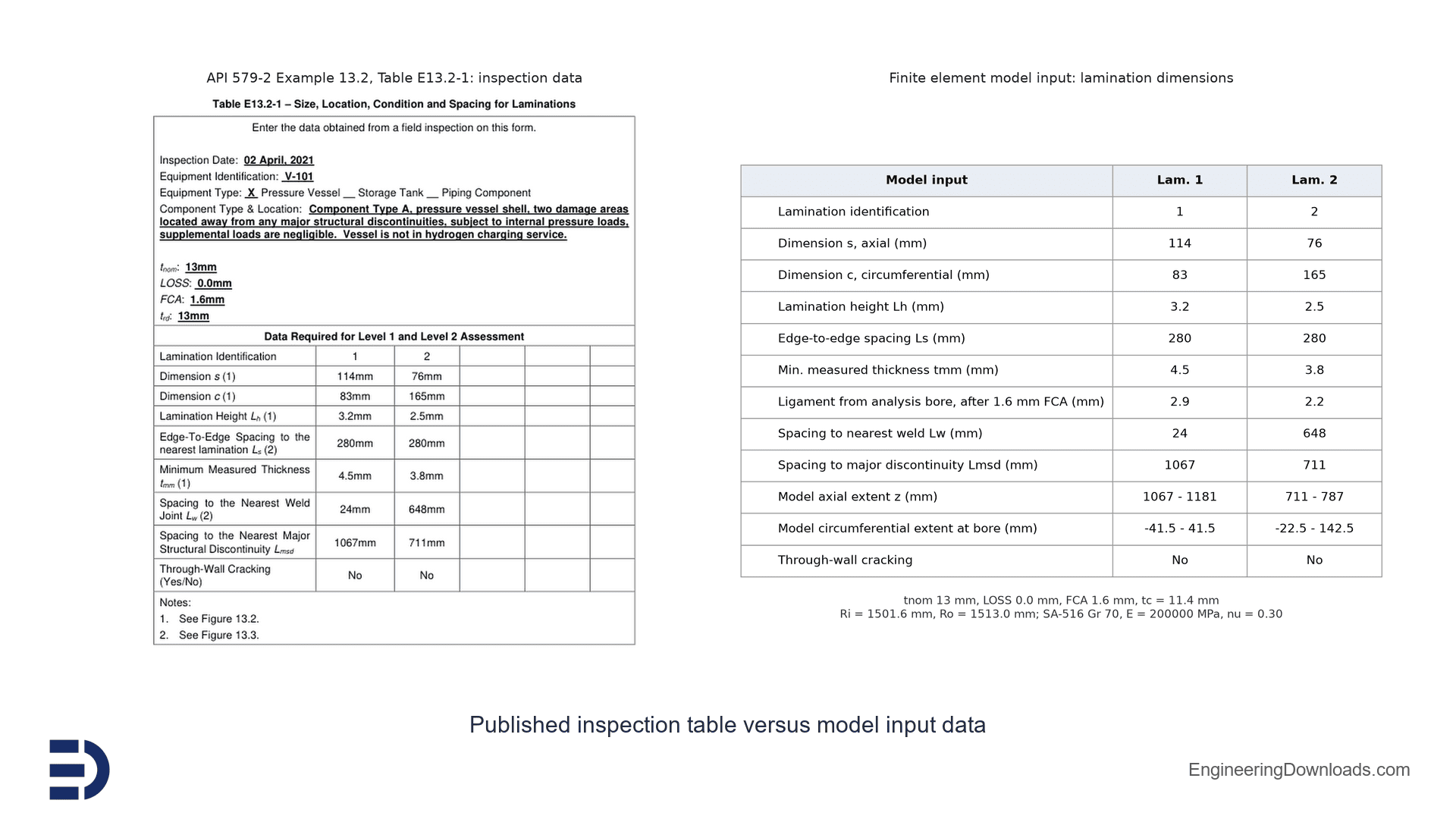
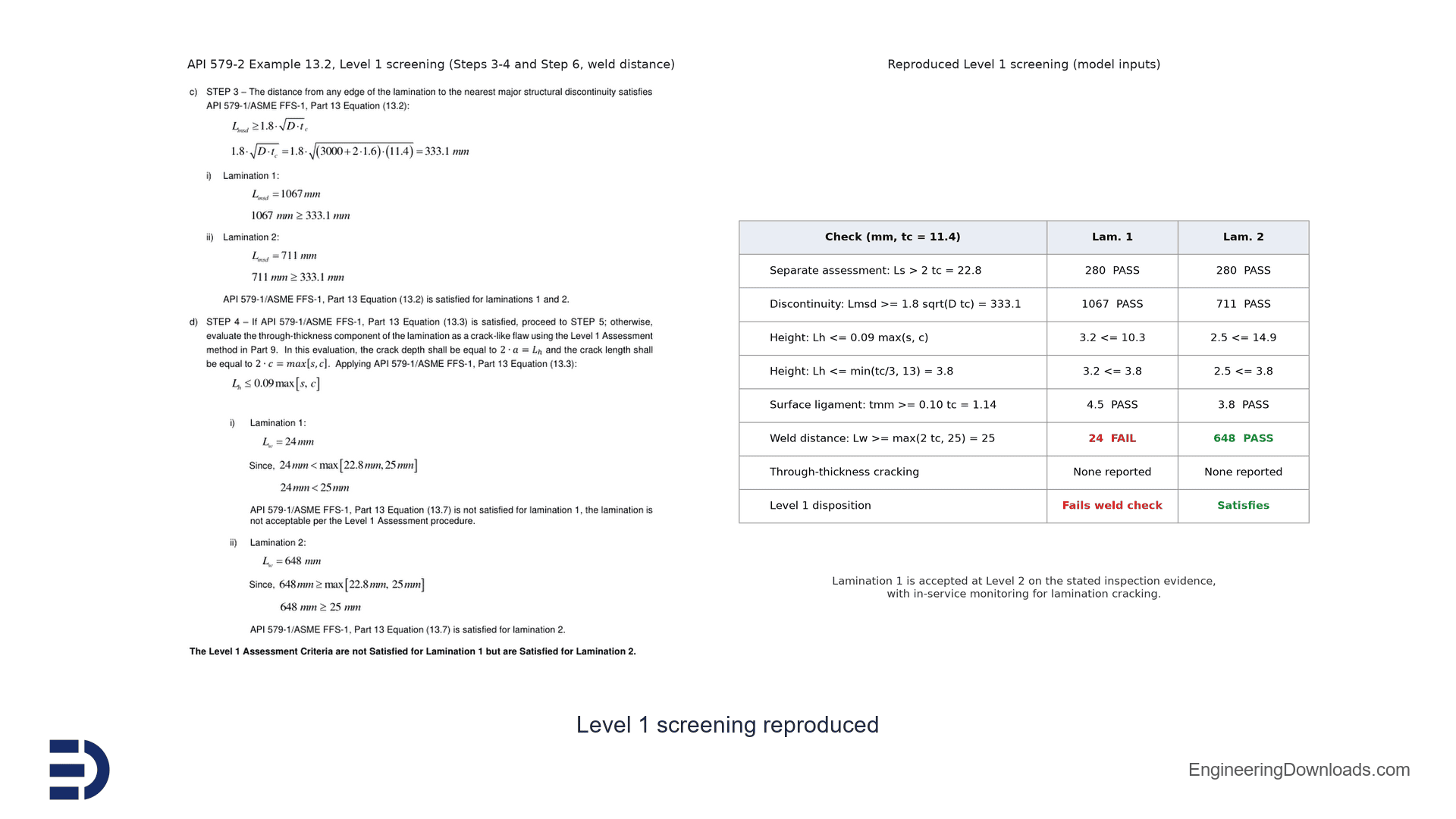
The example screens two laminations in vessel V-101 using the Level 1 criteria. Lamination 1 measures 114 x 83 mm, is 3.2 mm high and leaves a 4.5 mm ligament. Its distance to the weld, Lw, is 24 mm against 25 mm required, so it does not pass the weld-distance check at Level 1. Lamination 2 measures 76 x 165 mm, is 2.5 mm high, leaves a 3.8 mm ligament and sits 648 mm from the weld, so it satisfies Level 1. The example then accepts lamination 1 at Level 2. The MAWP per Annex 2C is given as 0.91 MPa against a design pressure of 0.86 MPa.
| Item | Lamination 1 | Lamination 2 |
|---|---|---|
| Size (mm) | 114 x 83 | 76 x 165 |
| Height (mm) | 3.2 | 2.5 |
| Ligament (mm) | 4.5 | 3.8 |
| Distance to weld Lw (mm) | 24 (25 required) | 648 |
| Level 1 weld-distance check | Fails at Level 1, accepted at Level 2 in the example | Satisfied |
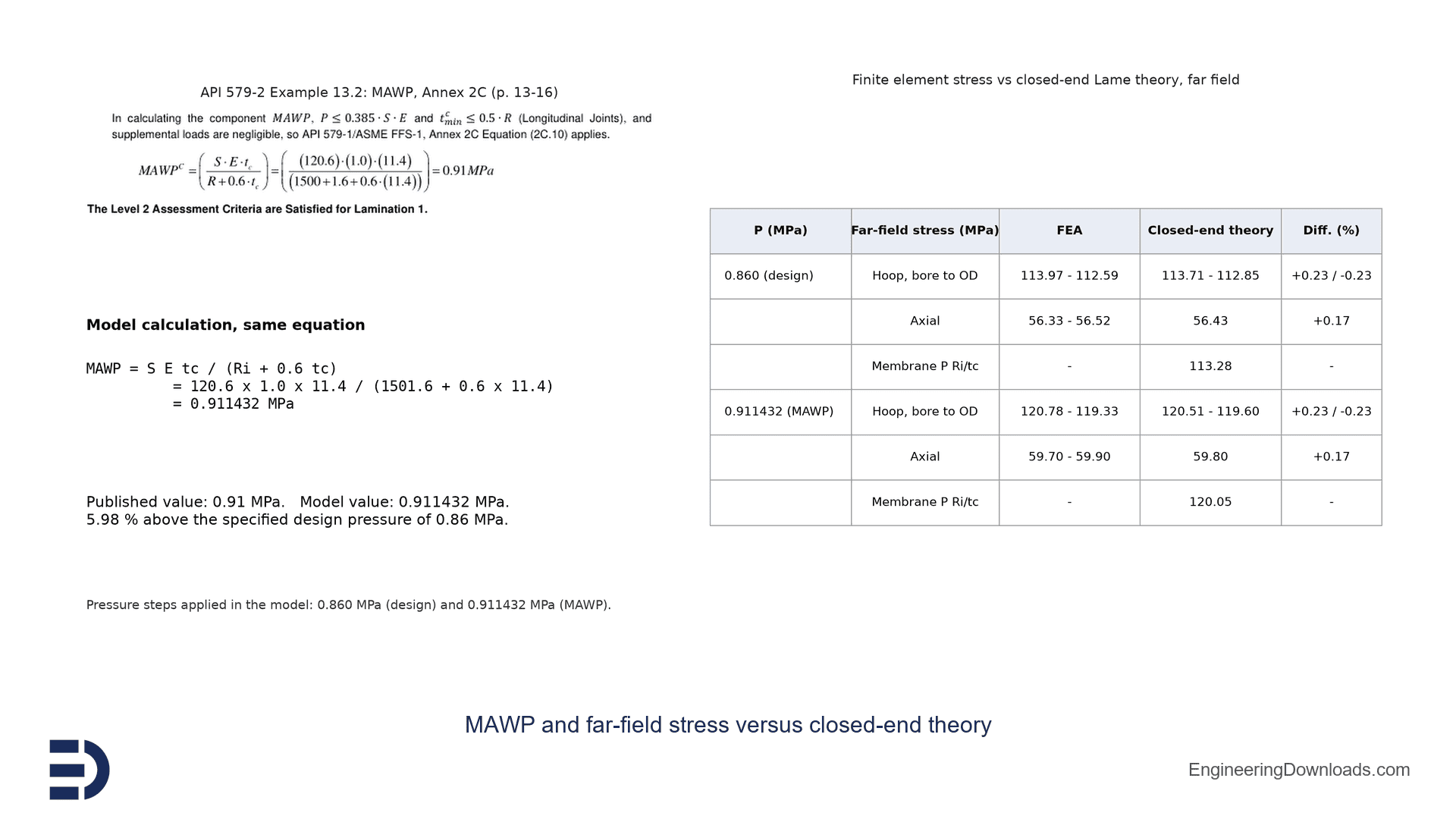
The Level 1 screening table and the Annex 2C MAWP are also reproduced in the package. The MAWP result is 120.6 x 1.0 x 11.4 / (1501.6 + 0.6 x 11.4) = 0.911432 MPa, which is 5.98 % above the design pressure.
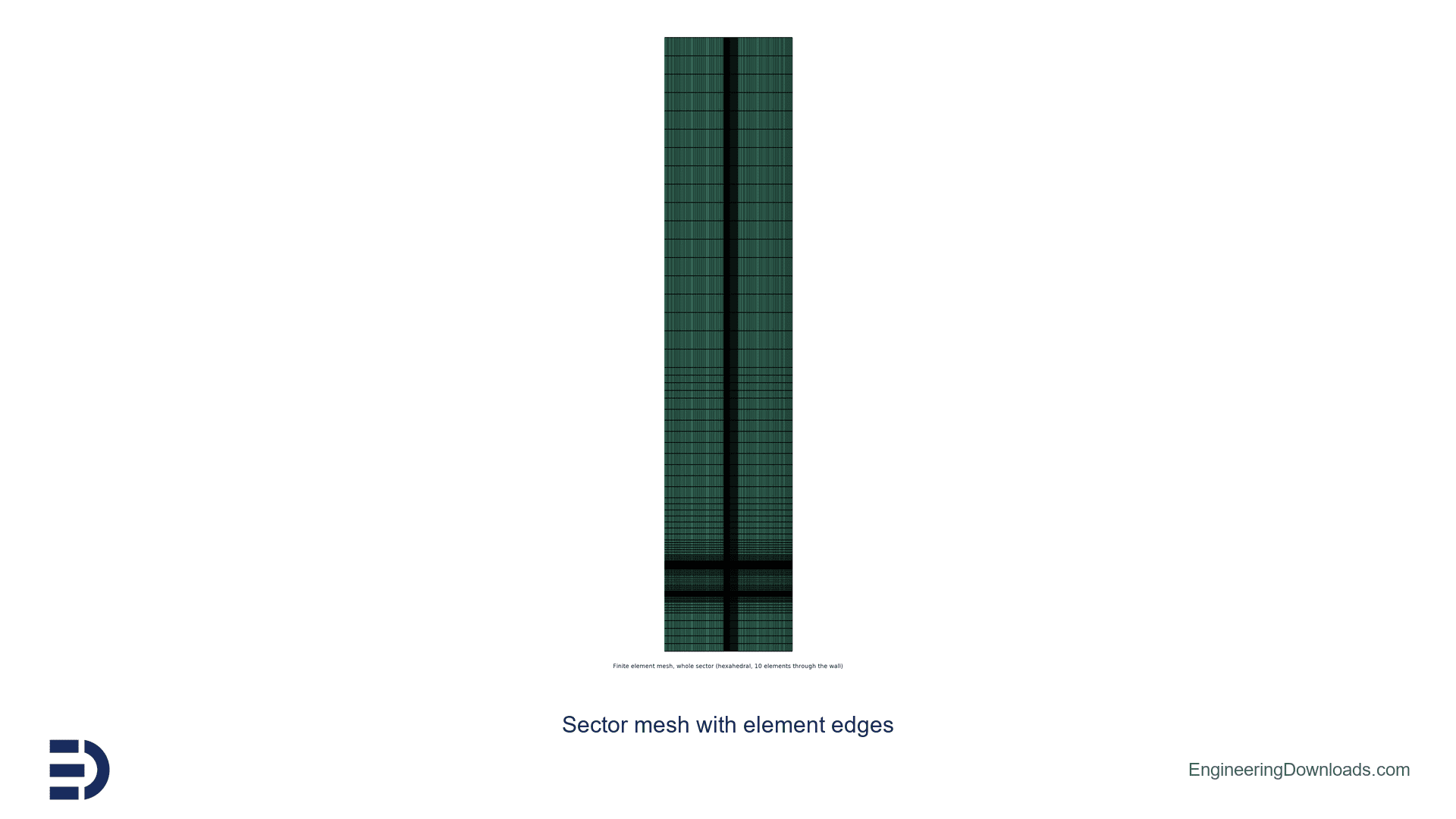
The far field of the model is compared with closed-end thick-cylinder (Lame) theory. All stresses are in MPa.
| Quantity | Abaqus (FEA) | Closed-end Lame |
|---|---|---|
| Hoop stress at MAWP | 119.33 – 120.78 | 119.60 – 120.51 |
| Hoop stress at design pressure | 112.59 – 113.97 | 112.85 – 113.71 |
| Axial stress | 59.70 – 59.90 | 59.80 |
| Radial displacement (mm) | 0.762 – 0.765 | 0.769 – 0.772 |
The base reaction equals the closed-end resultant. Both laminations remain closed at the MAWP, with contact pressure (maximum / mean) of 1.00 / 0.55 MPa on lamination 1 and 1.10 / 0.59 MPa on lamination 2. The contour plots show the hoop stress concentration around the laminations; local peak values depend on the mesh.
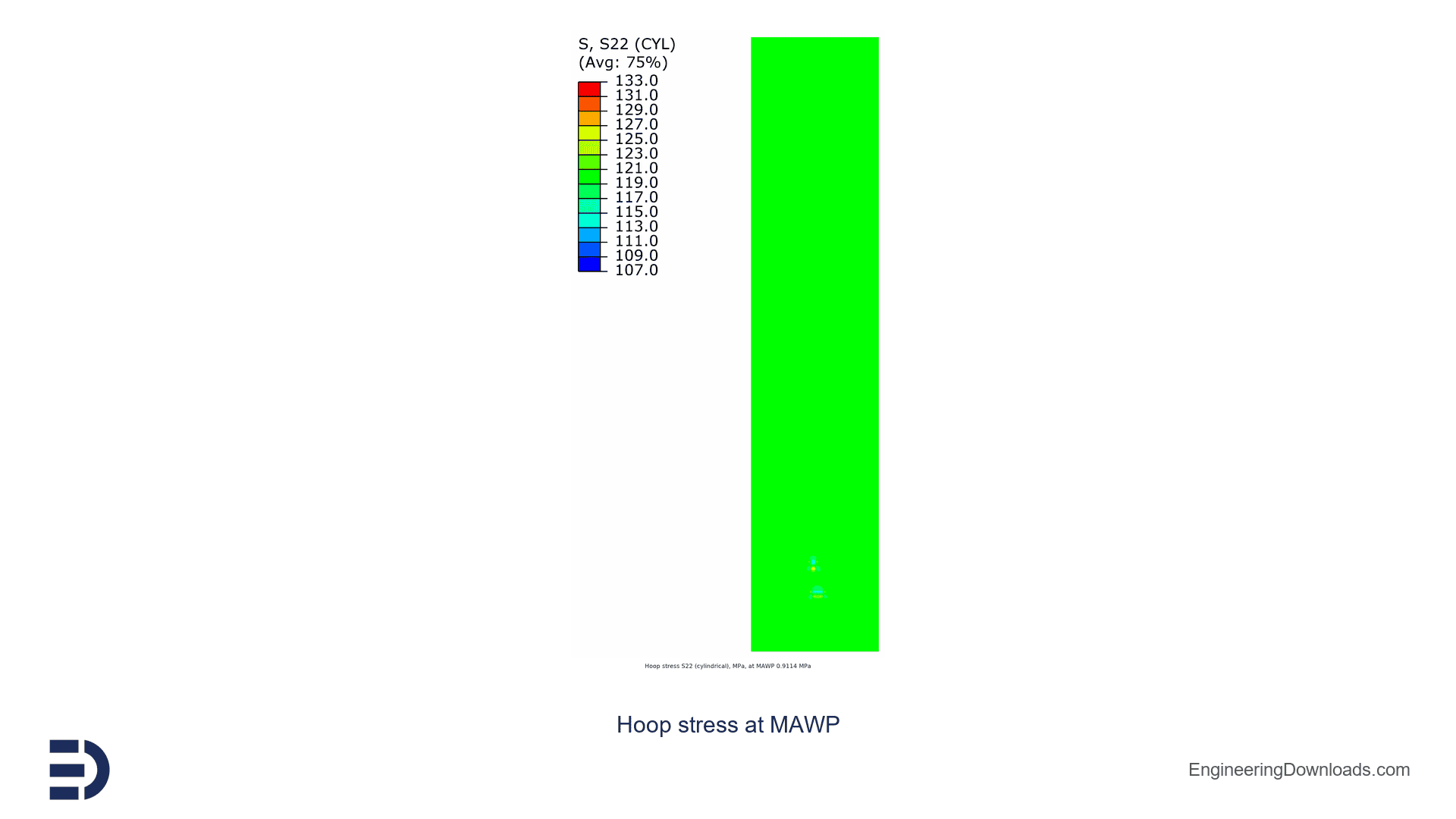
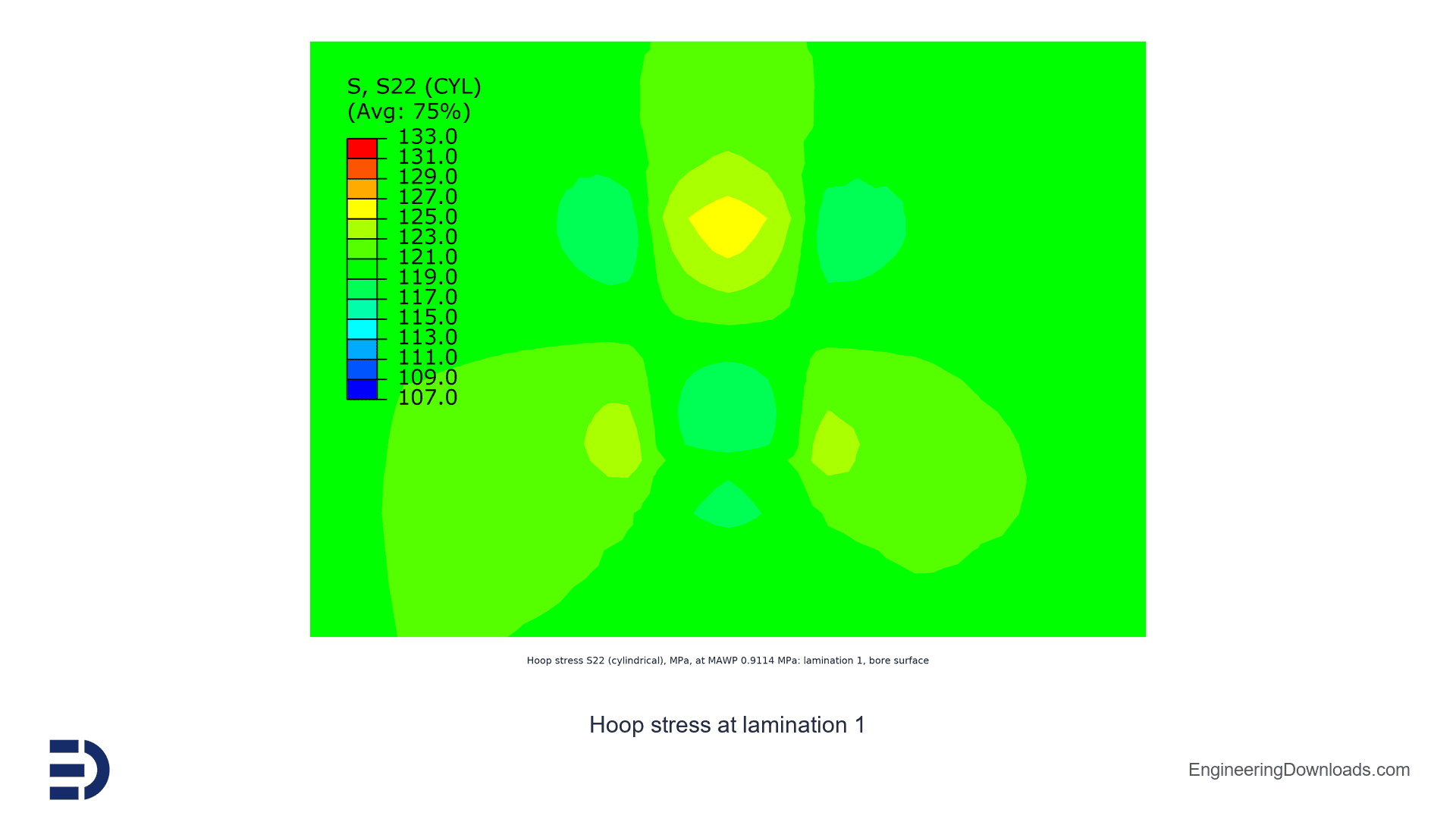
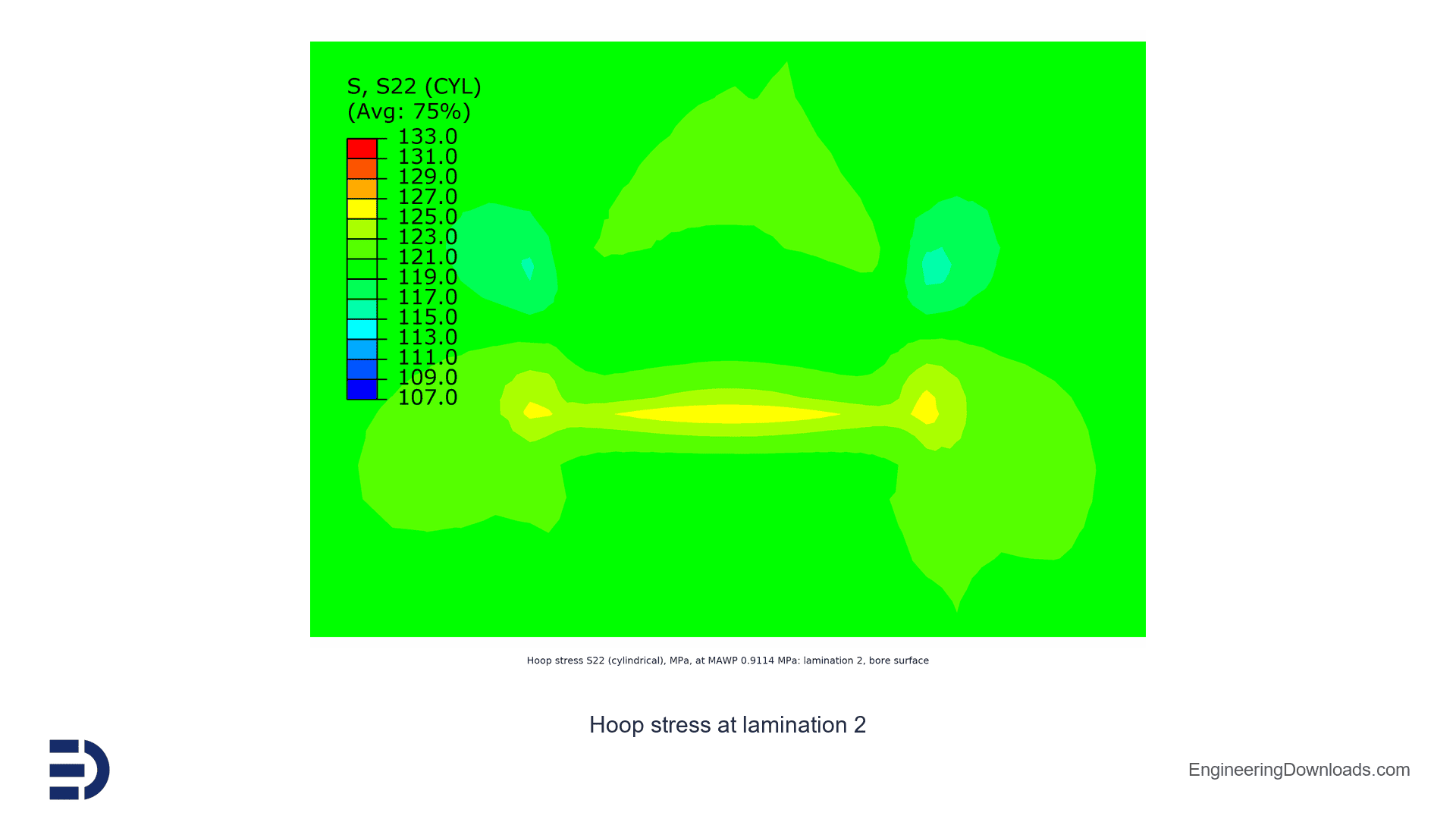
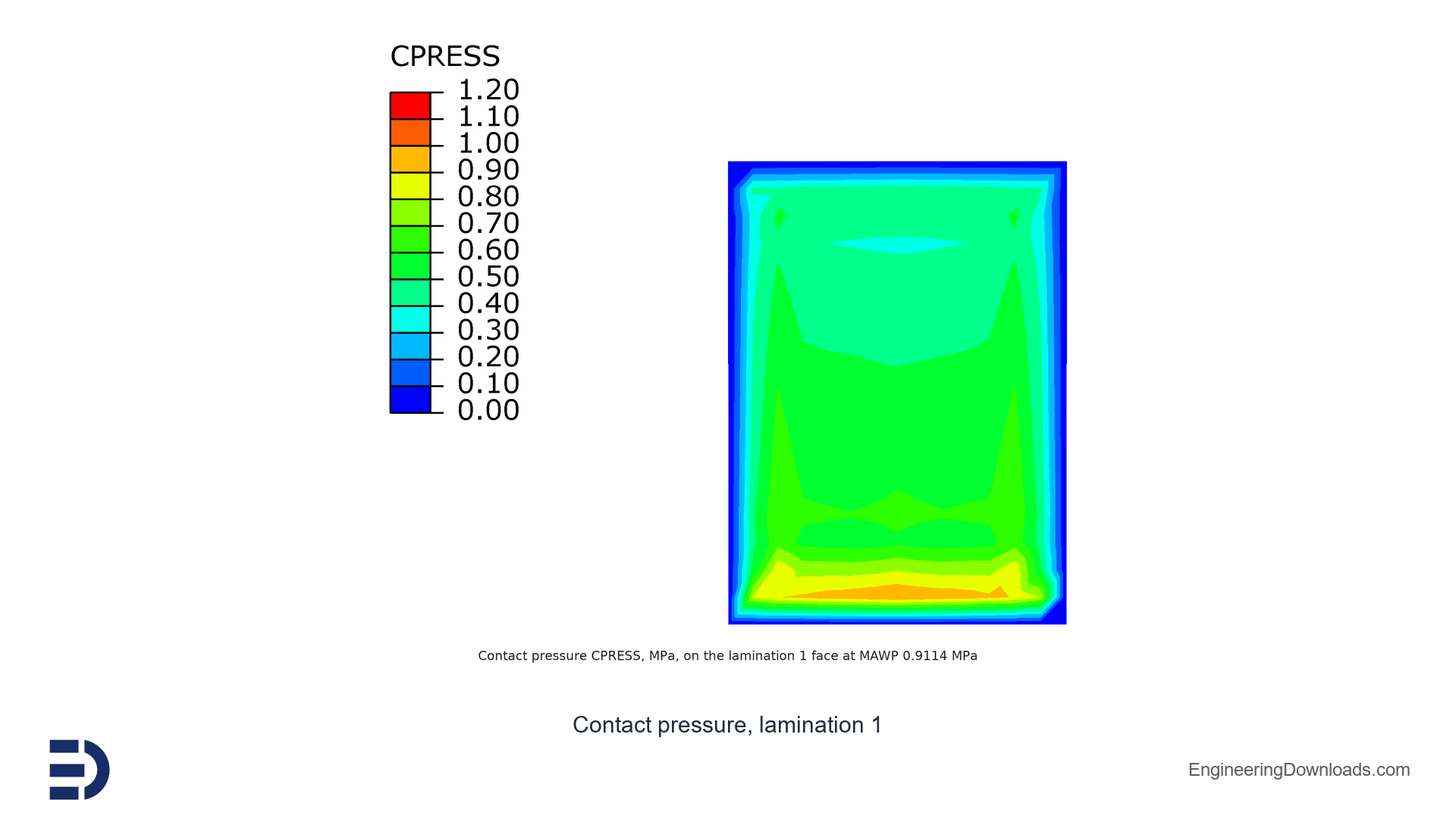
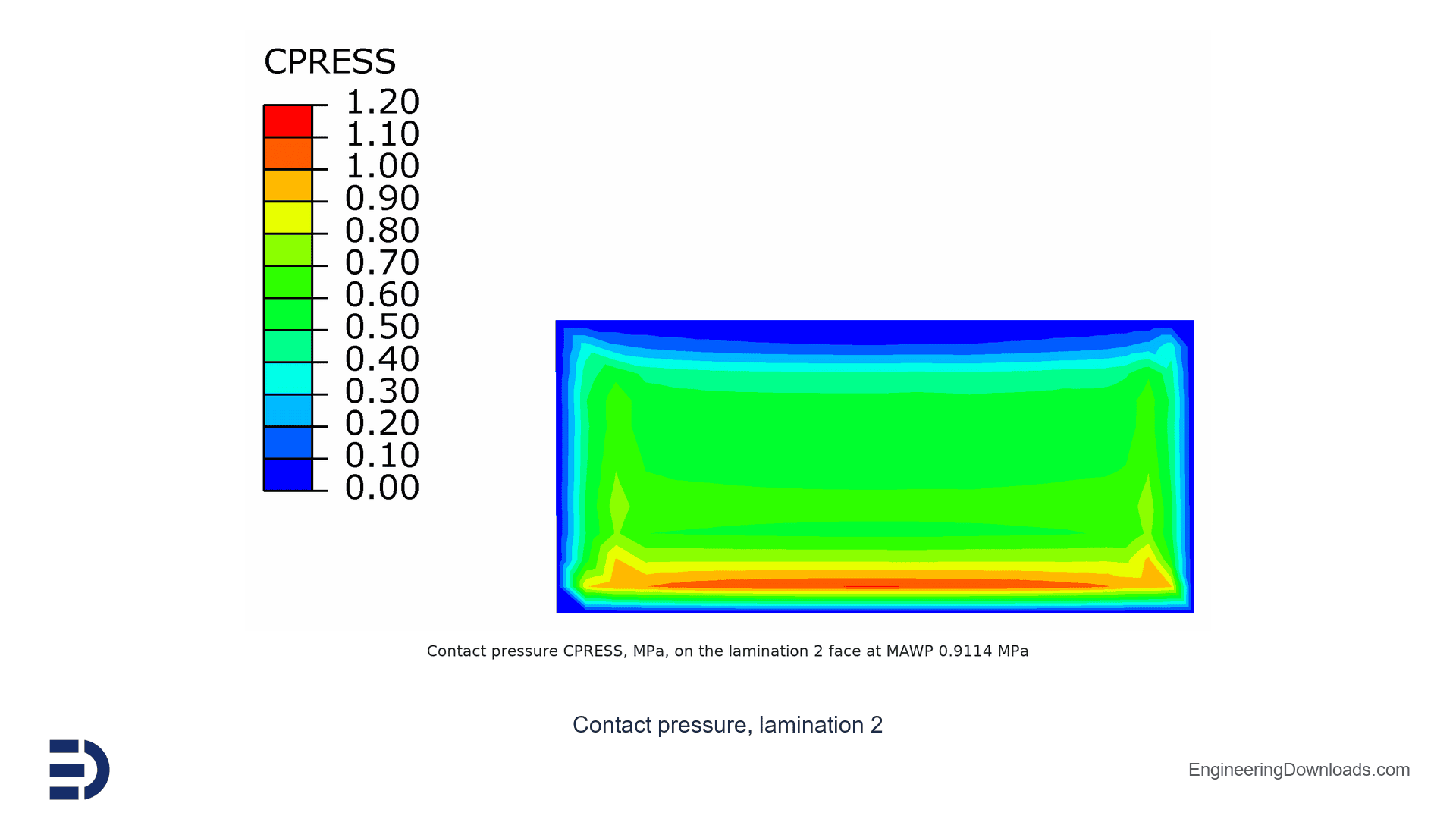
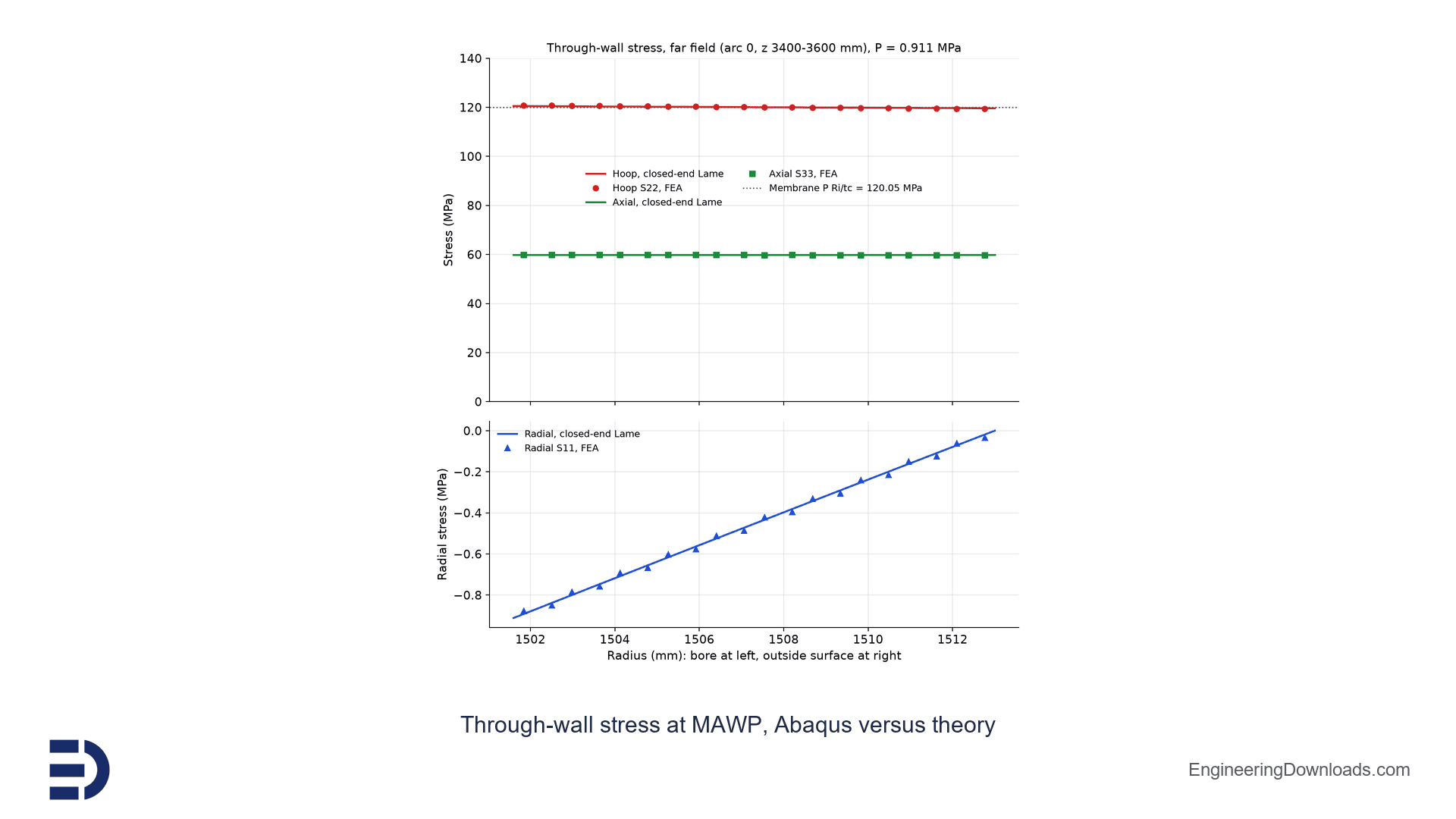
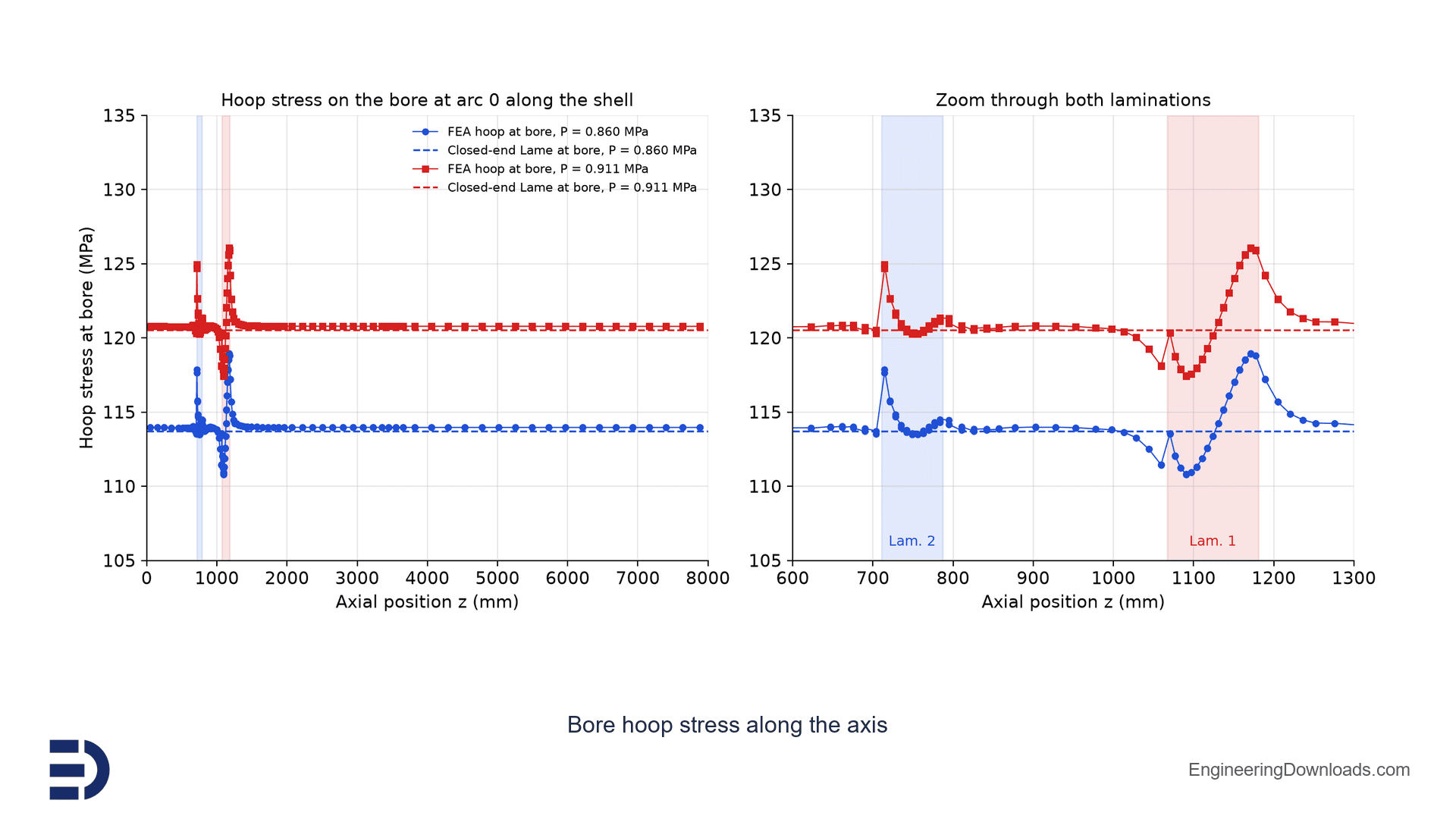
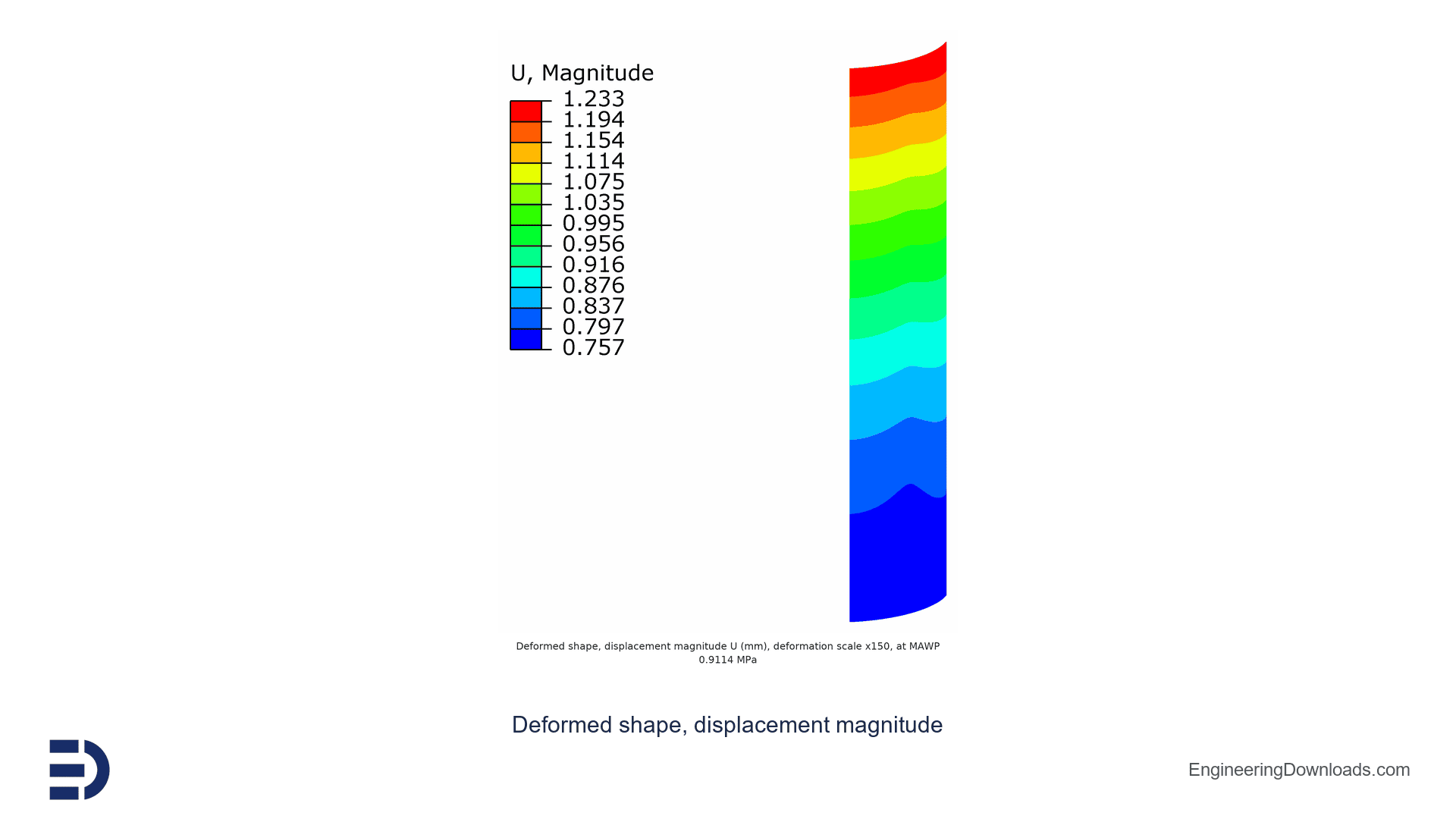
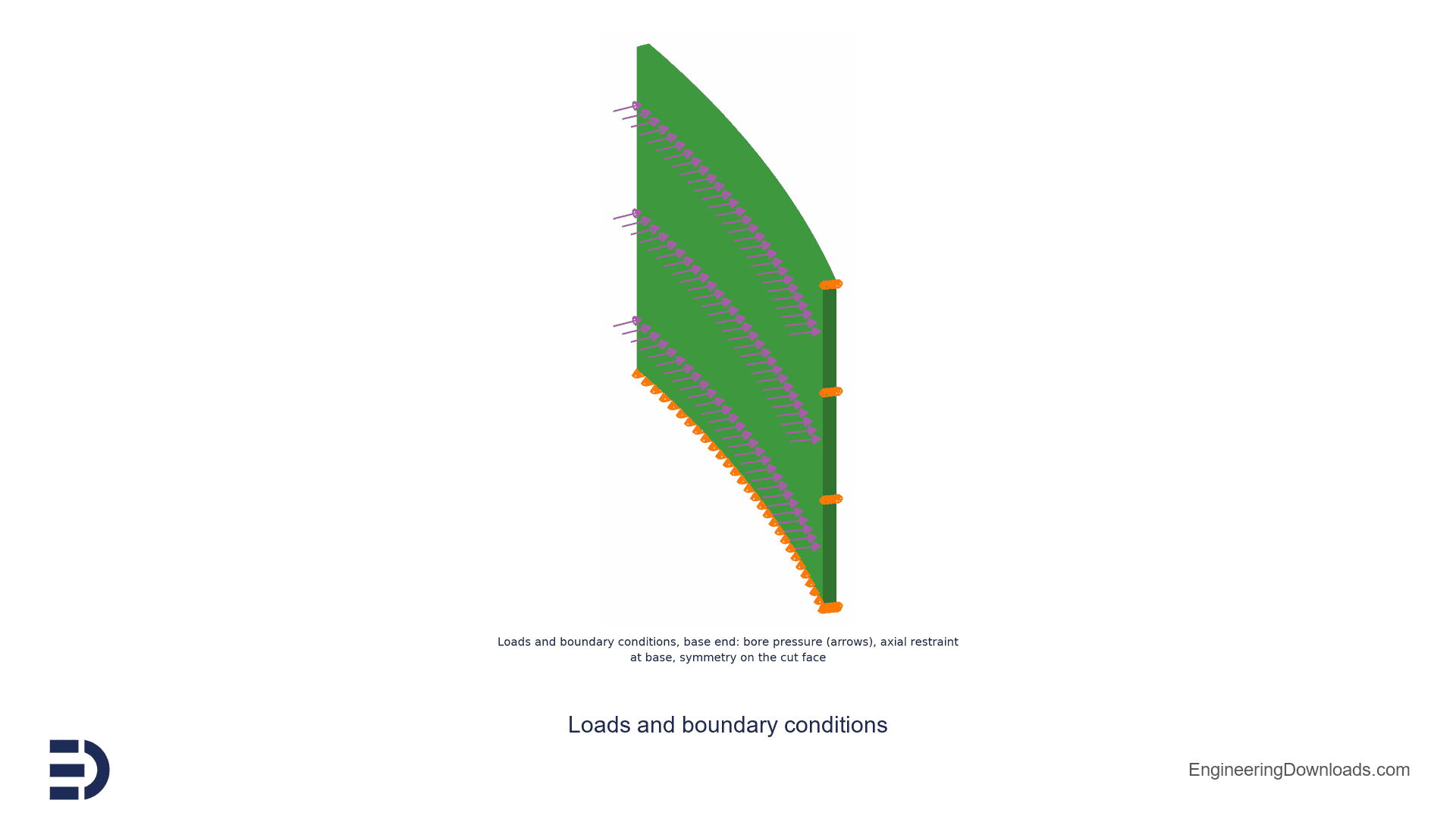
The package includes four comparison images that set the published example next to the model:
Each comparison image places a short excerpt of the published example beside the matching plot or table from the model, so you can check them side by side. Please refer to API 579-2/ASME PTB-14 for the complete original figures and tables.
| File | Purpose |
|---|---|
| Abaqus input file(s) (.inp) | Complete model with contact, loads and both steps |
| Abaqus CAE model (.cae) | Model ready to open, inspect and modify in CAE |
| One Python run script | One-click workflow: builds the model, runs the solution and writes the results table |
| README | Short instructions for running the script |
| Key result images | Geometry, mesh, loads, contours, contact pressure and comparison plots |
| PDF tutorial | Step-by-step explanation of the example, the model and the results |
This is an automated workflow, not simple manual modeling. The included Python script builds the geometry, assigns the material and contact, applies both load steps, runs the Abaqus solution and writes the results table in a single run. The settings are inside the script and it needs no edits. The README gives the one line needed to start it.
If you prefer to work by hand, the input file and CAE model let you open the same model directly and change laminations, mesh or loads yourself.
Note: this is an educational and engineering-reference model. It is not a certified fitness-for-service assessment.
Example Problem 13.2 in Part 13 (laminations) of API 579-2/ASME PTB-14: vessel V-101 with a 3000 mm bore, a 13 mm SA-516 Gr 70 wall, a 1.6 mm future corrosion allowance and two internal laminations near a weld.
No. The example is a screening and MAWP calculation. The Abaqus model in this package is an independent FE extension of the example geometry.
The Level 1 screening of both laminations (lamination 1 with Lw of 24 mm against 25 mm required, lamination 2 satisfying Level 1) and the Annex 2C MAWP of 0.911432 MPa, which is 5.98 % above the 0.86 MPa design pressure.
As unbonded internal seams with frictionless hard contact, at the published sizes, heights and positions, in a 3D sector of the cylinder.
Closed-end pressure in two steps: the design pressure of 0.86 MPa and the MAWP of 0.911432 MPa.
Far-field hoop, axial and radial response are compared with closed-end Lame theory (for example axial stress 59.70-59.90 MPa in FEA against 59.80 MPa), and the base reaction equals the closed-end resultant.
At the MAWP both laminations stay closed. Contact pressure (max/mean) is 1.00/0.55 MPa on lamination 1 and 1.10/0.59 MPa on lamination 2.
The Abaqus input file(s), the CAE model, one Python run script, a README, key result images and a PDF tutorial. Run the script in your own Abaqus installation; it builds the model, runs the solution and writes the results table in one go.
No. It is an educational and engineering-reference model. Use the standard and qualified engineering judgement for assessment of real equipment.
Need more than the files?
There are two ways we can help. Book a one hour online consultation if you want to talk a problem through with a CAE engineer, using the checkbox in the order box. Order a project if you need a full simulation built for you, delivered to an agreed scope, price and deadline under a written contract.
We work on FEA and CFD for engineers, researchers and companies. Order your project, or message us on WhatsApp for a quick reply.
Other packages engineers working on this topic also download.
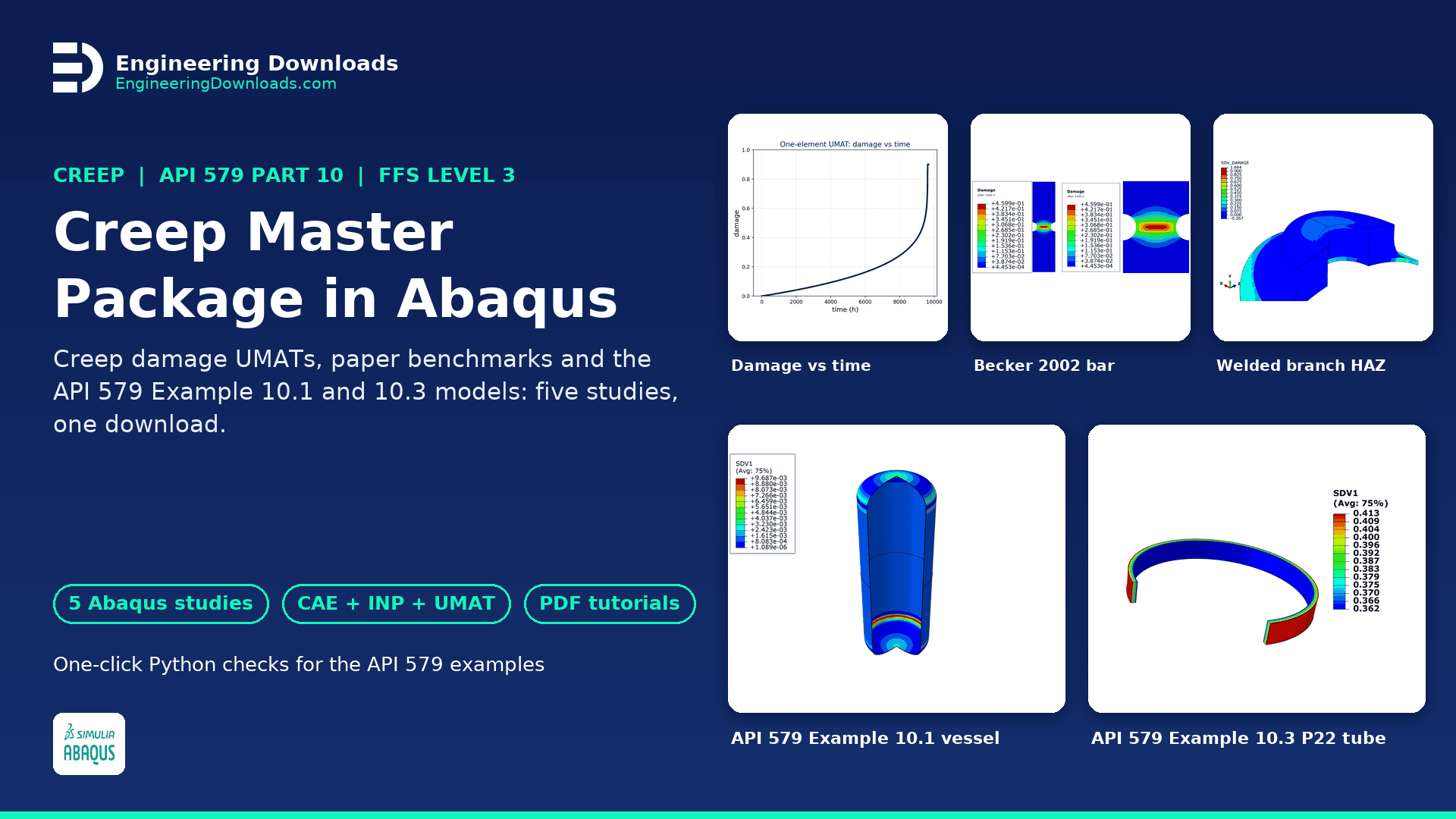 Creep Master Package in Abaqus: API 579 Part 10 Examples 10.1 and 10.3, Creep Damage UMAT and Paper Benchmarks€299,00
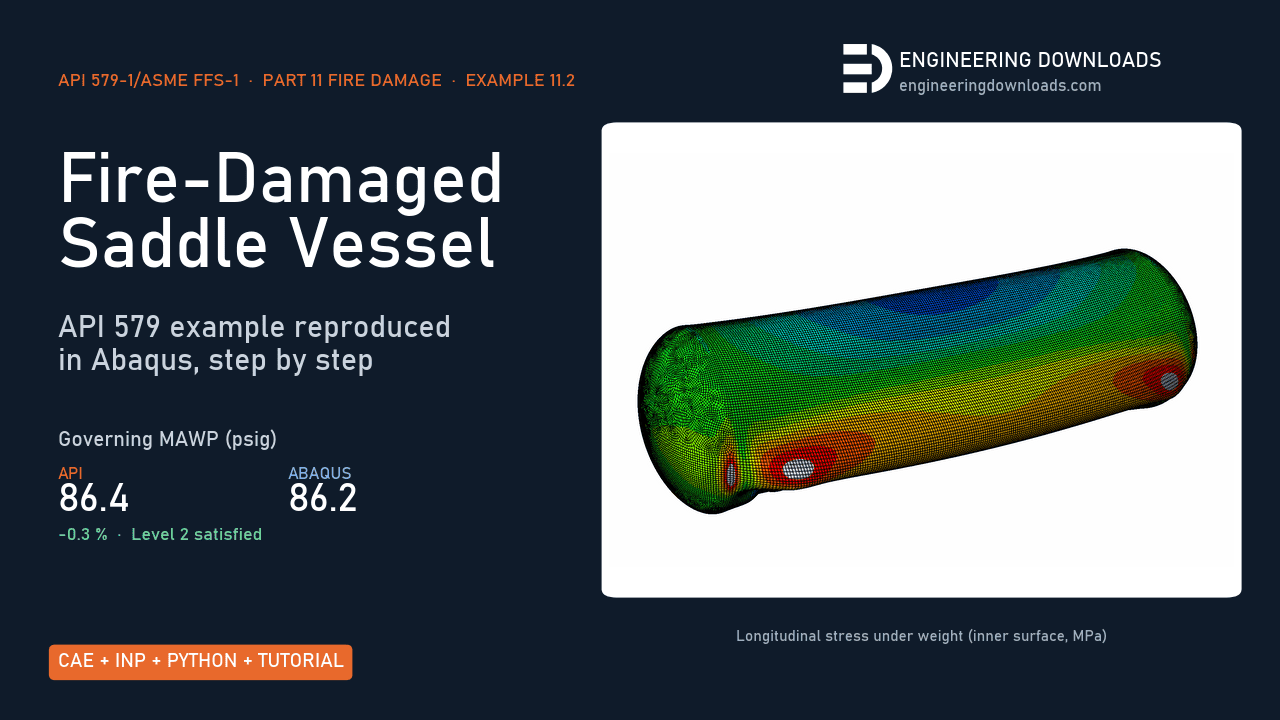 API 579 Example 11.2 in Abaqus: Fire-Damaged Horizontal Vessel on Saddles, Level 2 FFS
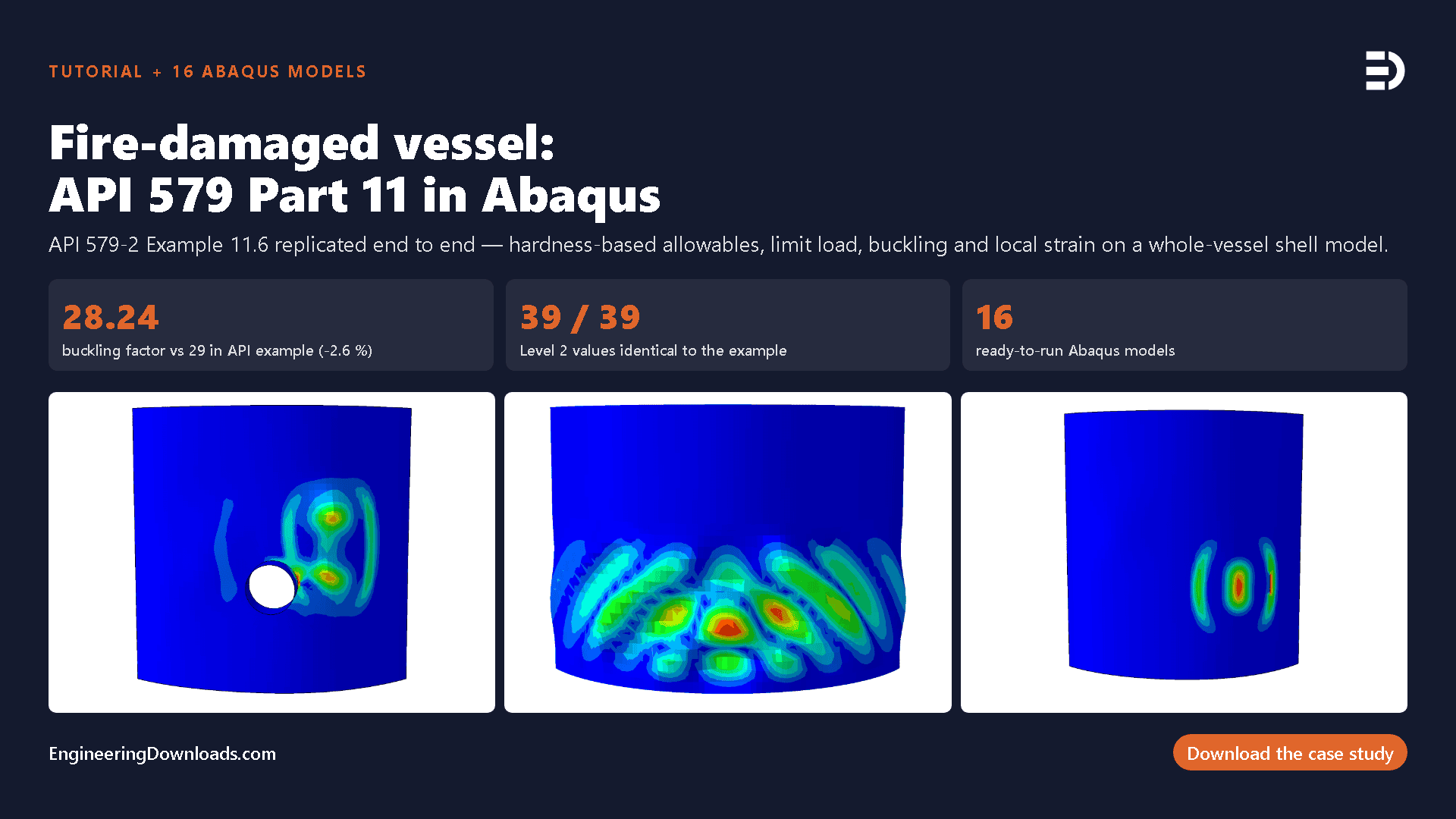 API 579 Example 11.6 in Abaqus: Fire-Damaged Fractionator, Level 3 FFS (Limit Load, Buckling, Local Strain)€139,00
 Contact Fatigue Limit of a Hardness-Graded Gear Flank: Abaqus Brown-Miller-Morrow Workflow€129,00
 Oil Storage Tank under Non-Uniform Foundation Settlement in Abaqus, after Jiao et al. (2024)€169,00
 Composite Fatigue UMAT for Abaqus: Hashin, Tsai-Hill and Maximum-Stress Criteria€159,00
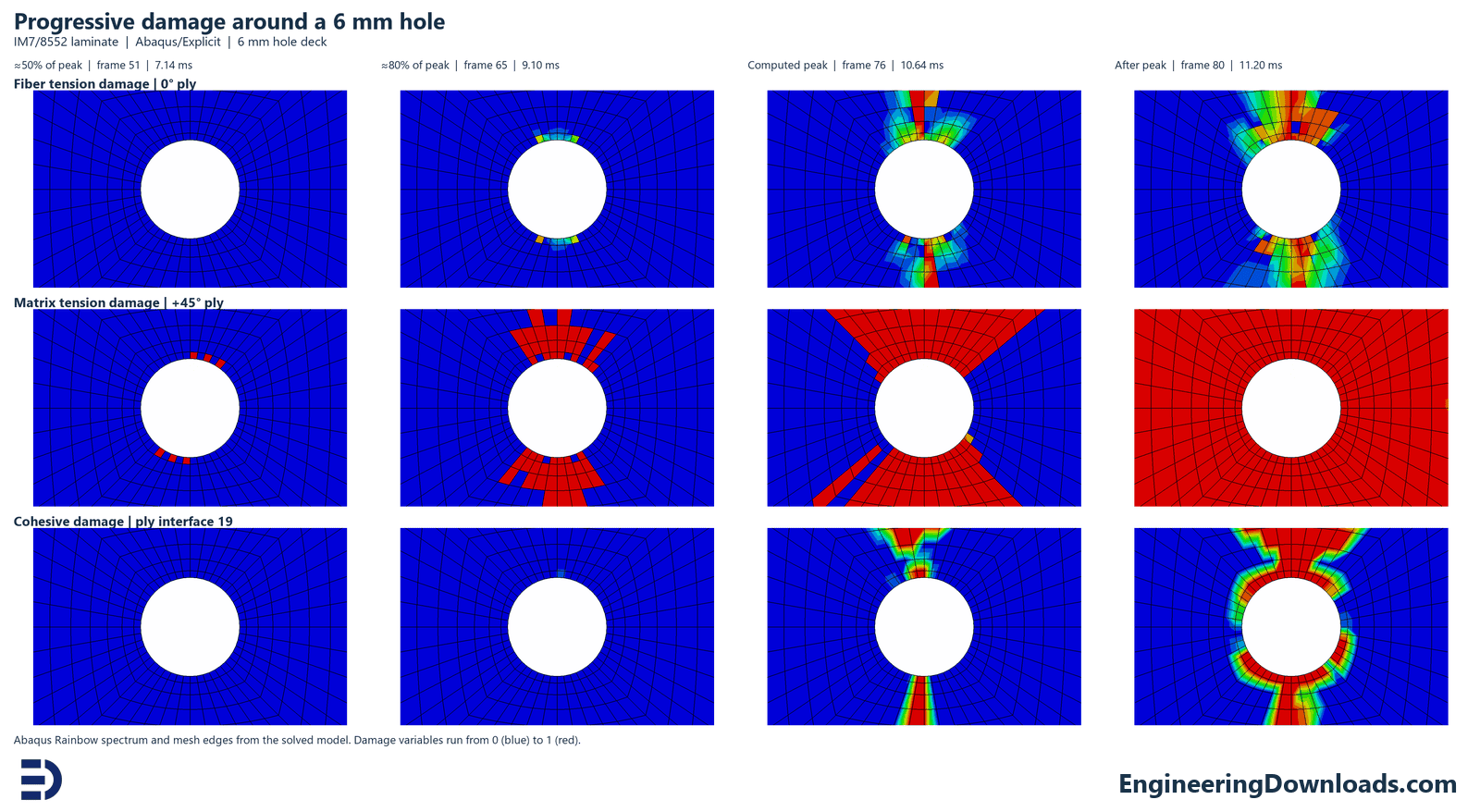 3D Hashin Progressive Damage VUMAT for Abaqus: Open-Hole Laminate with Cohesive Delamination€159,00
 Extended End-Plate Moment Connection in Abaqus: Bolted Beam-to-Column Joint, after Rahchamandi et al. (2026)€129,00

Need a full custom project? See the options below.

€129,00

€179,00

€149,00

€119,00

€129,00

€149,00
See more
Want to receive push notifications for all major on-site activities?



