Need a full custom project? See the options below.
Need a full custom project? See the options below.
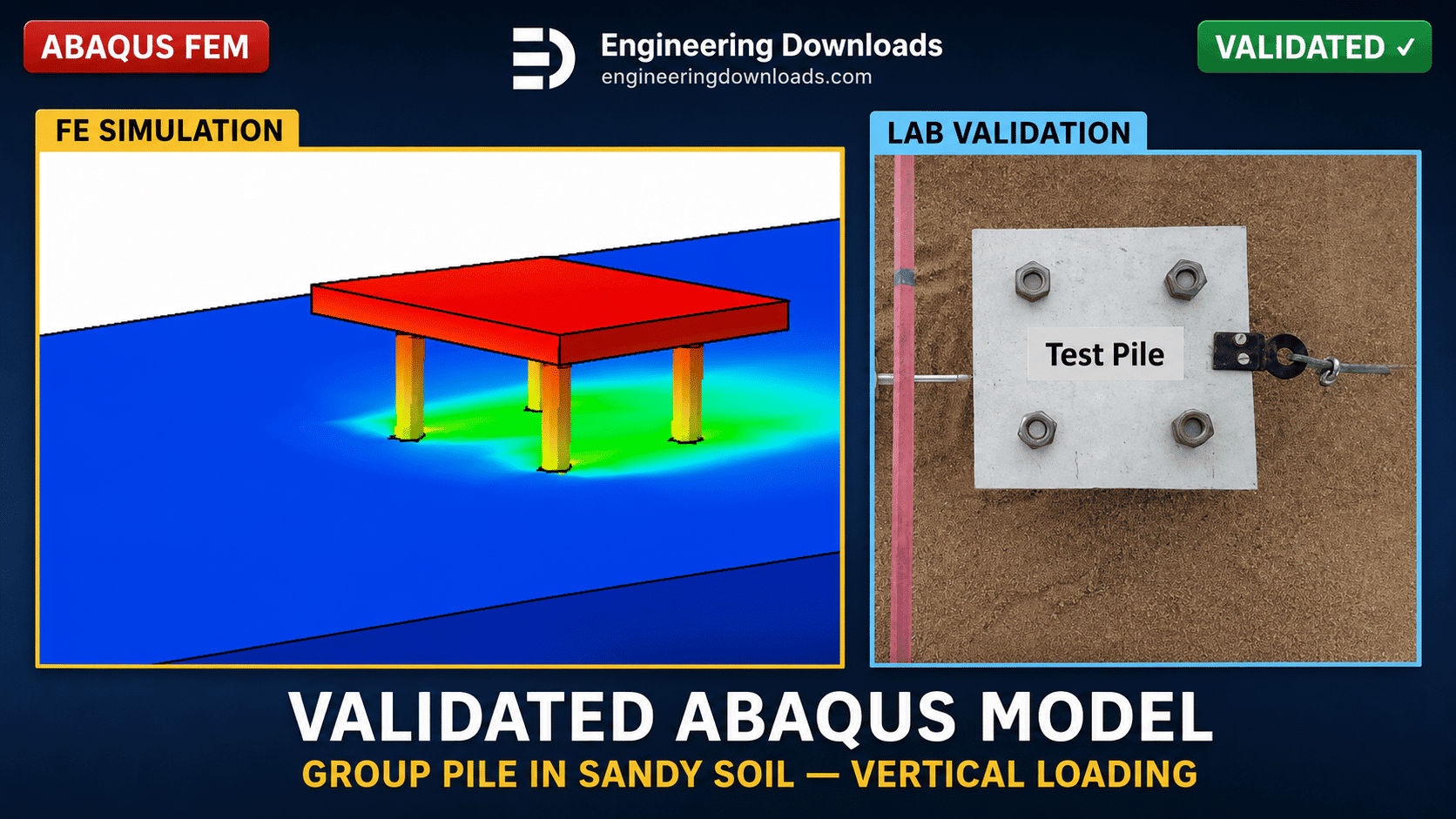
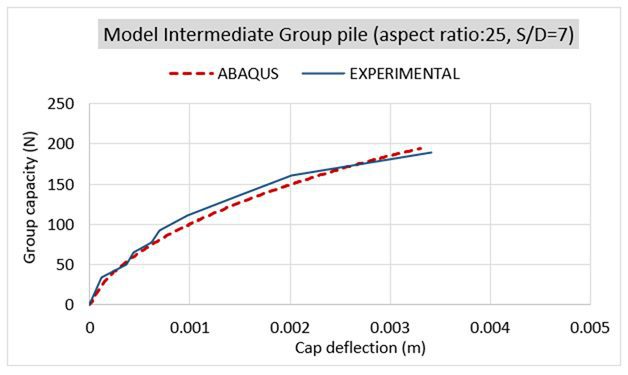
This Abaqus model simulates the vertical loading behavior of two pile groups (Long and Intermediate) embedded in sandy soil. The model is developed to investigate the interaction between the pile group and surrounding soil and to evaluate the response of the system under vertical loading.
The pile group consists of aluminum tubular piles embedded in a sandy soil medium. The soil is modeled using the Mohr–Coulomb constitutive model, with appropriate material and strength parameters defined to represent the mechanical behavior of the sand.
A realistic pile–soil interaction is incorporated to capture load transfer and frictional interaction between the pile surfaces and the surrounding soil. Appropriate constraints and boundary conditions are applied to the soil domain to minimize boundary effects and provide stable numerical behavior.
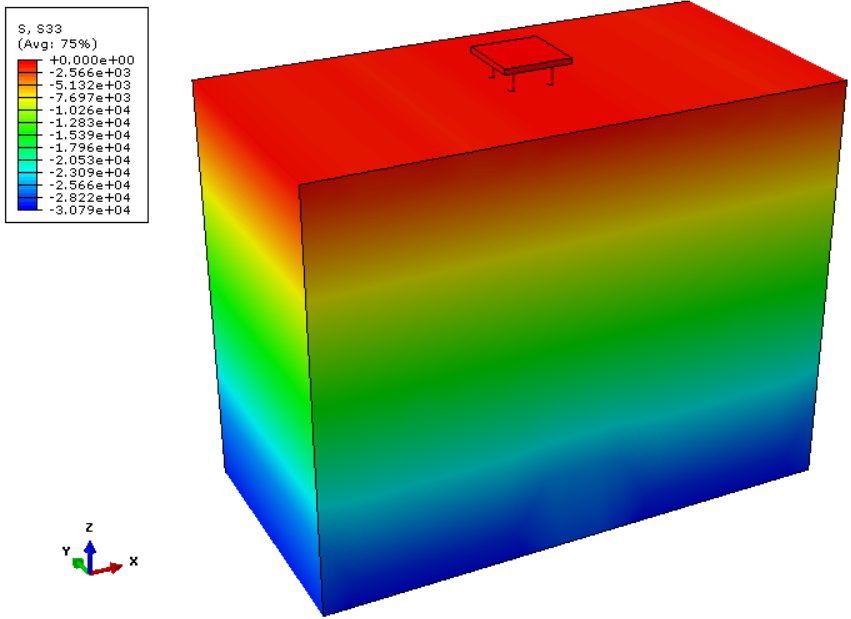
The initial stress state is established through gravity loading and geostatic analysis, allowing the soil to reach an appropriate initial stress equilibrium before the application of the external load.
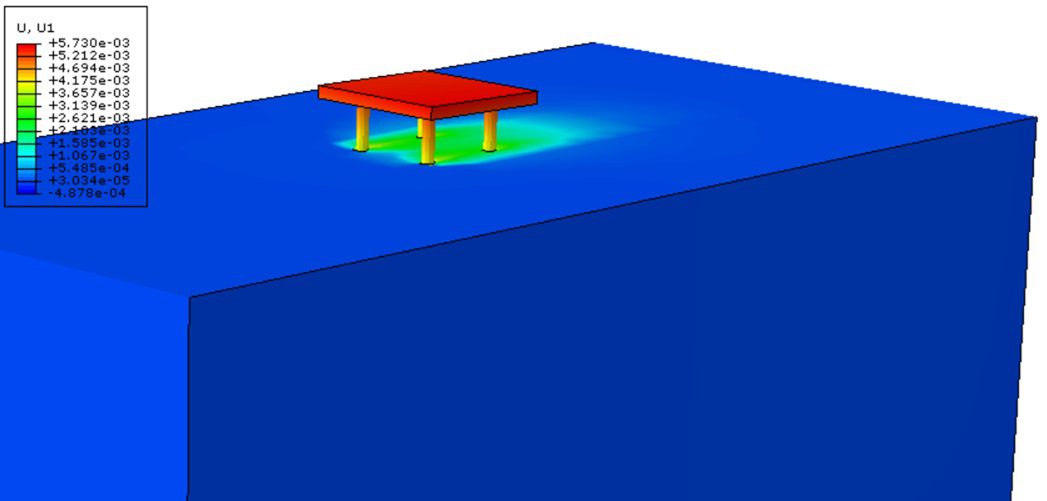
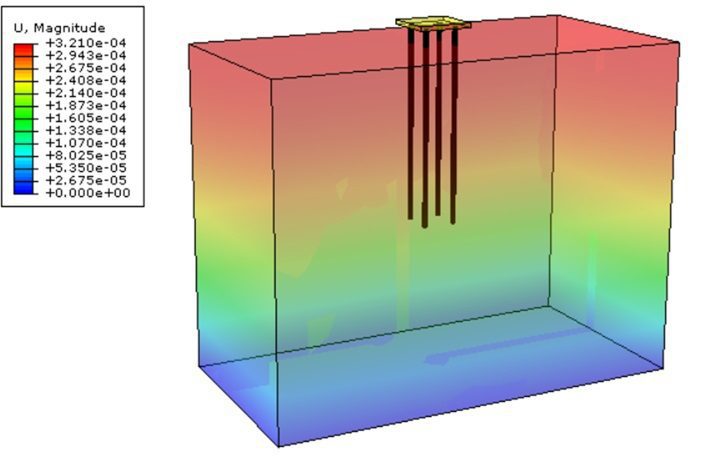
Following geostatic initialization, a vertical load is applied to the pile cap and transferred through the pile group into the surrounding soil. The model can be used to investigate pile–soil interaction, load transfer mechanisms, settlement response, and the behavior of pile groups subjected to vertical loading.
This model provides a ready-to-use starting point for researchers, students, and engineers working on pile foundations, soil–structure interaction, geotechnical engineering, and numerical modeling in Abaqus.
The abstract of the paper
Laterally loaded piles are most commonly used in foundations of structures subjected to wave action, winds, earthquakes, and traffic loading. More complexity is involved in analyzing the pile group response under the action of lateral loads. Soil–pile interaction significantly influences the behavior of pile groups under lateral loading. The current study aims to understand the behavior of individual piles and pile groups under lateral loads in uniform sand (relative density 80%) and stratified soil (sand overlain by clay) by conducting laboratory model tests. A test tank of length 1.52 m, width 0.76 m, height 1.2 m, and model aluminum test piles of 16 mm diameter (D) and aspect ratios 12, 25, and 40 were used for the tests. The response of individual piles and 2 × 2 pile groups was evaluated in terms of deflection at the pile head for varying aspect ratios and pile spacings of 3D, 5D, and 7D for the case of pile groups. The lateral load taken by the single pile for a deflection of 0.2D in the stratified soil was increased by 200% compared to that of the pile embedded in the uniform sand. It is noted that at all stages of the loading, the pile head deflection of the single pile and pile group was reduced for the stratified soil when compared to the uniform sand bed. However, the efficiency of the pile groups embedded in the stratified soil medium was observed to be less than that of the pile groups embedded in the uniform sand.
Link of the paper
Need more than the files?
There are two ways we can help. Book a one hour online consultation if you want to talk a problem through with a CAE engineer, using the checkbox in the order box. Order a project if you need a full simulation built for you, delivered to an agreed scope, price and deadline under a written contract.
We work on FEA and CFD for engineers, researchers and companies. Order your project, or message us on WhatsApp for a quick reply.
Other packages engineers working on this topic also download.
 Soil Analysis package
 CEL and Eulerian Analysis Package in Abaqus (24 Models)
 Underwater and Underground Explosion Simulation Package in Abaqus (20 Models)
 Sequential CEL Explosion Simulation in Soil Beneath a RC Slab Using Abaqus
 Micro-modeling of masonry wall under compression load
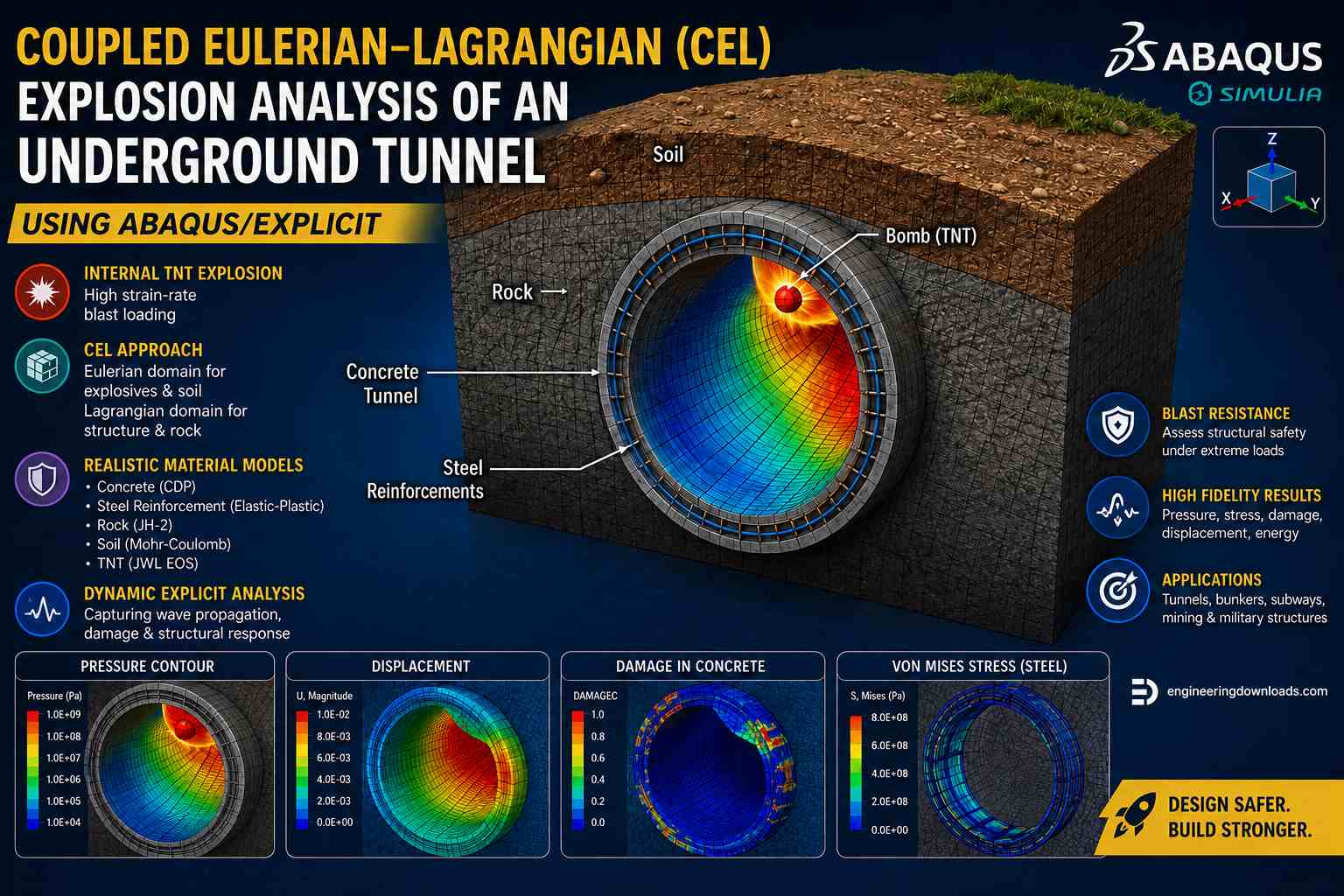 Analysis of a CEL explosion in an underground tunnel
 Contact Pressure Distribution on Subgrade Soil Underlying Geocell Reinforced Foundation Beds
 Soil Modeling in ABAQUS Part 1

Need a full custom project? See the options below.

€129,00

€179,00

€149,00

€119,00

€129,00

€149,00
See more
Want to receive push notifications for all major on-site activities?