


Need a full custom project? See the options below.
Need a full custom project? See the options below.
A man door at the base of a steel wind turbine tower removes shell material exactly where bending and axial compression are largest. How much buckling strength does it cost, and do you really need the expensive welded frame around it, or is a thicker door plate enough? This Abaqus package replicates the journal paper Gantes, Vernardos, Koulatsou and Gül, “Nonlinear Finite Element Analysis of Tubular Steel Wind Turbine Towers near Man Door and Ventilation Openings to Optimize Design against Buckling”, Vibration 2024, 7, 212–228 with 18 GMNIA shell models: the man door section with six stiffening alternatives, a section with two ventilation openings and a section with both. Every model comes as CAE + INP with a batch file to run it, and a step-by-step PDF tutorial.
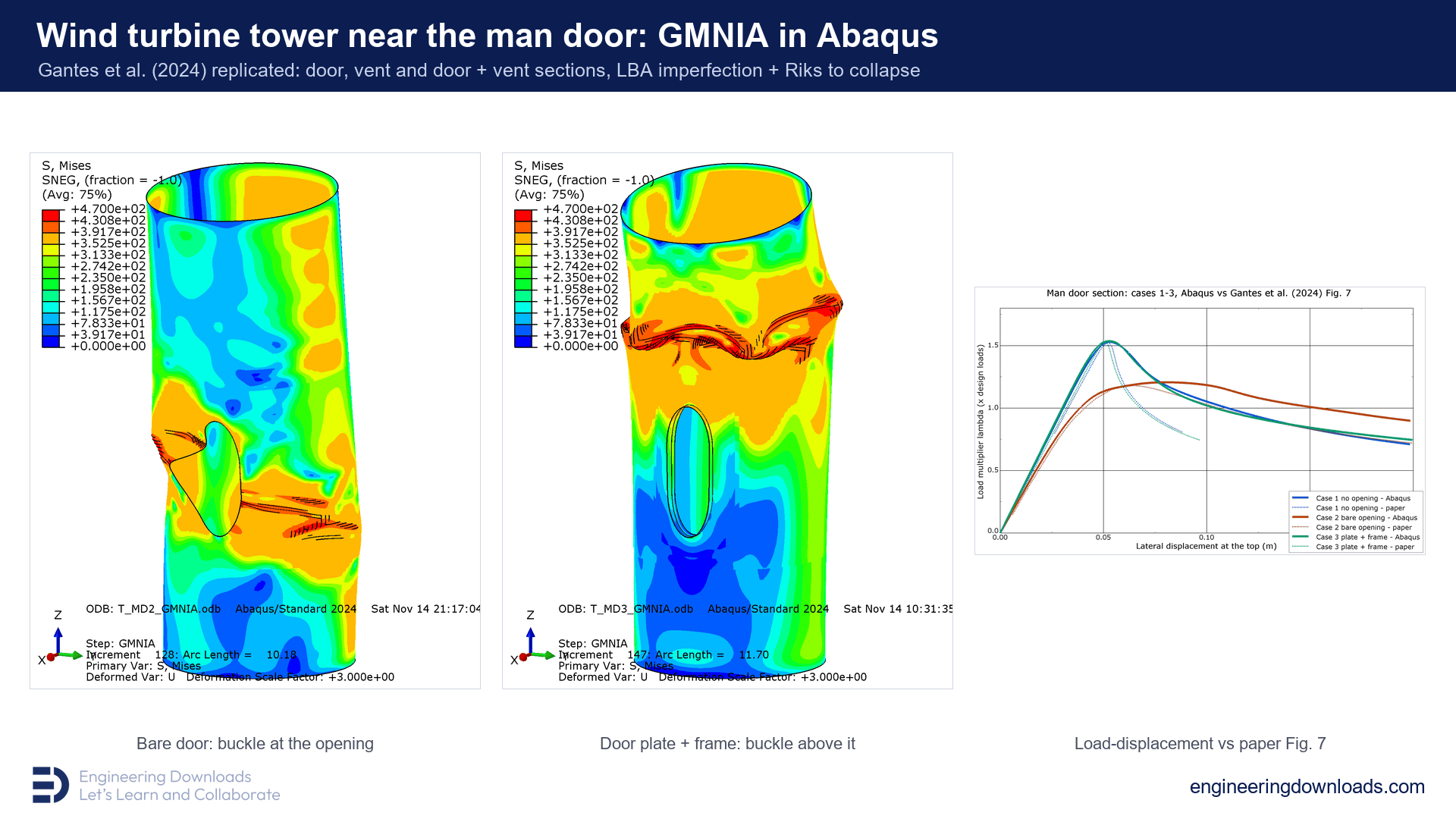
The paper studies a 4.3 m diameter tubular steel tower under the rotor loads at the top: a horizontal force H together with a vertical load of 6.5 H and an overturning moment of 110 m × H. A linear buckling analysis gives the imperfection shape, and a geometrically and materially nonlinear analysis with imperfections (GMNIA) traces each equilibrium path to collapse. The design loads are set so that the section without an opening fails at 1.53 times the design loads. The authors compare a bare door opening, a peripheral frame, thicker door plates and their combination, then the effect of wind direction, frames and plate thickness at the ventilation openings, and finally a section with both openings.
| Item | This package |
|---|---|
| Structure | Tubular steel tower segment, R 2150 mm, stepped cans 40–58 mm, S355 bilinear (355 / 470 MPa) |
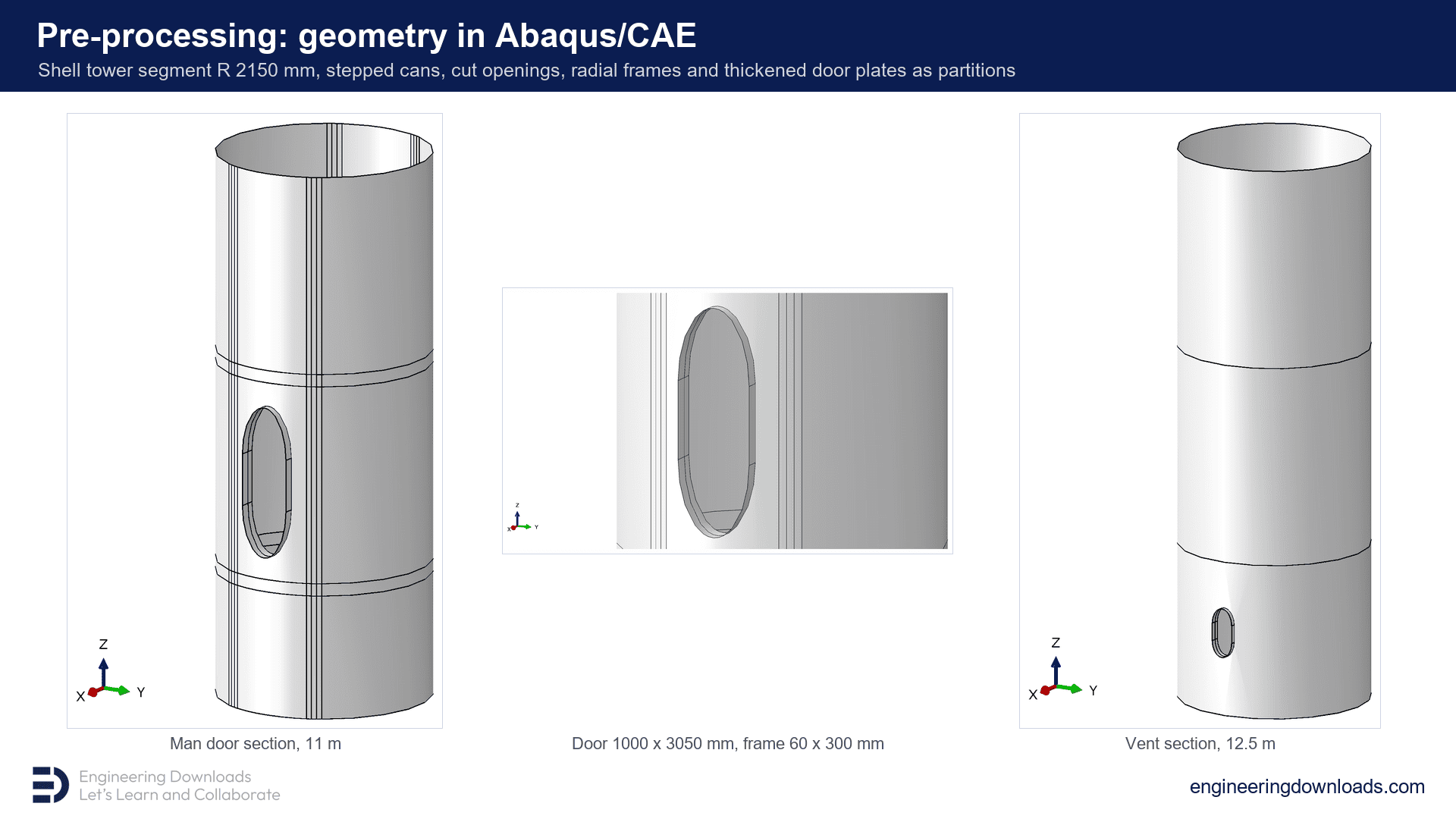
| Openings | Man door 1000 × 3050 mm with semi-elliptic ends; vents 500 × 1110 mm |
| Stiffening | Frame 60 × 300 mm (door), 55 × 200 mm (vents); door plates 65 / 75 mm with stepped tapers |
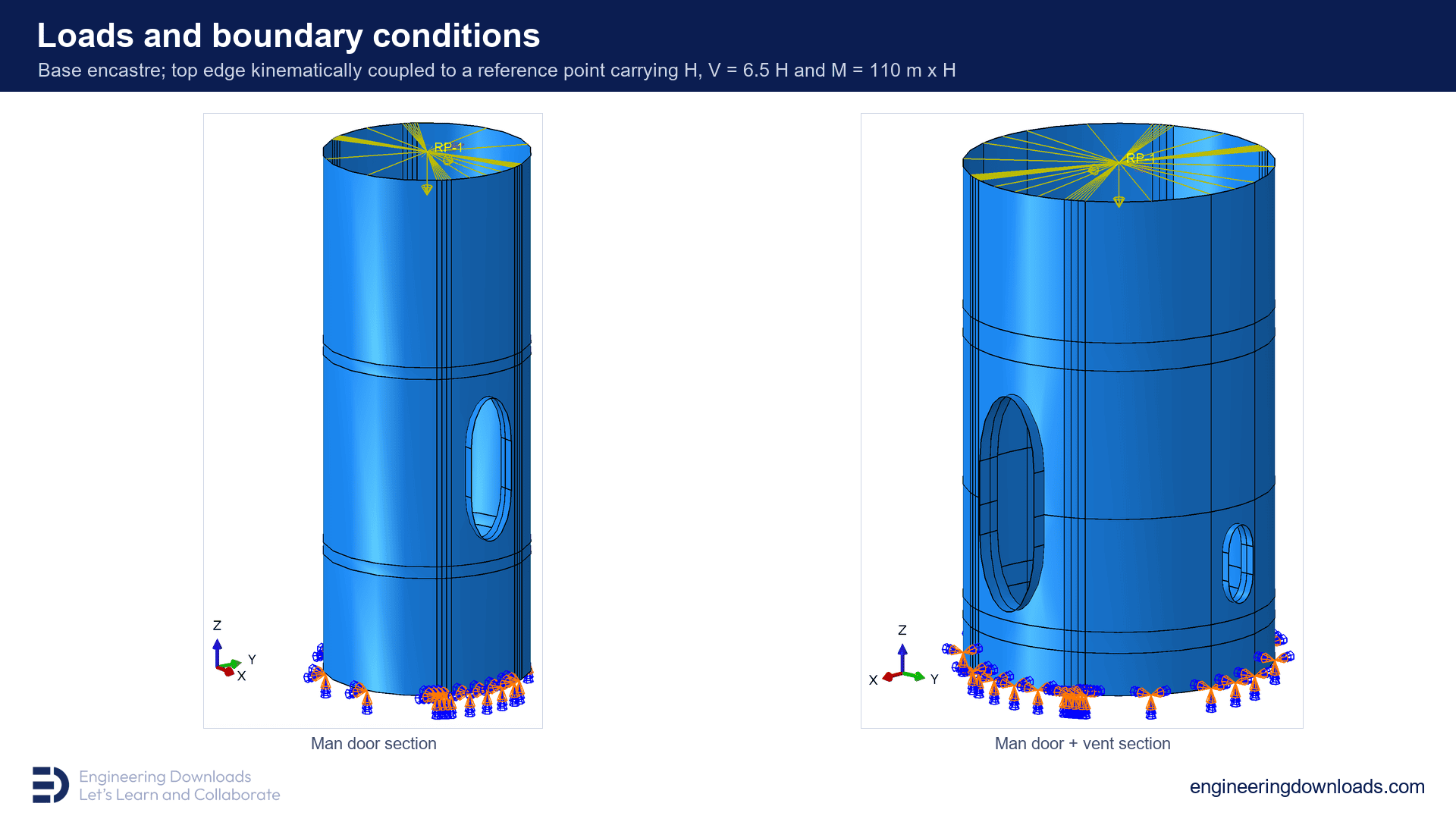
| Loads | H in direction φ, V = 6.5 H, M = 110 m × H at a reference point coupled to the top edge; base encastre |
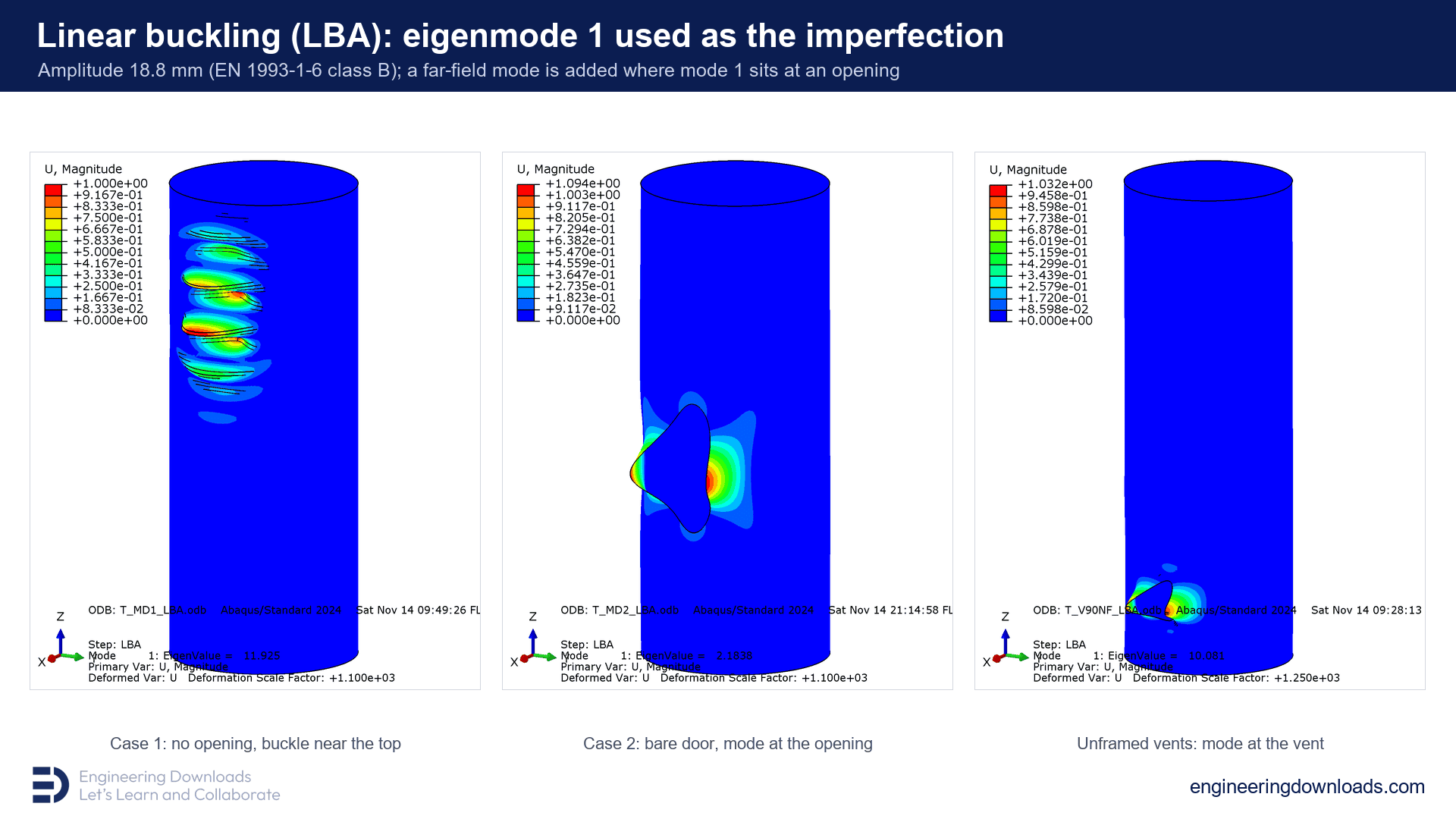
| Analysis | LBA (Lanczos) → eigenmode imperfection 18.8 mm (EN 1993-1-6 class B) → GMNIA with Static Riks, NLGEOM, plasticity |
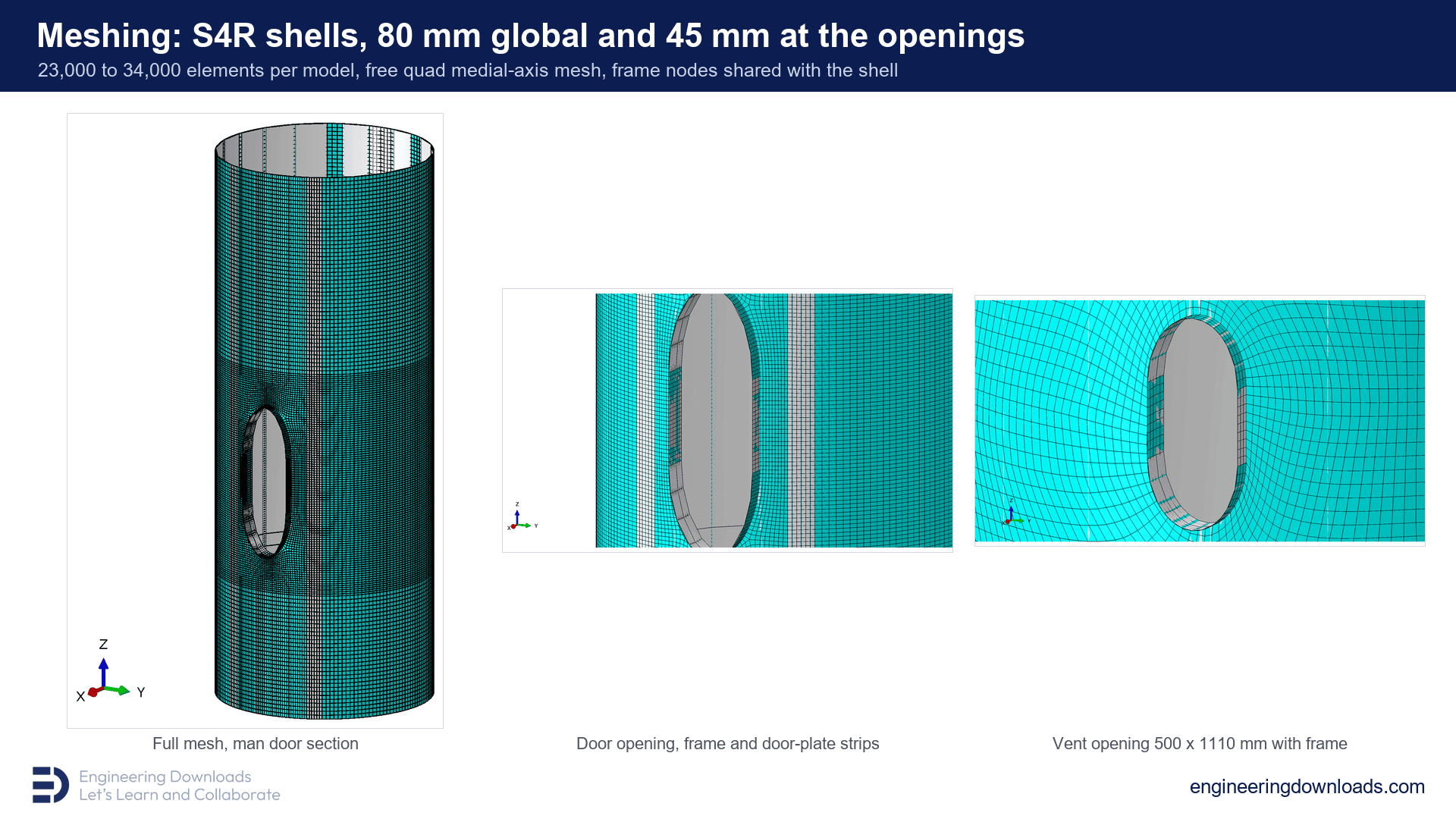
| Elements | S4R / S3 shells, 80 mm global and 45 mm at the openings, 23,000–34,000 elements per model |
| Cases | 18: man door cases 1–6, vents (wind 0/45/90°, frame, 44/48/58 mm), man door + vent (load to door / to vent) |
| Software | Abaqus/CAE and Abaqus/Standard 2024 or newer |
Loads at the top reference point: F = H (cosφ, sinφ, −6.5), M = 110 m × H (−sinφ, cosφ, 0). Imperfection amplitude for fabrication class B: Δw0 = 0.016 · 4√(R t) = 18.8 mm. Load multiplier of the paper's design loads: λ = K · LPF with K = 1.530 / LPFu(case 1) = 0.832, so Hd = 1.202 MN, Vd = 7.81 MN and Md = 132.2 MNm. K is fixed once from case 1; every other case is a prediction.
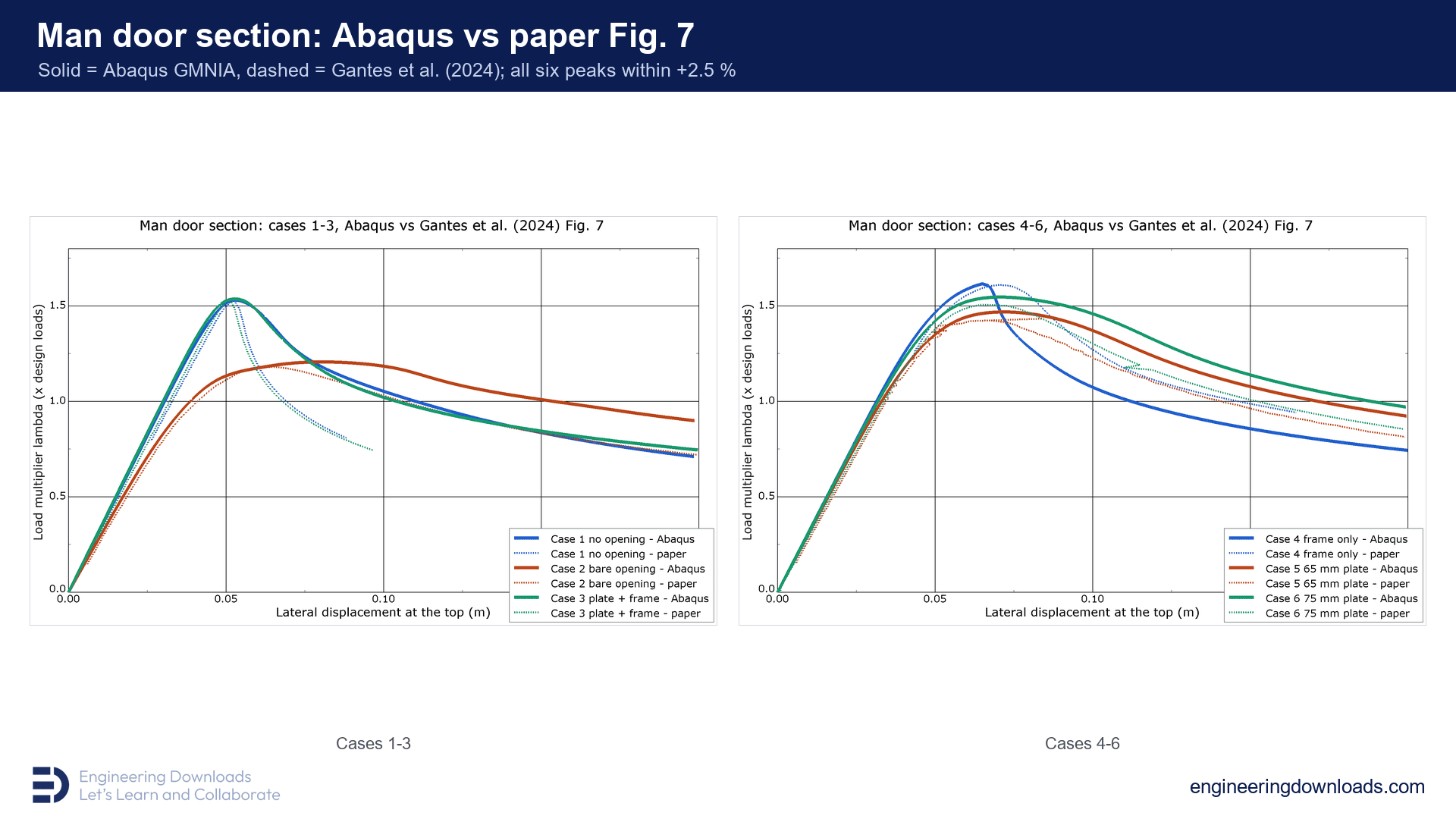
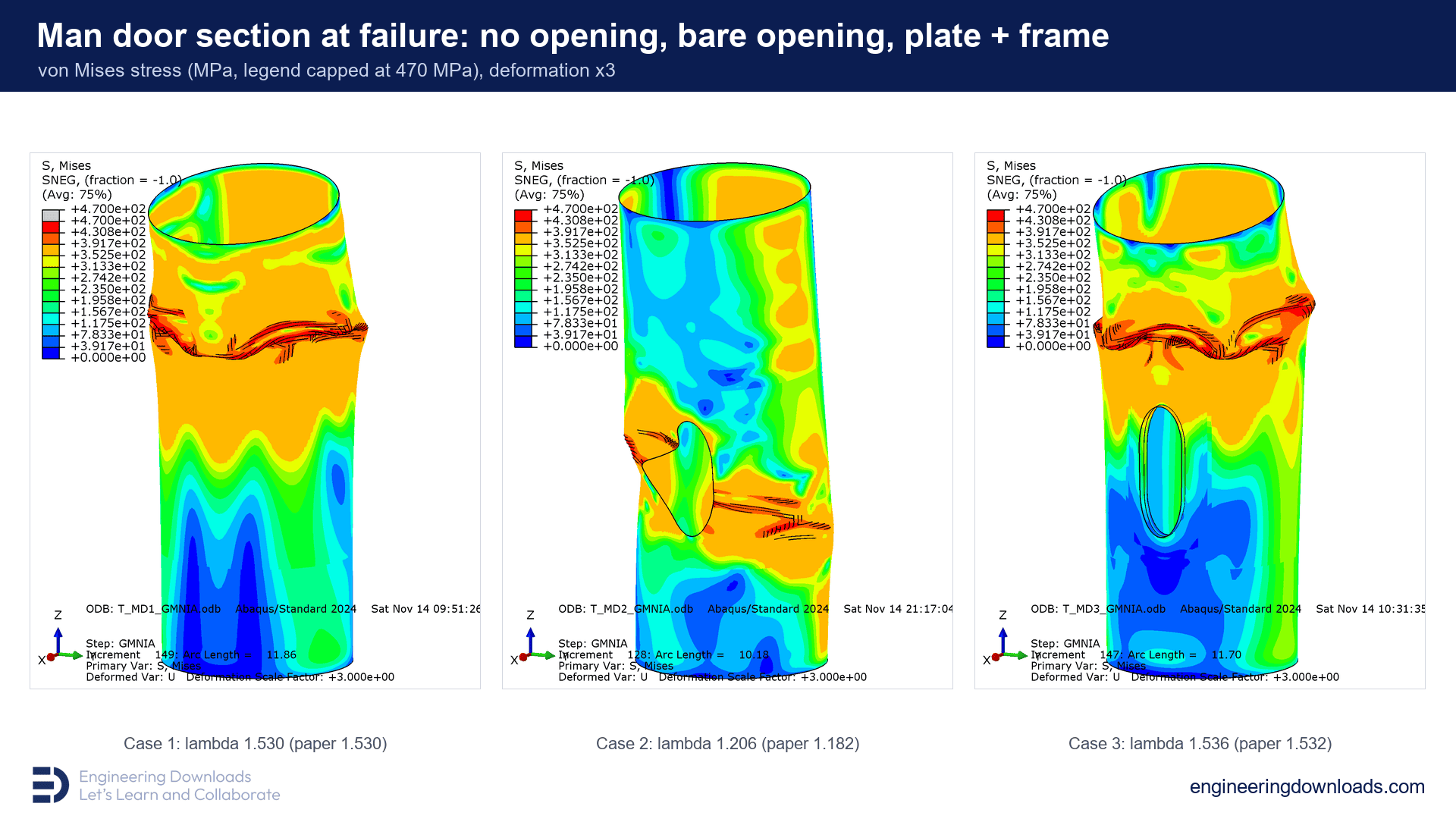
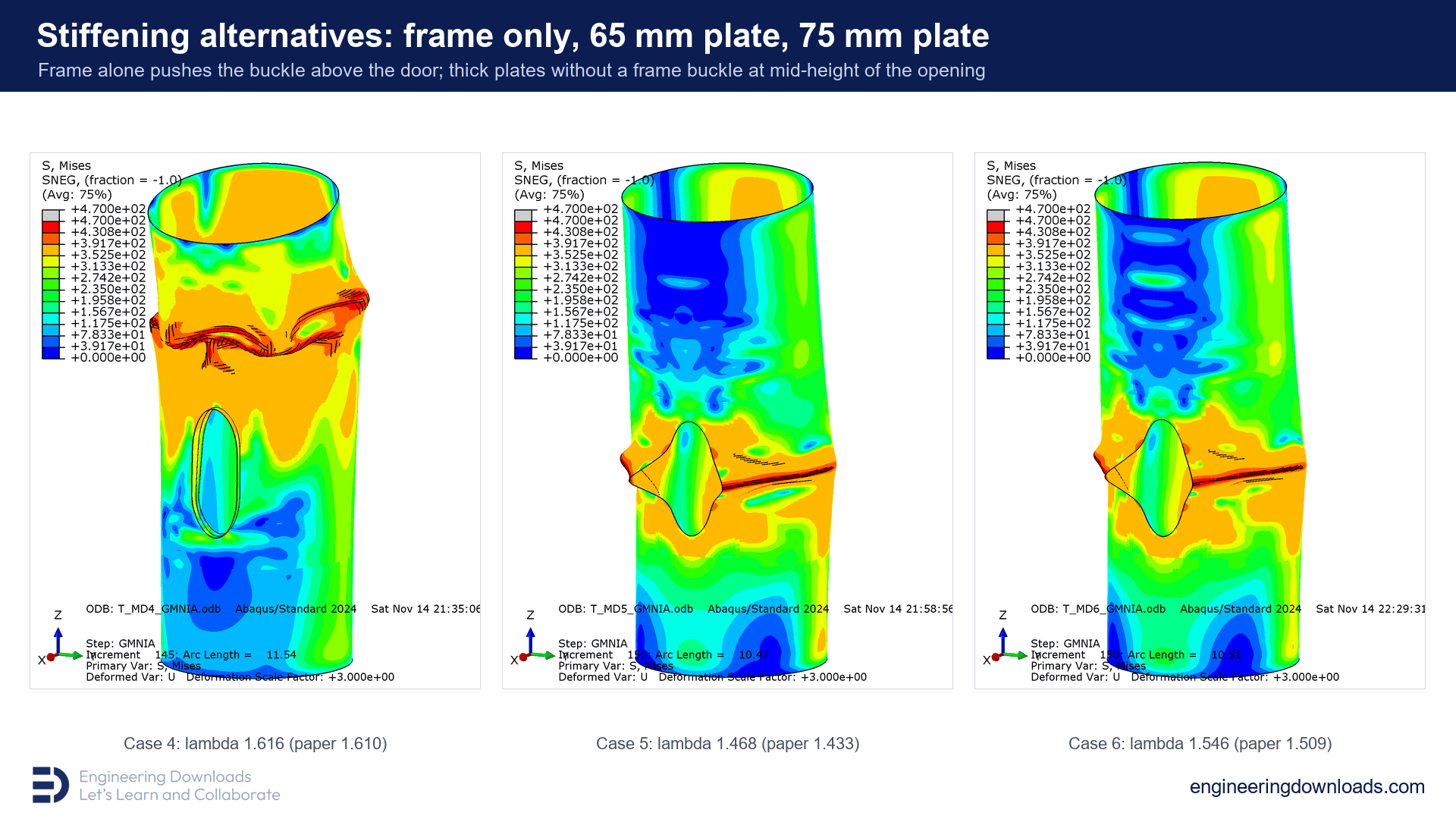
| Man door case | Paper λu | Abaqus λu | Difference |
|---|---|---|---|
| 1 No opening | 1.530 | 1.530 | +0.0 % |
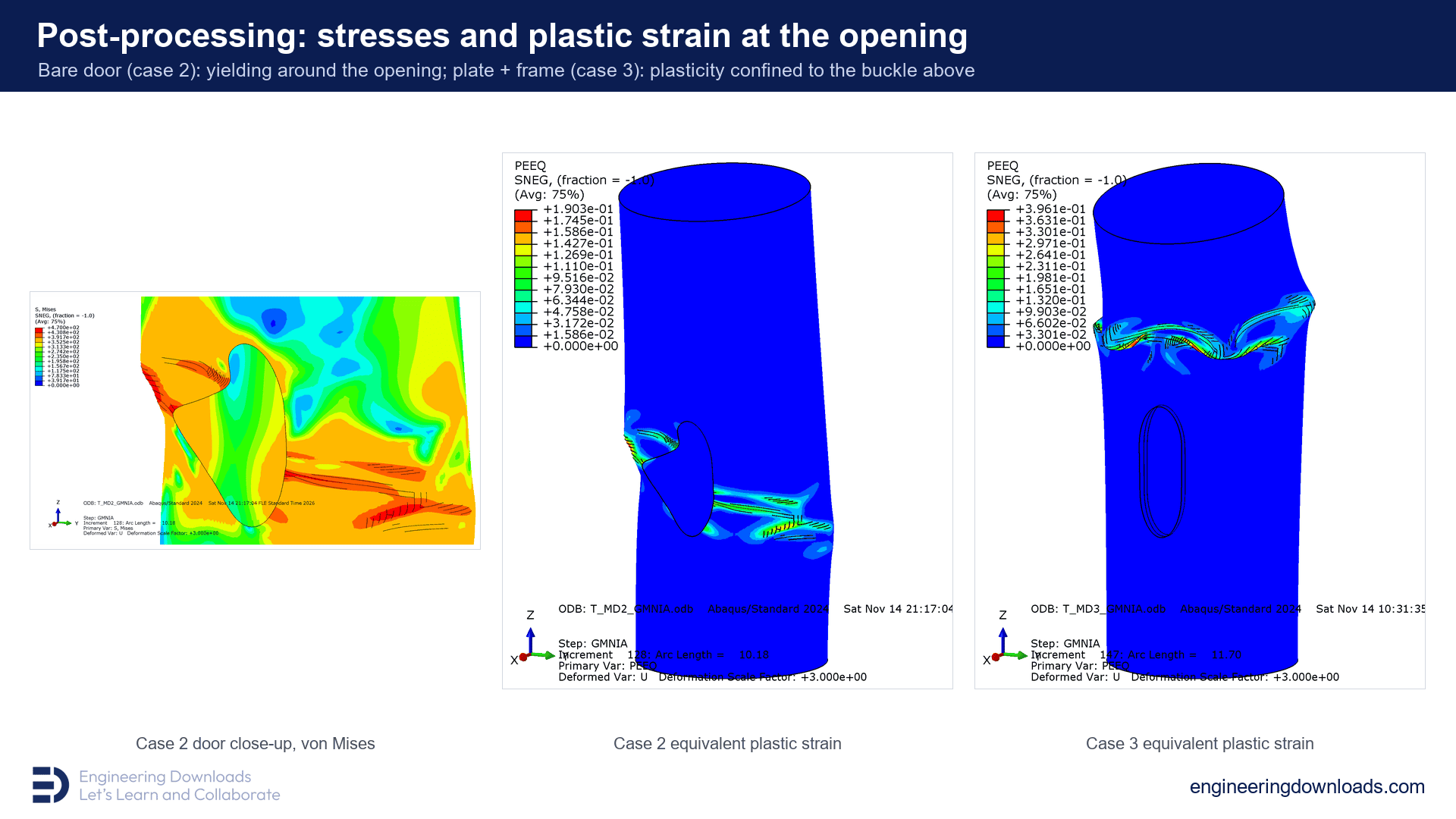
| 2 Opening, no plate, no frame | 1.182 | 1.206 | +2.1 % |
| 3 65 mm plate + frame | 1.532 | 1.536 | +0.3 % |
| 4 Frame only | 1.610 | 1.616 | +0.4 % |
| 5 65 mm plate, no frame | 1.433 | 1.468 | +2.5 % |
| 6 75 mm plate, no frame | 1.509 | 1.546 | +2.5 % |
| Case | Paper | Abaqus | Difference |
|---|---|---|---|
| Two framed vents, wind 0° | 1.529 | 1.484 | -3.0 % |
| Wind 45° | 1.494 | 1.450 | -2.9 % |
| Wind 90° | 1.476 | 1.499 | +1.5 % |
| 58 mm without frame | 1.478 | 1.493 | +1.0 % |
| 48 mm without frame | 1.444 | 1.501 | +3.9 % |
| 44 mm without frame | 1.312 | 1.494 | +13.9 % |
| Door + vent, load to door, both framed | 1.565 | 1.666 | +6.5 % |
| Door + vent, load to door, unframed | 1.487 | 1.546 | +4.0 % |
| Door + vent, load to vent, both framed | 1.533 | 1.652 | +7.8 % |
| Door + vent, load to vent, unframed | 1.556 | 1.667 | +7.1 % |
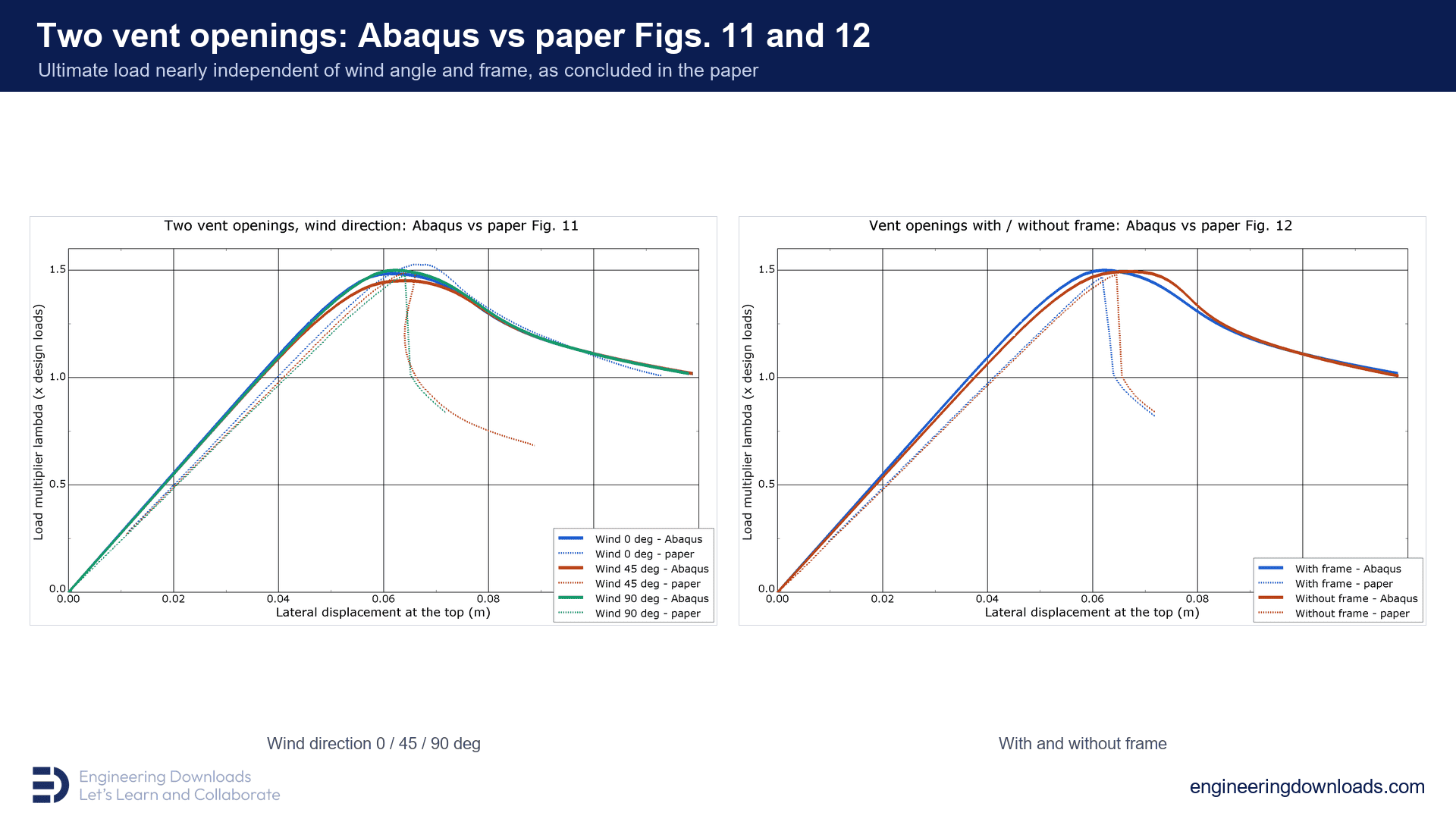
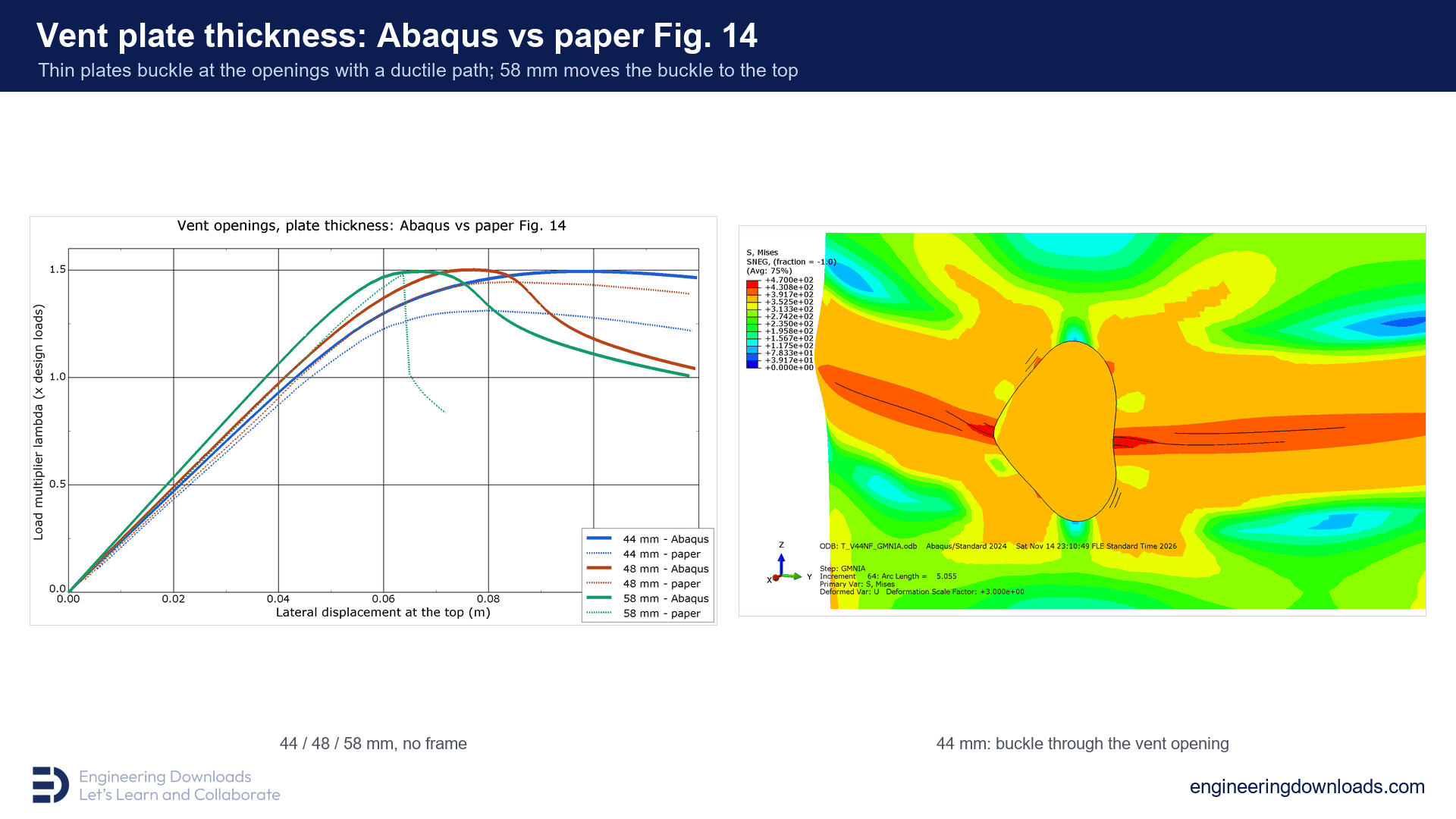
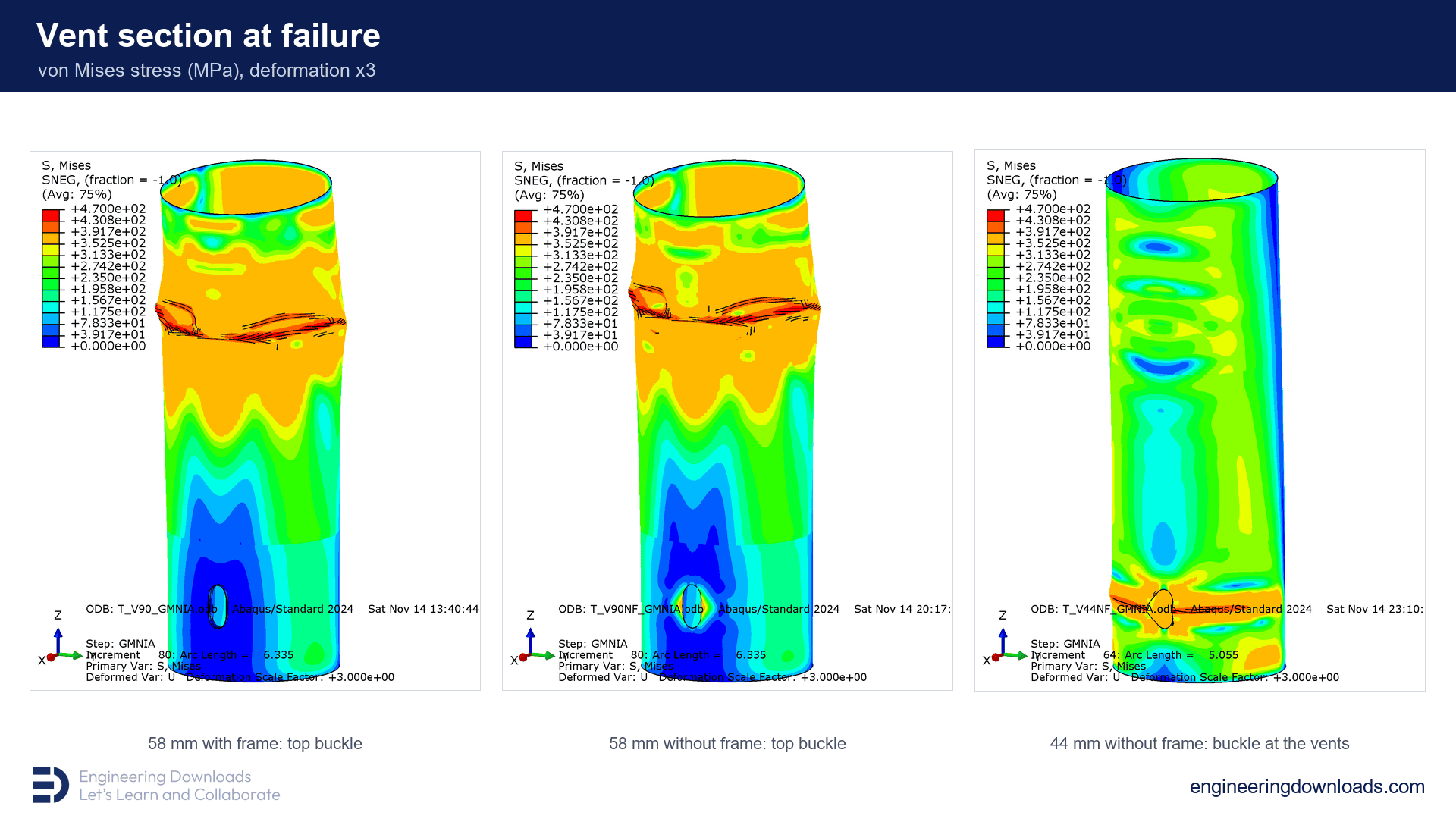
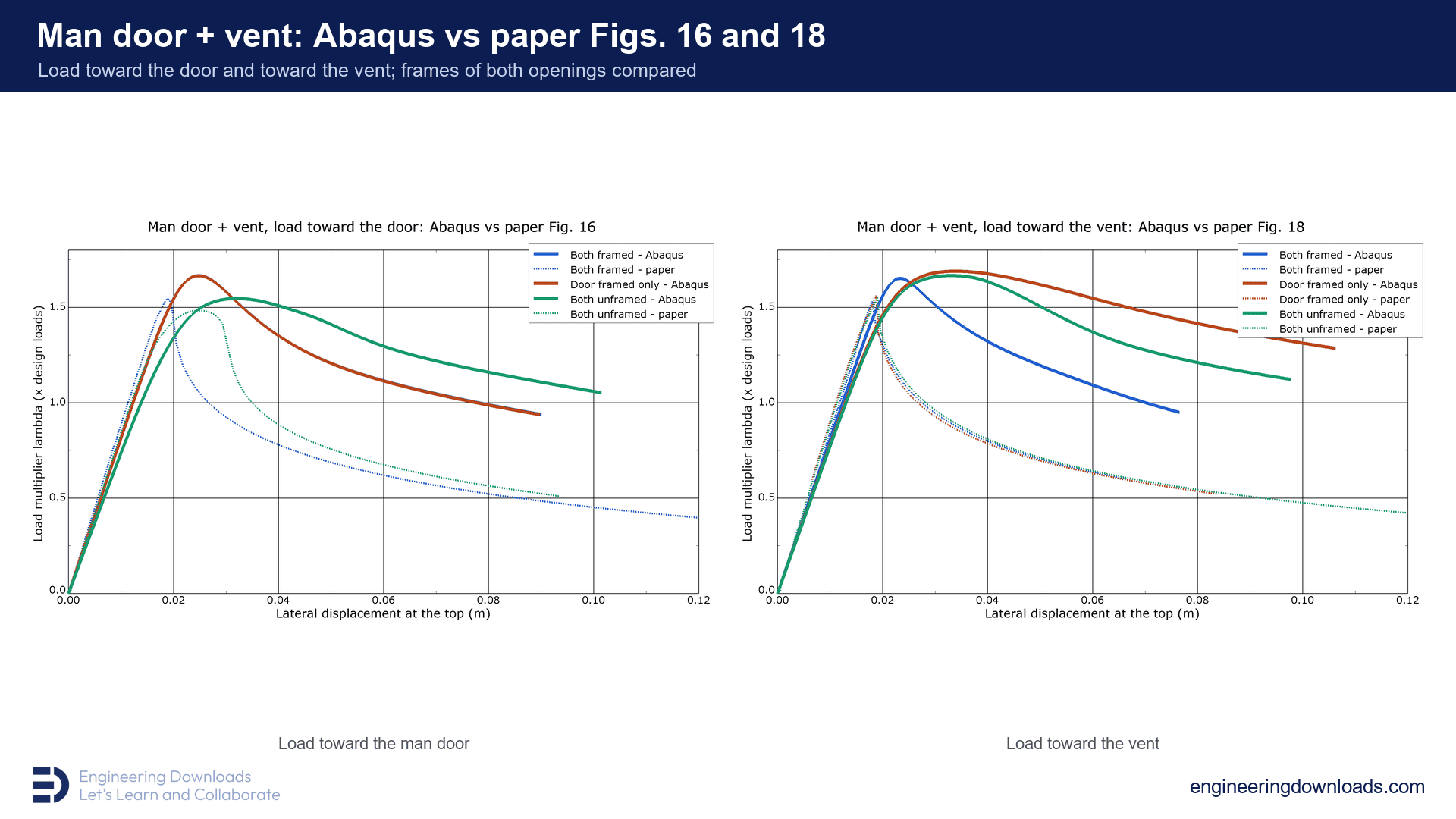
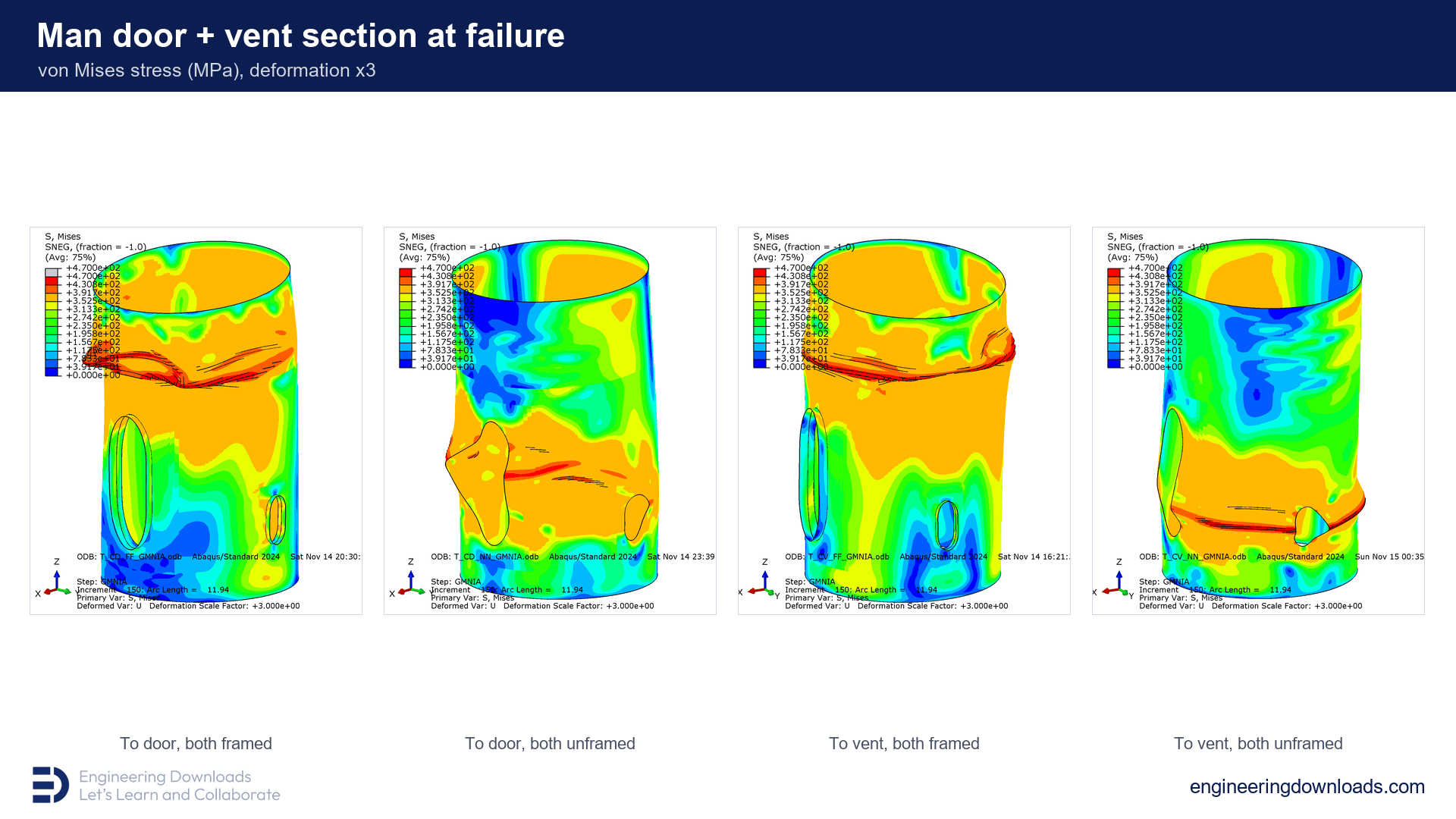
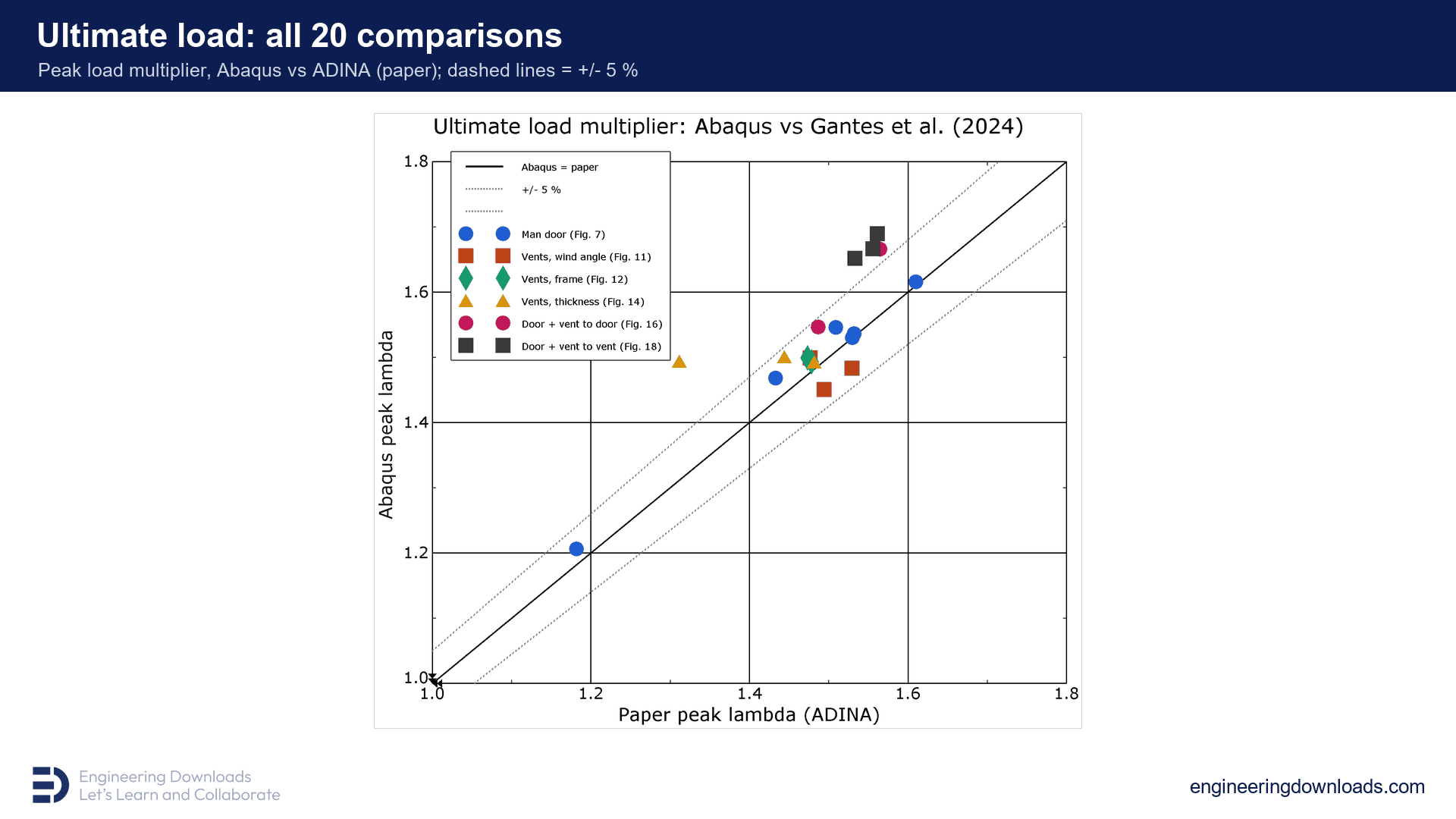
The man door study, the core of the paper, is reproduced within 2.5 % for all six cases, and the buckle forms where the paper reports it. The vent cases agree within 4 %, except the 44 mm plate, which fails at the openings as in the paper but 14 % higher. The man door + vent section is 4 to 8 % stronger and slightly softer than the paper: its can thicknesses and length are not published, so they are assumed and stated. One finding goes beyond the paper: where the first eigenmode sits at an unframed opening, using it alone as the imperfection leaves the rest of the shell perfect and overestimates the strength by 10–11 %. Adding the first far-field mode, as EN 1993-1-6 allows, fixes it; the tutorial shows both results.
Wind-energy and tower engineers who design door and vent reinforcement, FEA engineers who want a working LBA + GMNIA workflow with eigenmode imperfections and the Riks method in Abaqus, and students of shell buckling who want to see a published study rebuilt and checked case by case.
Which paper does this package replicate? Gantes, Vernardos, Koulatsou and Gul, Nonlinear Finite Element Analysis of Tubular Steel Wind Turbine Towers near Man Door and Ventilation Openings to Optimize Design against Buckling, Vibration 2024, 7, 212-228 (open access). The paper is cited, not bundled; its curves were digitised for the comparison.
How close are the results to the paper? All six man door cases are within +2.5 % of the paper's ultimate load multiplier, the vent cases within 4 % except the 44 mm plate (+14 %), and the man door + vent section 4 to 8 % higher. 15 of the 20 compared peaks are within 4 %.
How is the imperfection applied? A linear buckling analysis gives the eigenmodes, which are written to the results file. The GMNIA reads them with *IMPERFECTION and scales mode 1 to 18.8 mm, the EN 1993-1-6 class B amplitude. Where mode 1 is a local dimple at an unframed opening, the first far-field mode is added with the same amplitude, and the tutorial explains why.
What did you have to assume? The paper gives the openings, frames and plates but not the segment lengths or the can thicknesses. They were chosen from the paper's displacement scales and failure locations: 11 m (door), 12.5 m (vents) and 7 m (door + vent). Case 1 reaches its peak at 53 mm against 52 mm in the paper. All assumptions are listed in the tutorial.
Are the images real Abaqus results? Yes. Geometry, mesh, loads, mode shapes and contours are exported by Abaqus/CAE 2024 from the included models and their results, and the curves are Abaqus X-Y plots; only a title bar, the logo and the web address are added around them.
Which Abaqus version do I need? Abaqus/CAE and Abaqus/Standard 2024 or newer for the CAE files; the INP files also run in older releases. ODB files are not included. On 4 cores each LBA takes 1-2 minutes and each GMNIA 10-60 minutes.
What if the package is not what I expected? Write to us. Engineering Downloads refunds clients who are not satisfied with a delivered product.
Need more than the files?
There are two ways we can help. Book a one hour online consultation if you want to talk a problem through with a CAE engineer, using the checkbox in the order box. Order a project if you need a full simulation built for you, delivered to an agreed scope, price and deadline under a written contract.
We work on FEA and CFD for engineers, researchers and companies. Order your project, or message us on WhatsApp for a quick reply.
Other packages engineers working on this topic also download.
 Wind Turbine Tower Man Door and Ventilation Opening Buckling in Ansys: GMNIA after Gantes et al. (2024)€129,00
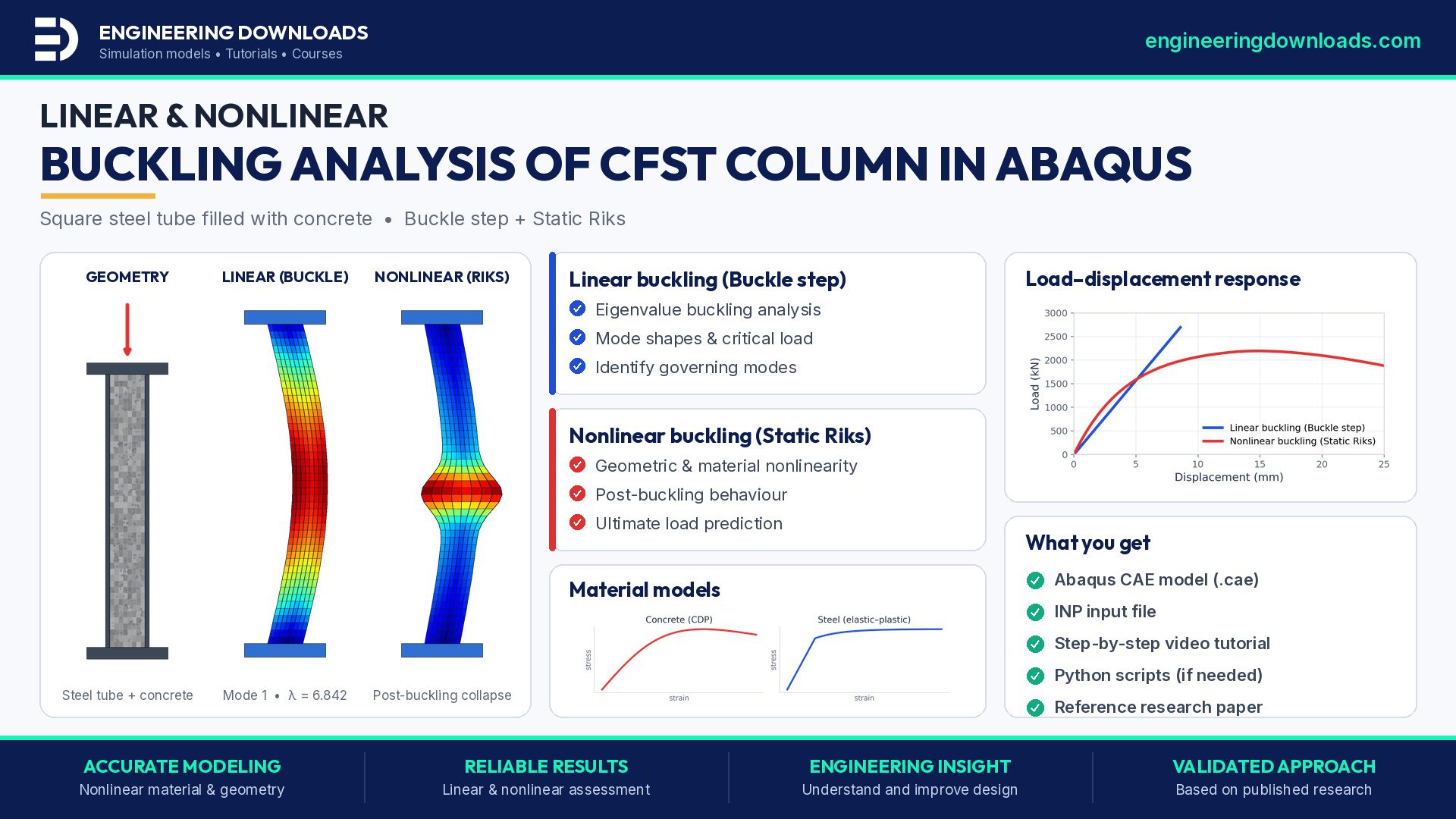 Buckling Analysis of a Concrete-Filled Steel Tube (CFST) Column Using Abaqus
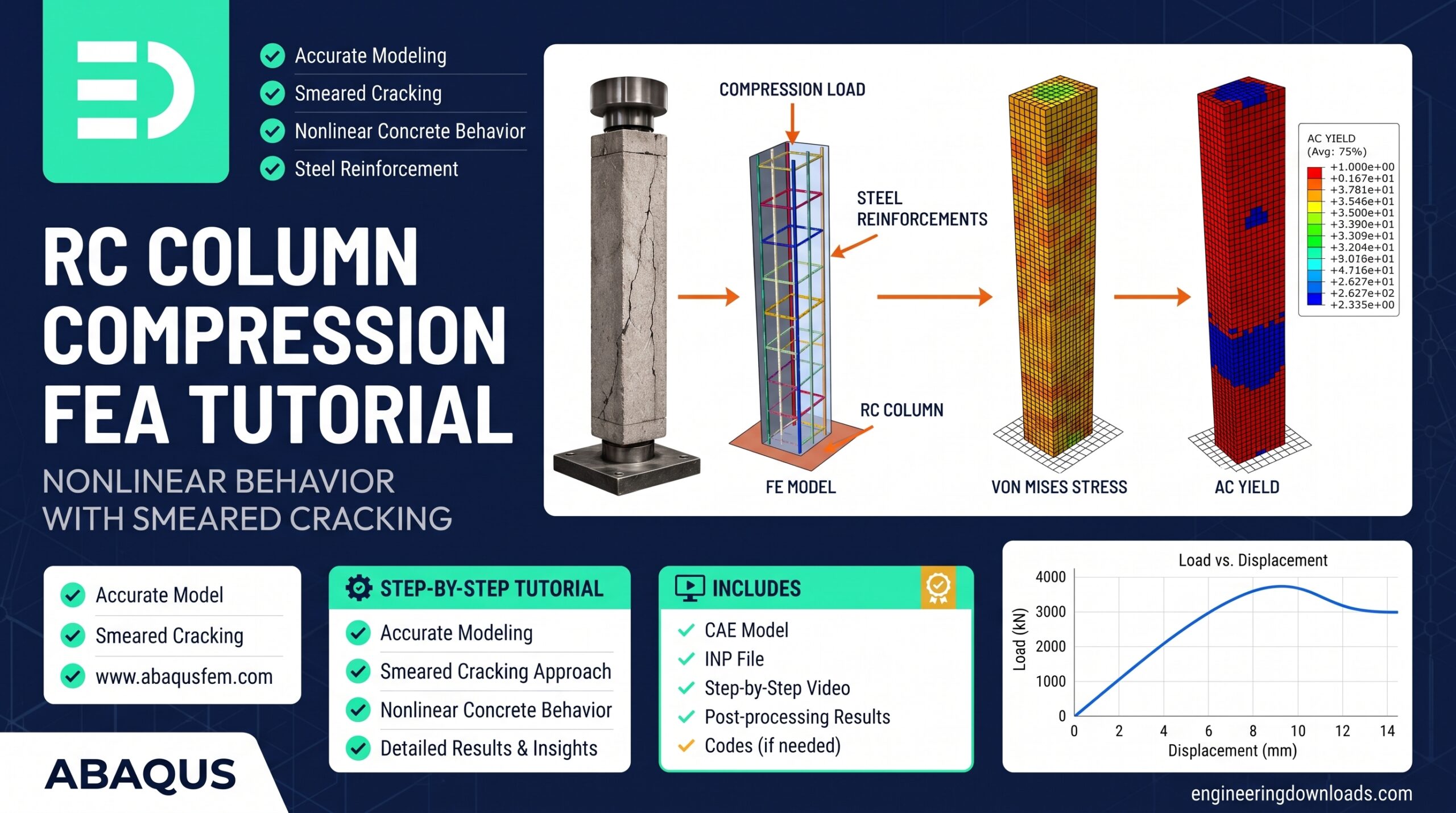 RC Column under Axial Compression in Abaqus: Smeared Cracking Model
 Seismic Cyclic Analysis of a Timber Frame in Abaqus: Hill Plasticity & Hysteresis
 Seismic Response of a Steel Building in Abaqus: Nonlinear Dynamic Analysis with Beam Elements
 ASME VIII Div.2 Part 5 Design by Analysis with Abaqus: Collapse, Buckling and Fatigue
 ASME VIII Div.2 Part 5 Design by Analysis with Ansys: Collapse, Buckling and Fatigue
 Steel Structure Analysis Package

Need a full custom project? See the options below.

€129,00

€179,00

€149,00

€119,00
€129,00

€149,00
See more
Want to receive push notifications for all major on-site activities?



