Need a full custom project? See the options below.
Need a full custom project? See the options below.
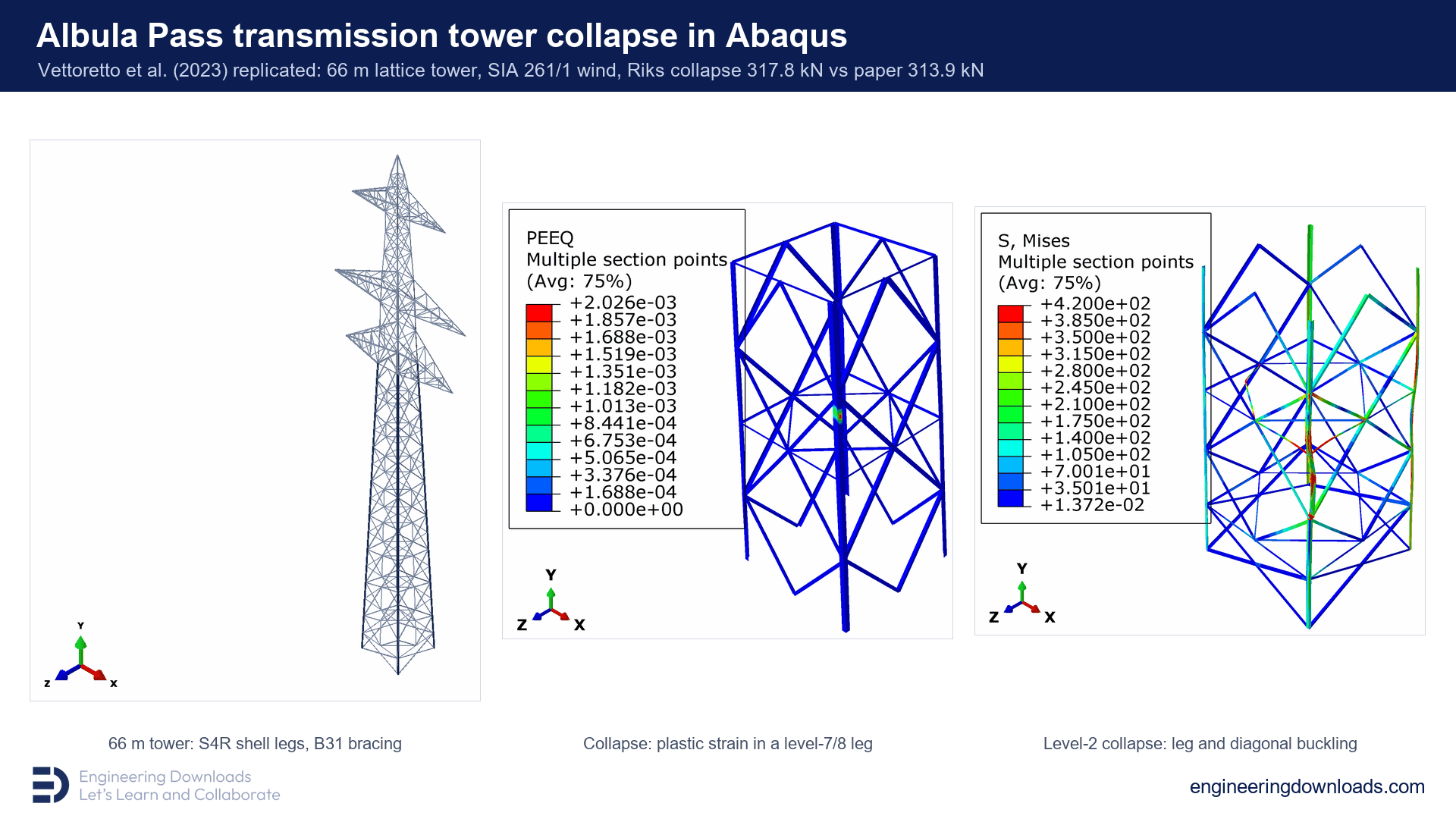
Why did four lattice pylons of a Swiss high-voltage line fall in one storm, and how much wind could they really carry? This Abaqus package replicates the journal paper Vettoretto, Li and Affolter, “Evaluation of the Ultimate Collapse Load of a High-Voltage Transmission Tower under Excessive Wind Loads”, Buildings 2023, 13, 513 on the towers that collapsed at Albula Pass in October 2018. It contains the full 66 m lattice tower with shell-modelled angle legs, linear buckling, Riks collapse with eigenmode imperfections, missing members, support settlement and post-buckling, plus the single-bolted angle brace and the tower sub-assembly used to validate the modelling. The full-tower collapse load is within 1.3 % of the paper.
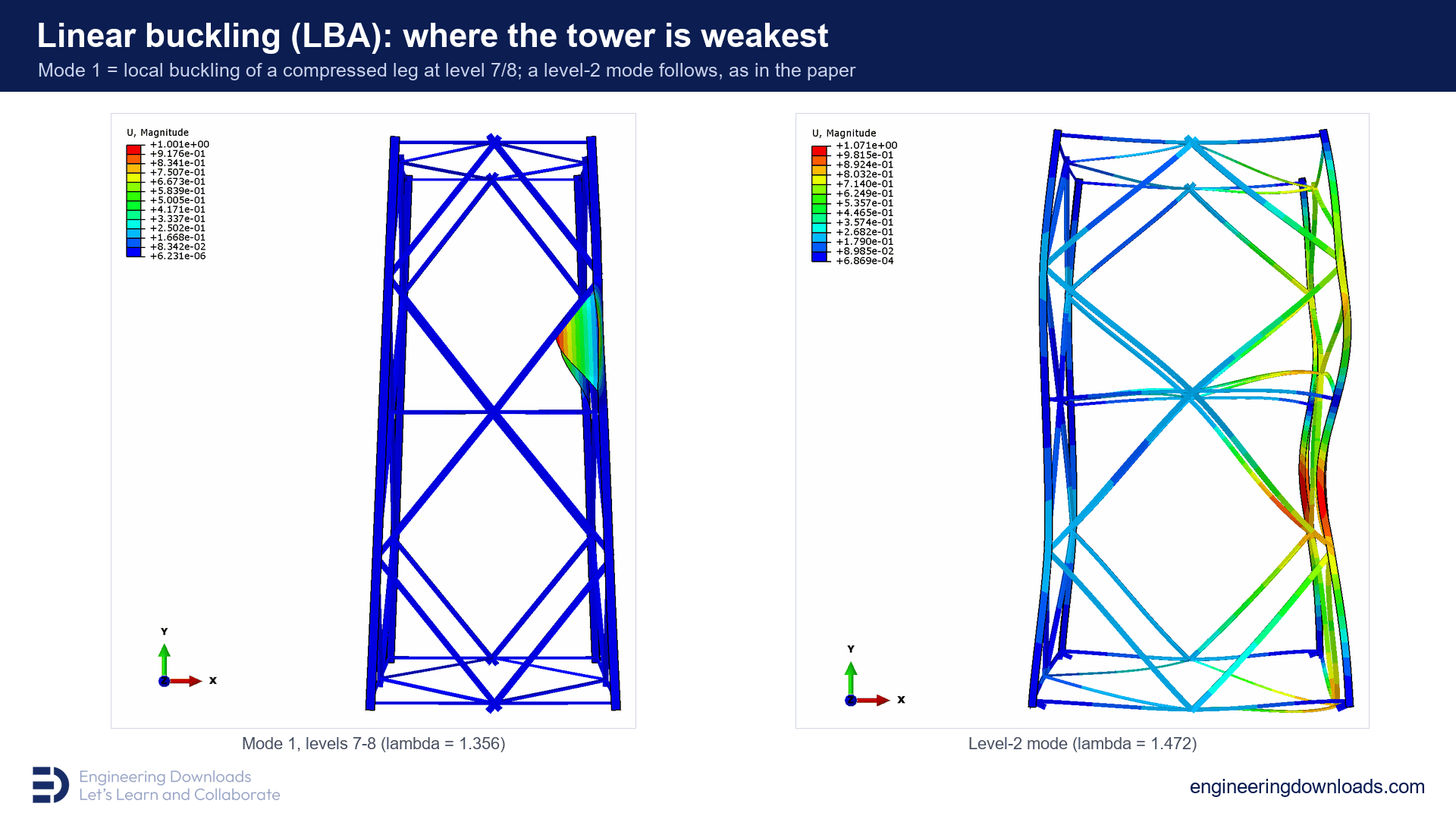
The paper rebuilds a suspension tower of the Albula line in Abaqus and loads it with the SIA 261/1 design wind perpendicular to the line (237.2 kN in total on the lattice and the conductors). It first checks the modelling on a single-bolted L80x8 angle brace tested by Kettler et al. and on tower sub-assemblies, then runs a linear buckling analysis and Riks collapse analyses with buckling-mode imperfections of L/706.5 (Eurocode 3), missing secondary members and support displacements, and finally removes the failed legs to see what the tower can still carry.
| Item | This package |
|---|---|
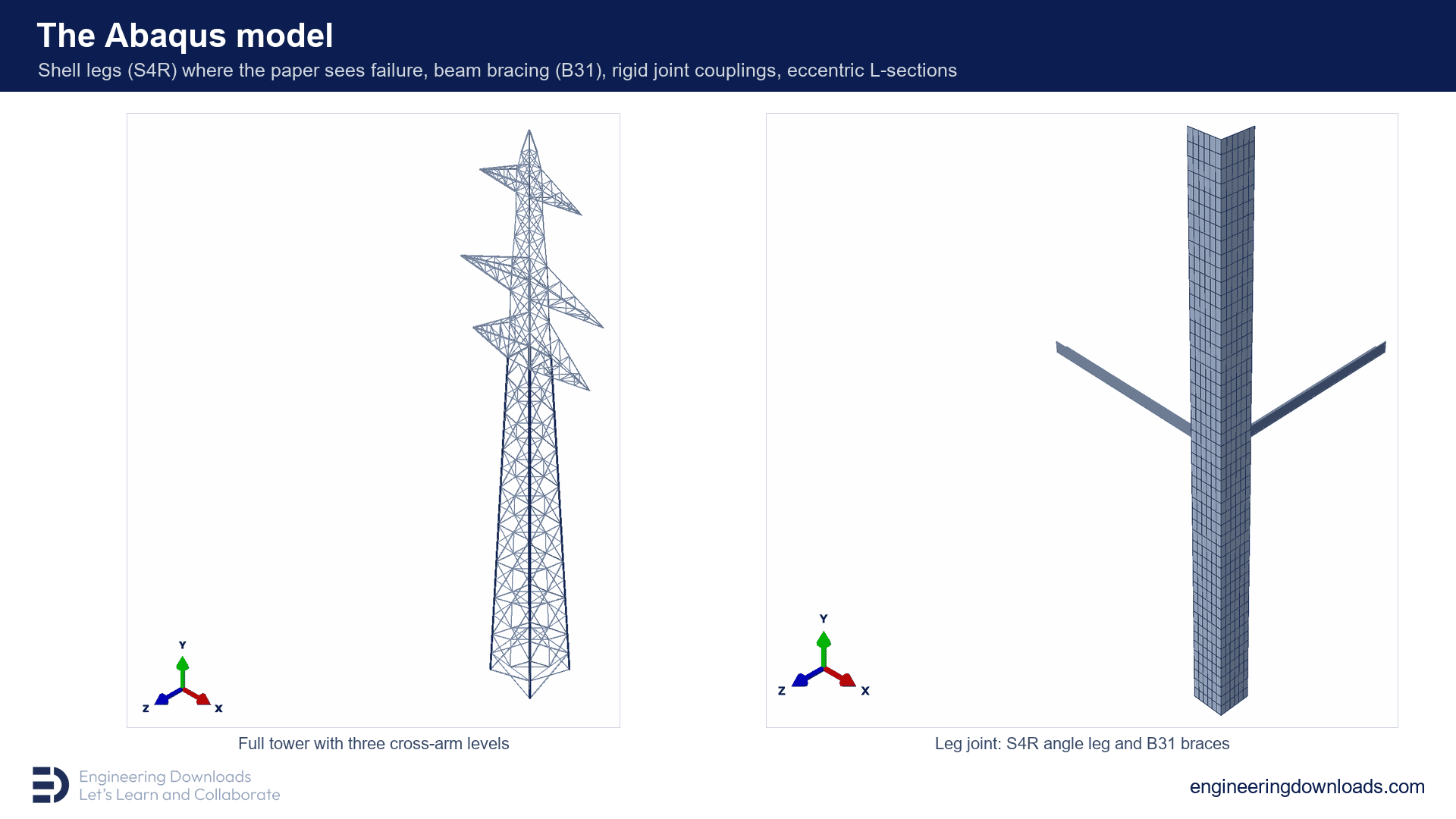
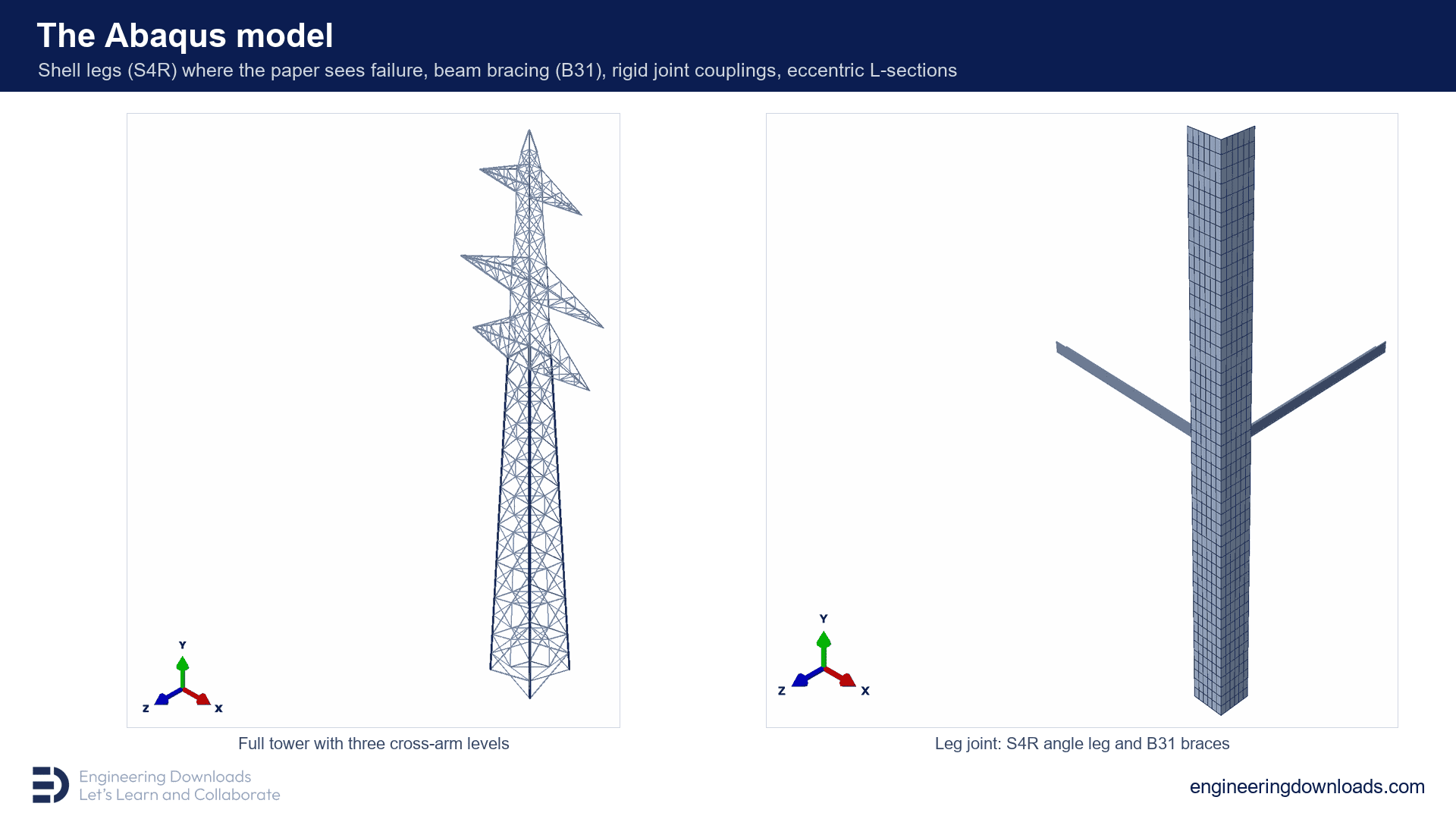
| Structure | 66.3 m suspension tower, 9 body levels, three cross-arm levels, base 6.4 m square |
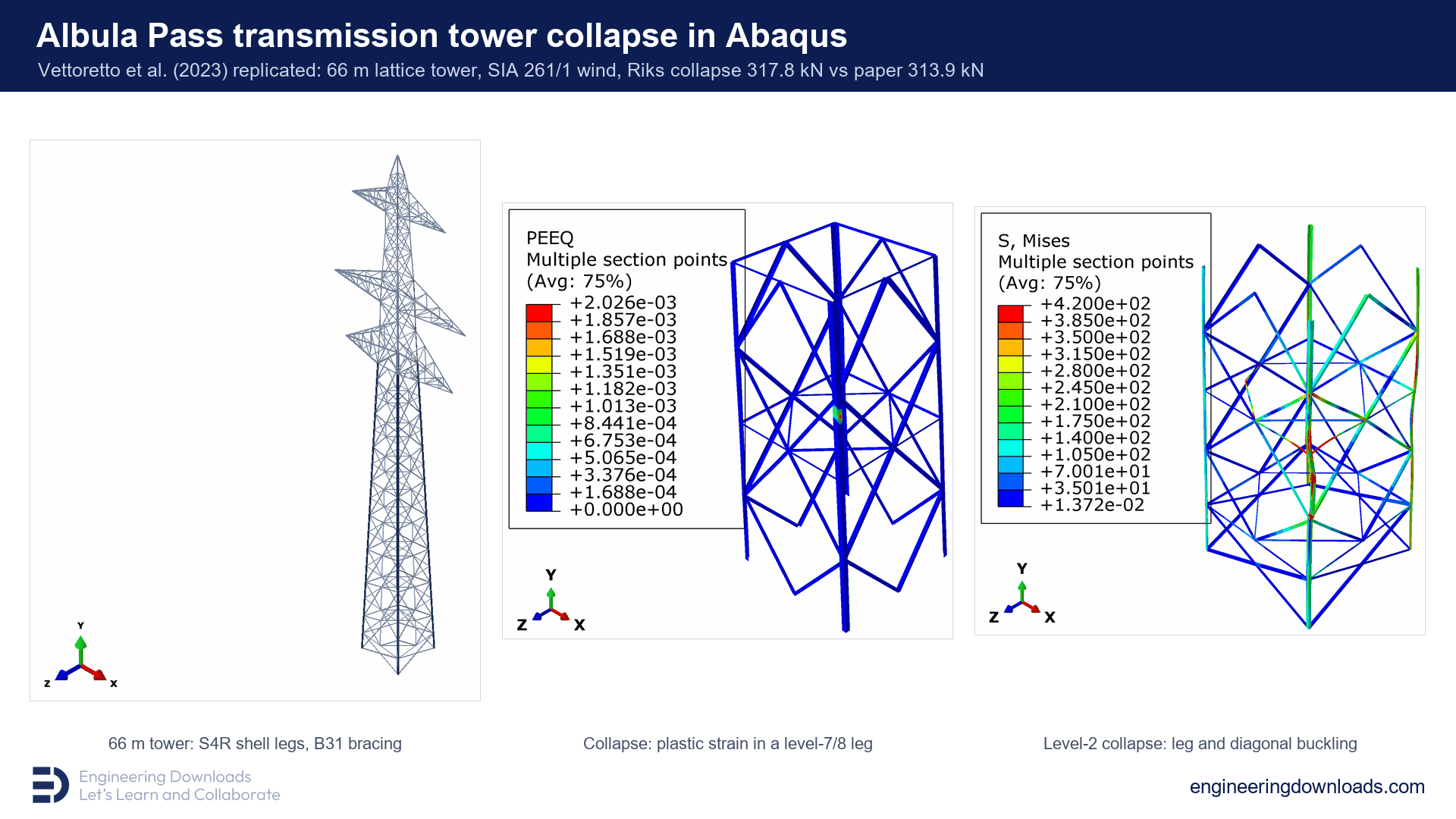
| Elements | Main legs as S4R shell angles (L152x8 to L152x13), bracing as B31 beams with eccentric L-sections, rigid joint couplings |
| Material | Steel S420, E = 210 GPa, elastic-perfectly plastic |
| Loads | Self-weight pre-load, then SIA 261/1 wind: 120.0 kN on the lattice by level, 117.2 kN from the conductors at the arm tips |
| Analyses | LBA (Lanczos, 10 modes), Riks with eigenmode imperfections L/706.5, missing members, support settlement, post-buckling |
| Validation models | L80x8 single-bolted brace (Kettler test C1, shell), 3D tower sub-assembly (beam and shell + beam) |
| Software | Abaqus/CAE and Abaqus/Standard 2024 or newer |
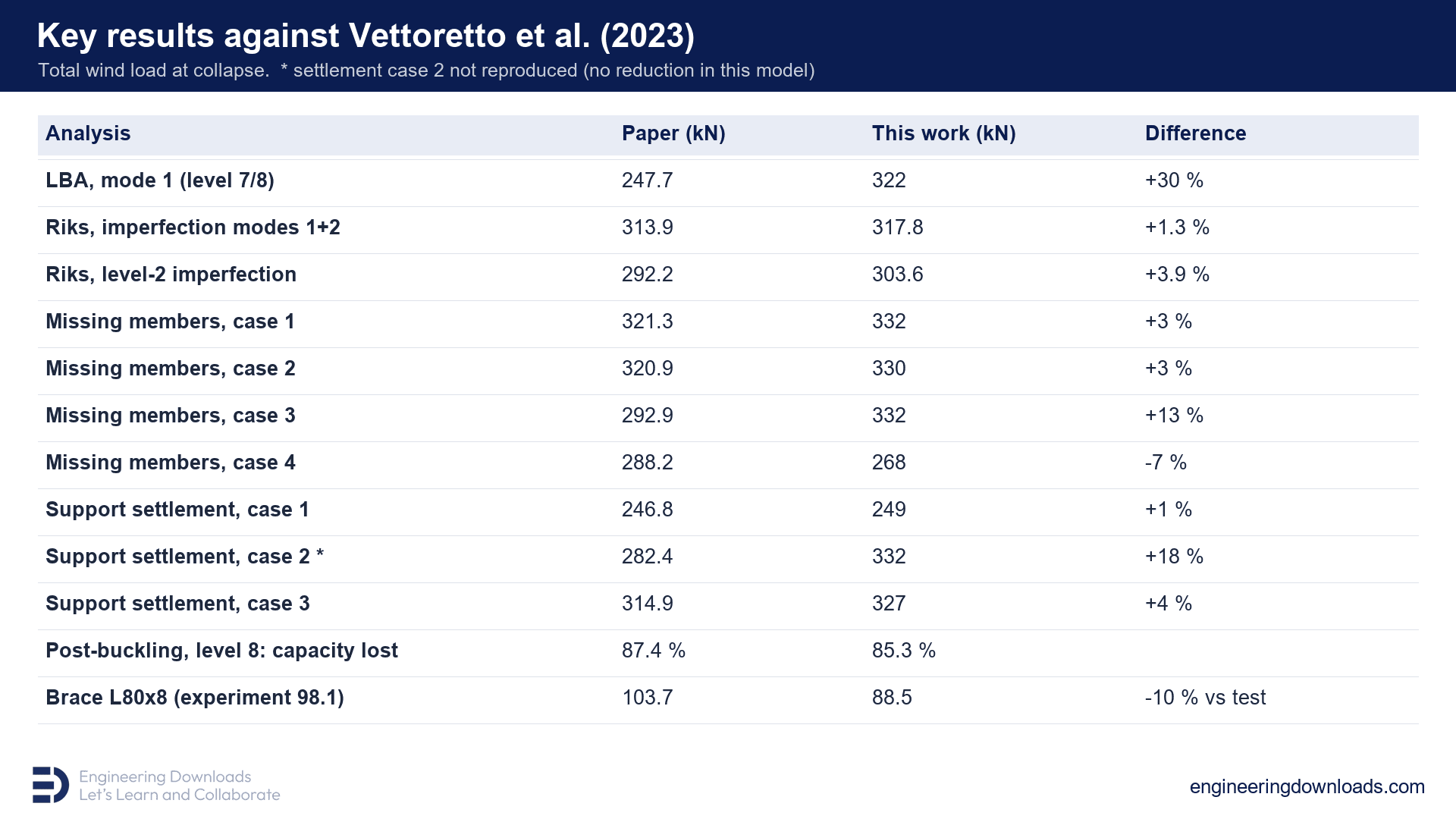
| Analysis (total wind load, kN) | Paper | This work | Difference |
|---|---|---|---|
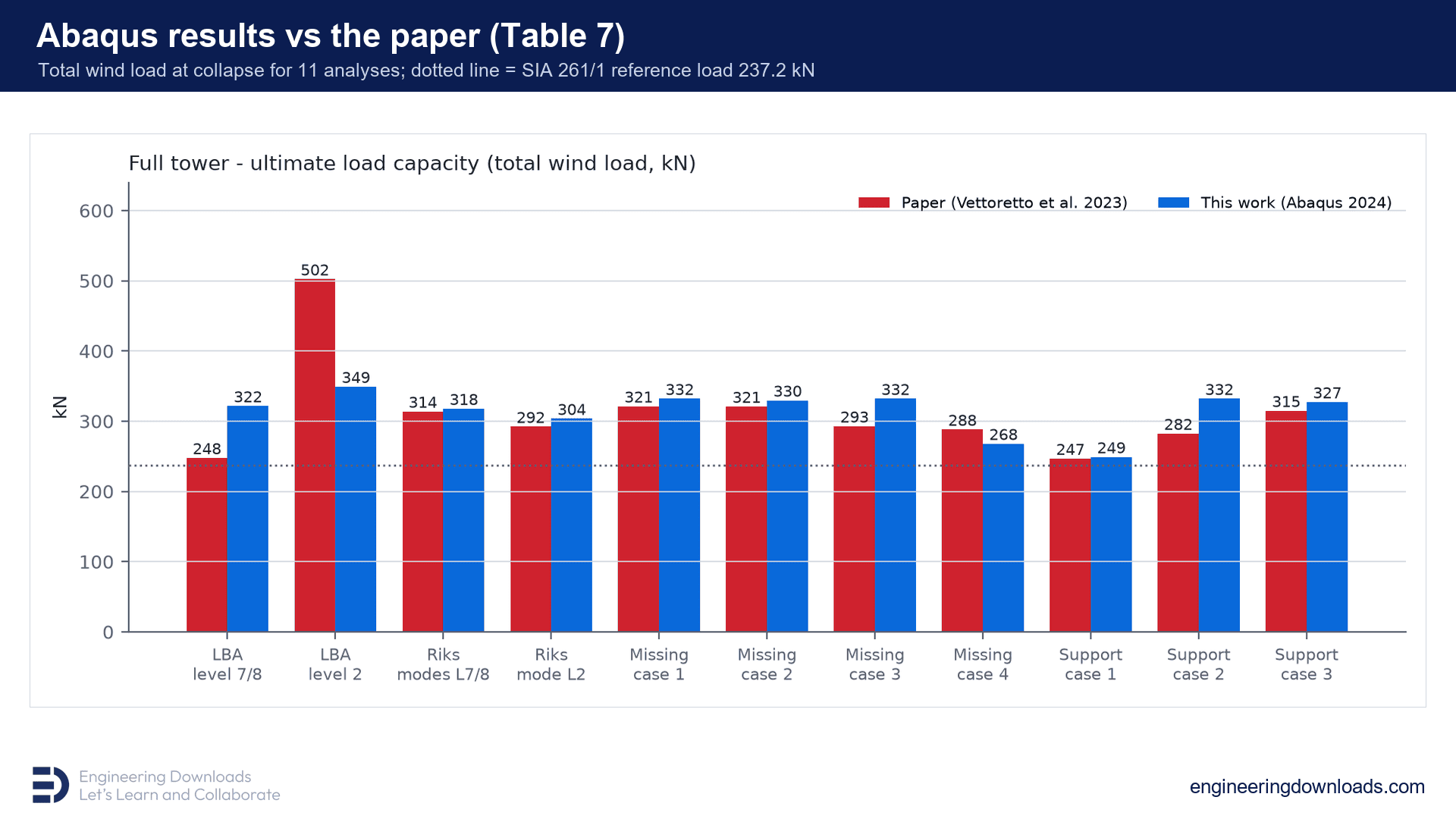
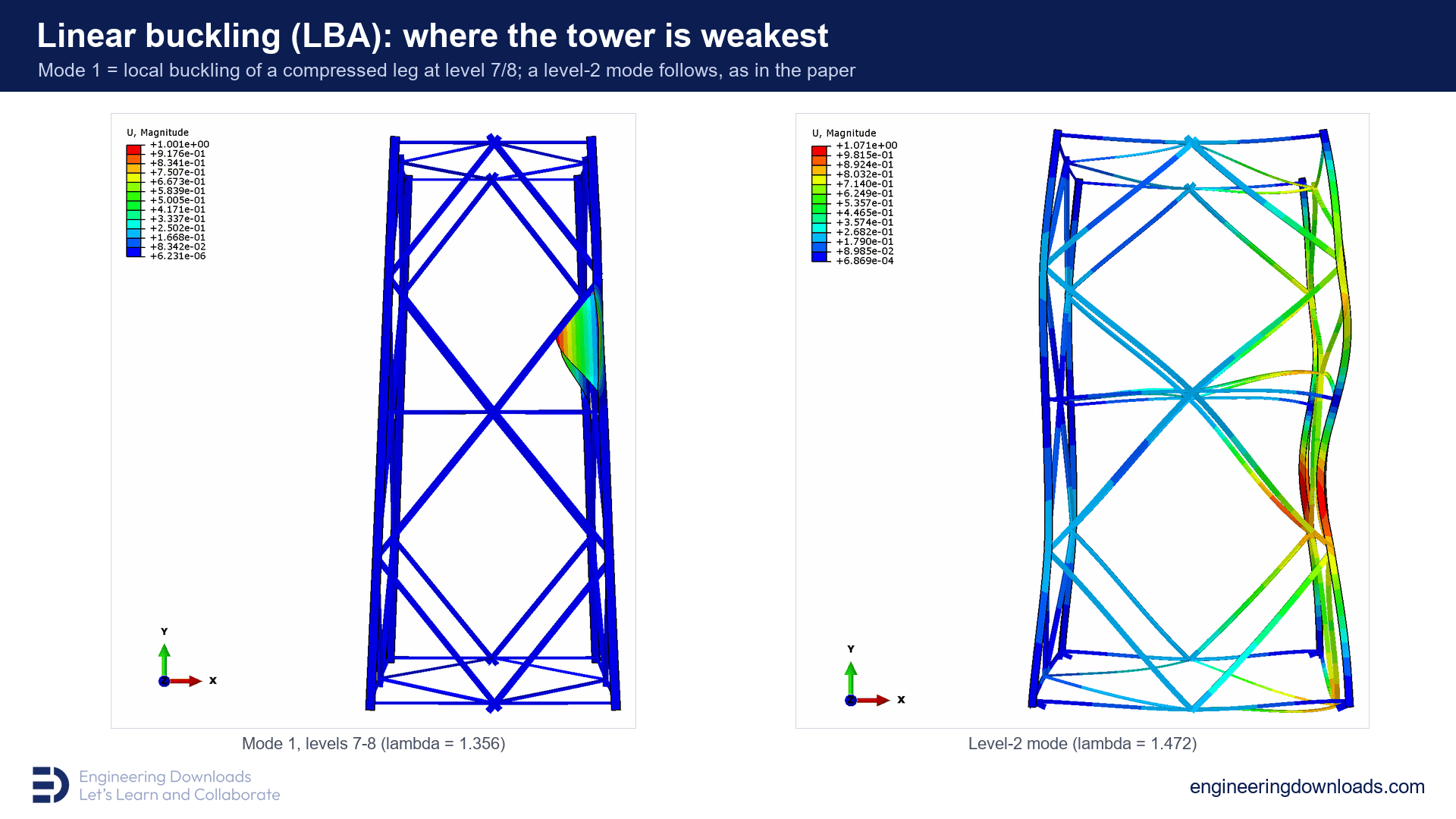
| LBA, mode 1 (level 7/8) | 247.7 | 321.6 | +29.9 % |
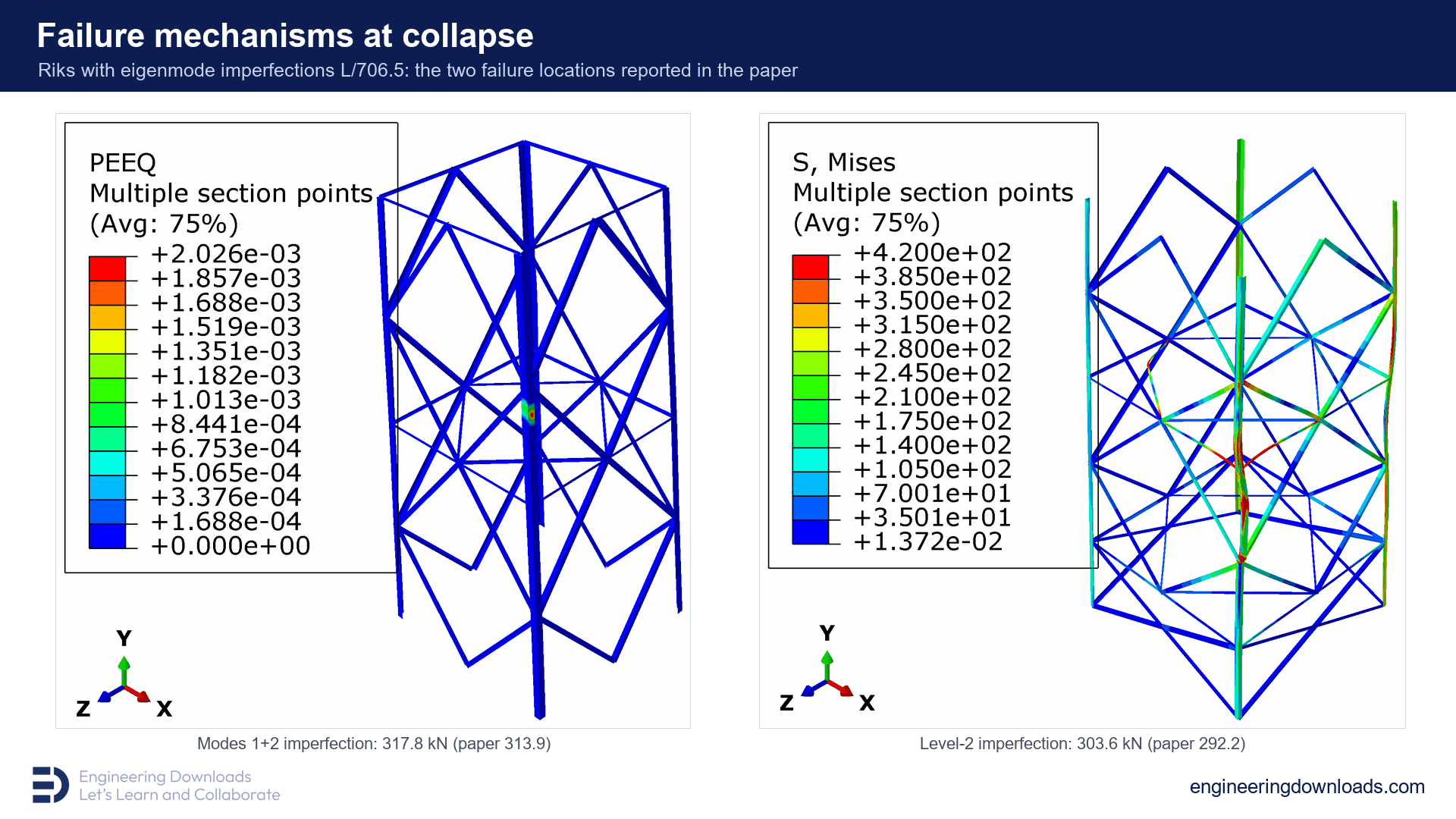
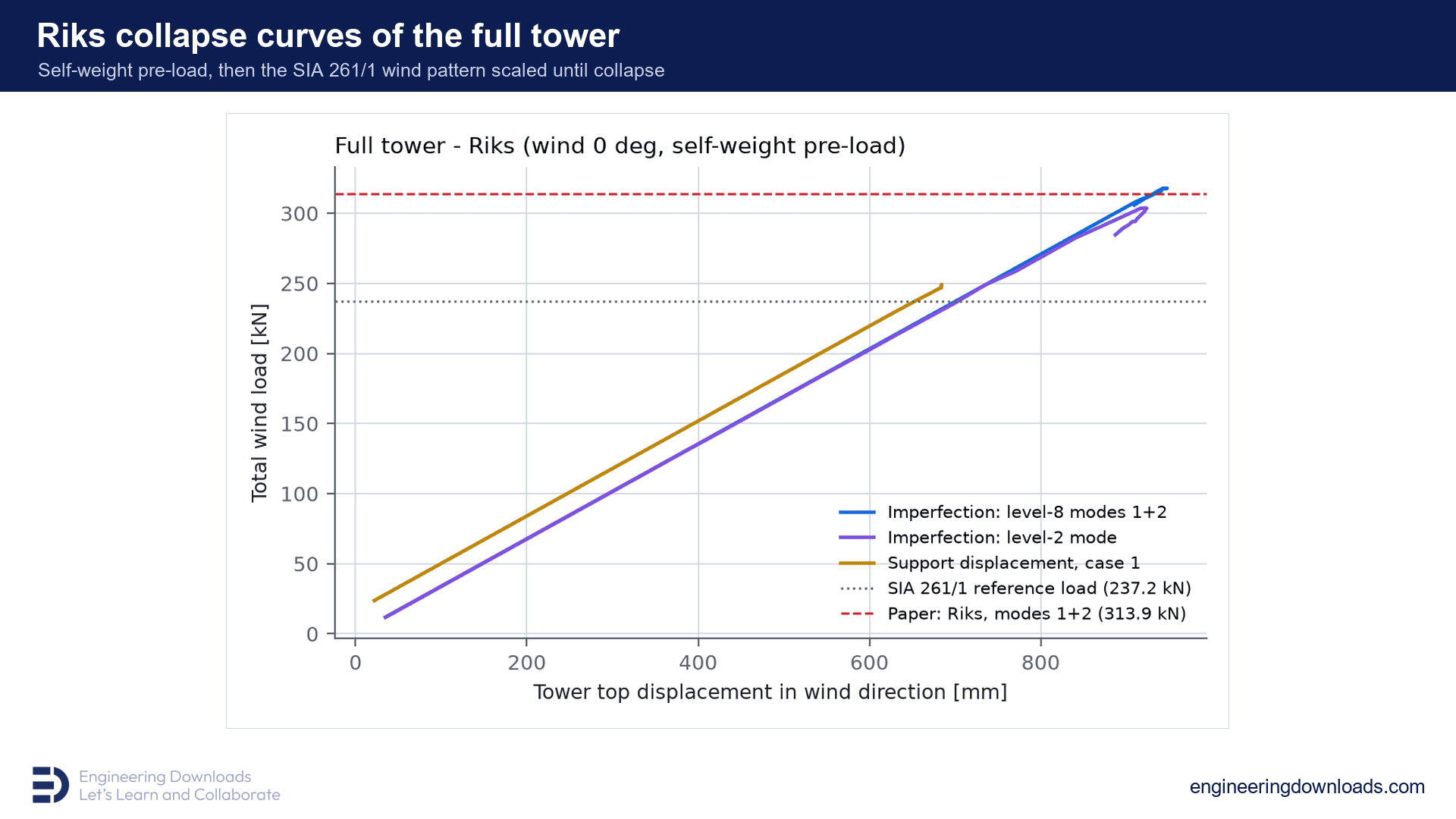
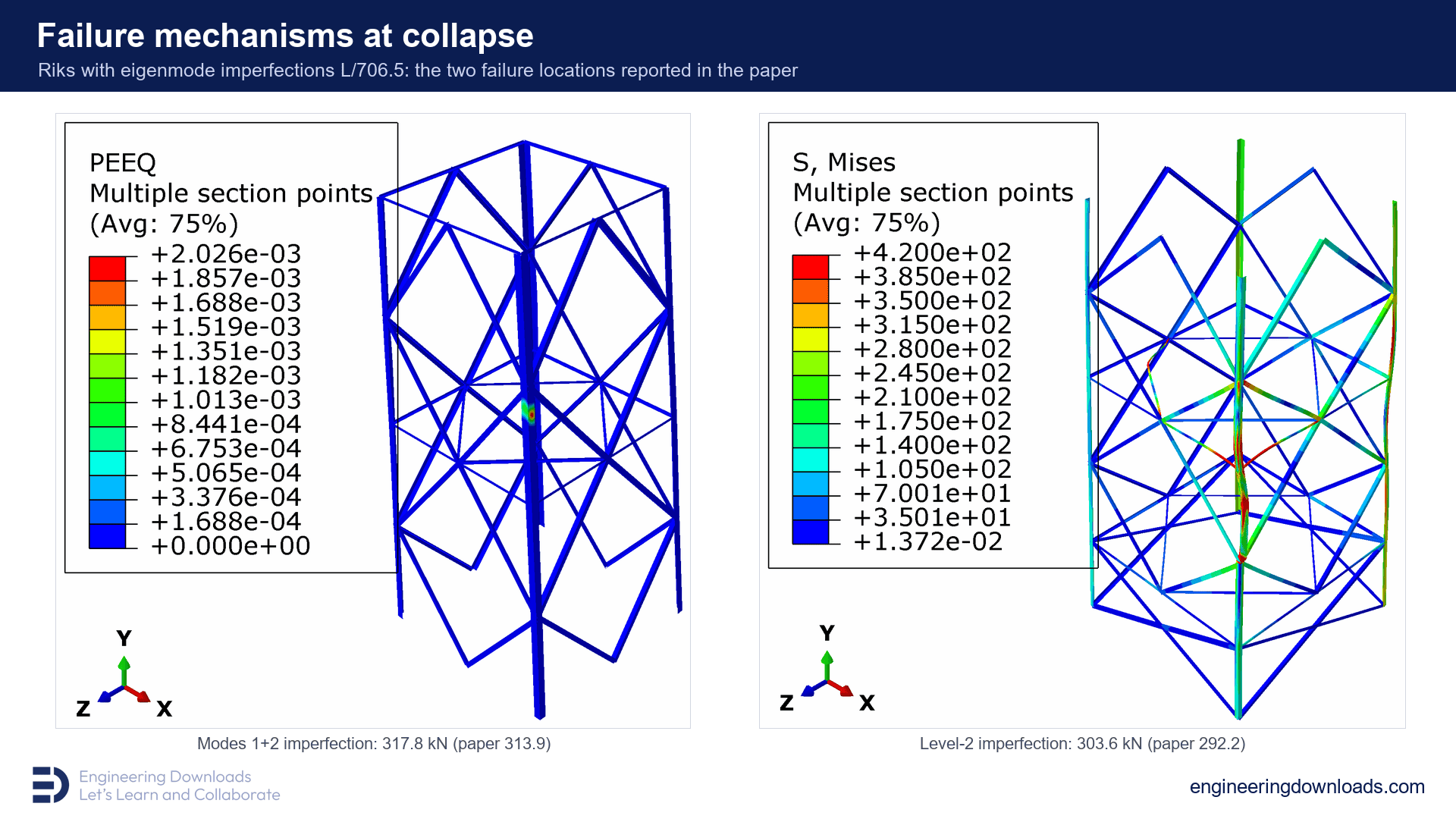
| Riks, imperfection modes 1+2 | 313.9 | 317.8 | +1.3 % |
| Riks, level-2 imperfection | 292.2 | 303.6 | +3.9 % |
| Missing members, case 1 | 321.3 | 332.1 | +3.4 % |
| Missing members, case 2 | 320.9 | 329.7 | +2.7 % |
| Missing members, case 3 | 292.9 | 332.1 | +13.4 % |
| Missing members, case 4 | 288.2 | 268.0 | -7.0 % |
| Support settlement, case 1 | 246.8 | 249.1 | +0.9 % |
| Support settlement, case 2 (not reproduced) | 282.4 | 332.1 | +17.6 % |
| Support settlement, case 3 | 314.9 | 327.3 | +3.9 % |
| Post-buckling, level-8 legs failed: capacity lost | 87.4 % | 85.3 % | |
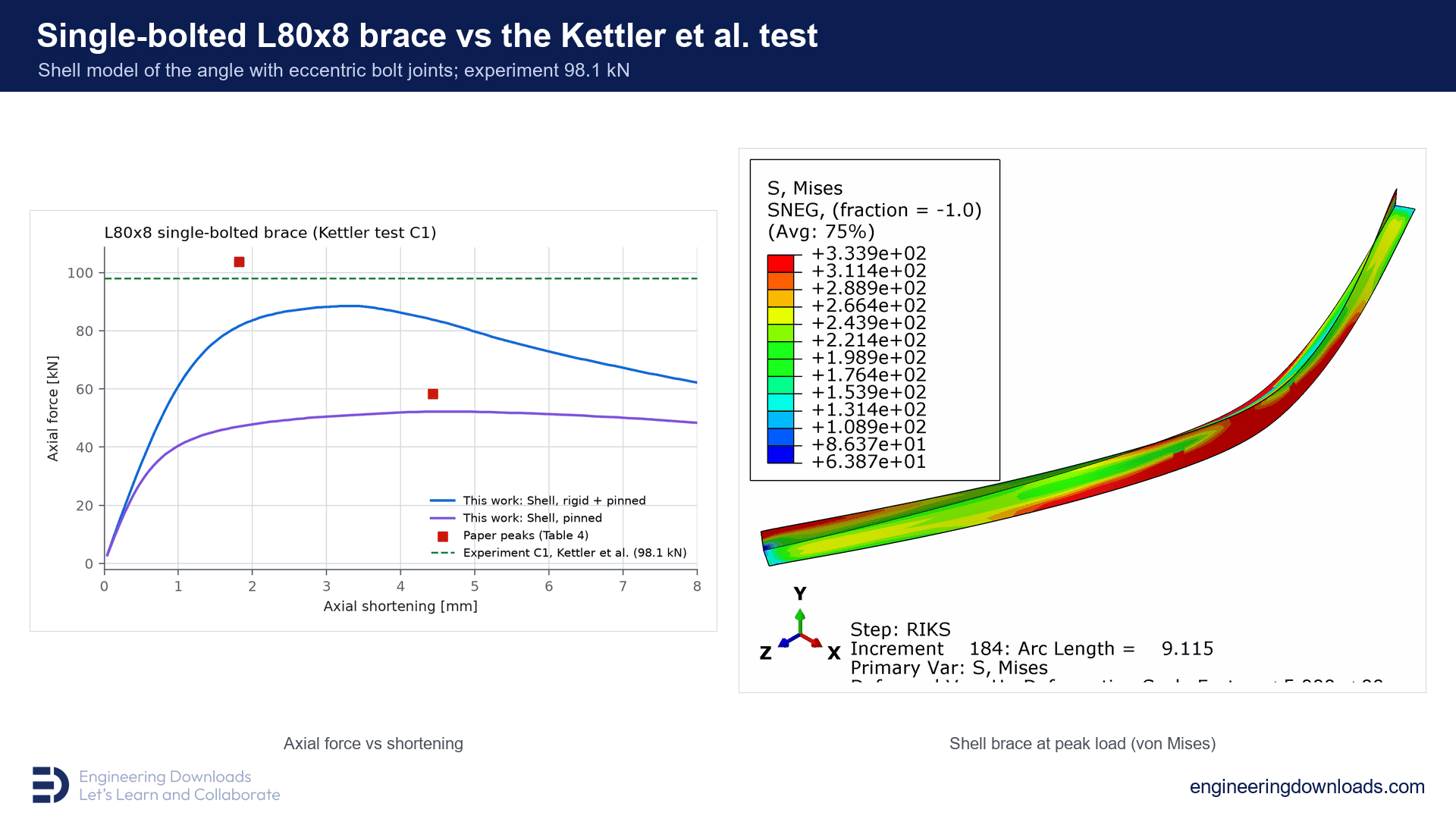
| L80x8 brace, rigid + pinned joint (test 98.1 kN) | 103.7 | 88.5 | -10 % vs test |
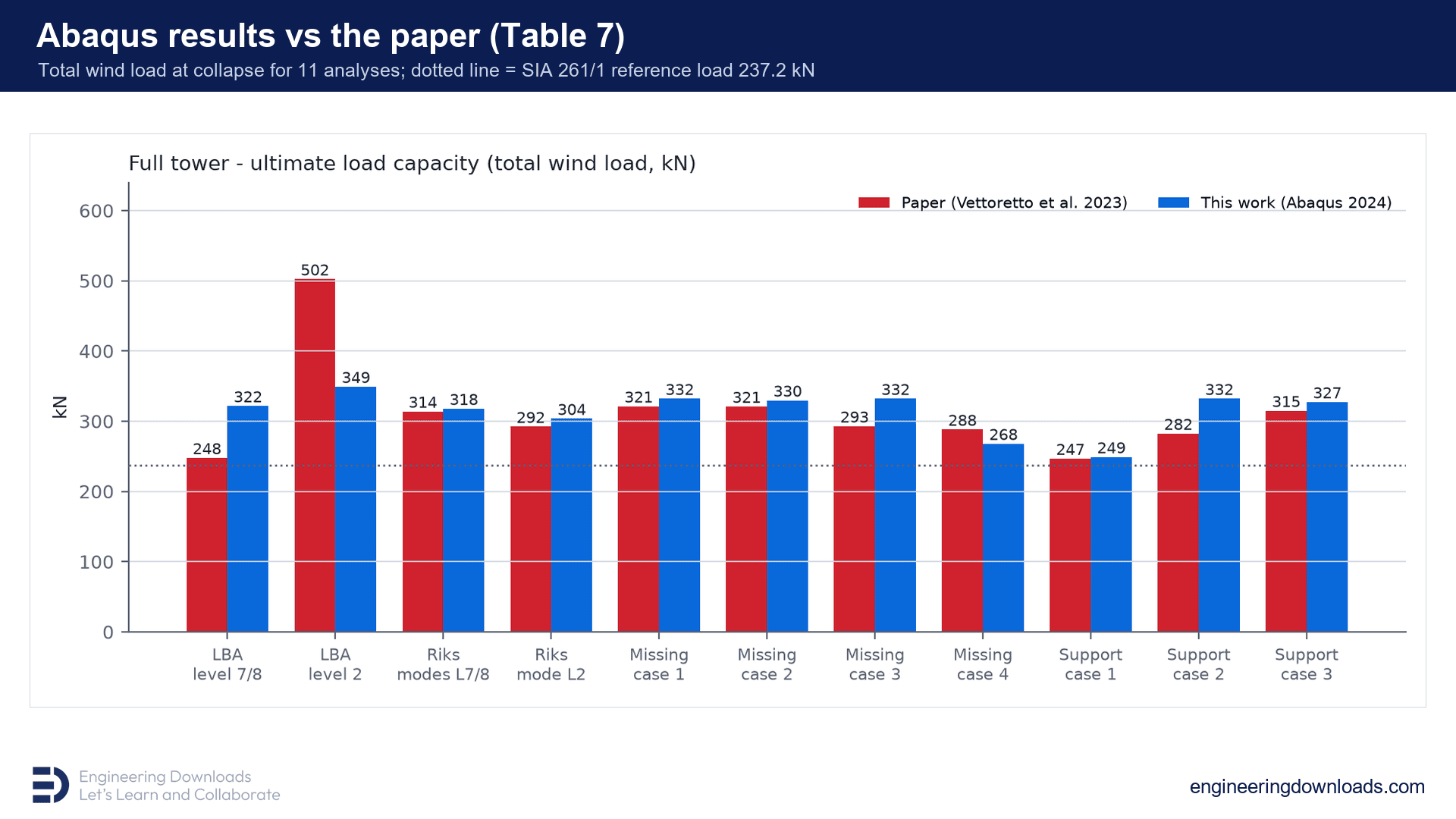
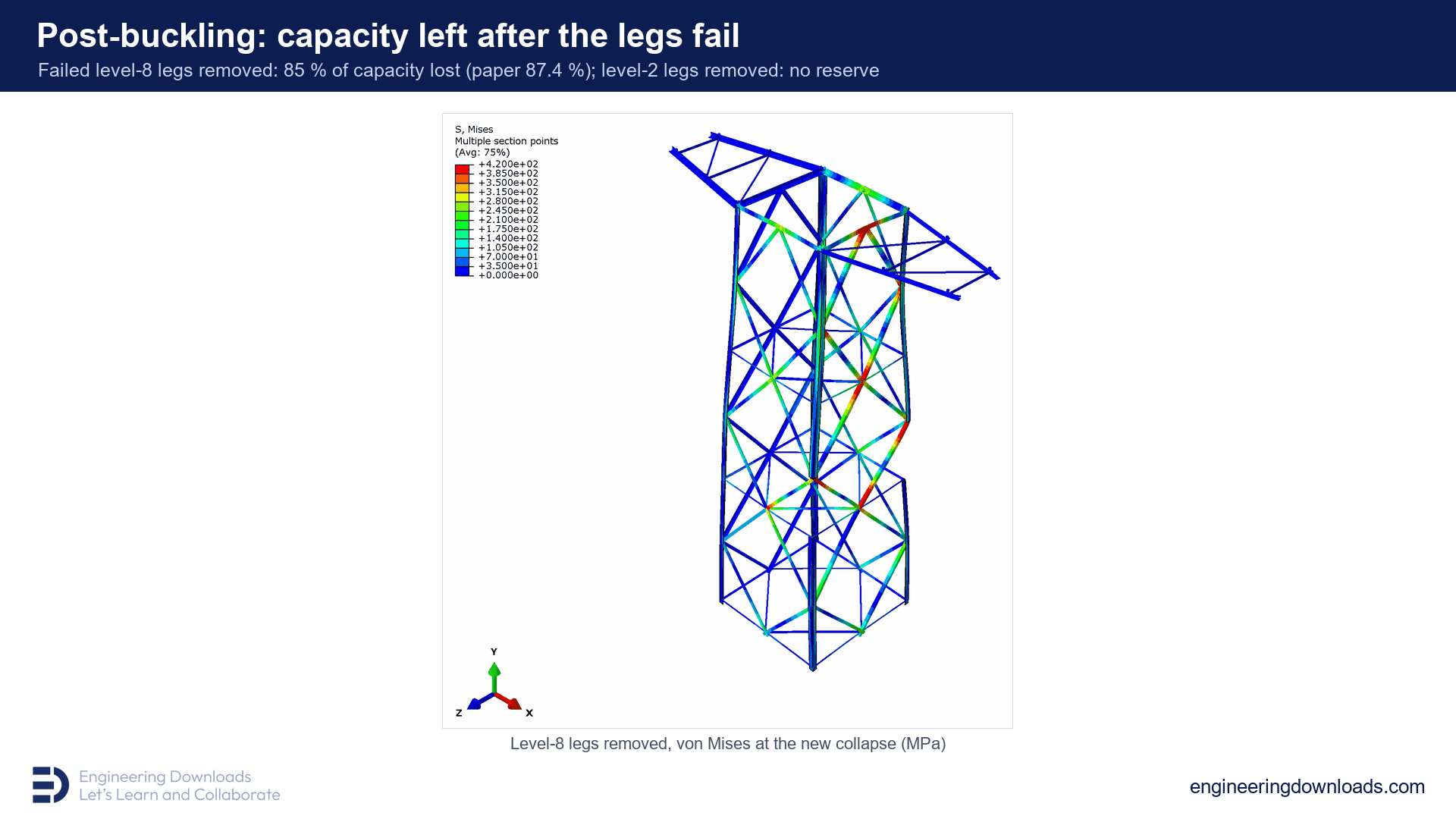
The paper's main result is reproduced: with buckling-mode imperfections the tower collapses at 317.8 kN (paper 313.9 kN) and at 303.6 kN with the level-2 imperfection (paper 292.2 kN), by local buckling of the compressed leeward legs at level 7/8 and level 2, the places where the real towers broke. Removing the failed level-8 legs costs 85 % of the capacity (paper 87.4 %) and removing the level-2 legs leaves practically nothing, as in the paper. Missing secondary members change the capacity by -7 to +13 %.
Support settlement, which the paper calls the most harmful imperfection, is reproduced for the worst case: moving one leg as in the paper's Fig. 24 gives 249.1 kN (paper 246.8 kN) with failure at level 2, and case 3 gives 327.3 kN (paper 314.9 kN) with failure at level 7, both as in the paper; case 2 shows no reduction here (paper -10 %).
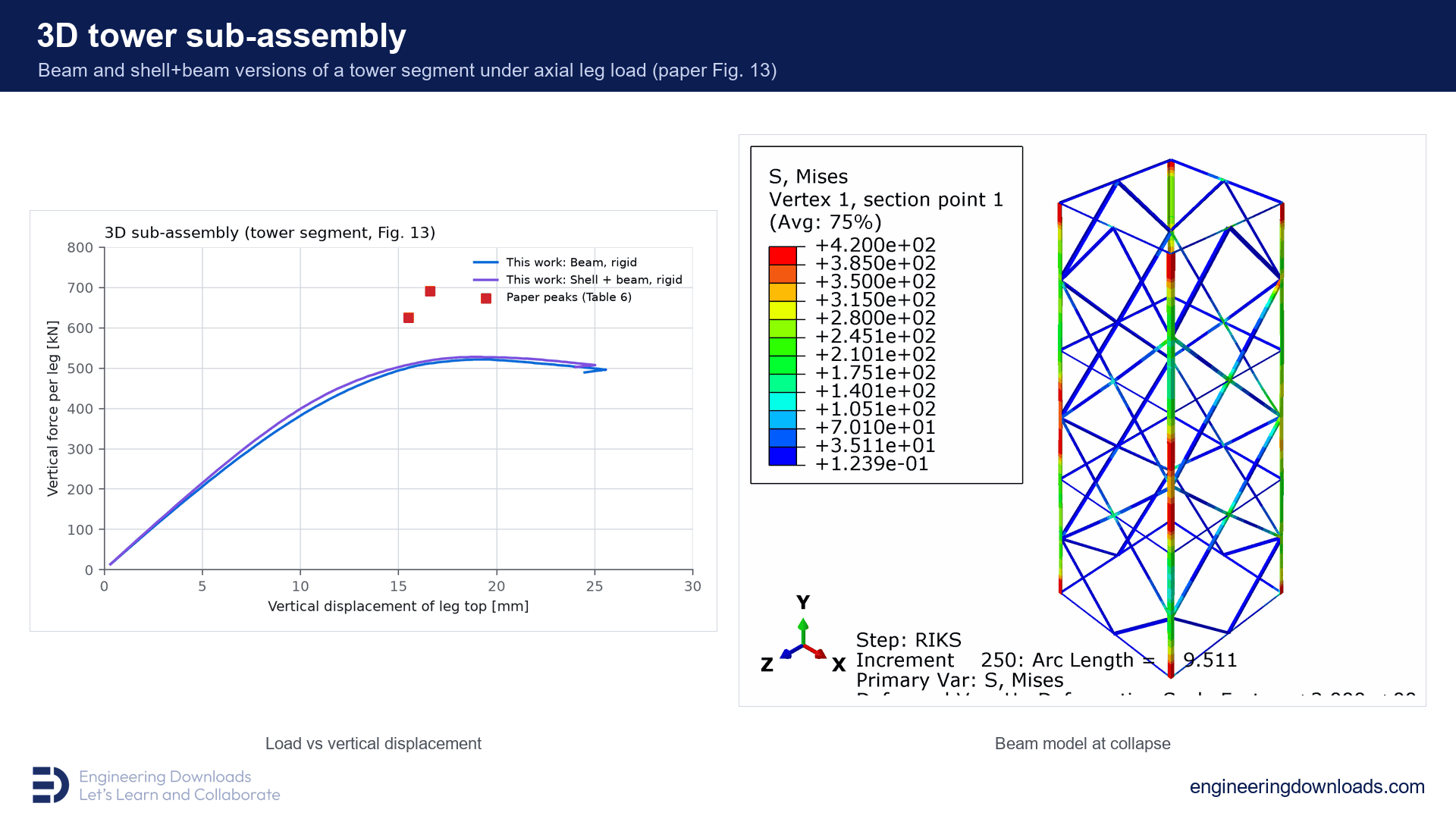
Be aware of the gaps. The paper gives no dimensioned drawing of the tower, so the geometry was rebuilt from its figures; the linear buckling loads differ by about 30 % because of that, while the nonlinear collapse loads are far less sensitive. The brace model is 10 % below the test (safe side) and the 3D sub-assembly 17 to 24 % below the paper. Where the paper leaves an input open (the settlement length L, its axis directions) the report states the reading used and why.
Transmission-line and tower engineers who check lattice towers beyond linear design, FEA engineers who want a working Riks collapse model with eigenmode imperfections and shell-beam coupling in Abaqus, and students who want to see a published tower-failure study rebuilt and checked number by number.
Which paper does this package replicate? Vettoretto, Li and Affolter, Evaluation of the Ultimate Collapse Load of a High-Voltage Transmission Tower under Excessive Wind Loads, Buildings 2023, 13, 513 (open access), on the towers that collapsed at Albula Pass, Switzerland, in October 2018. The paper is cited, not bundled.
How close are the results to the paper? The full-tower Riks collapse load is 317.8 kN against 313.9 kN with the level-7/8 imperfection and 303.6 kN against 292.2 kN with the level-2 imperfection. The capacity lost after the level-8 legs fail is 85 % against 87.4 %. Settlement case 1 gives 249.1 kN against 246.8 kN. Missing members agree within -7 to +13 %. The linear buckling loads differ by about 30 %, the brace is 10 % below the test and settlement case 2 is not reproduced.
Is the tower geometry the real Albula tower? The paper does not publish a dimensioned drawing. The geometry was reconstructed from the paper's figures: level heights from the wind-load steps, widths from the sub-assembly and the photographs, member sizes from the figure legend. The report lists every assumption. The collapse loads match closely, but this is a replication on a reconstructed tower, not the authors' own model file.
Why are the legs shells and the braces beams? As in the paper, the legs are where the tower fails by local and flexural buckling of the angle, which beam elements cannot show. The legs are S4R shell angles; the many braces are B31 beams with eccentric L-sections; each joint couples the shell leg to the brace ends.
How is the support settlement modelled? As in the paper's Fig. 24: one leg (case 1) or two adjacent legs (cases 2 and 3) are moved by L/706.5 in the drawn directions before the wind is applied, with all supports fixed in rotation. The paper does not define L or which horizontal axis is the wind direction; L is taken as the base width (9.0 mm) and the axis reading that reproduces the paper's failure levels is used. Case 1 gives 249.1 kN against 246.8 kN and case 3 327.3 kN against 314.9 kN; case 2 shows no reduction here (paper 282.4 kN).
Are the images real Abaqus results? Yes. Every model and contour image is exported by Abaqus/CAE 2024 from the included models and their results; only a title bar, the logo and the web address are added. Charts are drawn from the same solver output, with the paper's values as reference.
Which Abaqus version do I need? Abaqus/CAE and Abaqus/Standard 2024 or newer for the CAE files; the INP files also run in older releases. ODB files are not included. The full-tower Riks models have about 55,000 nodes and take one to several hours on 6 cores; the brace and sub-assembly models run in minutes.
What if the package is not what I expected? Write to us. Engineering Downloads refunds clients who are not satisfied with a delivered product.
Need more than the files?
There are two ways we can help. Book a one hour online consultation if you want to talk a problem through with a CAE engineer, using the checkbox in the order box. Order a project if you need a full simulation built for you, delivered to an agreed scope, price and deadline under a written contract.
We work on FEA and CFD for engineers, researchers and companies. Order your project, or message us on WhatsApp for a quick reply.
Other packages engineers working on this topic also download.
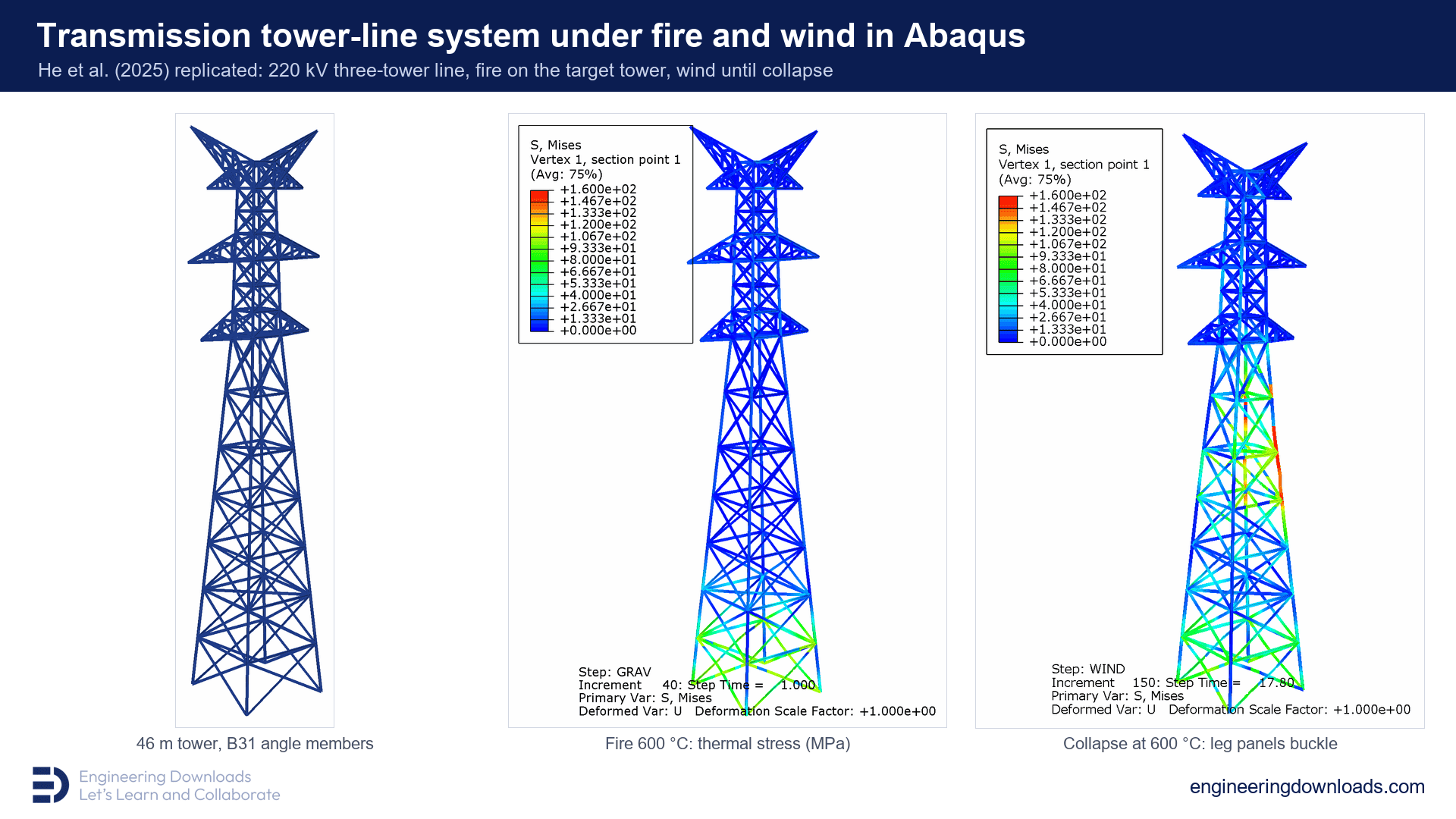 Transmission Tower-Line System under Fire and Wind in Abaqus: Modal and Collapse Analysis, after He et al. (2025)€169,00
 Abaqus Buckling Analysis of a Steel Braced Frame (Linear + Nonlinear)
 API 579 Example 5.6 in Abaqus: Local Thin Area Limit Load, Level 3 FFS€89,00
 Ring-Stiffened Cylinder Buckling in Abaqus: T and L Stiffening Rings vs Zhu, Dong & Gao (2015)€59,00
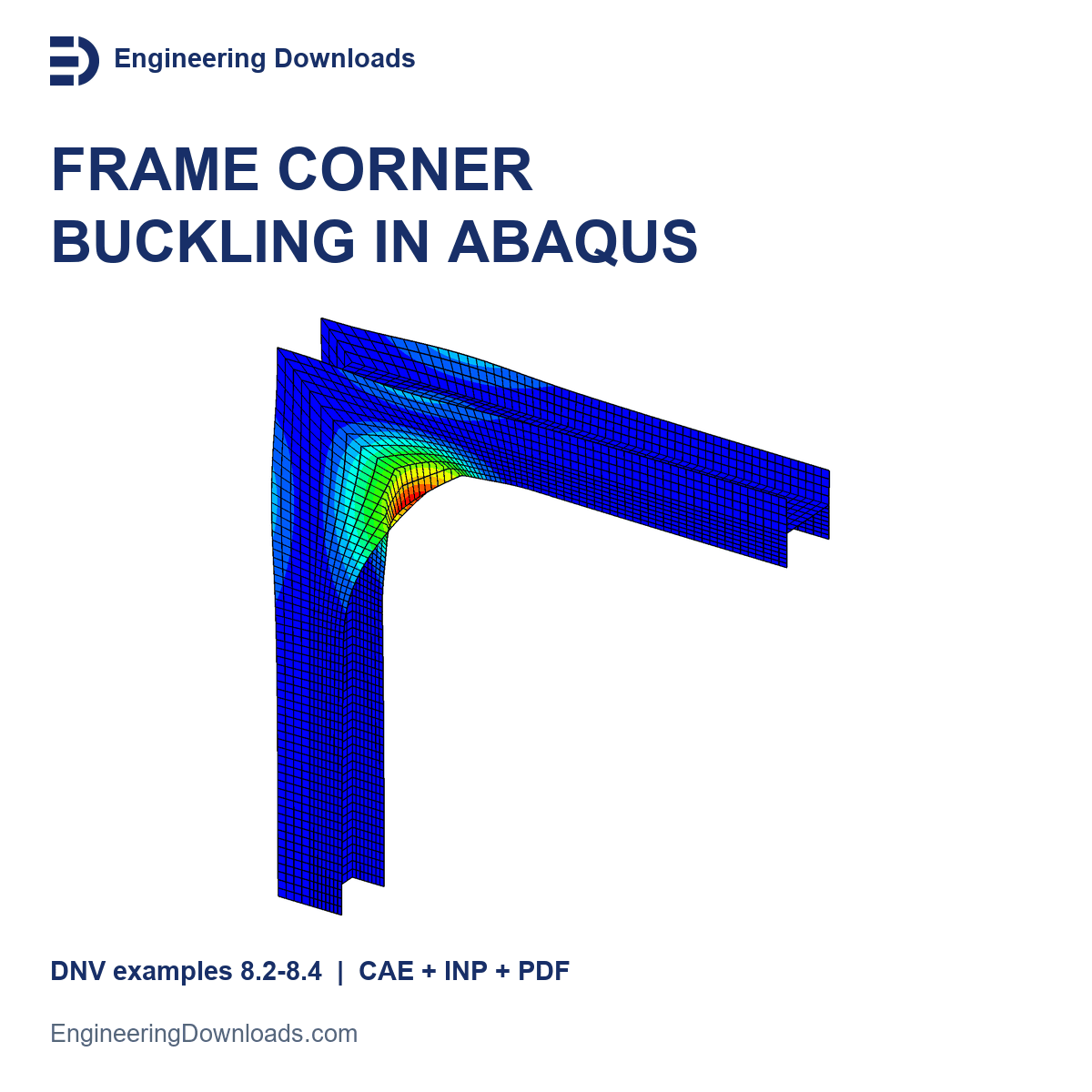 DNV-RP-C208 Examples 8.2-8.4 in Abaqus: Frame Corner Buckling, Resistance Check and Nonlinear Collapse€79,00
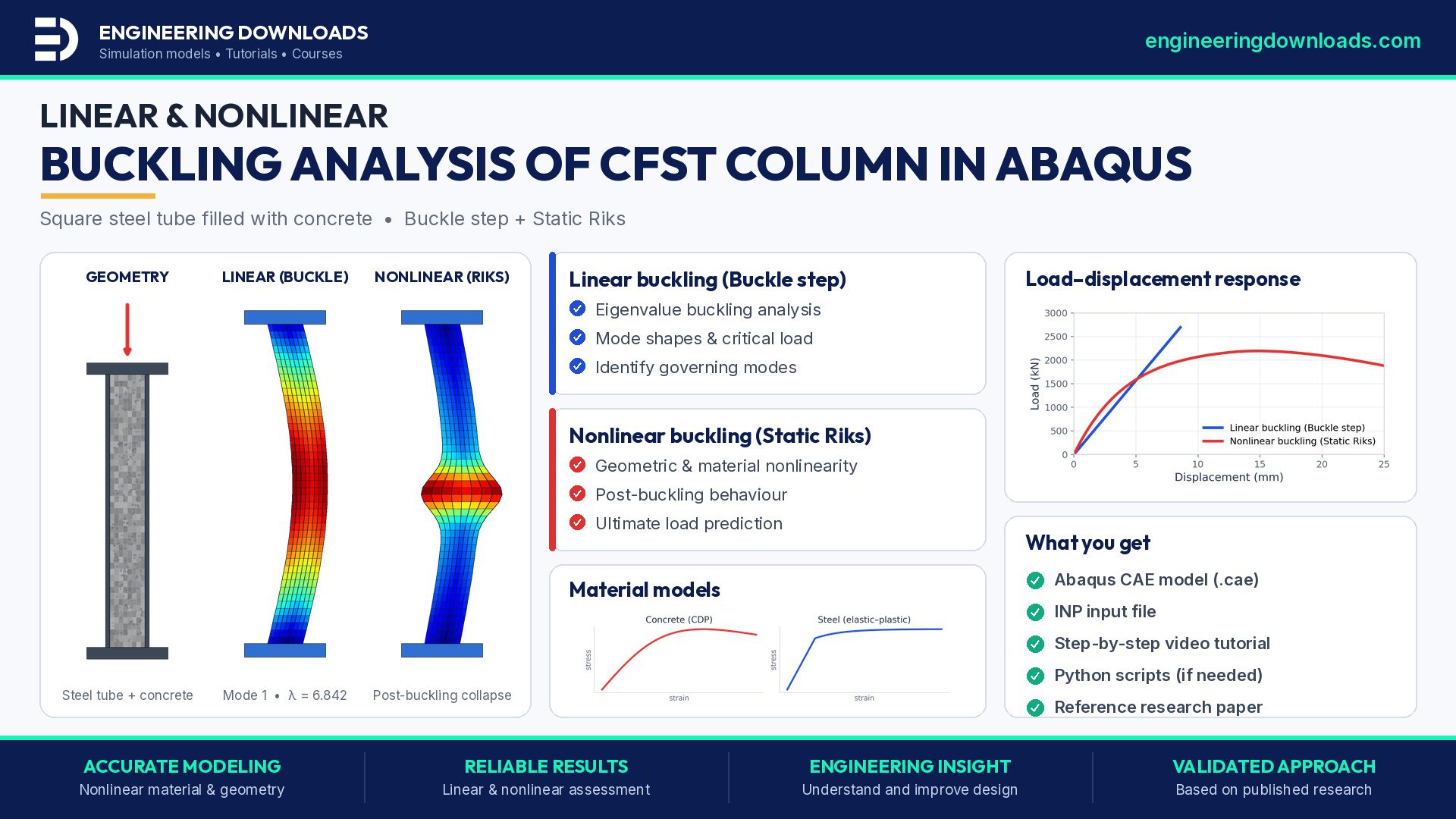 Buckling Analysis of a Concrete-Filled Steel Tube (CFST) Column Using Abaqus
 Tank Wind Buckling in ANSYS: EN 1993-1-6 MNA-LBA Model of a Cylindrical Oil Tank€129,00
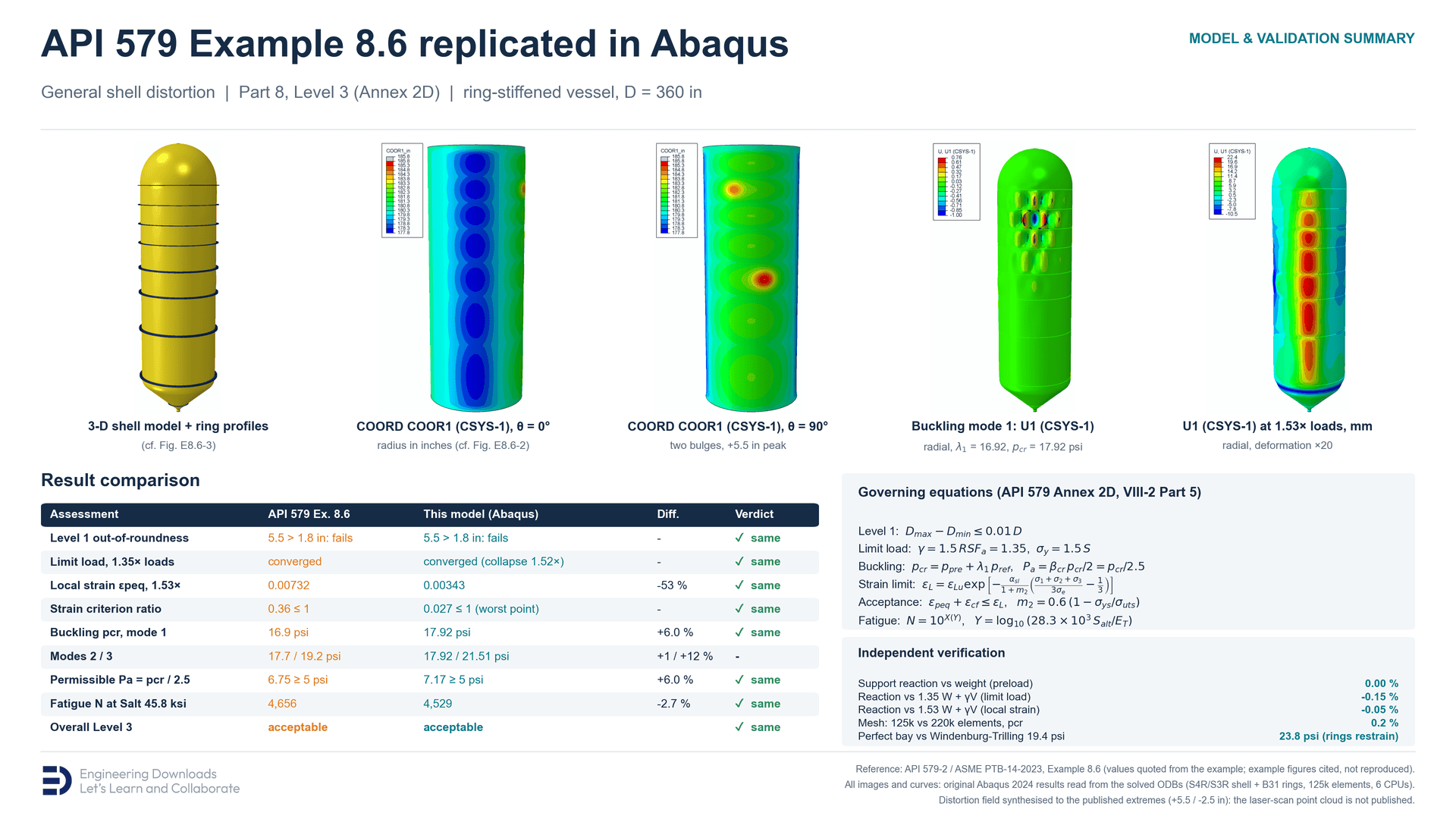 API 579 Example 8.6 in Abaqus: General Shell Distortion and Buckling, Level 3 FFS€129,00

Need a full custom project? See the options below.

€129,00

€179,00

€149,00

€119,00

€129,00

€149,00
See more
Want to receive push notifications for all major on-site activities?



