

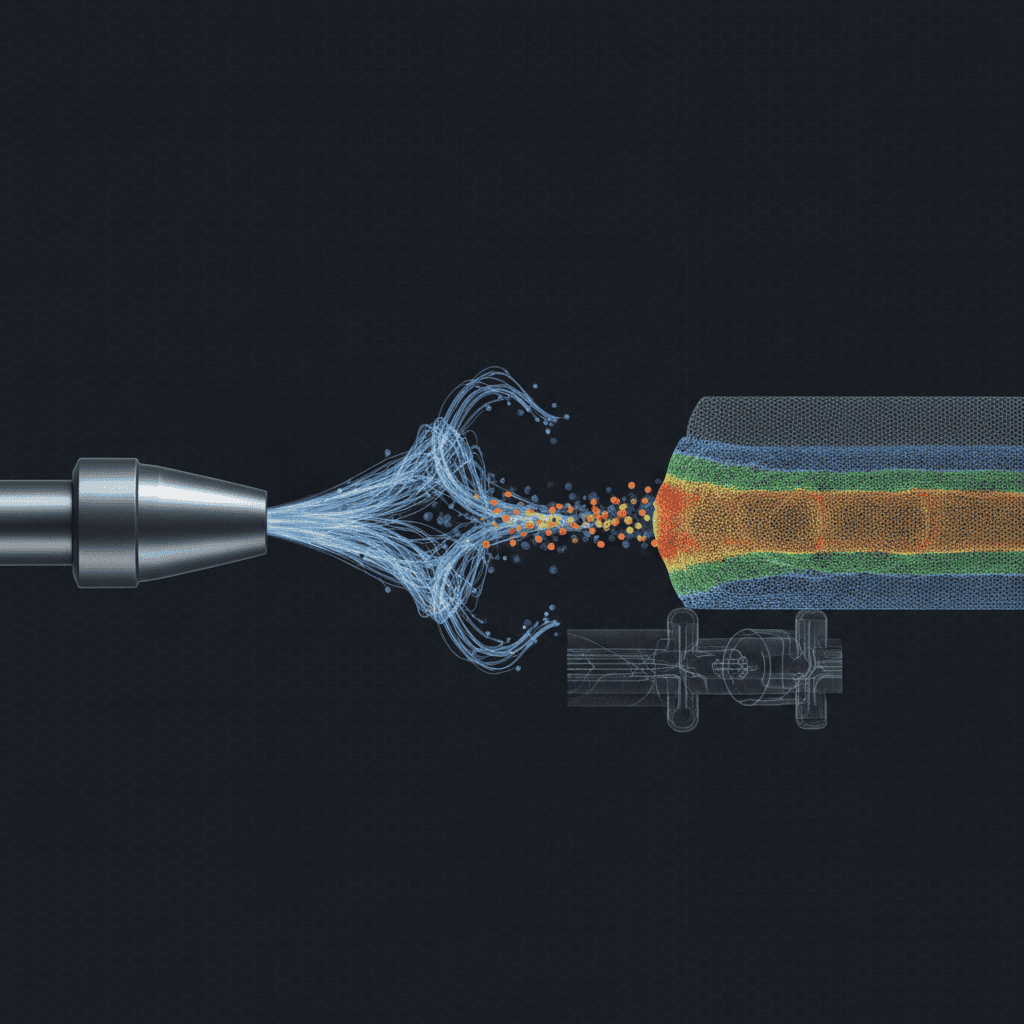
Got Cold Gas Spraying Bonding Problems? Let’s Fix Them Together.
Ever found yourself scratching your head, wondering why your cold gas spray coating isn’t sticking quite right? Or maybe you’re dealing with unexpected delamination, residual stresses, or just an inconsistent bond strength. These issues are super frustrating when you’re trying to design durable, high-performance components.
You’re not alone. Predicting how particles bond in cold gas spraying is a complex challenge. Luckily, simulation can be a game-changer, helping you understand what’s really happening at the micro-level without endless trial and error.
Understanding Cold Gas Spraying and Its Critical Bonding
What Exactly is Cold Gas Spraying?
Cold gas spraying, often called cold spray, is a really cool coating technology. Instead of melting material like in thermal sprays, it uses a high-velocity stream of gas to accelerate powdered particles to supersonic speeds. When these solid particles hit a substrate, they deform plastically and bond to the surface and to each other, forming a dense coating. Think of it like a microscopic high-speed collision that welds materials together without melting them.
Why Does Cold Spray Bonding Matter So Much?
The whole point of cold spray is to create strong, dense, and pure coatings. The quality of the bond – how well the particles stick to the substrate and to each other – is absolutely critical. A good bond means your coating will resist wear, corrosion, and fatigue. A weak bond, though, can lead to premature failure, peeling, or cracking, making your expensive component useless. This is why accurately predicting and controlling the bonding mechanism is so important in engineering applications.
When Do Engineers Need to Simulate Cold Gas Spraying Bonding?
You’ll typically reach for cold gas spraying bonding simulation when you’re:
- Developing new materials: Trying out new powder alloys or substrate combinations and need to predict their adhesion behavior.
- Optimizing process parameters: Adjusting gas temperature, pressure, particle velocity, or standoff distance to achieve the best bond strength.
- Troubleshooting defects: Investigating why a coating is failing, such as delamination or cracking, and looking for root causes related to bonding.
- Designing critical components: Ensuring coatings on aerospace, automotive, or biomedical parts meet strict performance and safety standards.
- Reducing physical experiments: Cutting down on costly and time-consuming experimental trials by using simulation to narrow down optimal conditions.
Essentially, anytime you need to understand or improve the adhesion, integrity, and performance of a cold spray coating, a detailed simulation can save you a lot of headaches and resources.
Your Step-by-Step Guide to Simulating Cold Spray Bonding
Simulating cold gas spraying bonding isn’t trivial, but breaking it down into manageable steps makes it much clearer. Here’s how a senior engineer might walk you through it:
1. Define Your Simulation Objectives and Scope
Before you even open your simulation software, think about what you want to learn. Are you interested in a single particle impact, or the buildup of multiple layers? Are you focusing on inter-particle bonding or substrate adhesion? What material combination are you using? Clearly defining your goal helps simplify the model and keeps you on track. For instance, if you’re exploring the critical velocity for a specific material, a single particle impact model is a great starting point.
2. Select the Right Material Models
This is crucial. Cold spray involves high strain rates and large plastic deformations. So, simple linear elastic material models won’t cut it. You’ll likely need advanced constitutive models like Johnson-Cook or isotropic/kinematic hardening models that capture strain rate sensitivity and thermal softening. Make sure you have accurate material properties for both your particles and your substrate, especially their yield strength, ultimate tensile strength, and ductility at relevant temperatures and strain rates.
3. Model the Particle Impact
The core of cold spray bonding is the particle’s impact. You’ll typically model individual particles as discrete elements or using mesh-based approaches (like Lagrangian particles in Abaqus/ANSYS). The initial conditions for each particle – velocity, temperature, and angle – are derived from your gas dynamics simulation or experimental measurements. It’s often impractical to simulate *every* particle in a full coating, so you might focus on representative impacts or a smaller number of particles to understand the fundamental bonding mechanisms.
4. Define Contact and Friction
How the particle interacts with the substrate (or other particles) is key. You need to set up appropriate contact definitions in your software. This includes specifying friction models – often Coulomb friction – to account for the sliding and shearing that occurs during impact. Don’t forget to consider surface roughness and potential oxide layers, as these can significantly influence initial contact and bonding efficiency.
5. Incorporate Adhesion/Bonding Criteria
This is where the ‘bonding’ part comes in. Since cold spray is a solid-state process, bonding happens due to intense plastic deformation, intimate contact, and mechanical interlocking. Simulation tools don’t inherently ‘know’ if a bond forms. You’ll often use criteria based on:
- Critical velocity: Particles must exceed a certain impact velocity to bond.
- Plastic strain: Sufficient plastic deformation at the interface is needed.
- Temperature: Localized temperature rise can also play a role, especially for harder materials.
- Shear instability: Sometimes, the formation of a bond is linked to shear deformation and jetting at the interface.
You might implement these criteria as user-defined subroutines (VUMAT/UMAT in Abaqus, user-defined functions in ANSYS) or by post-processing results to evaluate if bonding conditions were met.
6. Post-Processing and Validation
Once your simulation runs, you’ll analyze results like plastic deformation, stress states, temperature distribution, and contact pressure. Visualizing the deformed particle and substrate helps understand the bonding mechanism. Crucially, you must validate your simulation results against experimental data. Compare predicted critical velocities, bond strengths, or coating microstructure with what you observe in the lab. Iterative refinement is often necessary to get your simulation to accurately reflect reality.
Here’s a simplified breakdown of the key simulation stages:
| Simulation Stage | Key Actions | Typical Challenges |
|---|---|---|
| Pre-processing | Define geometry, mesh, material properties, initial conditions (particle velocity, temperature). | Accurate material data, complex geometries, mesh density. |
| Analysis Setup | Specify contact definitions, friction models, and any adhesion criteria (e.g., critical plastic strain). | Choosing appropriate contact algorithms, defining realistic friction, implementing bonding logic. |
| Solver Execution | Run the finite element or discrete element solver. | Computational cost for large models, convergence issues, numerical stability. |
| Post-processing | Visualize deformation, stress/strain fields, temperature. Evaluate bonding criteria. | Interpreting complex results, extracting meaningful data, comparing with experiments. |
Common Pitfalls in Cold Spray Bonding Simulation (and How to Dodge Them!)
Cold gas spraying bonding simulation is powerful, but it’s also easy to trip up. Here are some common mistakes and how you can avoid them:
Mistake 1: Using Oversimplified Material Models
The problem: You’re tempted to use simple elastic-plastic models without considering strain rate or temperature effects. Cold spray impacts happen at super high speeds, generating significant heat and causing materials to behave differently than they do in a slow tensile test.
How to avoid it: Always opt for advanced constitutive models like Johnson-Cook or similar rate-dependent plasticity models. Invest time in finding or calibrating accurate material parameters that reflect high strain rates and varying temperatures. Experimental data at relevant strain rates (e.g., from Split Hopkinson Pressure Bar tests) is gold here.
Mistake 2: Poor Contact Definition
The problem: Incorrectly setting up contact between particles and the substrate, or between particles themselves. This can lead to non-physical penetration, interpenetration, or failure to detect contact, making your bonding predictions meaningless.
How to avoid it: Take your time with contact definitions. Use appropriate contact algorithms (e.g., explicit contact in Abaqus/LS-DYNA). Ensure proper contact pairs, master/slave assignments, and normal/tangential behavior. Don’t forget about friction – it’s a critical component of shear deformation during impact. Sensitivity studies on friction coefficients can be very insightful.
Mistake 3: Insufficient Mesh Resolution
The problem: Using a coarse mesh at the impact interface. The bonding mechanism is localized and involves intense deformation over a very small area. A coarse mesh simply can’t capture these critical details, leading to inaccurate stress, strain, and temperature predictions.
How to avoid it: Always perform a mesh sensitivity study. Start with a finer mesh in the region of interest (the impact zone) and gradually refine it until your results (like maximum plastic strain or contact pressure) no longer change significantly. Adaptive meshing techniques can also be very useful for handling large deformations efficiently.
Mistake 4: Ignoring Thermal Effects During Impact
The problem: Assuming the process is purely mechanical and neglecting the localized temperature rise. While called ‘cold’ spray, the kinetic energy of the particles converts into heat upon impact, especially in the deformation zone. This localized heating can significantly soften the material and affect bonding.
How to avoid it: Perform coupled thermo-mechanical simulations. This means solving for both mechanical deformation and temperature changes simultaneously. Ensure your material models account for thermal softening. Even if the bulk temperature doesn’t rise much, the interface can experience flash heating, which is important for bond formation.
Mistake 5: Lack of Validation
The problem: Running a simulation and taking the results as gospel without comparing them to any real-world data. Simulations are models of reality; they need to be checked.
How to avoid it: Always, always, always validate your simulation against experimental results. This could be comparing predicted critical velocities, bond strengths, hardness profiles, or even the morphology of the splat (the deformed particle). If you don’t have your own experimental data, look for published literature. Iteratively refine your models and parameters based on validation feedback until your simulation can reliably predict physical phenomena. This step builds confidence in your models and makes your cold gas spraying bonding simulation truly useful.
What You Get in This Package
Understanding the theory behind cold gas spraying bonding simulation is one thing, but getting a simulation up and running can be a whole other challenge. That’s why ready-to-use simulation packages are so valuable. When you get a solution like the Cold Gas Spraying Bonding Simulation package, you’re not just getting software; you’re getting a head start.
Typically, a comprehensive package includes:
- Ready-to-run Abaqus/ANSYS files: Forget spending hours setting up complex models from scratch. These are pre-configured files that you can load directly into your preferred simulation software (like Abaqus, ANSYS, or other common FEA platforms). They often include pre-defined geometries, material properties, and analysis steps.
- Step-by-step documentation: Clear, concise instructions that walk you through how to use the simulation. This isn’t just a manual; it’s a guide designed for engineers, explaining each parameter and its significance. It helps you understand the underlying physics and numerical setup without needing to be a simulation guru.
- Example models for different scenarios: Need to see how different particle sizes or velocities affect bonding? The package often includes various example models, demonstrating different material combinations or impact conditions. These are excellent for learning and adapting to your specific needs.
- Validation cases: To build your confidence, these packages usually come with validation cases where the simulation results have been compared against experimental data or well-established theoretical models. This shows you that the model is reliable and accurate.
- Pre- and post-processing scripts: Many simulations benefit from custom scripts for setting up inputs or interpreting outputs. These can automate repetitive tasks, making your workflow smoother and more efficient.
- Support for common challenges: The documentation often anticipates common questions or issues you might encounter, providing troubleshooting tips and best practices.
Using a pre-built package means you can jump straight into analyzing and optimizing your cold spray process, saving precious time and resources you’d otherwise spend on model development and debugging.
Wrapping It Up & Your Burning Questions Answered
Cold gas spraying bonding simulation might seem daunting at first, but with a structured approach and an understanding of common pitfalls, you can accurately predict and optimize your coating processes. It’s about using the right material models, defining contact carefully, ensuring mesh quality, considering thermal effects, and always validating your work. By mastering these aspects, you can significantly improve coating adhesion, reduce defects, and innovate with confidence.
Remember, simulation is a powerful tool to complement your experimental work, not replace it. It helps you gain deeper insights and make smarter engineering decisions faster.
Frequently Asked Questions About Cold Gas Spraying Bonding Simulation
- Question 1: What’s the main challenge in simulating cold spray bonding?
- Answer: The biggest challenge is accurately capturing the material behavior at extremely high strain rates and localized temperatures, along with precisely defining the complex contact mechanics and adhesion criteria at the particle-substrate interface. It requires advanced material models and careful numerical setup.
- Question 2: Can I simulate the entire coating buildup process?
- Answer: Simulating the entire coating buildup with full detail for every particle is computationally very expensive, often impractical for complex structures. Engineers typically simulate individual particle impacts, or small collections of particles, to understand fundamental bonding mechanisms and then extrapolate these findings to the larger coating. Multi-layer buildup is sometimes done with simplified models or by focusing on statistical approaches.
- Question 3: What software is best for cold gas spraying bonding simulation?
- Answer: Commercial finite element analysis (FEA) software like Abaqus/Explicit, ANSYS Autodyn, or LS-DYNA are commonly used due to their robust capabilities for handling non-linear dynamics, large deformations, and advanced material models. Open-source options like OpenFOAM can also be adapted, especially for the gas dynamics part, often coupled with FEA for the particle impact.
- Question 4: How important is friction in cold spray bonding simulations?
- Answer: Friction is extremely important! During impact, particles not only compress but also slide and shear against the substrate or other particles. This shear deformation contributes significantly to the plastic work and localized heating, which are crucial for forming metallurgical bonds. Ignoring or misrepresenting friction can lead to inaccurate predictions of bond strength and interface characteristics.
- Question 5: What is ‘critical velocity’ and why is it important in simulation?
- Answer: Critical velocity is the minimum impact velocity a particle must achieve to form a metallurgical bond with the substrate or other particles. Below this velocity, particles will rebound without bonding. In simulation, predicting the critical velocity for different material pairs and conditions is vital for optimizing process parameters and ensuring high-quality coatings. It’s often determined by analyzing plastic deformation and local temperature rise at the interface.
For a deeper dive into the fundamental mechanisms of cold spray bonding, you might find comprehensive reviews helpful. For example, consider reviewing articles that discuss the various physical phenomena involved in solid-state bonding during high-velocity impact. This ScienceDirect review on cold gas dynamic spray bonding mechanisms provides excellent insights into the current understanding and challenges.









