New Blogs

Abaqus Integration Point vs Nodal Stress: Why Peaks Differ
Compare integration-point, element-nodal and unique-nodal stress in Abaqus, and check whether a contour peak depends on extrapolation, averaging or mesh size.
Abaqus Linear Perturbation vs General Step: What Actually Changes

You run a frequency extraction after a static step and the frequencies come out the same whether or not the part had yielded. You run a static linear perturbation step and the reaction force is a fraction of what you

Harmonic Response Analysis in ANSYS Workbench: A Practical Guide
How to set up harmonic response analysis in ANSYS Workbench: modal link, frequency range, solution method, damping, loads and results, plus the common mistakes.
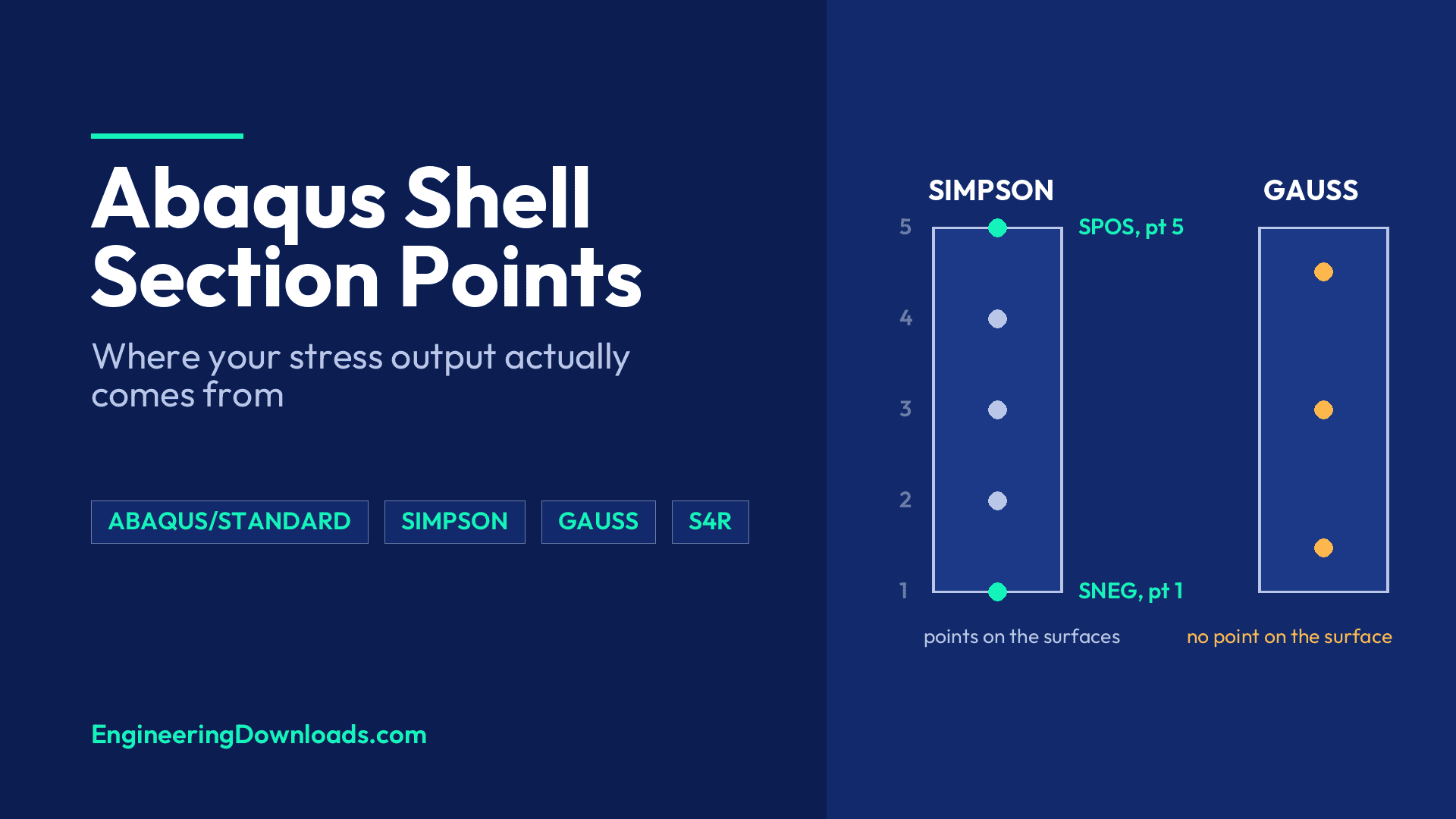
Abaqus Shell Section Points: Where Your Stress Output Comes From
What Abaqus shell section points are, the defaults you never chose, Simpson vs Gauss, SNEG and SPOS, and how to request the output location you actually need.
Abaqus NLGEOM On or Off: When Geometric Nonlinearity Changes Your Answer
What the Abaqus NLGEOM switch really does, why Standard and Explicit have opposite defaults, and how to decide which of your two answers to trust.

Featured Blogs

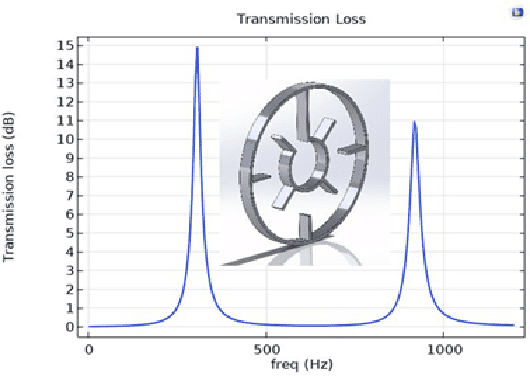
Acoustic metamaterials for advanced sound control and noise reduction
Acoustic Metamaterials and Metasurfaces: Shaping the Future of Sound Control

Intro Acoustic metamaterials and acoustic meta surfaces are changing how we control sound waves. These specially designed structures go beyond the limits of traditional soundproofing. They offer new ways to control sound, such as reducing noise over a wide frequency

OpenSees software simulation of nonlinear seismic response in a reinforced concrete frame
OpenSees for Structural Analysis

OpenSees (Open System for Earthquake Engineering Simulation) is an open-source software framework developed primarily for nonlinear structural and geotechnical analysis, with a strong emphasis on earthquake engineering. Developed at UC Berkeley’s Pacific Earthquake Engineering Research Center (PEER), it provides a
Abaqus or ANSYS : Which one is better?
Which one is better? Abaqus or ANSYS?

As an engineer, we need to build a model to simulate a process so we can save many and reduce processing time. For this aim, we need to use conventional solvers such as Abaqus, ANSYS, Solidwork (I know, Solidwork solver

See more

Latest Blogs

Abaqus Integration Point vs Nodal Stress: Why Peaks Differ
Compare integration-point, element-nodal and unique-nodal stress in Abaqus, and check whether a contour peak depends on extrapolation, averaging or mesh size.
Abaqus Linear Perturbation vs General Step: What Actually Changes

You run a frequency extraction after a static step and the frequencies come out the same whether or not the part had yielded. You run a static linear perturbation step and the reaction force is a fraction of what you

Harmonic Response Analysis in ANSYS Workbench: A Practical Guide
How to set up harmonic response analysis in ANSYS Workbench: modal link, frequency range, solution method, damping, loads and results, plus the common mistakes.

See more

All articles

Illustration of thermal expansion causing material stress
Thermal Expansion: Holding bad boys in their prison

Confession Time: I sometimes totally underestimate thermal expansion it looks so innocent on paper! 🤓 Let’s break it down: We’ve all seen that classic formula strain = ΔT × α, where α (alpha) is the material’s “how much do I

History of FEA COMPUTATION TIME
History of FEA Computation Time

In the past decade, processor performance has increased significantly, leading to a huge jump in computational speed. For example, the first computers, such as the ENIAC, could perform 385 multiplications per second, whereas modern processors can perform more than 11

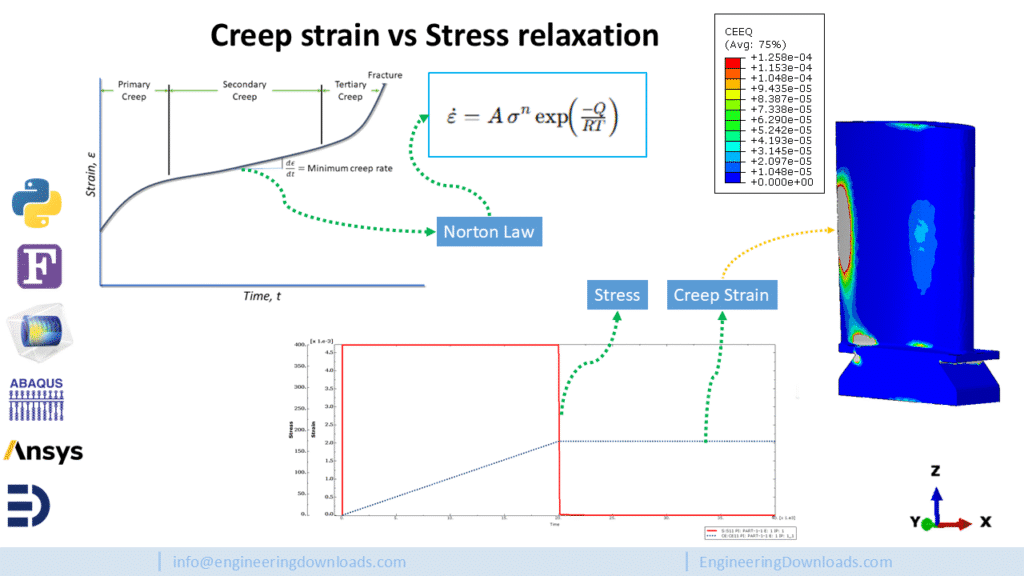
Creep strain vs stress relaxation
Creep Strain vs Stress Relaxation, A practical guide for CAE users

Description Learn what creep is, how temperature and stress control creep life, and which creep models CAE tools (ANSYS, COMSOL, Abaqus and others) use. Simple equations, practical CAE workflows, ASME / code context, and industrial project examples (boilers, pressure vessels,

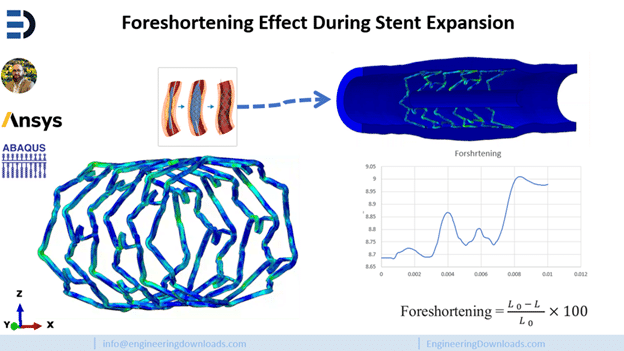
Finite element simulation of stent foreshortening in a coronary artery
Foreshortening During Stent Expansion: Why It Matters in Cardiovascular Simulations

Intro When placing a stent in a coronary artery, we expect it to hold its shape and position—but did you know that stent length can shorten by up to 10% during expansion? This change, known as foreshortening, is one of

Comparison of hyperelastic materials and linear elastic models
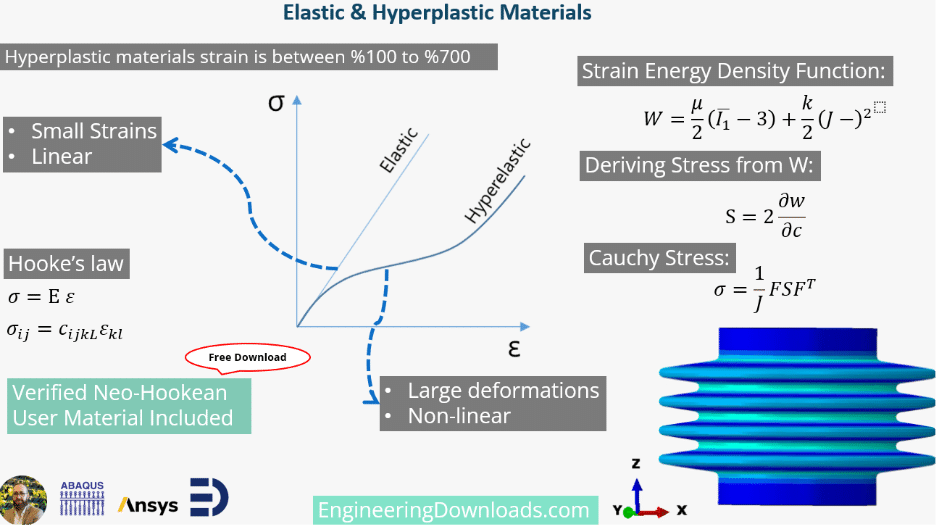
Hyper Elastic vs Linear Elastic Materials: Key Differences & Applications

Intro When designing materials for engineering applications, understanding their stress-strain behavior is critical. Two fundamental categories dominate this space: linear elastic and hyperelastic materials. Here’s what you need to know and why it matters. Linear Elastic Materials: Simplicity at Small

My FEM Software Journey: The Good, The Bad & The “Aha!” Moments

I’ve been quiet for a while, but for good reason—more on that later. Today, I’m sharing the messy, challenging, and surprisingly fulfilling path I took to learn commercial FEM software. If you’re navigating the same struggles in your FEM software

Linking Abaqus and FORTRAN: A Step-by-Step Guide

In this tutorial, we aim to explain the first step of subroutine programming in the Abaqus software, which is linking the Abaqus software and FORTRAN compiler. You can watch the video tutorial for additional tips, more detailed explanations, and a

Goldak Heat Input Model in Abaqus
Goldak Heat Input Model for Welding and Additive Manufacturing

Introduction In the present blog post, we explore the complexities of simulating Additive Manufacturing (AM) through Abaqus, under the guidance of Saman Hosseini. Specifically, our attention centers on incorporating the Goldak heat source model to conduct an in-depth examination of

Specialized Plasticity Models in Abaqus
Plastic behavior in ABAQUS-2: Specialized Plasticity Models

Introduction In our previous blog, we delved into the fascinating world of plastic behavior models, focusing on their application to metals and general materials. Now, get ready to take your understanding to the next level as we turn our attention

Plastic behavior in ABAQUS-1: Metals and General Materials

Different material behaviors The material library in Abaqus provides a wide range of options for modeling various engineering materials, such as metals, plastics, rubbers, foams, composites, granular soils, rocks, plain and reinforced concrete, and also different material behavior models including

fixing fortran compiler common errors
Troubleshooting Guide for Common Errors When Linking Abaqus with FORTRAN Compiler – Part 2

  Introduction Welcome back! In Part 1, we walked you through the initial steps of linking Abaqus with a FORTRAN compiler, tackling some of the most common errors you might encounter. But sometimes, the journey to a smooth integration involves

fixing Abaqus Fortran linking errors
Troubleshooting Guide for Common Errors When Linking Abaqus with FORTRAN Compiler – Part 1

    Introduction So, you’ve just installed Abaqus and a Fortran compiler, eager to dive into complex simulations and number-crunching. But wait! Something’s gone awry. Consequently, you’re hitting roadblocks, and error messages are popping up like dandelions in spring. Abaqus

See more