New Blogs

Abaqus Integration Point vs Nodal Stress: Why Peaks Differ
Compare integration-point, element-nodal and unique-nodal stress in Abaqus, and check whether a contour peak depends on extrapolation, averaging or mesh size.
Abaqus Linear Perturbation vs General Step: What Actually Changes

You run a frequency extraction after a static step and the frequencies come out the same whether or not the part had yielded. You run a static linear perturbation step and the reaction force is a fraction of what you

Harmonic Response Analysis in ANSYS Workbench: A Practical Guide
How to set up harmonic response analysis in ANSYS Workbench: modal link, frequency range, solution method, damping, loads and results, plus the common mistakes.
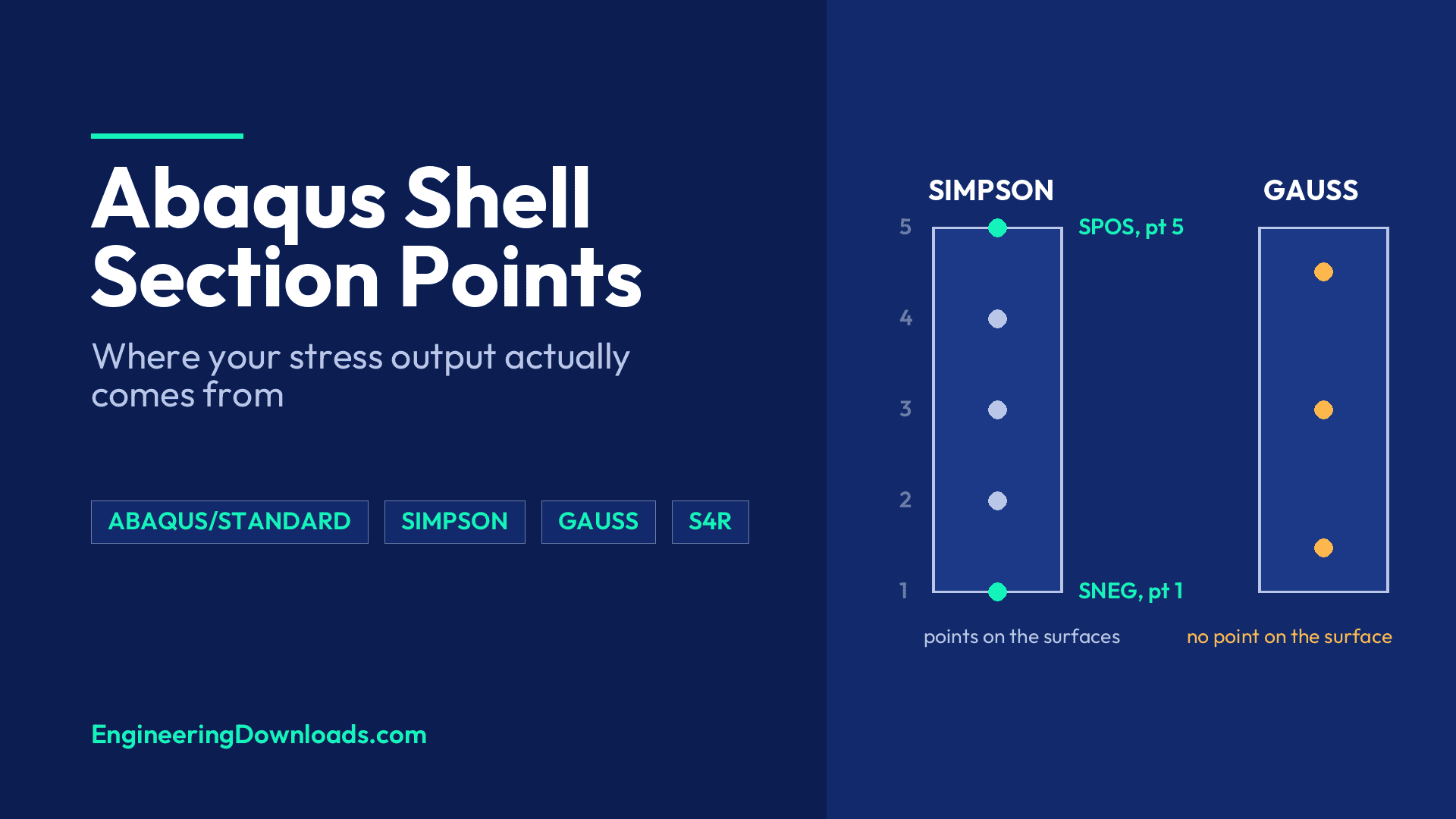
Abaqus Shell Section Points: Where Your Stress Output Comes From
What Abaqus shell section points are, the defaults you never chose, Simpson vs Gauss, SNEG and SPOS, and how to request the output location you actually need.
Abaqus NLGEOM On or Off: When Geometric Nonlinearity Changes Your Answer
What the Abaqus NLGEOM switch really does, why Standard and Explicit have opposite defaults, and how to decide which of your two answers to trust.

Featured Blogs

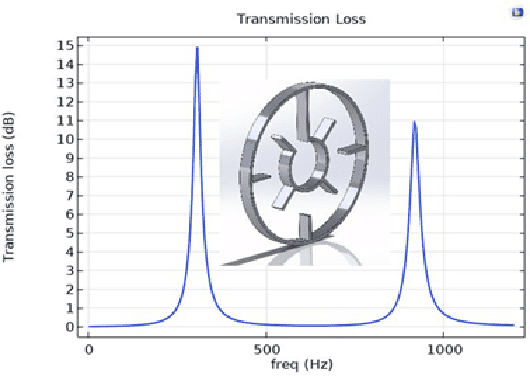
Acoustic metamaterials for advanced sound control and noise reduction
Acoustic Metamaterials and Metasurfaces: Shaping the Future of Sound Control

Intro Acoustic metamaterials and acoustic meta surfaces are changing how we control sound waves. These specially designed structures go beyond the limits of traditional soundproofing. They offer new ways to control sound, such as reducing noise over a wide frequency

OpenSees software simulation of nonlinear seismic response in a reinforced concrete frame
OpenSees for Structural Analysis

OpenSees (Open System for Earthquake Engineering Simulation) is an open-source software framework developed primarily for nonlinear structural and geotechnical analysis, with a strong emphasis on earthquake engineering. Developed at UC Berkeley’s Pacific Earthquake Engineering Research Center (PEER), it provides a
Abaqus or ANSYS : Which one is better?
Which one is better? Abaqus or ANSYS?

As an engineer, we need to build a model to simulate a process so we can save many and reduce processing time. For this aim, we need to use conventional solvers such as Abaqus, ANSYS, Solidwork (I know, Solidwork solver

See more

Latest Blogs

Abaqus Integration Point vs Nodal Stress: Why Peaks Differ
Compare integration-point, element-nodal and unique-nodal stress in Abaqus, and check whether a contour peak depends on extrapolation, averaging or mesh size.
Abaqus Linear Perturbation vs General Step: What Actually Changes

You run a frequency extraction after a static step and the frequencies come out the same whether or not the part had yielded. You run a static linear perturbation step and the reaction force is a fraction of what you

Harmonic Response Analysis in ANSYS Workbench: A Practical Guide
How to set up harmonic response analysis in ANSYS Workbench: modal link, frequency range, solution method, damping, loads and results, plus the common mistakes.

See more

All articles

Contact Mechanics
Contact Mechanics Explained: Theory and FEA Practice
Understand contact mechanics: Hertz theory, friction, contact pressure and how contact is modeled in FEA with penalty and Lagrange methods.
CAE Salary by Country
CAE Engineer Salary by Country: A Global Overview
How much do CAE and FEA engineers earn around the world? Compare typical salary ranges by country and see which skills push your pay higher.
pre-processing best practices
Pre-Processing Best Practices for Accurate CAE Results
Most simulation errors start in pre-processing. Learn best practices for geometry cleanup, meshing, materials, loads and boundary conditions.
Abaqus Contact
Abaqus Contact Modeling: A Practical Guide
Set up contact in Abaqus the right way: general vs surface-to-surface, master and slave choice, friction, overclosure and fixing convergence.
fea stress concentration
Stress Concentration in FEA: How to Find and Trust Hotspots
How to model stress concentration in FEA: Kt factors, mesh refinement, singularities vs real peaks, and how to use hotspot stresses in design.
J-Integral
J-Integral in Fracture Mechanics: Theory and FEA Calculation
What the J-integral is, when to use it instead of K, and how to calculate it in Abaqus or ANSYS with contour integrals and good crack-tip meshes.
Orthogonal Quality
Orthogonal Quality in CFD and FEA Meshes: A Practical Guide
What orthogonal quality means in ANSYS meshing, which values are acceptable, and how poor orthogonality affects CFD accuracy and convergence.
ADAMS Multibody Dynamics
ADAMS Multibody Dynamics: A Practical Guide for Engineers
Learn multibody dynamics with MSC ADAMS: joints, contacts, flexible bodies, co-simulation with FEA, and practical tips for accurate results.
Parametric Studies
Parametric Studies in Engineering Simulation: A Practical Guide
How to run parametric studies in FEA and CFD: choosing variables, design of experiments, automation with Python and reading the results.
Stress Intensity Factor
Stress Intensity Factor (K): Theory, Calculation and FEA
Understand the stress intensity factor: K formulas, modes I-III, fracture toughness, and how to calculate K in Abaqus or ANSYS for real cracks.
fatigue software
Fatigue Analysis Software: How to Choose the Right Tool
Compare fatigue analysis software options, from fe-safe to ANSYS and Abaqus workflows, and learn what matters when you pick a fatigue tool.
Courant Number
Courant Number (CFL) Explained: Time Step Stability in Simulation
What the Courant number is, why the CFL condition controls stability in CFD and explicit FEA, and how to choose a safe time step.

See more