New Blogs

Abaqus Integration Point vs Nodal Stress: Why Peaks Differ
Compare integration-point, element-nodal and unique-nodal stress in Abaqus, and check whether a contour peak depends on extrapolation, averaging or mesh size.
Abaqus Linear Perturbation vs General Step: What Actually Changes

You run a frequency extraction after a static step and the frequencies come out the same whether or not the part had yielded. You run a static linear perturbation step and the reaction force is a fraction of what you

Harmonic Response Analysis in ANSYS Workbench: A Practical Guide
How to set up harmonic response analysis in ANSYS Workbench: modal link, frequency range, solution method, damping, loads and results, plus the common mistakes.
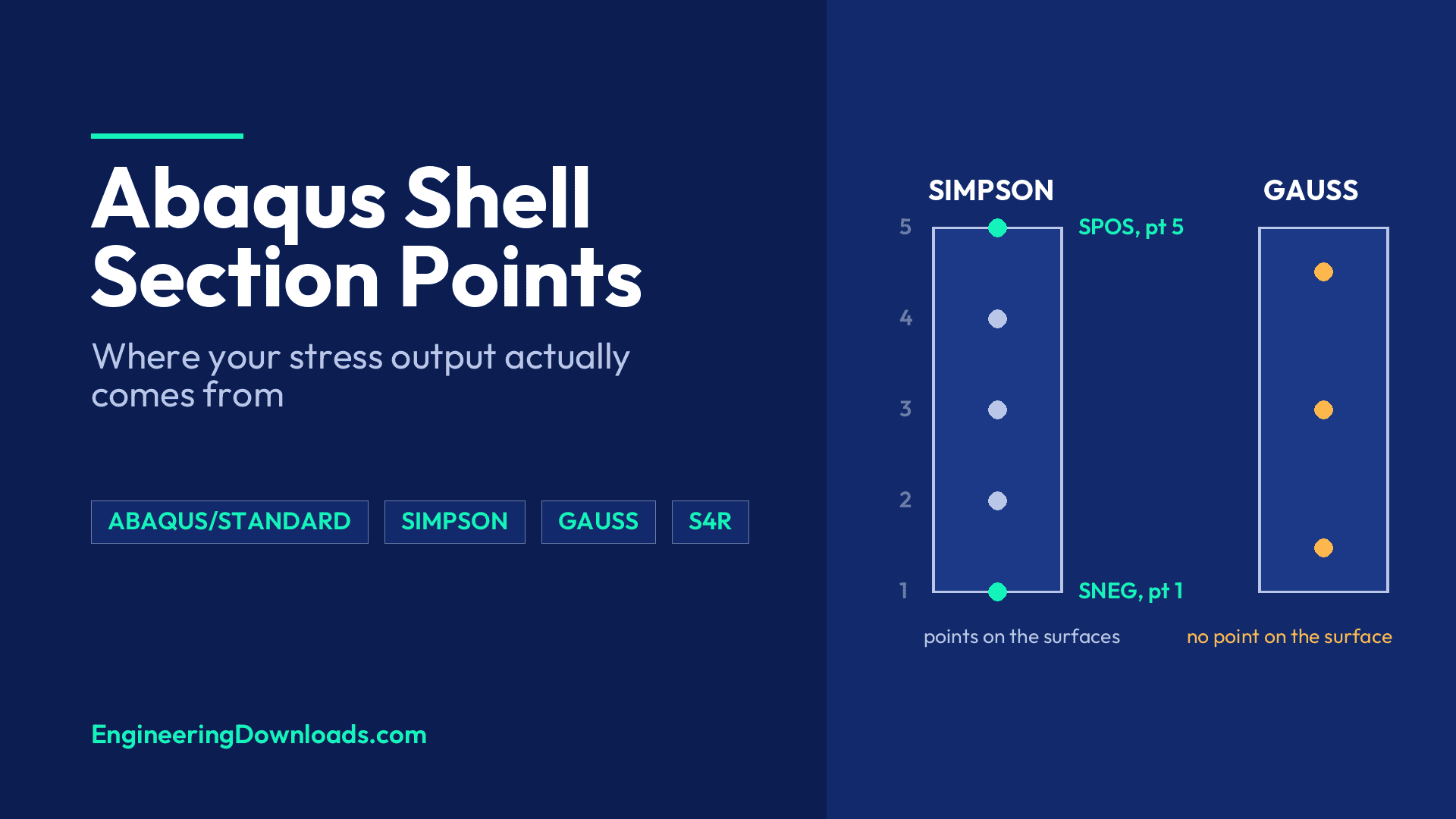
Abaqus Shell Section Points: Where Your Stress Output Comes From
What Abaqus shell section points are, the defaults you never chose, Simpson vs Gauss, SNEG and SPOS, and how to request the output location you actually need.
Abaqus NLGEOM On or Off: When Geometric Nonlinearity Changes Your Answer
What the Abaqus NLGEOM switch really does, why Standard and Explicit have opposite defaults, and how to decide which of your two answers to trust.

Featured Blogs

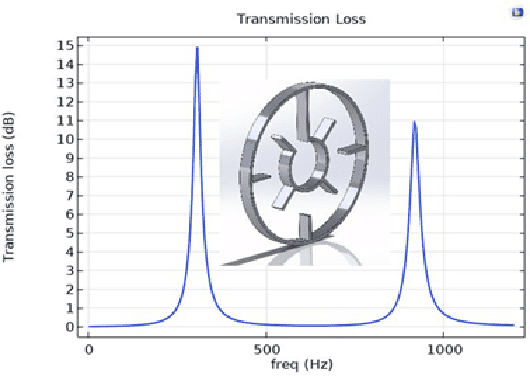
Acoustic metamaterials for advanced sound control and noise reduction
Acoustic Metamaterials and Metasurfaces: Shaping the Future of Sound Control

Intro Acoustic metamaterials and acoustic meta surfaces are changing how we control sound waves. These specially designed structures go beyond the limits of traditional soundproofing. They offer new ways to control sound, such as reducing noise over a wide frequency

OpenSees software simulation of nonlinear seismic response in a reinforced concrete frame
OpenSees for Structural Analysis

OpenSees (Open System for Earthquake Engineering Simulation) is an open-source software framework developed primarily for nonlinear structural and geotechnical analysis, with a strong emphasis on earthquake engineering. Developed at UC Berkeley’s Pacific Earthquake Engineering Research Center (PEER), it provides a
Abaqus or ANSYS : Which one is better?
Which one is better? Abaqus or ANSYS?

As an engineer, we need to build a model to simulate a process so we can save many and reduce processing time. For this aim, we need to use conventional solvers such as Abaqus, ANSYS, Solidwork (I know, Solidwork solver

See more

Latest Blogs

Abaqus Integration Point vs Nodal Stress: Why Peaks Differ
Compare integration-point, element-nodal and unique-nodal stress in Abaqus, and check whether a contour peak depends on extrapolation, averaging or mesh size.
Abaqus Linear Perturbation vs General Step: What Actually Changes

You run a frequency extraction after a static step and the frequencies come out the same whether or not the part had yielded. You run a static linear perturbation step and the reaction force is a fraction of what you

Harmonic Response Analysis in ANSYS Workbench: A Practical Guide
How to set up harmonic response analysis in ANSYS Workbench: modal link, frequency range, solution method, damping, loads and results, plus the common mistakes.

See more

All articles

Stress Linearization in Abaqus: A Practical ASME Guide
How to run stress linearization in Abaqus and ANSYS, where to place the stress classification line, and how to check membrane and bending stress against ASME VIII-2 limits.
Johnson-Cook Model in Abaqus: Parameters, Damage and Fixes
How to set up the Johnson-Cook model in Abaqus correctly: where A, B, n, C and m come from, the separate rate keyword, the d3 sign trap, damage evolution and element deletion.
Failure Assessment Diagram (FAD): A Practical Guide for Crack Assessment
How to build a failure assessment diagram, place the assessment point, and get Kr and Lr from Abaqus or ANSYS for API 579 and BS 7910 crack assessment.
Abaqus Riks Method: A Practical Guide to Post-Buckling Analysis
How to set up the Abaqus Riks method correctly: buckle step, imperfections, arc length settings, LPF, and the mistakes that stop post-buckling jobs.
Hashin Damage in Abaqus: Setup, Inputs and Fixes
A practical guide to Hashin damage in Abaqus: the six strengths, the four fracture energies, supported element types, viscous regularization and the fixes for jobs that stall after first failure.
Shell vs Solid Elements in FEA: How to Choose
A practical guide to choosing between shell and solid elements in FEA, with thickness rules, Abaqus and ANSYS setup, coupling and common mistakes.
Abaqus Mass Scaling: How to Speed Up Explicit Runs Safely
How Abaqus mass scaling works, how to set it up in Abaqus/CAE, and the checks that prove your faster explicit model is still accurate.
UMAT vs VUMAT in Abaqus: Which One Should You Use?
UMAT runs in Abaqus/Standard, VUMAT in Abaqus/Explicit. Here is what really differs between them, how to choose, and how to debug each one.
Hourglassing in Abaqus: How to Spot It and Fix It

You run an Abaqus job, the mesh comes back looking like a zig-zag accordion, and the stress contours show a checkerboard pattern that no real material would ever produce. That is hourglassing in Abaqus, and it is one of the

Abaqus Submodeling: A Practical Step-by-Step Guide

You have a large model — a pressure vessel, a welded bracket, a pipe support — and the stress that decides the answer lives in a 20 mm zone around a fillet or a weld toe. Mesh that everywhere and

Abaqus XFEM Crack Growth: Setup and Troubleshooting Guide
A practical guide to setting up XFEM crack growth in Abaqus, plus the specific reasons a crack refuses to propagate and how to fix them.
HPC for Abaqus and ANSYS: cores, licenses and cloud HPC costs
HPC for Abaqus and ANSYS: Cores, Licenses and Cloud Costs
How many cores do Abaqus and ANSYS really need? A practical guide to solver bottlenecks, Abaqus license tokens, ANSYS HPC Packs and cloud HPC costs.

See more